
The Centum Memo: Post-Mortem & The Boardlot Verdict
By Boardlot Sultan
Published: June 5, 2026
Following my recent market analysis on Centum Investment Company PLC’s structural trajectories, Group CEO James Mworia reached out and formally agreed to engage directly on the issues raised. On Thursday, June 4th, at 8:00 PM EAT, he appeared live on the Mwango Capital X Spaces platform (”Bonga Na CEO”) to address the market.
As I indicated to him in our preliminary correspondence, I did not present an isolated personal view. Instead, I acted as a conduit for our broader shareholder community—aggregating the urgent, unvarnished queries of retail investors, professional financial analysts, and institutional observers who have watched Centum’s public market capitalization languish at a profound ~80% discount to its stated Net Asset Value (NAV).
The market is deeply invested in Centum’s survival and ultimate recovery. To ensure our live engagement remained strictly data-backed, rigorous, and highly productive, I compiled and submitted a formal shareholder dossier to the executive team.
Below is the definitive post-mortem of that engagement, capturing the initial thematic areas, the CEO’s direct tracking responses, and The Boardlot Verdict.
1. Debt Architecture at Group vs. Subsidiary Level, Cost, and Sustainability
The Initial Question
Management frequently highlights minimal debt at the parent/Group company level, but there is severe market anxiety regarding heavily encumbered underlying subsidiaries. Specifically, borrowing short-to-medium-term instruments (1–5 years) to finance long-term real estate projects with development and payment cycles extending up to 9 years presents a fundamental maturity mismatch. Was this structural mismatch executed by design or an accidental oversight, and how does management plan to exit this existential risk? Furthermore, what explains the increasing consolidated debt burden (from KES 16.59B in FY24 to KES 17.85B in FY25) and reported alternative borrowing costs scaling up toward 25% p.a. with funders like Vantage Capital and Nedbank?
The CEO’s Answer
On the Maturity Mismatch: No clear answer was provided regarding the mismatch of borrowing short-term to finance long-term assets. However, the CEO stated that the debt was a factor of the board mandate, which was to grow assets without recourse, even if it required borrowing, and then pay down that debt.
On Parent vs. Subsidiary Debt: Debt at the parent/Group level is now fully paid off. The remaining debt resides entirely at the subsidiary level, specifically within Two Rivers.
On Two Rivers Liquidation: Debt at Two Rivers is actively being paid off through asset sales. The asset-to-debt coverage ratio at that level is almost 2:1, and active liquidation of assets is happening, which should complete in the near term.
On the 25% High-Interest Rates: The reported 25% debt rate at Two Rivers Development Limited (TRDL) was actually an internal lending arrangement sent to a subsidiary they own 58% of, structured as internal borrowing for tax efficiency.
📊 Score: 7 / 10
⚖️ The Boardlot Verdict
The decision to use short-term debt to finance long-term assets was a bad structural call, as admitted by the CEO. Moving forward, shareholders will wait for the audited FY26 results to conclusively confirm that debt at the Group level has hit absolute zero. We will independently time out the repayment cycle for the Two Rivers debt and predict a strict debt retirement timeline based on projected real estate sales. We intend to work directly with Centum management to thoroughly analyze subsidiary-level debt in FY26.
2. Real Estate Concentration, Cash Flow Realization, and Revenue Mismatches
The Initial Question
Centum’s balance sheet remains heavily concentrated in highly illiquid real estate (CentumRE, Two Rivers, Vipingo), accounting for approximately 80% of the portfolio. Real estate is clearly not pumping out the robust operational and financial results we grew accustomed to in the past. What is management’s explicit strategic timeline to unwind this concentration down to a diversified 50% baseline? With residential revenues projected to drop sharply by over 72% in FY26 (down to KES 600M from KES 2.2B in FY25), how does management plan to sustain the Group’s operational overhead and overall liquidity cushion?
The CEO’s Answer
On Portfolio Concentration: The high concentration of assets in real estate was the direct result of a previous Board Mandate.
On the End of the Development Cycle: The heavy real estate development phase is now coming to an end, and active liquidation of these real estate assets is currently underway.
On Cash Flow Cascade: The cash flows generated from these sales will first be utilized to pay off outstanding debt capital. The remaining balance will either be reinvested or distributed to owners as a dividend, a call that will be made by shareholders via the board.
On Market Demand: According to the CEO, Centum is facing a “very good problem” on the real estate side, where market demand is actively outpacing the physical speed of project completion.
📊 Score: 6 / 10
⚖️ The Boardlot Verdict
The executive commitment to liquidating the real estate portfolio is a positive step, and it will be rigorously tracked by shareholders. We will collaborate with Centum management to audit real estate sales and collection projections against the historical utilization of proceeds since FY23. Our goal is to map out an objective timeline showing indicative dates when the real estate portfolio can be realistically trimmed below 50% of the total asset portfolio. We also need to get a firmer grasp on upcoming cash flow outcomes to predict exactly what portion will be reinvested versus distributed.
3. Centum 5.0: Asset Disposals, Value Destruction, and Future Strategy (Private Equity)
The Initial Question
The market has expressed deep skepticism regarding the “Centum 5.0” strategic arc, perceiving that the company systematically dismantled its most reliable, cash-generating, defensive assets (such as GenAfrica and Sidian Bank) to bankroll an illiquid real estate framework. This has culminated in a profound valuation disconnect: the total investment portfolio is carried at a book value of KES 49 Billion, while the public market capitalization languishes at just KES 9 Billion. How does management reconcile this KES 40 Billion disparity, and are there active plans to exit Isuzu East Africa—our last premium cash cow—to unlock short-term liquidity?
The CEO’s Answer
On the KES 40B NAV vs. Market Cap Disconnect: The CEO stated that this massive valuation discount is not a surprise. The public market is heavily discounting the stock to account for the debt carried in the books. As real estate assets continue to be sold and debt is systematically paid off, there will be a natural convergence of the share price toward the underlying NAV per share, representing an opportunity for shareholder reward.
On Financial Transparency: Management committed to providing as much disclosure as possible regarding unlisted subsidiary performance, without compromising their commercial competitive positions.
On Historical Exits: The historical decisions to exit cash-positive pillars like Sidian Bank and GenAfrica were driven entirely by the capital mandate to service and reduce debt.
On Isuzu and the PE Portfolio: There are absolutely no planned exits on the remaining Private Equity portfolio unless a transaction presents clear, undeniable value—such as bringing in a strategic partner.
On Strategic Reversals: Any structural pivot or formal change of strategy will only be considered and executed once the debt retirement cycle is fully finalized.
📊 Score: 9 / 10
⚖️ The Boardlot Verdict
The CEO demonstrated excellent structural clarity and logic in this specific domain. We fully support the executive plan to liquidate real estate assets to clean the balance sheet, after which we will underwrite a fresh strategic plan on how to deploy the realized funds. Shareholders will enforce a strict, non-negotiable guardrail in the next corporate cycle: the real estate portfolio must never be allowed to grow beyond 40% of the total asset portfolio ever again.
4. The Share Buyback Plan: Capital Allocation vs. Debt Reduction
The Initial Question
The shareholder community has been highly critical of the timing and underlying financial logic behind Centum’s open-market share buyback program. From a strict capital allocation standpoint, why was valuable liquid cash utilized to support a heavily discounted share price instead of being aggressively deployed to pay down expensive subsidiary debt, which carries guaranteed double-digit interest savings? Has this program materially reduced operating liquidity at a time when underlying cash revenues are tightening?
The CEO’s Answer
On the Purpose of the Buyback: The primary objective was not a standard corporate share buyback. Instead, it was initiated to provide exit liquidity for trapped small/minority lots of shares in the market. Centum quickly realized they required much less capital than originally budgeted for this exercise, and the open offer was subsequently not extended.
On Funding Sources: The CEO provided no definitive answer regarding the exact source of funds utilized to finance the buyback program.
📊 Score: 4 / 10
⚖️ The Boardlot Verdict
This share buyback program was an inherently poor capital allocation idea ab initio. Management entirely failed to address the source of the budgeted funds or acknowledge the blatant, underlying financial conflict of carrying out an open-market share buyback program while the broader corporate ecosystem is saddled with heavy debt pressures.
5. Executive Compensation, Share Accumulation, and Value Alignment
The Initial Question
Over the last five years, minority shareholders have endured severely compressed dividends (dropping to KES 0.32) and a heavily depressed stock price. Concurrently, executive fixed compensation saw a permanent +31.8% structural upward adjustment, scaling to KES 60M annually, while the CEO’s personal equity holding expanded to 5.7 million shares by 2025. How does management justify expanding executive compensation during a multi-year cycle of flatlined payouts for the owners, and how many of those shares were bought with cash versus performance bonuses?
The CEO’s Answer
On Deferral to the Board: The CEO deferred the formal matter of executive compensation entirely to the Board of Directors.
On the Alternative Asset Manager Baseline: He argued that his historic KES 750M total compensation package should be analyzed against what constitutes standard, fair market compensation for an alternative fund manager operating within the global industry baseline.
📊 Score: Deferred to the Board
⚖️ The Boardlot Verdict
The CEO is technically correct that executive compensation is a matter for the board. However, as shareholders, we hold that the board made a profoundly bad deal. Alternative fund managers are compensated based on realized value and cash exits. The CEO was compensated largely on accounting growth and paper NAV valuations—a significant portion of which has now completely evaporated on the open market—while equity owners have been forced to wait 10+ years for real cash flows to materialize. There is a complete and total structural misalignment of interests here.
6. Asset Write-Downs and Risk Management Governance
The Initial Question
Sequential asset write-downs and impairments across mega-projects have signaled systemic underwriting and risk governance failures to the market. The total amounts at risk across Akira Geothermal and Amu Power combined sit at an alarming KES 4 Billion, alongside a KES 519 Million inventory book value vulnerability at Longhorn Publishers. Who within Centum’s governance structure has the proactive, independent authority to “pull the plug” and halt a failing investment before hundreds of millions of shillings are permanently impaired?
The CEO’s Answer
On the Evasion of Underwriting Failures: The CEO appeared to avoid this critical question entirely.
On Akira Geothermal: The only detail offered was a brief mention that Akira Geothermal has successfully acquired new partners and will proceed with its development track.
📊 Score: 3 / 10
⚖️ The Boardlot Verdict
Project risk decisions and underwriting frameworks at the commitment level remain deeply elevated and highly concerning for shareholders. The complete avoidance of the governance breakdown that led to a KES 4 Billion sunk-capital write-down is unacceptable. There is an urgent, structural need for shareholders to mobilize and put in place a far more independent, aggressive risk management oversight structure at the executive decision-making level to intercept flawed capital deployment before value is permanently destroyed.
7. Management Succession, Legacy, and Future Leadership
The Initial Position
While our shareholder community did not explicitly table a formal question regarding immediate management succession in our preliminary dossier, the live session opened up an unexpected and critical governance window.
The CEO’s Answer
During his remarks, the CEO volunteered a notable personal milestone: after navigating an intense turnaround period, he noted that after 2 years on the helm, he feels the company is much safer now to discuss his exit.
📊 Score: 7 / 10 (For transparency on transition)
⚖️ The Boardlot Verdict
We highly appreciate the CEO’s candid reflection on his tenure and legacy. Given that he feels the ship has stabilized and is safe enough to discuss an exit, we strongly urge the Board of Directors to take him up on that immediately and honor him with a well-deserved 25th year of service gift. It is time to gracefully close this chapter and pivot to the future.
However, succession must match the reality of Centum’s current balance sheet. The CEO stated that the heavy real estate focus was a board mandate and that the portfolio is currently highly concentrated at ~80% real estate. Because the asset mix stands at 80% real estate and will structurally remain that way for the foreseeable future, the next chief executive must be an operator who eats, sleeps, and breathes property development and cash realization.
We note the deep institutional talent already sitting within Centum’s senior executive ranks—specifically Fred Murimi and Pius Muchiri. While these are formidable corporate leaders, we explicitly task the board to evaluate them, alongside external candidates, through a single, non-negotiable lens: the next CEO must possess deep, proven, real-world development real estate experience.
Centum is no longer a pure-play liquid private equity fund; it is an 80% real estate holding ecosystem. The board must appoint a leader whose core competencies align with that operational reality to extract the remaining KES 6.4 Billion cash buffer and protect owner capital.
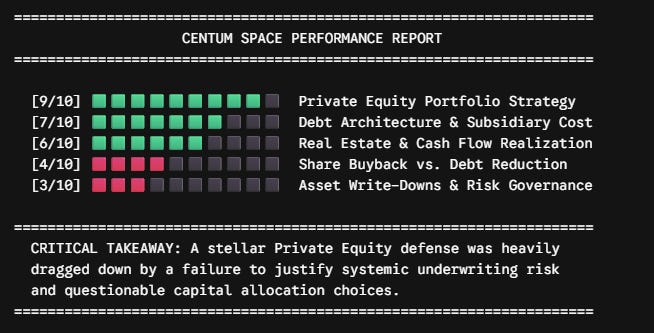
Final Space Scorecard Summary
Strategic Focus Area:
1. Debt Architecture & Subsidiary Cost7/10
2. Real Estate & Cash Flow Realization 6/10
3. Private Equity Portfolio Strategy 9/10
4. The Share Buyback Plan 4/0
5. Executive Compensation & AlignmentDeferred
6. Asset Write-Downs & Risk Governance 3/10
Weighted Management Average5.8/10 (58%)
Conclusion: The Boardlot Verdict stands. While James Mworia’s brilliant defense of the Private Equity segment and clear path toward Two Rivers debt retirement via real estate asset liquidation provides a glimmer of structural hope, Centum’s management remains deeply compromised in the eyes of the market regarding historical capital allocation failures, misaligned executive rewards, and a passive risk governance culture. We will be watching the FY26 books with an absolute fine-tooth comb.