
Part 1. The Opening Salvo: The $200 Million Hustle Economy
There is no balance sheet in East Africa quite like Watu Credit’s. While legacy commercial banks spent the last decade cowering behind sovereign Treasury bills and first-generation fintech apps bled venture capital chasing unsecured micro-loans, a quiet, hyper-aggressive non-bank asset financier out of Mombasa engineered the most formidable debt engine in the region. Their secret? Securitizing the daily, unbanked cash flows of the informal economy by wrapping them around physical hardware.
To understand Watu is to understand the raw, unpolished mechanics of the African bottom-of-the-pyramid hustle. This is an economy that does not run on formal payrolls, payslips, or CRB credit scores. It runs on daily M-Pesa collections, daily fuel burn, and the relentless imperative to earn enough by sunset to cover food, rent, and tomorrow’s tank of petrol. Where traditional risk models saw terminal default probability, Watu saw collateralizable cash flow.
Starting from a single coastal office in 2015, Watu transformed itself into an inescapable titan of African mobility and consumer credit. They financed over 500,000 two-wheelers and three-wheelers across East and Central Africa—turning the ubiquitous TVS Boxer and Piaggio tuk-tuk from mere transport into securitized income-generating assets. But when the mobility segment hit macro headwinds, currency devaluations, and rising credit impairments—slashing net profits by 85% down to KES 157 million ($1.2 million)—Watu did not pull back. They executed a pivot of staggering proportions.
Enter Watu Simu.
By aggressively scaling smartphone micro-financing across Kenya, Uganda, Tanzania, the DRC, Nigeria, and Sierra Leone, Watu financed well over 1.4 million handheld devices in a single year. The financial turnaround was immediate and ruthless: for the year ended December 31, 2025, Watu reported a historic 14-fold surge in net profit to KES 4.8 billion (~$37 million), backed by a 92.7% top-line revenue explosion to KES 28.3 billion (~$219.2 million)—a massive performance trajectory anchored by disclosures from listed conglomerate Car & General, which holds a 29% equity stake in the business.
With gross loan portfolios swelling past $300 million and targets set on hitting $340 million in revenue as they eye expansions into Latin America, Watu proved a fundamental thesis of frontier finance: if you control the asset that powers a worker’s daily livelihood, you control the cash flow.
Founding & Early Origins (2015)
Watu Credit was founded in July 2015 in Mombasa, Kenya, by European serial entrepreneurs Andris Kaneps (Founder & CEO) and Erick Massawe (Co-Founder & Country Director), alongside early Baltic tech-finance backers. Kaneps—drawing on his background in European consumer micro-finance and emerging market fintech—recognized a glaring structural gap in East Africa: millions of informal operators needed productive assets (motorbikes and tuk-tuks) to generate daily income, but formal commercial banks refused to lend to them without traditional collateral, land titles, or payslips.
The Coastal Entry Strategy
Rather than launching in the hyper-competitive, congested financial battlefield of Nairobi, Watu executed a calculated regional entry strategy:
Mombasa as the Proving Ground: They set up their initial headquarters on the coast, targeting the dense, highly organized boda boda and tuk-tuk transport networks in Mombasa, Kilifi, and Kwale.
Solving the Down-Payment Bottleneck: Local dealers required upfront cash, and traditional microfinance institutions (MFIs) took weeks to process loans. Watu entered the market with a same-day processing model: a rider walked in with a minimal deposit (KES 15,000–20,000), a national ID, and two guarantors, and walked out with a brand-new bike within hours.
The Pioneer Dealer Partnerships: Watu bypassed expensive standalone branches by placing loan officers directly inside local motorcycle dealerships, turning showroom floors into immediate point-of-sale financing desks.
Scaling Across Kenya
Once the coastal credit engine proved that daily M-Pesa collections combined with GPS tracking yielded sub-5% default rates, Watu aggressively expanded inland. By 2017–2018, they moved into Nairobi, Rift Valley, and Western Kenya, building a network of over 50 branches and cementing exclusive floor-space arrangements with major distributors—most notably Car & General (distributors of TVS)—before expanding across Uganda, Tanzania, Rwanda, Nigeria, and Sierra Leone.
Part 2. The Macro Landscape: The Evolution of African Digital Lending
To fully appreciate Watu’s position, one must place it within the tumultuous macroeconomic evolution of African fintech over the past fifteen years. The Failure of Unsecured Digital Apps: The first wave of African digital credit (2012–2020), headlined by pioneering apps like Silicon Valley-backed Tala and Branch, relied on downloading smartphone telemetry—SMS logs, mobile money velocity, and contact lists—to underwrite micro-loans. While revolutionary at launch, the model quickly hit a structural ceiling:
Terminal Non-Performing Loans (NPLs): Unsecured digital models lacked physical collateral, meaning defaulting carried zero material consequence beyond blacklisting on Kenya’s Credit Reference Bureaus (CRBs)—a threat that lost potency as millions accepted listings as a cost of doing business.
Regulatory Compression: Central Bank of Kenya (CBK) Digital Credit Providers (DCP) regulations clamped down on unbacked APRs, capping fees and restricting aggressive recovery tactics, squeezing margins for unsecured lenders.
Customer Acquisition Cost (CAC) Treadmill: Lenders were trapped acquiring short-term borrowers who churned or defaulted as soon as credit limits were capped.
The Hardware Lock Paradigm
Watu bypassed the unsecured digital lending trap entirely by shifting the underwriting anchor from data telemetry to Hardware Enforcement. Instead of suing a defaulting borrower in court or sending automated text blasts, Watu integrated real-time, remote kill-switches directly into the asset itself:
Mobility Assets (Two/Three-Wheelers): Heavy-duty GPS tracking units wired into the engine, capable of remote immobilisation the moment a daily or weekly installment is missed.
Smartphones (Watu Simu): OS-level digital locks (Samsung Knox / PayJoy) embedded into device firmware, disabling the touchscreen except for emergency calls or the M-Pesa repayment portal.
Structural Enforcement Breakdown:
Unsecured Digital Apps: Cash Loan → Default → CRB Listing → Zero Income Impact → High NPLs & Squeezed Yields
Watu Asset-Backed Engine: Hardware Asset → Default → Immediate Lockout → Loss of Daily Livelihood → High Repayment Priority (~95%+)
In the informal economy, the hardware lock is the judicial system, the credit score, and the bailiff rolled into one. The friction of repossession drops to near zero because the asset penalizes its own user instantaneously upon non-payment.
The Closed-Loop Ecosystem: The Car & General Synergy
Watu’s rise was engineered through a masterclass in supply-chain vertical integration. Car & General (C&G)—the exclusive East African distributor for TVS motorcycles and Piaggio tuk-tuks—did not merely act as a passive shareholder when acquiring its 29% equity stake in Watu. They built a self-sustaining, closed-loop economic flywheel:
Importation & Distribution: Car & General imports TVS motorcycles and Piaggio three-wheelers at wholesale scale.
Floor-Space Financing: Riders walk into C&G dealerships, where Watu sits directly at the sales desk to offer instant hire-purchase financing.
Double-Dip Balance Sheet Capture: C&G captures commercial retail margins on the primary vehicle sale while collecting high-yield interest dividends via its 29% equity stake in Watu’s loan book.
By controlling distribution, financing, and enforcement hardware, Watu built an asset-backed fortress that insulated itself from micro-finance fragility. Yet, as this balance sheet scaled to tens of billions of shillings, the aggressive mathematics powering these weekly repayments set the stage for a fierce political and social collision.
Car & General profit surges to KSh 2.4bn on regional recovery and boda boda sales rebound
This video covers the financial recovery and operational earnings of Car & General, detailing the rebound in boda boda sales and regional performance that feeds directly into Watu Credit’s asset-financing ecosystem.
Part 3. The Math of the Hustle: Unit Economics & The APR Reality
To grasp why Watu’s balance sheet prints money while its borrowers run on a relentless treadmill, one must dissect the micro-mathematics of a single boda boda hire-purchase contract. On the surface, the proposition presented to an unbanked rider in Nairobi, Kampala, or Mombasa is deceptively simple: walk into a showroom with a modest deposit, ride out on a brand-new TVS Boxer 150, and pay off the balance in small, digestible daily or weekly M-Pesa micro-deductions. But beneath this accessible consumer interface lies an aggressive, compounding interest engine structured to maximize balance-sheet yield.
The Boda Boda Hire-Purchase Equation
Cash Retail Price: ~KES 150,000 ($1,150)
Initial Down Payment: ~KES 20,000 – 30,000 ($150 – $230)
Financed Principal: ~KES 120,000 – 130,000 ($920 – $1,000)
Repayment Tenor: 18 to 24 Months (78 to 104 weekly installments)
Weekly Repayment Amount: ~KES 2,800 – 3,500 ($21.50 – $27.00)
Total Cumulative Payback: KES 240,000 – 290,000 ($1,840 – $2,230)
Unpacking the True Effective APR
While the nominal interest rate quoted on paper appears manageable, the effective annualized percentage rate (APR) paid by the rider tells a vastly different story. When you factor in the relentless weekly compounding frequency, mandatory comprehensive insurance premiums, annual GPS tracking maintenance fees, processing charges, and default penalty surcharges, the true cost of capital skyrockets:
Nominal Stated Rate: ~1.5% to 2.5% per month.
Effective Compounded APR: 45% to 65%+ per annum.
The “Two-Bike” Premium: By the time a rider completes their 18-to-24-month payment cycle, they have paid for the physical motorcycle nearly twice over.
For a rider netting KES 800 to KES 1,200 a day after fuel, paying KES 450 to KES 500 daily to Watu leaves zero margin for error. A single bad week—caused by police harassment, fuel price hikes, rain, or illness—instantly pushes the loan into default territory.
The Battle for the Bottom of the Pyramid: Watu vs. The Field
Watu Credit does not operate in a vacuum. The non-bank asset finance space in East Africa is a knife-fight fought on three fronts: origination speed, field enforcement footprint, and cost of capital.
While tier-1 commercial banks have historically avoided informal 2-wheeler micro-loans due to non-performing loan (NPL) phobias and a lack of physical collateral, specialized fintechs and non-bank financial institutions (NBFIs) have stepped into the void. To evaluate Watu’s defensibility, we must benchmark it against its three distinct rival archetypes: the direct peer (Mogo), the device-finance giant (M-KOPA), and the EV disruptors (Spiro, Roam, Ampersand).
watu credit
primary moat: boda field network
asset focus: boda & smartphones
underwriting: guarantors + gps
default response: 7-day repo window
ev transition: partner-led (e-boda)
mogo auto (eleving)
primary moat: broad asset scope
asset focus: cars, boda, logbooks
underwriting: credit score + gps
default response: granular restructure
ev transition: hybrid / multi-brand
m-kopa
primary moat: smartphone & pay-go
asset focus: phones & solar / evs
underwriting: behavioral data / iot
default response: remote os lockout
ev transition: ecosystem verticals
1. Mogo Auto: The Heavyweight Challenger
If Watu dominates the high-velocity boda-boda ecosystem in rural and peri-urban centers, Eleving Group’s Mogo is its most direct, head-to-head threat.
Where Watu Wins: Distribution and Transparency. Watu retains a significantly denser field-agent coverage across key transport hubs (Nairobi, Kisumu, Eldoret, Mombasa). Watu’s recovery playbook is aggressive but predictable—publishing clear 7-day redemption windows and set collection penalties.
Where Mogo Wins: Asset Diversification. While Watu remains heavily anchored to 2-wheelers and tuk-tuks, Mogo expanded rapidly into used-car financing, logbook loans, and larger commercial vehicles. Mogo’s broader product scope allows it to capture a borrower’s lifecycle up the asset ladder as their income matures.
2. M-KOPA: The Tech-First Threat to Watu Simu
Watu’s high-margin engine expansion—Watu Simu—places it in direct collision with M-KOPA, the pioneer of Pay-As-You-Go (PAYG) smartphone and solar financing in Africa.
Underwriting Mechanics: M-KOPA’s advantage lies in its proprietary telemetry and micro-payment algorithms honed over a decade of off-grid solar deployment. By leveraging machine learning on daily M-Pesa flows, M-KOPA routinely underwrites higher-risk borrowers with lower initial deposits.
The Counter-Attack: Watu’s structural edge over M-KOPA comes down to in-person distribution at the point of sale. By embedding sales agents directly inside thousands of independent retail electronics shops and motorcycle dealerships, Watu intercepts the buyer at the exact moment of transactional intent, bypassing M-KOPA’s app-centric funnel.
3. The Electric Vehicle (EV) Frontier: Threat or Moat?
The rapid electrification of East Africa’s transport sector—spearheaded by players like Spiro, Roam, and Ampersand—represents the single largest structural shift in Watu’s core market. EV operators introduce battery-swapping subscriptions that unbundle the vehicle frame from the energy source.
Integrated EV Financiers
Model: Spiro / Swap-and-Go
Financing: Captive financing model
Core Asset: Controls battery ecosystem
Capital & Fleet Partners
Model: Watu + Roam / Ampersand
Financing: Pure-play debt engine
Revenue Source: Financed on asset margins
The Risk to Watu: Vertically integrated EV players (like Spiro) offer “all-in-one” asset-plus-fuel financing. If a rider can get the bike, battery swaps, and service under one proprietary subscription, traditional hire-purchase models lose leverage.
Watu’s Strategic Pivot: Rather than building proprietary hardware, Watu is positioning itself as the universal balance-sheet partner for EV OEMs. By entering strategic financing agreements with manufacturers like Roam, Watu offsets the risk of hardware obsolescence while scaling its debt engine into the green transition.
The Regulatory Gray Zone: Hire-Purchase vs. Direct Credit
How has Watu maintained these lucrative margins without triggering caps from financial regulators? The answer lies in clever legal structuring.
The Hire-Purchase Shield: Watu does not issue cash loans. Under the Hire Purchase Act (Cap 507), agreements are structured as asset sales where Watu retains primary ownership until the final shilling is paid.
Bypassing CBK DCP Caps: Because they finance physical equipment rather than disbursing cash to a bank account or mobile wallet, Watu operated outside the Central Bank of Kenya’s (CBK) Digital Credit Providers (DCP) interest rate regulations.
Joint Logbook Registration: The vehicle logbook is registered jointly under “Watu Credit / Borrower Name” with the National Transport and Safety Authority (NTSA). Watu holds physical possession of the original logbook, making it legally impossible for the rider to sell, transfer, or refinance the asset without Watu’s explicit clearance.
By mastering the legal mechanics of hire-purchase and embedding daily micro-deductions directly into the rider’s M-Pesa workflow, Watu built an unrivaled cash-collection apparatus. But as default penalties mounted and riders struggled under the weight of weekly compounding debt, this high-yield formula inevitably sparked widespread social friction across the East African landscape.
Part 4. The Dark Side of Mobility Finance: Repossession Heat & Social Friction
When a credit model relies on stripping a worker’s daily livelihood to force repayment, social friction is built directly into the balance sheet. As Watu’s loan book scaled to tens of billions of shillings, the compounding math powering its weekly M-Pesa collections spilled onto the streets. In Africa’s informal economy, a motorcycle is not an impulse consumer item—it is an entire household’s primary capital asset. Taking it away halts daily survival.
The “Near-Clearance” Repossession Controversy
By 2023, complaints regarding asset finance repossessions began dominating rider forums, civil society petitions, and media headlines. Hundreds of riders across Kenya alleged a troubling pattern: after paying down 80% to 90% of their 18-to-24-month hire-purchase contracts—often handing over upwards of KES 250,000 on a motorcycle with a KES 150,000 cash price—their assets vanished or were repossessed over minor defaults.
The GPS Tracking Glitch Allegations: Riders petitioned lawmakers claiming installed GPS units mysteriously failed or lost signal just as loans approached final clearance, triggering automated recovery protocols.
The “Near-Clearance Theft” Anomaly: Operators raised concerns over bikes stolen under suspicious circumstances near loan maturity—despite active tracking devices fitted on board—leading to accusations of tracking data leaks.
The Equity Forfeiture Trap: Under standard hire-purchase terms, defaulting near the end of a contract meant the lender repossessed and auctioned the motorcycle. Because riders lacked sole title until the final shilling was cleared, months of daily payments were wiped out, leaving them with zero equity.
The Mechanics of the Enforcer Pipeline
When a loan slipped into arrears, Watu’s recovery operations moved swiftly, outsourcing field enforcement to third-party recovery agents operating on bounty commissions per seized unit.
The Repossession Surcharge Stack: Once repossessed, riders faced compounding administrative fees before regaining their assets:
Default Penalty Surcharges: KES 2,000 – KES 5,000
Towing & Recovery Agent Fees: KES 5,000 – KES 15,000
Daily Yard & Storage Charges: KES 500 – KES 1,000 per day
The Rapid Auction Engine: If arrears and new recovery fees were not cleared within 7 to 14 days, the unit was listed for private auction.
The Resale Flywheel: Repossessed assets were refurbished and re-financed to new operators under fresh hire-purchase agreements, generating a second cycle of yield on the exact same physical frame.
For young men working sixteen-hour days to service weekly debt, losing an asset near the finish line felt less like a commercial default and more like systemic asset stripping—setting off a wave of public anger that reached the floors of Parliament.
Part 5. Regulatory Storms: Parliamentary Probes & Political Backlash
In Kenya, alienating organized boda boda operators inevitably invites political scrutiny. Boda boda riders constitute a highly organized, vocal voting bloc. When regional grievances boiled over into public protests, lawmakers intervened.
The Senate & National Assembly Probes
Late 2023 through 2024 marked a wave of parliamentary inquiries into non-bank asset financiers. Nandi Senator Samson Cherargei sought a formal statement on Watu Credit’s practices before the Senate Trade and Industrialization Committee (chaired by Kajiado Senator Seki Lenku), while Kigumo MP Joseph Munyoro filed a public petition in the National Assembly triggering hearings led by Molo MP Kuria Kimani’s Finance Committee.
Lawmakers summoned executive leadership—including CEO Andris Kaneps, Country Manager Erick Massawe, and Legal Head Rose Osiemo—to address allegations of predatory lending, exorbitant effective rates, and unfair repossession practices.
Core Parliamentary Grievances:
Regulatory Arbitrage: Lawmakers questioned how non-bank asset financiers operated outside direct Central Bank of Kenya (CBK) Digital Credit Provider (DCP) caps by structuring deals under the Hire Purchase Act.
Logbook Ownership Structure: Committees challenged why logbooks were retained solely under lender names rather than joint ownership, delaying title transfers after full settlement.
Effective Interest Rates: MPs scrutinized compounding weekly terms pushing effective interest charges to 50%+ over cash retail prices.
The Defense & Clearance: Watu defended its model, showing that over 85% of borrowers successfully completed loans, repossession remained a last resort under 5%, and over KES 5 billion in taxes had been paid to KRA. Following submissions detailing active police registers and county repossession records, the Senate Trade Committee deemed the responses sufficient and cleared the firm of illegalities in December 2023.
The Sovereign & Political Risk Flashpoint
The probes highlighted the central dilemma of bottom-of-the-pyramid credit in emerging markets:
Essential Capital vs. Extraction Risk: Asset financiers provide essential access to productive assets that traditional banks refuse to fund. However, when private debt enforcement relies on aggressive extraction from low-income workers, it becomes a political flashpoint.
Legislative Push for Regulation: The parliamentary pressure accelerated legislative efforts to bring all non-bank asset financiers and hire-purchase entities under formal CBK regulation and standardized consumer protection rules.
Realizing that physical mobility assets carried high street friction, heavy repossession costs, and constant regulatory exposure, Watu executed its strategic pivot: transitioning into an asset class that was lighter, highly scalable, and enforced entirely via code—the smartphone.
Part 5B. The Balance Sheet Engine: How Watu Funds Its Credit Monopoly
To sustain an asset-financing portfolio spanning over $300 million across multiple East African jurisdictions, Watu Credit cannot rely solely on founder equity or retained earnings. Operating as a non-bank financial institution means Watu cannot collect public customer deposits like commercial banks. Instead, it has engineered one of the most sophisticated, multi-layered debt-capital mobilization engines in Sub-Saharan Africa—blending local-currency commercial paper, regional private debt funds, international development finance institutions (DFIs), and specialized asset-backed securitization.
1. The Local Debt Market: Dry Associates & Commercial Paper
When Watu needs high-velocity, local-currency funding inside Kenya to match its M-Pesa-based weekly shilling collections, it turns to the domestic capital markets. A central pillar of this local funding strategy has been its structured debt relationship with Dry Associates, one of Kenya’s premier investment bank arrangers specializing in private wealth and corporate commercial paper.
Through Dry Associates, Watu Credit has repeatedly tapped high-net-worth individuals, institutional investors, and local fund managers by issuing short-to-medium-term commercial paper and corporate notes:
Currency-Risk Mitigation: Borrowing in Kenya Shillings (KES) through local commercial paper protects Watu’s balance sheet from foreign exchange mismatch—ensuring that loans backed by KES-denominated boda boda and smartphone collections are funded by KES-denominated liabilities.
Over-Subscription Trends: Dry Associates has arranged several multi-billion shilling private placement rounds for Watu, consistently drawing strong yield-seeking demand from local capital markets due to Watu’s high-yield asset-backed profile.
On Watu’s appetite for local debt capital: “Watu Credit has demonstrated an extraordinary ability to turn informal sector cash flows into structured institutional debt. Through short-term commercial paper and private placement notes arranged by Dry Associates, local investors receive competitive, risk-adjusted yields anchored directly by asset-backed loan books.”
— Dry Associates Wealth Management / Capital Markets Commentary
2. International DFIs & Impact Debt Funds
While local commercial paper finances short-term operational liquidity, Watu secures long-term debt and growth capital from global Development Finance Institutions (DFIs) and impact investment funds dedicated to financial inclusion and micro-mobility:
Global Debt Syndicate: Watu has secured credit facilities and senior debt lines from international impact financiers including Symbiotics, Responsibilities, Finnfund, Triple Jump, and the U.S. International Development Finance Corporation (DFC).
The ESG & Mobility Thesis: European and American impact funds channel capital into Watu under green-mobility mandates, micro-entrepreneurship programs, and gender-lens financing initiatives (funding female riders and mobile vendors).
On funding financial inclusion at the bottom of the pyramid: “Our investments in asset-backed micro-financing platforms like Watu Credit are driven by a mandate to deepen financial inclusion for the unbanked. By collateralizing productive assets, Watu bridges the credit gap for informal workers who would otherwise be locked out of the formal economy.”
— Symbiotics Group / DFI Senior Portfolio Manager Statement
3. Strategic Equity & Parent Synergies: Car & General
Watu’s balance sheet leverage is further anchored by equity support and trade credit from its cornerstone corporate shareholder, Car & General (C&G), which holds a 29% equity stake in Watu Credit.
Trade Credit & Supplier Lines: C&G’s distribution agreement provides Watu with direct inventory credit access for TVS motorcycles and Piaggio tuk-tuks, allowing Watu to deploy vehicles into the market before fully settling wholesale import bills.
Dividend Reinvestment: C&G’s public financial disclosures consistently highlight how dividend revenues from Watu Credit reinforce parent company earnings, which in turn allows C&G to support Watu’s regional credit line expansions.
On the synergy between distribution and financing: “The strategic alignment with Watu Credit has been a primary growth driver for our mobility business. By pairing distribution infrastructure with an integrated asset financing vehicle, we unlock demand for TVS and Piaggio units that traditional banking channels simply cannot serve.”
— Car & General Corporate Financial Report Statement
4. How the Funding Flywheel Operates
Watu Credit Capital-Raising Model
Dry Associates & Local CP $\longrightarrow$ Local KES Debt (Zero FX Risk)
Global DFIs & Impact Funds $\longrightarrow$ USD/EUR Long-Term Senior Debt
Car & General (29% Equity) $\longrightarrow$ Trade Credit & Inventory Lines
Step 1: Watu pools short-term KES paper via Dry Associates for local currency liquidity.
Step 2: Senior debt lines from global DFIs provide long-term growth capital to scale across regional borders (Tanzania, Uganda, DRC, West Africa).
Step 3: M-Pesa collections from 500,000+ motorbikes and 1.4 million smartphones feed daily interest back into servicing local commercial paper and international debt facilities.
By combining local commercial paper arranged by firms like Dry Associates with international DFI senior debt, Watu has built a resilient debt-refinancing engine—ensuring that no matter how hard local credit markets contract, its loan-generation machine never runs out of capital.
Part 6. The Strategic Pivot: Decoupling via “Watu Simu”
Enter Watu Simu: By late 2023, the strategic writing on the wall was undeniable: scaling a multi-billion shilling balance sheet purely on physical mobility assets was a high-friction, politically hazardous endeavour. Every bike repossessed on the streets of Nairobi, Kampala, or Mombasa brought field agent overheads, yard storage fees, legal threats, and potential parliamentary summonses. To sustain its growth trajectory without getting bogged down in street-level friction, Watu needed a lightweight, hyper-scalable asset class that was politically invisible, carried low unit capital risk, and could be enforced entirely through automated code.
The Micro-Asset Revolution
Through Watu Simu, the lender systematically shifted its capital deployment strategy away from high-CAPEX two-wheelers and into handheld digital infrastructure. Operating across Kenya, Uganda, Tanzania, Rwanda, the Democratic Republic of Congo (DRC), Nigeria, and Sierra Leone, Watu tapped into a massive structural reality: millions of informal workers need a modern smartphone to access M-Pesa, gig-economy platforms, social commerce, and business communications, but lack the KES 15,000 to KES 35,000 required for upfront cash retail purchases.
By partnering directly with global hardware giants like Samsung alongside Transsion Holdings (Tecno, Infinix, Itel), Watu transformed consumer electronics into micro-collateralized income assets.
Comparative Asset Economics: Mobility vs. Watu Simu
Capital Exposure per Unit:
Boda Boda Mobility: High (~KES 150,000 – KES 250,000)
“Watu Simu” Device Finance: Low (~KES 10,000 – KES 35,000)
Loan Repayment Tenor:
Boda Boda Mobility: 12 to 24 Months
“Watu Simu” Device Finance: 3 to 12 Months (Daily/Weekly M-Pesa micro-deductions)
Primary Enforcement Mechanism:
Boda Boda Mobility: Physical GPS tracking units + Third-party field recovery agents
“Watu Simu” Device Finance: OS-level digital locks (Samsung Knox / PayJoy software integration)
Default Enforcement Friction:
Boda Boda Mobility: High (Physical towing, yard fees, public resistance, parliamentary scrutiny)
“Watu Simu” Device Finance: Near-Zero (Instant, automated remote touchscreen lock)
Portfolio Velocity & Turnaround:
Boda Boda Mobility: Slow capital recycle rate due to long payment tenors
“Watu Simu” Device Finance: Rapid capital recycling (High velocity, weekly cash-spin cycles)
The OS-Level Lockdown Mechanism
Unlike mobility assets that require physical recovery agents when defaulted, Watu Simu relies on software-driven digital lock technology integrated directly into the phone’s operating system firmware (such as PayJoy or Samsung Knox). If a user misses a daily installment (often as low as KES 50 to KES 100 per day), the software automatically locks the device. The touchscreen becomes completely unresponsive for browsing, messaging, or app usage—restricting functionality strictly to placing emergency phone calls or accessing the M-Pesa menu to clear the outstanding balance.
The moment the M-Pesa transaction clears, the digital lock instantly lifts. The asset penalizes its user via code, eliminating towing fees, storage yards, and field enforcement teams entirely.
Part 7. Strategic Playbook for African Founders & Investors
The rise, regulatory friction, and rapid product pivot of Watu Credit offer vital strategic lessons for founders, venture capitalists, and private equity firms operating across African markets:
1. In Informal Markets, Hardware Control IS Credit Scoring:
Traditional credit bureau scoring (CRB) fails in unbanked economies because borrowers can afford to ignore blacklisting. Watu proved that controlling the physical hardware or digital device powering a worker’s daily livelihood provides absolute enforcement—creating repayment priority far higher than unsecured fintech loans.
2. Social Friction Eventually Becomes Political & Sovereign Risk:
High effective APRs and aggressive enforcement tactics can drive short-term balance-sheet profits, but unmanaged social friction at the bottom of the pyramid will eventually draw state intervention. Lenders scaling high-yield credit must proactively manage their social contract before parliamentary committees step in.
3. Agility in Balance-Sheet Allocation Preserves Margins:
When macro headwinds, inflation, and regulatory investigations threatened its core mobility business, Watu did not double down on a high-friction asset class. By pivoting capital into micro-assets via Watu Simu, they insulated their balance sheet, accelerated liquidity velocity, and drove a historic financial turnaround.
Strategic Outlook & Asset Allocation Thesis: The Future of Mobility Fintech in East Africa
The mobility fintech sector in East Africa has moved past its initial, high-friction venture phase. What began as basic asset financing for internal combustion engine (ICE) two-wheelers has matured into an asset-backed financial asset class at the intersection of clean energy, embedded finance, and transit infrastructure.
As the sector scales across Kenya, Rwanda, and Uganda, three core structural shifts will define capital deployment, risk-adjusted yield profiles, and fund structuring over the coming decade:
Key Structural Drivers & Investor Risk Archetypes
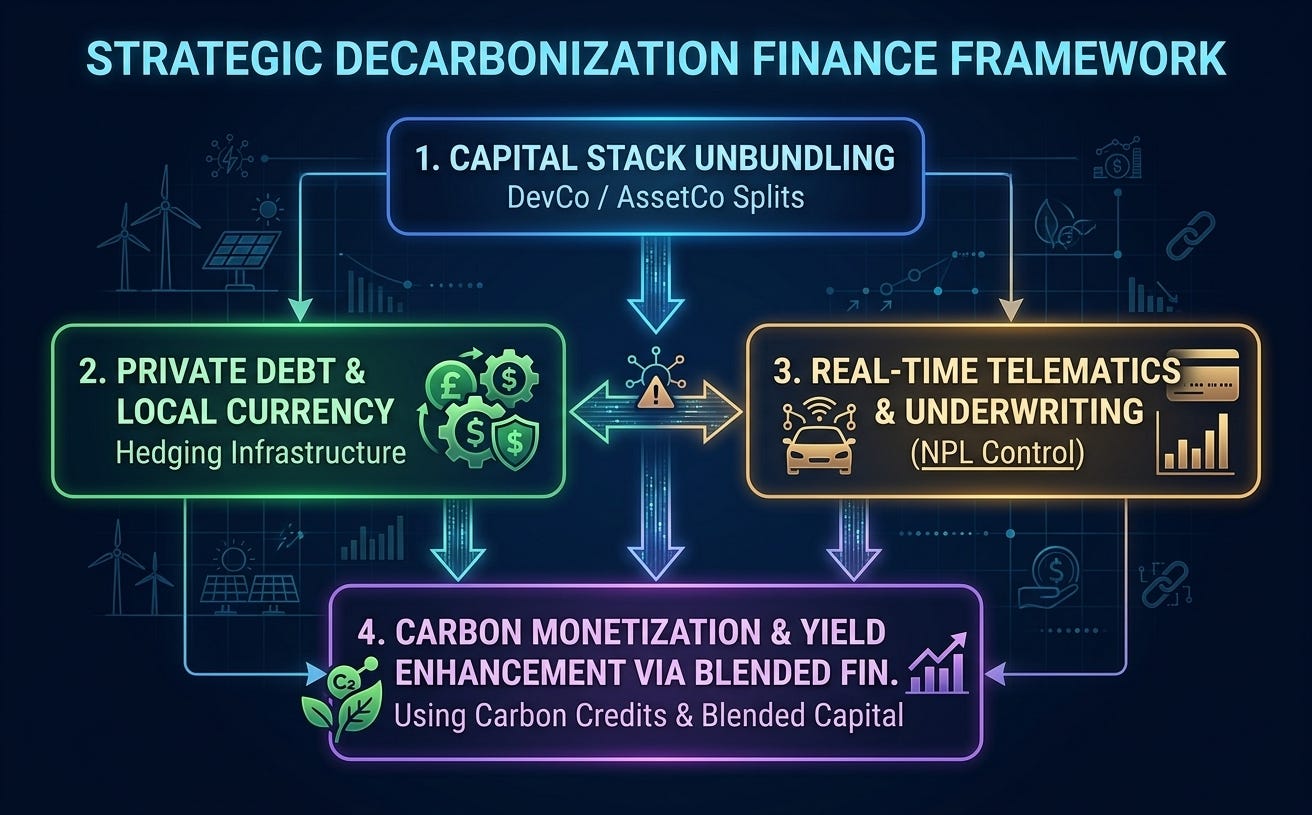
1. Unbundling the Capital Stack: DevCo vs. AssetCo
To deploy capital at scale, institutional asset allocators are decoupling technology development from asset-heavy infrastructure.
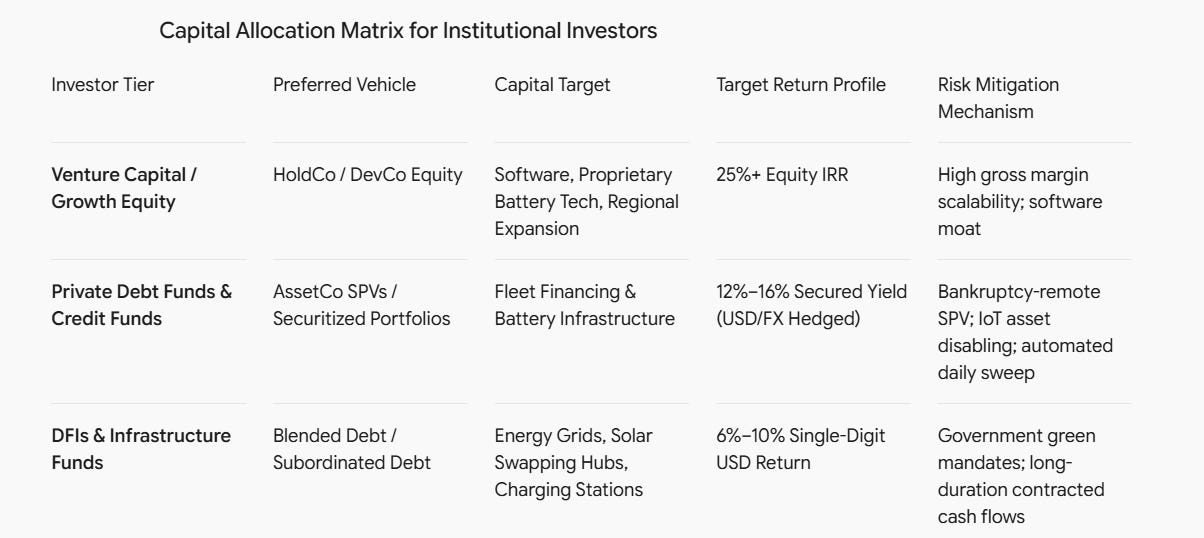
Venture Capital / Growth Equity (DevCo): Absorbs software platforms, hardware design, and brand execution. Equity investors target high-margin recurring SaaS fees and software scalability without clogging balance sheets with depreciating physical hardware.
Special Purpose Vehicles & Private Debt (AssetCo): Dedicated asset-backed vehicles pool batteries, vehicles, and swap stations. Private debt funds, infrastructure managers, and DFIs finance these bankruptcy-remote SPVs based on predictable, daily micro-payment cash flows from rider battery subscriptions.
2. Private Debt Expansion and FX Hedging Structures
Equity financing alone is structurally incapable of funding the physical fleet transition. The market requires a heavy shift toward institutional private debt.
Yield Profiles & Local Currency Facilities: Debt providers (such as climate debt funds and non-bank financial institutions) are structuring local-currency or FX-hedged debt facilities. This eliminates foreign exchange mismatches where platforms borrow in hard currency (USD) but collect revenue in local currencies (KES, RWF, UGX).
Credit Enhancement & First-Loss Tranches: Blended finance structures—supported by multilateral DFIs and philanthropic foundations—provide first-loss equity guarantees, lowering capital costs for senior debt institutional allocators.
3. Telematics-Driven Underwriting and Lowering NPLs
Credit risk management in the informal transport sector has transitioned from manual collection to automated, data-driven asset control.
Dynamic Credit Risk Control: Embedded IoT sensors, continuous route tracking, and remote disabling protocols allow lenders to underwrite informal gig workers based on real-time cash flow performance rather than collateral.
Asset Recovery Value: Battery swapping models ensure that the high-value asset (the battery) remains tied to the network grid, maintaining high recovery rates and capping non-performing loans (NPLs) even during macroeconomic stress.
4. Blended Yields: Carbon Monetization as Capital Protection
East Africa’s e-mobility transition offers asset allocators structured ESG and carbon offset integration.
Carbon-Backed Debt Subsidies: By aggregating kilometer data from zero-emission commercial fleets, mobility platforms generate verifiable carbon credits. Monetizing these credits allows funds to offset local currency depreciation or boost investor net internal rate of return (IRR).
Capital Allocation Matrix for Institutional Investors
Strategic Conclusion: The Institutional Asset Class Transition
The East African mobility fintech sector is executing a classic structural shift: evolving from a venture-funded experiment into an institutional-grade, asset-backed infrastructure asset class.
For asset allocators, winning strategies require building or backing barbell portfolios: combining high-upside equity stakes in core platform orchestrators (DevCo) with predictable, yield-generating debt allocations secured by operational fleets and battery networks (AssetCo). As regional trade integrates under the African Continental Free Trade Area (AfCFTA), the fund structures and debt models deployed across Kenya, Rwanda, and Uganda will define the institutional playbook for commercial transit finance across emerging markets.
About Boardlot Africa Research
Boardlot Africa is a premier financial intelligence and corporate governance publication dedicated to unpacking the mechanics of capital, market strategies, and structural shifts across East Africa’s corporate landscape. By bridging the gap between raw economic data and actionable market intelligence, we deliver deep-dive research, independent corporate analysis, and policy insights designed for institutional investors, boardrooms, and sharp market observers.
Get in Touch
Email: sultan@boardlot.africa
Phone: +254 753 133 901
Substack: Subscribe to Boardlot Africa
X (Twitter): BoardLotSultan
Linkedn:): BoardLot Sultan