
Could KCB, Under Paul Russo, Become the Unlikely Leader in Corporate Banking in East Africa?
For decades, the narrative surrounding Kenya Commercial Bank (KCB) was firmly anchored in retail dominance. It was the retail powerhouse—the bank of everyday citizens, government payrolls, and extensive regional branch networks. The corporate banking arena, meanwhile, was widely viewed as the domain of established international players or nimble private specialists.
That paradigm is shifting. Under the leadership of Group CEO Paul Russo, KCB is quietly positioning itself as the undisputed primary corporate bank across East and Central Africa. Behind this shift is a clear, execution-focused strategy: led by Peter Ng’eno (Director of Corporate Banking) alongside Maurice Opiyo (Managing Director, KCB Investment Bank) and backed by a formidable team of over 150 dedicated professionals, KCB is leveraging its massive balance sheet, intra-regional corridor footprint, and deep local market intelligence to challenge traditional leaders.
Central to this transformation is a bold philosophical pivot articulated by Russo himself:
“The cost of payments is heading to zero. Banking can no longer build a long-term business model on charging customers just to move their own money. The future of corporate and retail banking lies in unlocking value from the flow of trade, providing liquidity, and offering structured advisory—not clipping tickets at the transaction gate.”
— Paul Russo, Group CEO, KCB Group
By treating payment rails as a utility rather than a primary revenue stream, KCB is proving that true thought leadership means anticipating where the market is going. While competitors cling to transaction fees, KCB is absorbing the flow of regional trade and building an ecosystem where value is captured through balance sheet depth, treasury solutions, and structured corporate advisory.
The corporate banking battle in East Africa is becoming KCB’s to lose. Here is how the institution is deploying its core capabilities across its expanded operational pillars.
1. Agribusiness Exports: Anchoring Working Capital in Growth Corridors
Kenya’s agricultural export sector—spanning horticulture, avocado, meat, and dairy—is undergoing a structural transition. Many growing agribusinesses discover that traditional borrowing limits fail to resolve liquidity bottlenecks tied to extended international payment cycles.
KCB addresses this by offering specialized trade finance solutions tailored specifically for regional producers:
Export-Factoring & Invoice Discounting: Converting receivables into immediate liquidity, shielding exporters from 60–90 day payment delays from European and Middle Eastern buyers.
Structured Commodity & Working Capital Facilities: Aligning debt service directly with crop harvesting, packing, and processing seasonal cycles rather than relying on rigid monthly repayments.
Warehouse Receipt Financing & Letters of Credit (LCs): Mitigating counterparty risks for large-scale produce orders while securing supply chain inputs like fertilizers and packaging materials.
By shifting corporate conversations from simple balance-sheet debt to structured trade facilities, KCB enables agribusinesses to secure cash flows and scale export volumes efficiently.
2. Streamlining Mid-Market Cross-Border Trade
While multinational conglomerates navigate cross-border trade effortlessly through global treasury networks, regional mid-market enterprises face friction. Importers moving produce—such as maize or onions—across borders like the Kenya–Tanzania corridor regularly encounter high transfer fees, delayed settlement times, and foreign exchange illiquidity.
In alignment with Russo’s vision of zero-cost movement of money, KCB eliminates this friction by leveraging its integrated multi-country presence and low-cost rails:
Direct Intra-Group Settlement & PAPSS: Utilizing direct Pan-African payment systems and wholly-owned subsidiaries across Kenya, Tanzania, Uganda, Rwanda, South Sudan, Burundi, and the DRC to process cross-border payments internally.
Bypassing Intermediary Correspondent Fees: Internal routing lowers processing overhead, reduces FX conversion markups, and accelerates transaction speeds from days to seconds.
Local Currency Clearing: Allowing mid-tier traders to invoice and settle transactions using regional currencies, minimizing reliance on USD clearing for local trade.
3. Oil & Gas and Infrastructure: Powering Regional Corridors
Beyond traditional trade, KCB acts as the heavy financial backbone for regional energy security and mega-infrastructure development:
Refined Fuel Imports: Financing over 70% of refined fuel imports into Kenya, playing a vital role in fueling domestic industries and export markets including the DRC, Rwanda, and South Sudan.
Upstream Oil & Gas & Crude Infrastructure: Breaking new ground in upstream financing, supporting the acquisition of oil-producing blocks in Northern Kenya, and backing major crude infrastructure projects to position Uganda as a primary regional oil exporter.
Clean Energy & Gas Solutions: Structuring innovative sustainable projects, including regional methane-to-CNG gas developments.
Industry Thought Leadership: Driving market dialogue by co-hosting the Quarterly State of the Petroleum Industry forums and maintaining active participation in the majority of major Independent Power Producer (IPP) financings reaching financial close.
4. Digital Integration: Multi-Country Account Visibility
Operating across multiple borders often strains operational efficiency when corporate treasurers must manage separate banking relationships in each market. Real-time financial control requires centralized visibility.
KCB addresses this through its enterprise digital architecture, such as KCB iBank:
Single Sign-On (SSO) Executive Dashboard: Enabling group CFOs and CEOs to view multi-entity account balances, active trade facilities, and cash positions across all East African subsidiaries in real time.
Centralized Liquidity Management: Allowing corporate treasurers to perform multi-currency sweeps, manage inter-company cash flows, and execute batch payroll or vendor payments across borders from a single interface.
Streamlined Authorization Protocols: Providing customizable governance controls and multi-tiered sign-offs to maintain enterprise security without compromising operational velocity.
5. Capitalizing on Eastern DRC: The TMB Advantage
The acquisition of Trust Merchant Bank (TMB) gave KCB one of the deepest operational networks in the Democratic Republic of Congo (DRC). TMB brings extensive coverage to critical trading hubs in Eastern DRC, including Goma, Bukavu, and Lubumbashi.
This network provides East African enterprises with a secure entry point into the DRC market:
On-the-Ground Trade Infrastructure: Delivering reliable physical branches and digital clearing capabilities in regions long underserviced by traditional international banks.
Mitigated Settlement & Counterparty Risk: Removing the reliance on unsecured cash transit or informal clearing systems by enabling direct Bank-to-Bank LC issuance and escrow arrangements between DRC buyers and East African sellers.
Seamless Commercial Corridors: Linking the ports of Mombasa and Dar es Salaam straight to Eastern DRC’s mining and consumer centers, providing local businesses with a single banking partner across the entire transit route.
6. Public Sector & Landmark Capital Structuring
KCB’s corporate and investment banking arms frequently bridge the gap between public infrastructure needs and private capital markets:
Talanta Sports Stadium Financing: Participated as a core arranging partner in the KES 44.79 billion Infrastructure Asset-Backed Security (via Linzi FinCo 003 Trust), with KES 14.9 billion directly engineered and mobilized through KCB Investment Bank to deliver the iconic 60,000-seater stadium.
Strategic FDI Partnership with Invest Kenya: Operating a dedicated framework with the Kenya Investment Authority to accelerate Foreign Direct Investment by tying government-led facilitation directly with KCB’s project financing, trade advisory, and local corporate linkage capabilities.
7. Advisory as the Gateway: Midwifing Deals & Pipeline Creation
Under Maurice Opiyo, Managing Director of KCB Investment Bank, advisory services have become the crucial top-of-funnel driver for corporate relationships. By stepping in early to structure complex M&A, valuations, and corporate reorganizations, KCB Investment Bank positions the broader group as the primary lender when transaction funding is ultimately deployed.
A prime example of this advisory-led origin pipeline is the Taarifa Ltd acquisition of NPRT Holdings Africa (giving Taarifa indirect control of 54.08% of Nation Media Group), alongside transaction advisory for Taarifa Gas and Amsons Group’s $180 million takeover offer for Bamburi Cement Plc. Beyond M&A, the investment bank midwifed the securitisation of Sports Fund Levy cash flows for Talanta Stadium, as well as advising KCB Group on the divestment of National Bank of Kenya (NBK) to Access Bank. By guiding corporates through strategic restructuring, valuation, and capital raising, Maurice Opiyo’s arm acts as an essential bridge, turning deal-making advisory into long-term corporate banking and lending flows.
8. Treasury Literacy & Strategic Operating Partnerships
Persistent currency volatility, elevated interest rates, and macro shocks continue to impact corporate P&Ls across the region. Under Paul Russo, KCB is successfully completing its evolution from traditional transactional lending to acting as a strategic “operating partner” for corporate finance teams.
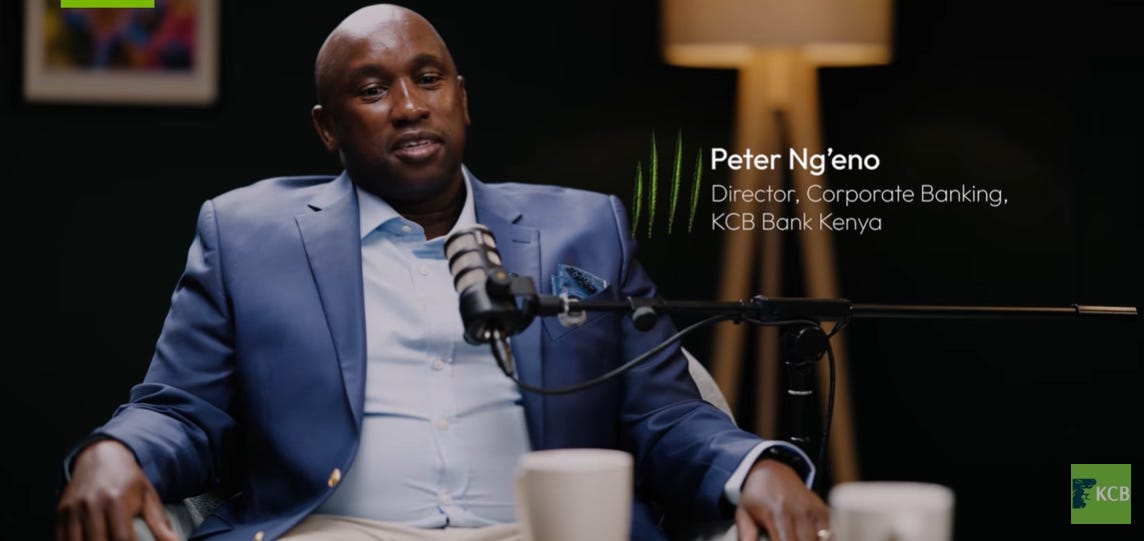
As Peter Ng’eno (Director of Corporate Banking) outlines in his institutional strategy breakdowns, corporate banking can no longer rely on standard balance-sheet lending alone. Rather than relying on ticket-clipping transactional fees, KCB’s corporate, investment banking, and treasury specialists collaborate with clients to optimize financial structures. Today, enterprise finance leaders are encouraged to evaluate key tactical questions with their treasury desks:
FX Exposure & Natural Hedging: “How can we structure foreign currency earnings against imported input costs to minimize unhedged currency conversion exposure?”
Yield on Idle Cash: “Are our operating buffers dynamically placed in automated money market sweeps or structured yield instruments to offset inflation?”
Working Capital Efficiency: “Can we convert static supply-chain payables into dynamic vendor financing programs to optimize cash conversion cycles?”
Interest Rate Risk Management: “How can we structure interest rate caps or swaps to protect margins during prolonged high-interest rate cycles?”
The Foundation to Lead
KCB’s corporate strategy is backed by leadership depth under Peter Ng’eno (Corporate Banking) and Maurice Opiyo (Investment Banking), powered by a 150+ strong corporate and investment banking team, a massive regional balance sheet, and a footprint spanning the East African Community into the DRC.
By eliminating the cost of payments, financing vital energy corridors, structuring landmark national projects like Talanta Stadium, and securing trade into high-growth markets, KCB has assembled all the structural elements required to lead. Under Paul Russo’s visionary leadership, the regional corporate banking throne is KCB’s to lose.
KCB Corporate Banking & Executive Briefings with Peter Ng’eno: KCB Corporate Banking Insights & Strategic Framework — Detailed discussions and strategic outlooks led by Peter Ng’eno regarding sector-driven corporate financing and regional client coverage expansion.
Paul Russo, Group CEO of KCB on the Main Stage Inspire.
This video features Paul Russo discussing KCB’s strategic vision, regional growth approach, and long-term economic development across East Africa.