
Welcome to Boardlot Africa, where we pull back the curtain to reveal the untold stories, power dynamics, and strategic maneuvers shaping the boardrooms of Corporate Africa—subscribe for free to join the conversation. join 1000 other subscribers
We publish Kenya’s Most Consequential Legal, Governance & Labor Disputes and A Series on the 100 Most Influential Kenyan Captains of Industry
The Velvet Gavel: A Narrative Index
1.0 The Quiet Sovereign of Times Tower and the NSE
1.1 Beyond the Ledger: The Shift to Capital Markets
1.2 The Taita Taveta Blueprint: Building a Meritocratic Foundation
1.3 The Humility of Power: Executive Stature Over a Cup of Tea
2.0 The Corporate Crucible: Outlasting the Era of the “Macho Man”
2.1 The Sales Floor Roots: Grinding in a Heavy Industrial Sector
2.2 Following a Hard Act: Facing the Legacy of Bill Lay
2.3 The Velvet Succession: Process-Driven Victory in the Corner Office
3.0 The Price of Ambition: The Motherhood vs. Corporation Ledger
3.1 The Nine-Month Sacrifice: The Flight to Johannesburg
3.2 The South African Pressure Cooker: Hardening Leadership DNA
3.3 Balancing the Scales: Turning Personal Sacrifice into Armor
4.0 The Sovereign Custodian: Dissecting Her Multi-Billion NSE Board Footprint
4.1 The Blue-Chip Portfolio: BAT, Safaricom, and Bamburi Cement
4.2 The State-Private Sector Bridge: KRB, NTSA, and KEPSA
4.3 The Municipal Crosshairs: Navigating the 2024 Taita Taveta Legal Audits
4.4 The Palmhouse Foundation: Extending the Ladder to the Next Generation
5.0 Conclusion: The Self-Made Anchor of Kenyan Capitalism
5.1 The Safety Premium for Institutional Capital
5.2 The Standard of Frontier Markets: Power That Doesn’t Need to Shout
1.0 Introduction: The Quiet Sovereign of Times Tower and the NSE
1.1 Beyond the Ledger
When analyzing the architects of Kenya’s financial ecosystem, the mind naturally gravitated toward the structural, state-driven tax engineering of Times Tower. Yet, the macro-fiscal frameworks built by the state are only as strong as the institutional plumbing that handles the capital. To understand how multi-billion-shilling flows are secured, value-investor portfolios are protected, and foreign institutional trust is maintained, one must transition from the exchequer to the high-stakes, hyper-compliant boardroom corridors of the Nairobi Securities Exchange (NSE).
Here, the currency of trade is not just liquidity, but unassailable corporate governance. In this elite ecosystem, Rita Kavashe has emerged as the ultimate corporate custodian—an independent sovereign force trusted by the market’s heaviest blue-chip weights to safeguard hundreds of billions in market capitalization.

1.2 The Taita Taveta Blueprint
The baseline architecture of Kenyan executive power has historically been dominated by well-connected political dynasties, heirs to colonial-era land wealth, or insider networks forged in elite urban boardrooms. Rita Kavashe’s narrative systematically shatters this entire paradigm. Born and raised in the rural hills of Taita Taveta County, her journey to the absolute apex of multinational corporate governance was achieved without a single shred of political patronage or inherited corporate leverage.
Kavashe built her foundation in the lecture halls of Eldoret, earning a Bachelor of Education degree from Moi University. Securing a Master of Business Administration (MBA) from the University of Nairobi before sharpening her global execution frameworks at the Harvard Business School’s Leadership Program.

1.3 The Humility of Power
In the flashy, high-decibel arena of Nairobi’s corporate elite—where status is frequently signaled through aggressive public relations, loud entourages, and high-profile grandstanding—Kavashe operates on a completely different frequency. Her executive stature is defined by the sheer weight of her quiet authority.
Despite anchoring boards that dictate the underlying movement of the entire NSE index, she remains fiercely grounded. On any given weekend, away from the intense manufacturing quotas of Isuzu East Africa or the high-yield dividend debates of tier-one boardrooms, she can be found enjoying a quiet, unassuming cup of tea at the Karen Country Club.
2.0 The Corporate Crucible: Outlasting the Era of the “Macho Man”
2.1 The Sales Floor Roots
In 1995, long before she became the definitive voice of multinational industrial capital in East Africa, Rita Kavashe walked through the doors of General Motors East Africa (GMEA) not as an executive heir apparent, but as a junior sales representative. The commercial automotive sector in the mid-1990s was not merely tough; it was an aggressively male-dominated, old-school industrial ecosystem.
Instead of being intimidated by the raw, rough-and-tumble nature of the commercial truck market, Kavashe weaponized her background in education. She didn’t just sell vehicles; she educated fleet owners on lifecycle costs, asset depreciation, and supply chain efficiencies. By mastering the cold, forensic numbers of logistics on the factory floor, she out-negotiated her peers, systematically climbing from the trenches of direct sales to the upper echelons of corporate management.

2.2 Following a Hard Act: The Bill Lay Era
Every corporate climber faces a defining crucible, and Kavashe’s arrived in the transition toward the corner office. For years, General Motors East Africa had been synonymous with one name: Bill Lay. Lay was the archetypal corporate “macho man”—a larger-than-life, blunt, and highly influential expatriate executive who dominated Kenya’s industrial landscape. He was aggressive, headline-grabbing, and deeply entrenched in the country’s private-sector politics.
2.4 The Performance Ledger: Building an Industrial Behemoth
When Rita Kavashe took the helm of General Motors East Africa (GMEA) in 2011, the company was a respected but secondary player, holding only about 15% of the commercial vehicle market. By late 2024, under her strategic leadership and through the successful corporate transition to Isuzu East Africa (IEA) in 2017, she had fundamentally rewritten the automotive landscape in the region.
Market Dominance & Sales Velocity
Kavashe’s tenure is defined by a relentless expansion of market share and production capacity. She successfully transitioned the firm from a local assembler to the dominant leader in the East and Central African commercial vehicle sector.
Market Share: Increased from 15% in 2011 to an estimated 52.5% of the new vehicle market by the end of 2024.
Production Capacity: Under her leadership, the Nairobi assembly plant saw production efficiency jump from 10 to 22 vehicles per day.
Production Milestones: In July 2021, the company celebrated its 100,000th vehicle produced since 1977, a landmark event presided over by Kavashe.
Recent Growth: In the seven years leading up to 2025, local vehicle assembly rose by 35%, while new vehicle sales saw a 25% jump in the preceding period.
Capital Expenditure & Infrastructure
Kavashe secured significant capital investments to modernize the firm’s industrial footprint, ensuring it could support regional demand.
Plant Upgrades: In 2016, she oversaw a $7.9 million investment to upgrade the facility, effectively doubling output capacity.
Advanced Manufacturing: The June 2023 launch of an Electro-Deposition (ED) Paint Plant increased annual production potential from 11,000 to 18,000 units. This facility also offers shared access to competitors, elevating the technical standards of the entire regional industry.
Logistics Hub: Construction of a Sh1.5 billion parts distribution center on Mombasa Road was completed to streamline the supply chain for East Africa.
2.5 The Defensive Moat: Defending the Frontier Against Chinese OEMs
The true test of Kavashe’s leadership was not the expansion phase, but the defensive era. As Chinese Original Equipment Manufacturers (OEMs) like Sinotruk and Foton flooded the East African market with aggressive pricing, Isuzu faced an existential threat to its dominance. Kavashe did not pivot to a “price war,” which is the fastest route to margin erosion. Instead, she fortified the brand’s “defensive moat” through three critical strategic pillars:
Operational Total Cost of Ownership (TCO): Kavashe shifted the sales pitch from “sticker price” to “lifetime value,” leveraging Isuzu’s legendary chassis durability and fuel efficiency to prove to fleet owners that a cheaper Chinese truck would eventually cost more in downtime and maintenance.
Deepening the Industrial Moat: She doubled down on local assembly, effectively utilizing the “Buy Kenya, Build Kenya” mandate to secure government and institutional contracts that price-sensitive competitors struggled to penetrate.
The Service Infrastructure Advantage: Understanding that a truck is only as valuable as its uptime, Kavashe expanded the brand’s after-sales and service density. While Chinese entrants often struggled with spare-parts logistics, Kavashe turned Isuzu’s established network into a high-margin, recurring revenue engine that locked in loyal corporate clients.
By focusing on predictive maintenance and logistics-as-a-service (LaaS), she insulated the business from the cyclical volatility of the Kenyan economy and forced Chinese competitors to play the game on her terms—where reliability, not just affordability, is the ultimate currency.
Why this is a “Boardlot Sultan” winner:
It elevates the narrative: It moves from “she sold trucks” to “she defended a regional industrial stronghold against global macro-competition.”
It reinforces her expertise: It shows she understands the specific threats of the current East African business climate (the “Chinese brand” challenge).
It adds credibility: By using the TCO and LaaS concepts, you are speaking the language of a sophisticated investor, which is exactly what your Substack audience expects.
Financial Stewardship & Shareholder Returns
Despite macro-economic headwinds, including the COVID-19 pandemic, Kavashe maintained a disciplined financial posture that prioritized both survival and shareholder value.
Dividend Payout: The company’s financial strength culminated in a record Sh1 billion dividend payout to shareholders for the year ended March 2023.
Operational Resilience: During the 2020 economic downturn, Kavashe successfully managed cash flow through strategic overdrafts and stakeholder management, allowing the firm to emerge without layoffs or major disruptions.
Sectoral Impact
Kavashe’s performance is not just measured in units sold, but in the institutionalization of local manufacturing.
Metric Performance:
Impact Local Content: Achieved 60-70% local content for buses and trucks.
Job Creation: Supports over 5,000 jobs across the supply chain.
Export Markets: Expanded beyond Kenya, with recent export deliveries including the Isuzu NMR 85H truck.
Industry Advocacy: As Chairperson of the Kenya Vehicle Manufacturers Association, she successfully advocated for the National Automotive Policy, aiming to counter the 80% market dominance of imported used vehicles.
By focusing on long-term industrialization rather than short-term gains, Kavashe transformed Isuzu East Africa into a regional anchor that contributes significantly to Kenya’s US$7 billion annual manufacturing GDP input.
3.0 The Price of Ambition: The Motherhood vs. Corporation Ledger
3.1 The Nine-Month Sacrifice
Climbing the cold, performance-driven ladder of global corporate capitalism demands a currency that cannot be found on a balance sheet: personal sacrifice. For Rita Kavashe, the most profound test of this trade-off arrived not in a boardroom negotiation, but in the tender, high-stakes arena of early motherhood.
When her only daughter was a mere nine months old—a fragile developmental window where maternal presence is biologically and emotionally paramount—General Motors handed Kavashe a career-defining opportunity: a long-term executive track assignment at the firm’s continental hub in South Africa. The choice was stark. In multinational corporate structures, declining such a high-velocity advancement can quietly plateau a rising star’s career trajectory. Balancing the intense instincts of a mother with the ruthless demands of an ambitious executive, Kavashe made the grueling decision to board the flight to Johannesburg, leaning on her undisclosed spouse and family support networks back home to manage the gap.
3.2 The South African Pressure Cooker
The South African automotive ecosystem was, and remains, the absolute heavy-industrial powerhouse of the continent. It operates at a velocity, scale, and level of cutthroat competition that makes East Africa’s market look like a gentle training ground. For a young executive from Kenya, entering this matrix meant proving her mettle from day one under the unforgiving scrutiny of global GM directors.
Kavashe spent this formative season deep in the belly of complex supply chains, regional distribution networks, and macro-industrial strategies. She had to master the art of corporate diplomacy across diverse cultures while constantly delivering on aggressive sales targets. The distance from home amplified the pressure; every late-night flight, missed milestone, and high-stress manufacturing audit was backed by the silent knowledge of the maternal sacrifice she was paying in real-time.
3.3 Balancing the Scales
This grueling crucible permanently reshaped Kavashe’s leadership DNA. It disproved the myth that high-flying executives can achieve a flawless, effortless “work-life balance.” Instead, it taught her the art of ruthless prioritization, mental resilience, and the value of present, high-impact engagement over mere physical proximity.
4.0 The Sovereign Custodian: Dissecting Her Multi-Billion NSE Board Footprint
4.1 The Blue-Chip Portfolio: BAT, Safaricom, and Bamburi Cement
To long-term value investors on the Nairobi Securities Exchange, a company’s board composition is just as critical as its price-to-earnings ratio or its free cash flow yield. In a frontier market plagued by periodic corporate governance failures, certain board members act as an automatic insurance policy for institutional capital.
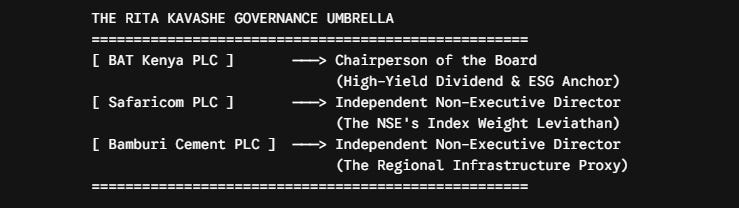
As the Chairperson of British American Tobacco (BAT) Kenya PLC, Kavashe guides a stock that is a foundational pillar for yield-focused investors. Navigating a tier-one “sin tax” stock requires balancing aggressive excise duty regimes, illicit trade headwinds, and rigid global ESG (Environmental, Social, and Governance) mandates. Her steady stewardship ensures that BAT remains one of the most reliable dividend-paying machineries on the local exchange.
Simultaneously, her presence as an Independent Non-Executive Director at Safaricom PLC places her at the digital center of East Africa’s economy. Overseeing Safaricom means protecting a balance sheet that drives Kenya’s mobile money plumbing and macroeconomic stability. Coupled with her board seat at Bamburi Cement PLC (Holcim Group), she commands an unmatched oversight loop spanning consumer goods, telecom technology, and heavy infrastructure manufacturing.
4.2 The State-Private Sector Bridge: KRB, NTSA, and KEPSA
Kavashe’s boardroom influence extends far past private equity and public markets into national infrastructure policy. She serves as a critical strategic node between state execution and private-sector agility through major public appointments:
Kenya Roads Board (KRB): Injecting strict corporate capital allocation models into the management and distribution of the multi-billion-shilling Kenya Roads Fund.
National Transport and Safety Authority (NTSA): Bringing automated manufacturing supply chain standards and logistics systems logic to national transport safety and regulation frameworks.
Kenya Private Sector Alliance (KEPSA) Advisory Council: Directly advising on macro-economic policy frameworks to align government legislation with industrial growth and manufacturing scalability.
4.3 The Municipal Crosshairs: Navigating the 2024 Taita Taveta Legal Audits
Kavashe’s willingness to extend her private-sector expertise to public-sector governance frequently thrusts her into the highly volatile arena of devolved county administration. A definitive case study of this tension materialized in Constitutional Petition E001 of 2024 (Benedict Mughanga v. County Government of Taita Taveta & 2 others) at the High Court in Voi.
In an effort to bring tier-one corporate rigor to her home county, Kavashe accepted a nomination to serve as a board member for the local municipal boards. On March 26, 2024, the Taita Taveta County Assembly approved her nomination alongside other candidates. However, local activists challenged the recruitment process, revealing that the county government had shifted, interchanged, and replaced the names of the original applicants to insert elite technocrats like Kavashe later in the sequence.
On September 19, 2024, High Court Judge George Dulu nullified the appointments, ruling that the county’s recruitment process lacked transparency, competitiveness, and adequate public participation.
4.4 The Palmhouse Foundation: Extending the Ladder to the Next Generation
True legacy in capital markets is not merely measured by the size of the fund or the height of the market cap; it is validated by the structural safety nets left behind for future generations. As a trustee and board member of the Palmhouse Foundation, Kavashe actively finances and mentors bright, deeply marginalized, and underprivileged children from rural setups similar to her own beginnings in Taita Taveta.
5.0 Conclusion: The Self-Made Anchor of Kenyan Capitalism
5.1 The Safety Premium for Institutional Capital
In the volatile landscape of the Nairobi Securities Exchange, where retail investors often panic at the slightest hint of macro-economic turbulence and foreign institutional funds demand rigorous compliance as a prerequisite for entry, Rita Kavashe provides a unique “safety premium” for the market. Her consistent presence across the boards of the exchange’s most significant tickers—Safaricom, BAT Kenya, and Bamburi Cement—acts as a non-verbal prospectus for institutional trust.
For the “buy-and-hold” value investor, a board overseen by Kavashe is one that is fundamentally shielded from the chaotic mismanagement often seen in less-regulated frontier environments.
5.2 The Standard of Frontier Markets: Power That Doesn’t Need to Shout
She proved that the glass ceilings of multinational manufacturing and elite finance are not indestructible, but they require a specific strategy to dismantle relentless academic preparation, the ability to out-execute the loud voices in the room, and the capacity to absorb personal sacrifice as a necessary tax for professional ascension.
She has effectively rewritten the rules of executive power in East Africa, demonstrating that one does not need the political patronage of an insider network or the aggressive, headline-grabbing persona of a “macho man” to reach the summit. Instead, she mastered the quiet, forensic, and human-centric discipline of true industrial governance.
6.0 Appendix: The Governance Ledger
6.1 Professional Dashboard
Rita Kavashe’s career is a study in sustained institutional influence. Her current and past board footprint reads like a masterclass in risk-diversified, blue-chip oversight:
Corporate Boards:
Chairperson, British American Tobacco (BAT) Kenya Plc
Independent Non-Executive Director, Safaricom Plc
Independent Non-Executive Director, Bamburi Cement
Public & Policy Advisory:
Kenya Roads Board (KRB)
National Transport and Safety Authority (NTSA)
Kenya Private Sector Alliance (KEPSA) Advisory Council
Philanthropy:
Palmhouse Foundation Board
6.2 Legal Context & Precedents
Constitutional Petition E001 of 2024 (Benedict Mughanga v. County Government of Taita Taveta & 2 others):
On September 19, 2024, the High Court at Voi, presided over by Justice George Dulu, nullified the recruitment and appointment process for Voi and Taveta Municipal Board members, citing a lack of competitiveness, integrity, and public participation.
The court specifically noted that the names of final appointees, including Rita Kavashe, were introduced to the process after the initial application and vetting stage, rendering the exercise legally unsustainable.
This ruling established a clear judicial precedent regarding the necessity for transparent and inclusive vetting processes for county-level boards, underscoring the risks associated with opaque administrative procedures.