
For decades, The Nairobi Hospital has stood as the gold standard of East African medicine. Yet, beneath the veneer of world-class clinical care lies a boardroom defined by a recurring, expensive, and increasingly chaotic 'Governance-Litigation Feedback Loop.' We have seen executive purges, court-ordered halts to AGMs, and allegations of multi-billion shilling mismanagement. But why? Is the hospital’s governance model—a member-owned structure—built for the modern era, or is it fundamentally designed to turn itself into a litigation factory
Whats in this brief
The Structural Fault Line: Why Member-Owned Models Fail
The Governance Paradox
The “Litigation Factory” Narrative
The Root Cause: The “Tender-and-Job” Trap
Pathways to Professionalization
The Verdict
1. The Structural Fault Line: Why Member-Owned Models Fail
At the heart of The Nairobi Hospital’s recurring crises is its foundational structure: the Kenya Hospital Association (KHA). Unlike a standard private hospital operated by a clear corporate entity with defined shareholders, the KHA is a company limited by guarantee. This “member-owned” model, while designed to foster democratic oversight, has become the hospital’s greatest vulnerability.
The Tragedy of “Member-Owned” Governance
The KHA’s structure effectively treats the hospital as a community-run asset, where membership grants the right to vote at Annual General Meetings (AGMs). In theory, this allows stakeholders—doctors, patients, and corporate bodies—a voice in the institution’s future. In practice, however, it has created a “tragedy of the commons.”
Because the hospital is a prestigious and high-revenue institution, the membership list itself has become the ultimate prize. If the register of members is the “voting roll,” then controlling that register is equivalent to controlling the board. This has turned the KHA into a magnet for lobby groups seeking to influence elections to secure seats on the Board of Management.

The “Fraudulent” Takeover Mechanism
Recent investigations and judicial interventions have highlighted the ease with which this model can be subverted:
Manipulation of the Register: Allegations have surfaced repeatedly that the register of members—which determines who can attend and vote at AGMs—is prone to manipulation. By inflating the register with “ghost” members or excluding legitimate ones, factions can effectively “capture” the hospital, ensuring their preferred candidates are elected to the board.
The Power Vacuum: The lack of traditional equity shareholders means there is no “owner” with a direct financial incentive to stop the erosion of institutional value. Instead, the board is often composed of volunteers who may be more accountable to the lobby groups that helped them get elected than to the institution’s long-term health.
The Litigation Factory: Because the KHA Articles of Association provide few effective internal dispute resolution mechanisms, every disagreement over membership or election legitimacy inevitably spills into the courts. This has led to a cycle where the judiciary is forced to intervene in internal hospital politics—blocking AGMs, pausing board appointments, and overseeing forensic audits—to prevent a “governance catastrophe.”
State Intervention: A Symptom of Systemic Failure
The recent intervention by the State, including President Ruto’s role as Patron and the subsequent call for a “Five-Point Reform Agenda,” is the clearest signal that the member-owned model has reached its limit. When an institution becomes so essential to national healthcare that its internal disputes threaten clinical stability, the government is eventually forced to step in to prevent the hospital from being “held hostage” by internal wrangles.
Ultimately, the KHA model relies on a level of altruistic engagement that, in the face of multi-billion shilling interests, has proven unsustainable. The question facing Nairobi Hospital today is whether it can survive as a member-owned association, or if the “governance-litigation feedback loop” proves that this structure is fundamentally incompatible with a modern, high-stakes medical enterprise.
Leadership wrangles rock Nairobi Hospital
This video captures the intense leadership wrangles and rival factions at the hospital, highlighting the very boardroom instability that has turned the institution into a high-stakes legal battleground.
How Membership works
To become a member of the Kenya Hospital Association (KHA), which owns and operates The Nairobi Hospital, you must apply through their formal process. As a company limited by guarantee, the KHA relies on membership to facilitate governance, with members possessing voting rights at Annual General Meetings (AGMs).
Membership Categories
The KHA typically offers different tiers of membership, each with its own costs and benefits (such as inpatient rate rebates and priority admission). Common categories include:
Ordinary Membership: A standard entry level that provides voting rights at general meetings and specific hospital benefits.
Gold Membership: Often structured as a multi-year plan (e.g., three years) that may include benefits for immediate dependent family members, such as a waiver of admission deposits.
Corporate Membership: Designed for organizations to cover their employees. These memberships typically grant the corporate entity a vote at general meetings.
How to Apply
Obtain the Application Form: You can access the official membership application form directly through The Nairobi Hospital’s official website or by contacting their administration office.
Submit Documentation: You will need to complete the form with your personal or corporate details. For family-inclusive plans (like Gold Membership), you will need to provide details of your immediate dependents.
Pay Fees: Membership requires an entry fee and an annual subscription fee (or a lump-sum payment for multi-year schemes). Payment details are provided by the KHA office.
Approval: Once the form and payment are submitted, your application is processed by the association’s management.
Key Considerations for Prospective Members
Voting Power: Being a member grants you one vote at the KHA’s General Meetings. This is the mechanism that allows members to participate in the election of the Board of Management.
Administrative Oversight: As noted in your research on the “governance-litigation feedback loop,” the membership register is a sensitive area. Because membership equates to voting power, the KHA strictly regulates the register to prevent the kind of manipulation—such as the inclusion of ineligible “ghost members”—that has historically fueled boardroom wrangles at the institution.
The “Litigation Factory” Narrative: When Legal Action and Executive Purges Replace Strategic Planning
At The Nairobi Hospital, the boardroom has undergone a troubling metamorphosis. What should be a strategic hub for advancing clinical excellence and infrastructure development has increasingly functioned as a “litigation factory.” In this environment, the institution’s most significant capital is no longer being directed toward life-saving medical technology, but rather toward sustaining an endless cycle of legal maneuvering and executive turnover.
Data Points of a Governance Crisis
The evidence of this shift is visible in a series of high-stakes legal battles and a recurring pattern of leadership instability that has effectively paralyzed the hospital’s strategic momentum:
The “Ten-Year Purge” of CEOs: The hospital has become a revolving door for its top leadership, characterized by a pattern of summary dismissals and high-profile legal battles. In just the past year, the hospital has faced massive court-ordered payouts to former CEOs—including Sh206 million to Dr. Allan Pamba, Sh100 million to James Nyamongo, and Sh72.9 million to Gordon Odundo—all for wrongful and unlawful termination. This “purge” culture suggests a board that prioritizes the removal of executives over stable, long-term operational continuity.

The Sh9.1 Billion Allegation: The institution is currently embroiled in a petition—spearheaded by activists—that alleges severe financial mismanagement, including an unaccounted-for Sh9.1 billion. These claims, which include gaps in audited accounts and mounting supplier arrears, have forced the hospital to spend critical resources defending its financial reputation in court rather than reinvesting in its operational core.
Omtatah Files Petition to Block Nairobi Hospital AGM Over Sh 9.1 Billion Mystery https://insiderbits.co.ke/court/omtatah-files-petition-to-block-nairobi-hospital-agm-over-sh-9-1-billion-mystery/ via @Insider BitsNews
Halted AGMs as a Strategic Standoff: The Annual General Meeting (AGM), the primary vehicle for shareholder accountability and strategic direction, has been repeatedly frozen by the High Court. When a premier hospital cannot even convene its owners to approve a budget or strategic plan, the focus shifts entirely from long-term growth to short-term judicial survival.
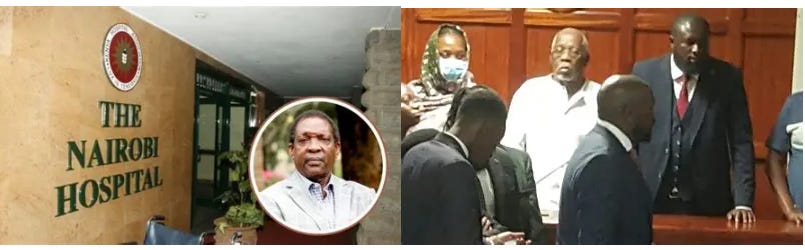
The Criminalization of Governance: The arrest and arraignment of senior board members over allegations of falsifying the member register signifies a new low in the “governance-litigation” cycle. When leadership must answer to investigators and prosecutors, the board’s capacity for high-level strategy is eclipsed by the immediate need for legal counsel and crisis management.
The Cost of the “Litigation Factory”
This shift toward judicial intervention has profound implications for the hospital’s future:
Strategic Paralysis: Every hour spent by hospital leadership in the Milimani Law Courts or at the DCI headquarters is an hour lost on clinical innovation and resource mobilization.
Reputational Erosion: The constant cycle of injunctions and allegations undermines the confidence of donors, investors, and, most importantly, patients who expect a center of excellence, not a center of controversy.
Governance Tax: The vast financial burden of hiring top-tier legal teams to defend against these ongoing petitions is essentially a “governance tax,” draining the very liquidity the hospital needs to modernize its facilities.
The hospital’s board of management has consistently defended the institution, insisting it remains stable and fully operational despite these allegations. However, the recurring pattern of intervention suggests that until the underlying structural friction is resolved, the boardroom will continue to produce court filings instead of strategic results—cementing the hospital’s status as a high-stakes litigation factory.

Nairobi Hospital governance crisis
This video provides an in-depth breakdown of the leadership wrangles and the tactical legal battles that have pushed the hospital to the center of a national governance crisis.
The Call to Action: Reimagining the Institution
The persistent cycle of boardroom wrangles and judicial interventions at The Nairobi Hospital forces a fundamental question upon its members and the public: Is the problem the people in the boardroom, or is the model itself the primary architect of this chaos?
When an institution’s governance structure prioritizes the control of a membership register over clinical strategy, it ceases to be a hospital and becomes a political prize. The primary friction is simple: In the current KHA model, members derive no financial dividend from their membership. Without a return on investment, the “value” of membership is instead extracted through the only remaining currency—influence over tenders and employment. This turns every AGM into a high-stakes battle for the “tender-and-job” pipeline.
To move beyond this “litigation factory” and restore the hospital to its prestige, the institution must transform membership from a political tool into a financial stake. Below are three pathways that could professionalize governance by realigning the members’ interests with the hospital’s financial health:
1. The Dual-Arm Strategy: Creating a Profit-Making Engine
The hospital could adopt a holding company model that separates its clinical mission from its commercial ambition.
The Concept: The KHA would retain its non-profit, medical-focused identity, while a new, distinct commercial entity would be created to manage high-revenue facilities and expansion projects.
The Benefit: A profit-making arm is inherently attractive to private equity investors. By bringing in outside capital, the hospital gains the funds to modernize its infrastructure without the need for contentious, politically-driven board elections. Most importantly, this entity can generate and distribute dividends to its stakeholders, shifting the membership incentive from “tender-chasing” to “value-creation.”
2. OTC Liquidity: Membership as a Tradable Asset
If full corporatization is too sudden, the hospital could transition membership into a liquid, tradable asset class.
The Concept: Membership interests could be structured as tradable units on an Over-the-Counter (OTC) platform.
The Benefit: This provides a clear “exit” mechanism for long-standing members who feel marginalized or simply wish to cash out their “investment.” By creating a market for these units, the hospital forces a transparent valuation on its own governance. When members can sell their stake for a fair price, the desperation to “capture” the membership register for political influence loses its appeal.
3. Listing by IPO: The Path to Institutional Maturity
For a hospital of such scale, a public listing on the Nairobi Securities Exchange (NSE) is the ultimate test of accountability and the definitive cure for boardroom chaos.
The Concept: Converting the KHA into a company limited by shares and initiating an IPO would bring the hospital into the full light of public market regulation.
The Benefit: IPOs demand rigorous oversight, independent board members, and standardized financial reporting. By moving from a closed membership model to a share-based model, the hospital can finally offer dividends to all owners. This grants every Kenyan the right to own a piece of their healthcare infrastructure, replacing the current “tender-influence” culture with a transparent dividend policy that rewards actual institutional performance.
The Verdict
The current member-owned model has provided the hospital with its history, but it is currently threatening its future. By introducing a dividend-bearing structure, we strip away the primary incentive for boardroom wrangles and replace it with the disciplined, performance-oriented culture that modern institutions require.
What do you think? Should we continue to defend the “tradition” of the member-based model, or has the time come to list The Nairobi Hospital on the stock exchange and let the market—not the lobby groups—determine its direction?
