
Welcome to Boardlot Africa, where we pull back the curtain to reveal the untold stories, power dynamics, and strategic maneuvers shaping the boardrooms of Corporate Africa—subscribe for free to join the conversation. join 1000 other subscribers
We publish Kenya’s Most Consequential Legal, Governance & Labor Disputes and A Series on the 100 Most Influential Kenyan Captains of Industry
As we navigate the intersection of political consolidation and regional market dynamics, the following analysis examines the systemic risks posed to Nation Media Group’s institutional independence and the subsequent implications for the broader East African investment climate.
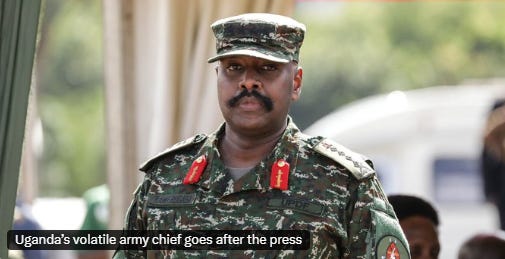
Table of Contents
I. The Mirage of the “Business Deal”
II. The Shift: Aga Khan vs. The New Guard
III. The Muhoozi Doctrine: A New Blueprint for Authoritarianism
IV. For the Investors: The Erosion of Value
V. Can Diplomatic Pressure Save the Media?
VI. Can the Generals Stop Him?
VII. Conclusion: The Point of No Return
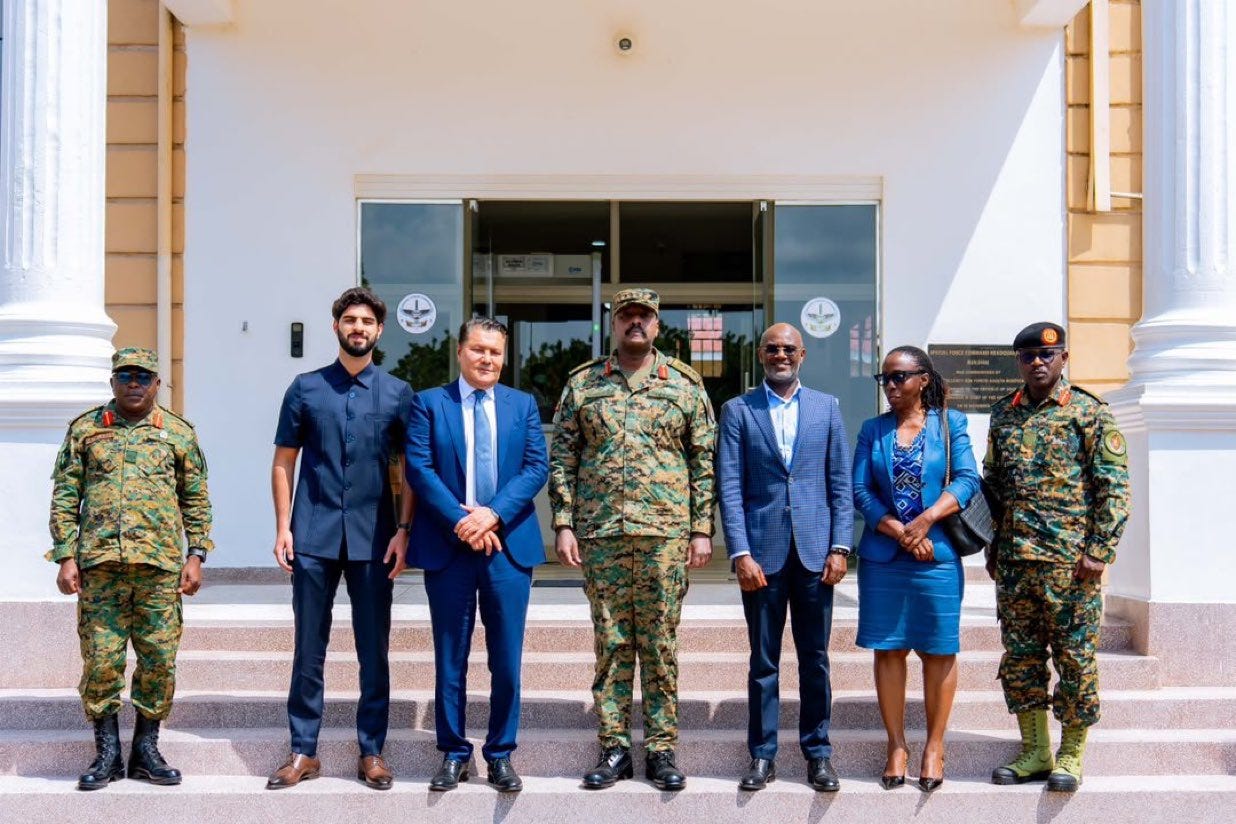
The image from Entebbe is worth a thousand words—all of them chilling. When Rostam Aziz with Muhoozi Kainerugaba sandwiched between 2 other Generals, earlier this week, the optics were not those of a business tycoon meeting a political leader to discuss media growth. They were the optics of a hostage negotiation. This meeting, captured in a post that has sent shockwaves through East African boardrooms, serves as a grim punctuation mark to the corporate takeover of the Nation Media Group (NMG).
When Aziz finalized his control over NMG in early 2026, the public-facing narrative was purely commercial: an expansion of influence, a revitalized strategy, and a promise to secure the future of the region’s largest media house. Yet, the reality of mid-2026 tells a different story. It is a story where the “commercial” assurances provided by the new majority shareholder have been systematically dismantled by the very state actors who view independent journalism as an existential threat.
The Entebbe negotiation proves that in 2026, corporate ownership in East Africa is no longer a shield against the state—it is a hostage. The acquisition of NMG was not merely a change in the registry of shareholders; it was the definitive end of an era of institutional independence. When a media house’s fate is decided in a military-adjacent meeting room rather than an editorial boardroom, the business deal is no longer about profitability; it is about survival under state sufferance.

II. The Shift: Aga Khan vs. The New Guard
For over six decades, the Nation Media Group functioned under the steady, if sometimes cautious, stewardship of the Aga Khan. It was an era defined by a specific brand of “soft power”—a commitment to independent journalism that, while occasionally tested by regional regimes, provided a sanctuary for voices that had nowhere else to turn. It was the gold standard of East African media, an institution that stood as a pillar of accountability and a beacon for journalists who viewed their craft as a public service rather than a private convenience.
Transitioning to the ownership of Rostam Aziz has brought this era to a jarring close. While the initial corporate messaging promised expansion and modernized strategies, the functional reality has been a fundamental rewriting of the social contract between the media house and the governments it covers. The intellectual and institutional distance that once protected the Daily Monitor and its sister outlets from the whims of State House is evaporating.
We are witnessing a shift from “journalism as a public good” to “journalism as a transactional asset.” The hallmark of this new regime is a commitment to “patriotic” and “balanced” reporting—terms that, when uttered by men like Muhoozi Kainerugaba and his peers, serve as convenient euphemisms for state-compliant narratives. The independence that the Aga Khan spent a lifetime cultivating is being bartered away, replaced by a model of political accommodation where the primary editorial mandate is no longer to hold power to account, but to ensure that the business of the corporation remains undisturbed by the state’s insecurities.

III. The Muhoozi Doctrine: A New Blueprint for Authoritarianism
To understand the current crisis, one must look closely at the architect of this shift. General Muhoozi Kainerugaba’s adversarial relationship with the media is not a newfound reaction to recent reporting; it is a well-documented pattern of hostility. For years, Muhoozi has utilized his X (formerly Twitter) feed as a weaponized platform to bypass traditional gatekeepers and intimidate those who dare to scrutinize his actions. His digital discourse has consistently signaled a disdain for the Fourth Estate, framing critical journalism not as a pillar of democracy, but as a malicious interference.
Most alarming is how openly he has declared his intentions. Through his active X presence, Muhoozi has left no ambiguity regarding his worldview, making it clear that in his eyes, media freedom in Uganda is non-existent. He has previously asserted his perceived authority to shut down any media house that falls out of favor, a threat that moved from the digital realm to physical reality during the recent military-enforced silence of the Nation Media Group’s Ugandan operations.
This is more than just the petulance of a powerful figure; it is a calculated “Muhoozi Doctrine.” By demonstrating that he can neutralize the region’s largest media conglomerate, he provides a blueprint for other authoritarian regimes across East Africa. The message to the region’s leaders is seductive: independent media does not need to be debated or tolerated—it can simply be silenced. As this trend takes hold, the distinction between a private media enterprise and a state-controlled propaganda wing is vanishing, signaling a dark, new chapter for regional press freedom

IV. For the Investors: The Erosion of Value
For the minority shareholders of Nation Media Group, the Entebbe meeting and the subsequent alignment with state interests represent a profound and dangerous shift in the company’s risk profile. When capital was initially deployed into NMG, investors were not just buying shares in a media house; they were buying into a brand synonymous with neutrality, institutional credibility, and regional influence. This perceived editorial independence served as the company’s most significant competitive moat, ensuring audience loyalty and, by extension, sustained advertising revenue.
However, when a media outlet pivots from a watchdog to a state-accommodating entity, it triggers a catastrophic erosion of brand equity. The economic risk is twofold:
Audience Abandonment: As the public begins to perceive NMG as a mouthpiece for state narratives, the core consumer base is likely to migrate toward independent digital platforms and alternative media. This migration directly threatens the viewership numbers that drive advertising spend, effectively cannibalizing the company’s primary revenue stream.
Political Liability as an Asset: The shift toward political compliance effectively transforms NMG from a commercial entity into a political liability. Investors who once viewed the stock as a reliable “dividend play” must now grapple with the volatility inherent in being a partisan actor in a volatile political climate.
If the brand’s credibility is the bedrock upon which its market value is built, the “Patriotic Pivot” has effectively removed the foundation. Investors must now ask themselves: are they holding shares in a resilient media institution, or a hostage asset whose market value is now entirely contingent on its ability to please political actors? The market rarely rewards uncertainty, and the current trajectory of NMG suggests that the “neutral stance” that once attracted institutional capital is rapidly becoming a relic of the past.

VI. Can the Generals Stop Him?
The question of whether the Ugandan military establishment—the very institution meant to be the safeguard of the state—can check General Muhoozi Kainerugaba’s influence is the central anxiety of Uganda’s political class. While high-ranking military officials such as Major General Kahinda Otafiire have famously voiced public and private opposition to the President’s handling of succession and the military’s direction, the institutional reality within the Uganda People’s Defence Forces (UPDF) makes a conventional “military coup” or internal uprising against Muhoozi highly improbable.
The structural insulation Muhoozi enjoys is significant. As the son of President Yoweri Museveni, he is not merely a military officer; he is an extension of the presidency itself. His career, marked by repeated appointments to lead the Special Forces Command (SFC)—the elite unit responsible for the President’s personal security—has allowed him to cultivate a deep, loyalist core within the military’s most critical power center. Any general contemplating opposition must weigh the risk of challenging not just the Chief of Defence Forces, but the Commander-in-Chief who has meticulously groomed his successor for decades.
Furthermore, Muhoozi has demonstrated a willingness to marginalize those who represent alternative power centers. When historical figures like Otafiire criticize the path of the state or the military’s role in succession, they are increasingly framed as outliers rather than standard-bearers of a viable alternative military faction. In the current climate, where military personnel are deployed to enforce political directives—such as the recent shutdown of independent media—the UPDF is being increasingly utilized to solidify Muhoozi’s authority rather than function as an independent state institution.
Ultimately, the generals are unlikely to stop him because the chain of command has been effectively merged with a dynastic succession plan. To stop Muhoozi would require a total fracture of the military’s loyalty to Museveni himself—a prospect that remains, for now, the final and most difficult barrier to his absolute control.
The video provides a visual and auditory record of the rising tensions between established military figures and the younger leadership.
VII. Conclusion: The Point of No Return
We are witnessing the end of an era. The events in Entebbe, the shuttering of the Daily Monitor and its sister outlets, and the bold warnings issued by historical figures like Kahinda Otafiire all point to a singular, uncomfortable truth: the institutional safeguards we once relied upon are dissolving.
East Africa is drifting toward a model where media ownership is a form of political insurance, and “press freedom” is treated as an obsolete luxury of a bygone democratic age. For the investors, the journalists, and the citizens who believed in a different future, the signal is clear. The “Muhoozi Doctrine”—a fusion of military enforcement and the suppression of dissent—is no longer a theoretical threat; it is the new regional standard.
If this trend continues, the history of East African media will be divided into two distinct periods: the decades of hard-fought, independent evolution under the Aga Khan, and the current, accelerating descent into a controlled, state-aligned information ecosystem. The question for the region is no longer whether press freedom can be saved, but whether there is a remaining coalition of voices—in the boardroom, in the barracks, or in the diplomatic corps—willing to pay the price to fight for it. The space for neutrality is closed. It is time to choose sides.
About Boardlot Africa Research
Boardlot Africa is a premier financial intelligence and corporate governance publication dedicated to unpacking the mechanics of capital, market strategies, and structural shifts across East Africa’s corporate landscape. By bridging the gap between raw economic data and actionable market intelligence, we deliver deep-dive research, independent corporate analysis, and policy insights designed for institutional investors, boardrooms, and sharp market observers.
Get in Touch
Email: boardlot.research@gmail.com
Phone: +254 753 133 901
Substack: Subscribe to Boardlot Africa
X (Twitter): BoardLotSultan