
The Nairobi Stock Exchange: A Chronicle of Kenya’s Capital Frontier
The history of the Nairobi Stock Exchange (NSE) is a narrative of transformation—from a colonial-era “gentleman’s agreement” in a hotel bar to the sophisticated, electronic marketplace that anchors the East African economy today.
I. The Gentlemen’s Syndicate (1951–1954)
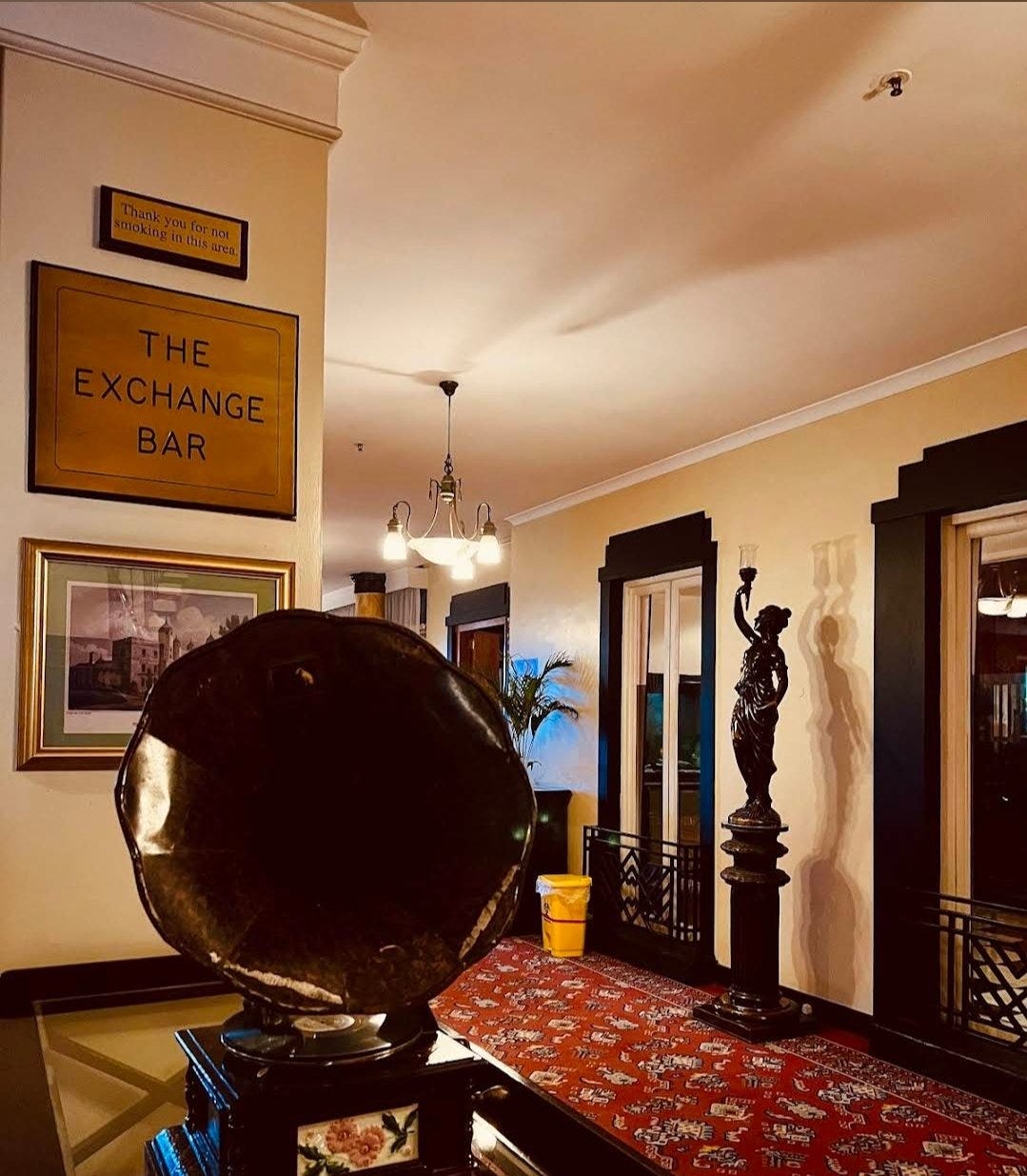
The genesis of the NSE was not a state-mandated project but an audacious act of networking. In 1951, Francis Drummond established the first stock brokerage firm in Nairobi. By 1954, he was joined by pioneers such as J.S. Donovan, the house of Dyer & Blair, and Chandulal Shah. These men met within the “Exchange Bar” of the Stanley Hotel, where the air was thick with the tension of capital finding a home.
This was the “Wild West” of finance. Foreign investors dominated the market, commanding 95% of trading volume, while local participation was restricted to 5% by low income and colonial-era statutory barriers. Trading was conducted via a Periodic (Call) Auction system, where brokers manually shouted bids—a process that relied entirely on the integrity of handshakes and personal trust.
The Business of Agency and the Culture of Restraint
Within this nascent financial ecosystem, the role of the stockbroker was defined by a delicate balance of agency and strict institutional control. Brokers acted as both intermediaries and advisors, tasked with helping firms determine fair issue prices and navigating the intricate landscape of corporate finance. Under the 1954 rules, they were granted the flexibility to perform auxiliary services—such as insurance or merchant banking—but only with the committee’s explicit sanction. Crucially, in their role as guardians of the Exchange’s exclusivity, they were strictly prohibited from joining any competing exchanges.
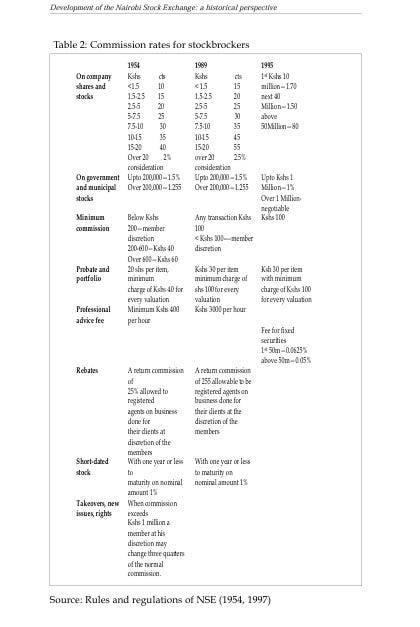
The Exchange enforced a culture of professional restraint that would be unthinkable in today’s aggressive, competition-driven markets. Members were forbidden from advertising, canvassing, or soliciting business in any form; success was expected to come from reputation and referral, not marketing.
To ensure stability and prevent “cut-throat” competition, their income was dictated by rigid, Exchange-set commission rates. This was a protected, uniform marketplace where the penalty for deviating from the collective was severe. Any member found charging less than the mandated minimum risked a fine of up to Kshs 2,000, suspension, or outright expulsion—a testament to the Committee’s commitment to maintaining a controlled, orderly environment where the brokerage firm’s primary allegiance was to the Exchange’s established norms rather than to the pursuit of individual market share.
II. Governance and the “Committee of Five”
The formalization of the market under the Rules and Regulations of the NSE 1954 introduced an elite governance structure: the Committee of Five. This committee held absolute power, acting as the market’s gatekeeper, adjudicator, and information controller. They could unilaterally halt share dealings and set commission rates, enforcing these rules with the threat of fines or expulsion.
III. Regional Integration and the Post-Independence Pivot
For years, the NSE operated as the financial hub of the East African Community (EAC), listing shares from companies in Kenya, Uganda, and Tanzania. However, the 1963 independence of Kenya triggered a shift. The government’s Kenyanisation policy sought to dismantle the colonial monopoly on wealth. To protect foreign investment while managing capital, the 1964 Foreign Investment Protection Act was passed, ensuring stability even as exchange controls on sterling transactions were introduced in 1965 to stem “funk money” flight.
IV. Government Takes Control: The Rise of the CIC
By the 1970s, the state became a direct participant in market oversight. The establishment of the Capital Issue Committee (CIC) in 1971 ended the era of total self-regulation. The CIC was tasked with “screening” all new share issues to ensure that capital raised from the public was directed toward domestic development rather than the repatriation of funds by foreign firms. This was reinforced by a aggressive fiscal policy, including the 1975 introduction of a 36% Capital Gains Tax, which—while intended to curb speculation—inadvertently stifled market liquidity.
The Fiscal Squeeze: Withholding Taxes and the State’s Regulatory Grip
By the 1970s, the government’s efforts to “Kenyanise” the economy moved beyond mere oversight; they became deeply fiscal. To curb capital flight—where foreign firms were selling shares to locals only to repatriate the cash—the State began using the tax code as a blunt instrument to keep wealth within national borders.
The Rise of Withholding Taxes (1971–1975)
In 1971, the government initiated a aggressive tax strategy. A 12.5% tax was imposed on dividends and interest paid to both residents and non-residents, alongside a 20% levy on fees and royalties paid to non-residents. This was not merely about revenue; it was a structural defense of the national economy.
As the fiscal years progressed, the pressure intensified:
1974/75: The withholding tax on both resident and non-resident dividends was standardized at 15%.
The “Borrowing Freeze”: To force foreign companies to look inward, the Central Bank restricted local borrowing to 20% of total investment for firms with more than 15% non-resident ownership.
Profit Repatriation: The Central Bank withdrew permission for foreign firms to remit interim dividends before annual accounts were finalized, effectively locking their capital within Kenya until the tax authorities could assess their total liability.
The Capital Gains Tax and Speculation
In June 1975, the government introduced a 36% Capital Gains Tax (CGT). While intended to curb excessive speculation, it had an unintended chilling effect on the market. By taxing the “growth” of assets, the government had inadvertently stifled the liquidity of the NSE.
The weight of these taxes became apparent as the market stagnated. The ratio of Government stocks listed on the NSE had climbed steadily—from 5.4% in 1954 to 13% in 1959, and eventually reaching total integration by 1969—but the private industrial sector was struggling under the fiscal burden.
The Pendulum Swings: 1985/86 Reforms
The government eventually realized that its tax policies were “inhibiting capital and share mobility.” Acknowledging that punitive taxes were counterproductive to economic expansion, the state began a series of reversals.
In the 1985/86 fiscal year, the government made a landmark decision: the suspension of the Capital Gains Tax. This was followed by efforts to eliminate certain withholding taxes and make public offer expenses tax-deductible. The realization was clear: for the NSE to evolve from a colonial relic into a robust engine for development, it required a tax environment that rewarded growth, rather than one that treated share mobility as a target for extraction.
V. Modernization: Sessional Paper No. 1 and the CMA
The mid-1980s marked a turning point. Recognizing that punitive taxes hindered economic growth, the government released Sessional Paper No. 1 of 1986. It proposed a bold transition:
Fiscal Reform: Suspension of Capital Gains Tax and elimination of tax disparities between debt and equity.
Institutionalization: The proposal for a formal, statutory regulator, leading to the creation of the Capital Markets Authority (CMA) in 1989.
VI. From Coffee House to Open Outcry and Automation
In November 1991, the NSE moved from the informal coffee-house style to a floor-based open outcry system, enhancing transparency by exposing all buy and sell interests. To support this growth, a multi-tiered compensation framework was established, including mandatory bank guarantees for brokers and an Investor Compensation Fund.
The final hurdle was automation. The manual settlement process, which could take two weeks, was an impediment to liquidity. Following intense lobbying, the Central Depository and Settlement Corporation (CDSC) was incorporated in 1999. By August 2000, the introduction of the Delivery versus Payment (DvP) system signaled the end of the manual era, paving the way for the electronic, high-speed trading environment that defines the NSE today.
V: Today’s NSE Membership and Governance
The evolution of the Nairobi Stock Exchange (NSE) from an exclusive, closed-loop club to a modern, regulated institution necessitated a complete overhaul of its membership and governance structure.
a. From Limited Company to Guarantee
Initially registered as a limited company under the Companies Act in 1991, the NSE underwent a pivotal change following the 1994 CMA Act (Amendments). To ensure the exchange functioned in the public interest rather than for private profit, it became mandatory for any CMA-approved stock exchange to be re-incorporated as a company limited by guarantee. This shift was fundamental in detaching the entity from private interests and aligning it with broader national economic development goals.
b. Expanding the Board
The original “Committee of Five” was dismantled and replaced by a more inclusive Board of Directors designed to incorporate diverse market stakeholders:
5 Broker Representatives: Drawn from the main brokerage firms to provide market expertise.
2 Listed Company Representatives: To advocate for the firms utilizing the exchange.
3 Investor Representatives: To ensure that the interests of the public and individual shareholders remained central to decision-making.
c. Professionalization and Market Expansion
To drive competitiveness and handle growing trading activity, the NSE aggressively expanded its brokerage base. In July 1994, seven new stockbrokers were licensed, and by June 1995, following further licensing and one suspension, the total reached twenty. This expansion was a direct response to the market boom of 1994, where stock prices peaked at 5030, fueling intense public and institutional interest.
The professional standards also saw a marked increase. In March 1997, stockbrokers formed the Association of Kenya Stockbrokers (AKS). Their mandate was to:
Develop a rigorous code of conduct.
Promote professional ethics.
Establish examinable courses for members to ensure a baseline of financial competency.
Facilitate official liaison between brokers, the CMA, and the NSE Board.
d. Rising Barriers to Entry
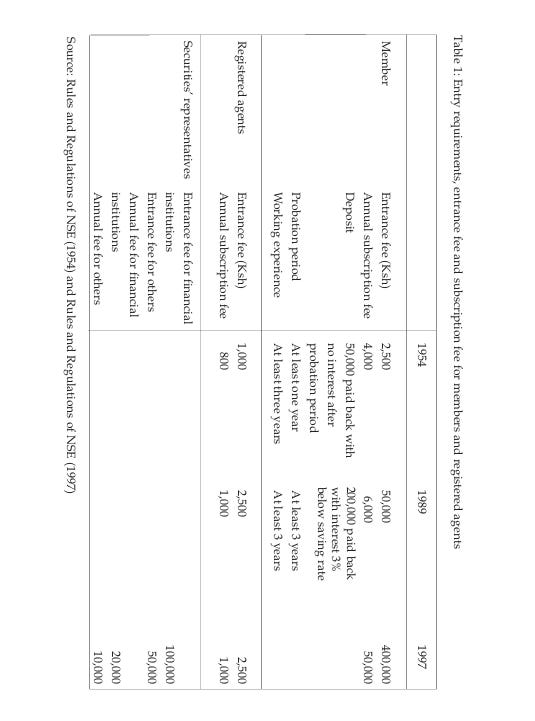
As the market modernized, the financial requirements for participation grew significantly. To ensure that only stable, well-capitalized firms operated within the market, the CMA significantly raised the bar:
Capital Requirements: In 1993, the initial paid-up capital for stockbrokers was raised from a modest Kshs 100,000 to a substantial Kshs 5 million.
Regulatory Compliance: Under the 1997 rules, no dealer or broker could be granted membership without a valid license, and listing requirements for firms were standardized to include minimum paid-up capital and public offer thresholds (such as the requirement to offer at least 20% of authorized capital).
These measures effectively ended the era of informal brokerage, replacing it with a standardized, capital-heavy, and professionally audited framework that serves as the foundation for today’s NSE operations.