
In February 2026, I stood on a 50x100 plot in Juja and made a decision most middle-class Kenyans would call crazy. Around me were the usual rows of mabati houses — those corrugated iron structures that many dismiss as eyesores. Yet right there, in one of the fastest-growing areas near JKUAT and various industries, I saw something else: a clear, high-return opportunity to solve a real problem while generating serious cash flow.
Everyone wants to talk about “proper” housing at KES 5,000 or more per month. The truth is, not everyone can afford it. Students, young workers, and families moving into Juja need decent, affordable shelter today — not tomorrow when the fancy apartments finally arrive. That gap is exactly where well-executed mabati rentals shine.
I leased the plot for KES 30,000 per month and went ahead with a 30-unit layout. No fancy architect. No long construction delays. Just practical materials, smart density, and a focus on what tenants actually need: a clean room, reliable water, basic security, and a fair price.
The result? A project that proved these “simple” investments can be highly profitable and relatively easy to run. In this piece, I’m pulling back the curtain on the full model I built and operated: the exact numbers (including the lease), the budget breakdown, how we completed construction in just six weeks, the operational tweaks that boosted rents, and the real lessons from putting my own money and time into it.
This isn’t theory or someone else’s spreadsheet. This is the project I executed earlier this year. If you’ve ever wondered whether low-cost rental housing makes sense in today’s Kenya — or if you’re actively looking for accessible ways to build cash-flowing assets — you’ll find the full playbook here.
Part 2: Why Juja & Why Mabati
Before diving into the numbers and build details, it’s important to understand why this model makes sense specifically in Juja in 2026.
Juja has transformed rapidly. Sitting just outside Nairobi along the Thika Superhighway, the area benefits from Jomo Kenyatta University of Agriculture and Technology (JKUAT), which draws thousands of students every year. Add to that the growing industrial and commercial activity — factories, warehouses, small businesses, and the general urban spillover from Nairobi — and you have a constant inflow of young professionals, workers, and families looking for housing.
Many of these people cannot comfortably pay KES 5,000–8,000 for a one-bedroom apartment or a more formal unit. They need something clean, secure, and affordable in the KES 2,500–3,500 range. At the same time, formal developers often focus on higher-end segments, leaving a persistent gap in decent, entry-level rental supply. That gap is where mabati (corrugated iron sheet) structures have historically filled the need — and continue to do so effectively.
Mabati housing gets a bad reputation because poorly built examples quickly become run-down. But when done right — with proper concrete flooring, good drainage, shared but clean ablution blocks, and basic security — they offer excellent value. They are fast to construct, relatively cheap to maintain, and can be scaled on smaller plots. In a market where land and construction costs keep rising, the speed and lower capital intensity of mabati projects become a real advantage.
I chose to lease rather than buy the 50x100 plot precisely because of this dynamic. At KES 30,000 per month, the lease allowed me to deploy capital straight into the build and start generating income much faster. It also gave flexibility — if the area continues to develop rapidly, the option to renegotiate or move remains open.
From my observation on the ground, occupancy in well-managed mabati compounds in Juja stays high because the product matches the demand. Tenants are often stable — students who pay reliably through guardians, workers with monthly salaries, and small families. The key is execution: deliver cleanliness, reliability, and fair pricing, and the units practically rent themselves.
I i am not romanticizing informal housing. It’s about recognizing an economic reality. Kenya’s urban population is growing fast. Not everyone starts at the top of the housing ladder. Providing quality entry-level options is both good business and a practical response to the market as it actually exists today.
Part 3: The Project Blueprint – 30 Units on 50x100
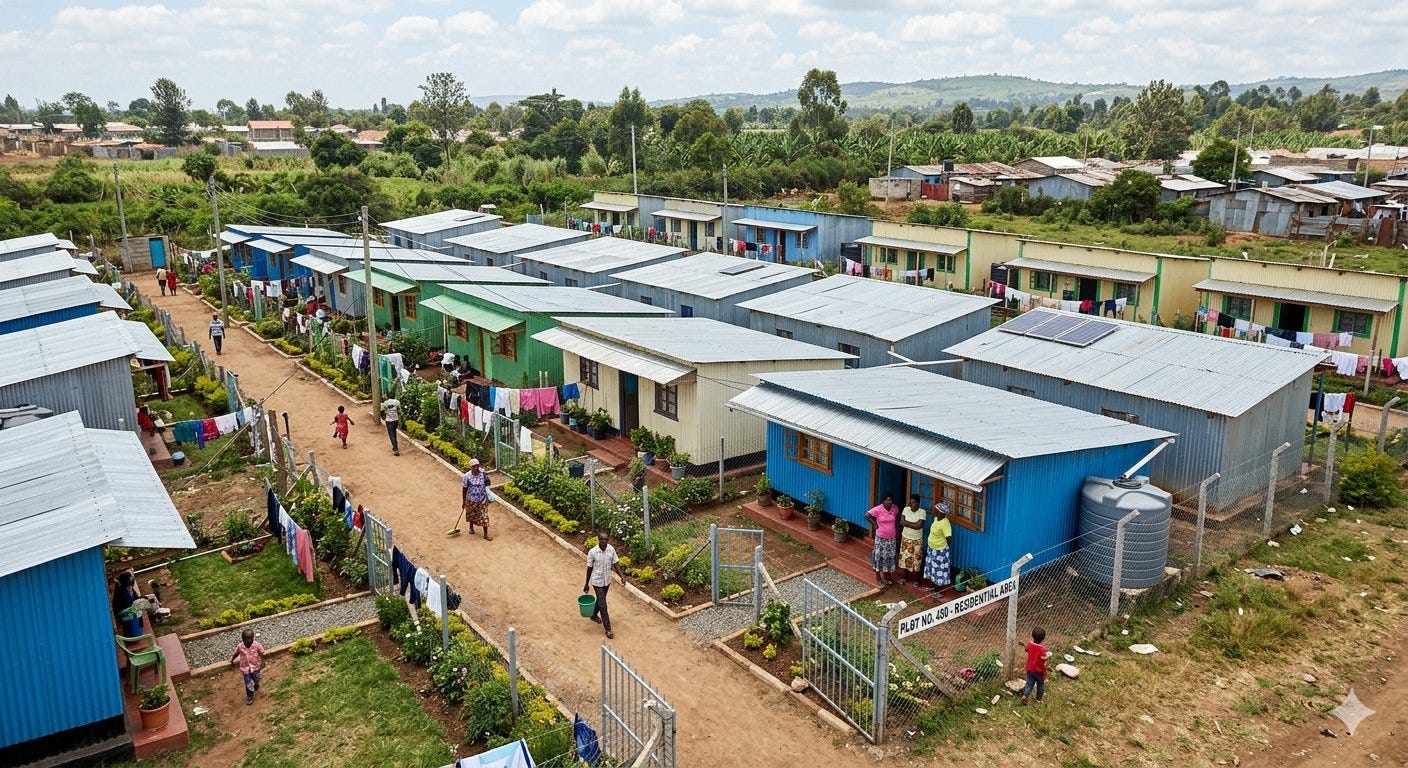
The layout is straightforward and efficient: 30 single-room units arranged in neat rows with shared pathways. Each unit measures roughly 10x10 ft, giving tenants enough space for a bed, sitting area, and basic belongings. I went with this density because it maximizes income on the plot while still allowing reasonable living conditions and manageable operations.
The design includes:
A central 1-meter paved walkway for easy movement and to keep the compound looking neat.
Shared ablution facilities (more on the exact ratio in the budget section).
A single master water and electricity connection for simplicity and cost control.
Perimeter fencing with a basic gate for security.
I chose 30 units deliberately. It strikes a good balance: enough to generate meaningful cash flow, but not so many that management becomes chaotic on a plot this size. The rooms are basic but finished with a light concrete floor and cement screed — a big upgrade over dirt floors that helps with cleanliness and justifies the rent.
Because the plot is leased (KES 30,000/month), every shilling of build capital went into creating rentable space rather than tying up money in land. This approach let me keep the total project capital focused and recoverable within a reasonable timeframe.
The entire setup targets the core demand in Juja: students who need proximity to JKUAT, workers employed in nearby industries, and young families starting out. They don’t need luxury — they need reliability, affordability, and a safe place to return to every evening.
This blueprint is intentionally simple. No complex multi-storey construction, no expensive finishes. Just proven, locally available materials and a layout that works with the realities of the plot and the market. The result is a compound that looks orderly and functions efficiently — far from the chaotic image many associate with mabati rentals.
Part 4: The Numbers That Matter
On the 30-unit layout I built, the model works as follows at standard pricing:
Base Case (KES 3,000 per unit)
Gross monthly rental income: 30 × 3,000 = KES 90,000
Monthly utilities (water + power, master meter): KES 9,000
Plot lease: KES 30,000
Net monthly cash flow: KES 51,000
That’s KES 612,000 per year in hand after the main operating costs.
Total capital outlay for construction: KES 2.04 million (I’ll break this down in detail in the next section).
Payback period on the build cost: approximately 3.3–3.5 years at the base net cash flow.
If I push average rent to KES 3,500 through better finishes, security, and a clean compound (which I discuss later), net monthly cash flow rises to around KES 66,000. Payback then drops closer to 2.6 years. That’s the power of active management.
Here’s a clear summary table:
Rental Income 90,00 30 units at 3000
Utilities (Water & Power)-9,000 Shared master meter
Plot Lease-30,000 Fixed monthly
Net Rent 51,000 Base case
Annual Net Rent 612,000 Before minor maintenance
At optimized KES 3,500/unit:
Net Rent ≈ KES 66,000/month (annual ≈ KES 792,000)
These figures assume high occupancy, which has held up well in Juja because the product matches what tenants actually need and can pay. Of course, real life includes occasional vacancies, minor repairs, and management time — but even with realistic deductions, the returns remain strong compared to many other investment options that require far more capital upfront.
One important note: because I leased the land, my total invested capital stayed at the build cost. This preserved liquidity and allowed faster deployment. A friend’s larger project in Kangemi (mentioned in replies to my original thread) showed even stronger long-term results when combining rental income with land appreciation, but the leased model gave me speed and lower entry barriers.
The numbers prove the point: done right, these mabati projects are not marginal — they are genuinely profitable and cash-flow positive within a short window.
Part 5: How We Built It – Materials, Budget & Choices
The numbers only work because I kept construction costs tight and smart. Here’s the full budget breakdown for the 30-unit project on that 50x100 plot.
Total Build Cost: KES 2.04 million
I broke it down into clear categories, choosing locally available materials that balance cost, speed, and basic durability:
Slab/Floor: Light concrete + cement screed – KES 380,000
A proper floor was non-negotiable. It makes cleaning easier, reduces dust, and allows higher rents compared to dirt floors.Framing & Shell: Blue gum posts + Gauge 32 mabati sheets – KES 720,000
Blue gum is fast-growing, affordable, and widely available. Gauge 32 mabati gives decent strength without jumping to more expensive gauges. This combination keeps the structure light yet functional.Openings: Doors + 2×2 ft steel grill windows – KES 220,000
Simple, secure, and sufficient for ventilation and light.Security: Gauge 32 perimeter fence + basic steel gate – KES 80,000
Basic boundary protection that defines the compound.Ablution Block: 8 toilets + 8 baths with standard pit/conservancy tank – KES 250,000
We used a 1:4 ratio (roughly one toilet/bath per 4 units). This is efficient for the unit count and keeps costs down compared to individual facilities. Maintenance is shared and easier to manage.Water Supply: 3,000L tank + main plumbing line – KES 95,000
Electrical: Surface-mounted wiring + single master meter – KES 110,000
Keeps installation fast and bills simple.Permits & Buffer/Contingency: KES 185,000
Approvals and a realistic buffer for surprises.
Total: KES 2.04 million
Why these choices? Speed and cost control were priorities. The entire build was designed to be completed in weeks, not months. Using proven local materials reduced both expense and supply-chain risk. I avoided over-engineering — this is rental housing for the mass market, not luxury apartments.
The ablution block deserves special mention. Many people underestimate shared facilities, but when kept clean and properly sized, they work very well for this tenant segment. The concrete floors across all units further differentiate the compound from lower-standard options nearby.
Every decision was driven by one question: “Does this add enough value to justify the cost, or will tenants pay for it?” The answer guided the budget and kept us disciplined. No unnecessary finishes, but nothing critical was skipped either.
Part 6: Execution Timeline & On-the-Ground Reality
One of the biggest advantages of this mabati model is speed. From the day we started clearing the site, the entire 30-unit compound was ready for tenants in just six weeks (42 days). Here’s how it actually unfolded on the ground in February 2026.
Days 1–10: Site clearance, digging the septic system, and pouring the mass concrete floor slab across the units. Getting the floors right early was critical — it set the standard for the whole project.
Days 11–21: Erecting the blue gum frames and cladding the roofs and walls with Gauge 32 mabati. This phase moved surprisingly fast once the framing crew got into rhythm. The lightweight materials made a huge difference.
Days 22–32: Installing the 3,000L water tank, running the main plumbing lines, and doing the surface-mounted electrical wiring with the master meter. We also completed the ablution block during this window.
Days 33–42: Clearing debris, levelling and paving the 1-meter corridors, installing the perimeter fence and gate, and doing final testing of water and electrical systems. A thorough cleanup made the compound look professional from day one.
On the ground, things went smoother than I expected, but not without small realities. Weather delays were minimal, but coordinating the different teams (masonry, carpentry, plumbing) required daily oversight. The biggest lesson was the importance of having a reliable site supervisor — I checked in personally almost every day to keep quality and pace on track.
The speed was transformative. Instead of waiting 6–12 months for a conventional build, I had income-generating units within weeks. This quick turnaround is one of the strongest arguments for this type of project: low opportunity cost and fast capital recovery.
By the end of the 42 days, the compound was neat, functional, and ready. The paved walkways and clean appearance immediately set it apart from many neighbouring mabati setups. That visual difference helped with tenant perception and faster occupancy.
With the build complete, the real test began: turning the physical asset into a smoothly running, cash-flowing operation. That’s where the next phase made the biggest difference.
Part 7: Operations, Optimization & Results
Building the units was only half the job. Turning them into a reliable income stream required deliberate operations and a few smart optimizations.
From day one, I focused on three things: cleanliness, security, and simplicity. Tenants received clear rules about waste disposal and compound maintenance. We hired a part-time caretaker/security guard who lives nearby — this single addition dramatically improved peace of mind and reduced petty issues.
The results spoke quickly. At the base rent of KES 3,000, occupancy climbed steadily. Once the compound was fully let, I tested the optimization route we discussed earlier: improving the walkways, ensuring consistent cleaning, and marketing the cleaner, more secure environment. Several units moved to KES 3,500. The extra KES 500 per unit added meaningful cash flow without pricing out the core tenants.
Real-World Performance (Post-February 2026)
High occupancy with minimal vacancies so far.
Net cash flow tracking close to the base case (KES 51,000/month) and trending higher as optimized units come through.
Utilities stayed predictable thanks to the master meter and shared setup.
Maintenance has been light — occasional mabati repairs and septic checks are the main items.
The shared ablution block has worked better than skeptics expected. Regular cleaning keeps it functional, and the 1:4 ratio feels fair for this tenant group. Concrete floors have been a game-changer for hygiene and tenant satisfaction.
Tenant profile has been exactly as anticipated: JKUAT students (often sponsored), industrial workers, and young families. Payment discipline is generally good because the price matches their budgets and the location is convenient.
What surprised me positively was how much a neat appearance and basic security influence perception. The compound doesn’t look like a typical “mabati slum” — it looks like a well-managed, purposeful rental community. That perception helps with retention and word-of-mouth referrals.
Of course, it’s not perfect. There are occasional late payments, minor repairs, and the ongoing discipline required to keep standards high. But overall, the operation is straightforward enough that it doesn’t consume all my time — which was a key goal.
This phase confirmed my original thesis: mabati rentals are profitable and manageable when you treat them as a real business rather than a passive afterthought.