
Strategy for Investors & Suppliers
For Agribusiness Investors: Companies like Farmer’s Choice, which rely on diversified B2C and structured corporate B2B cash cycles, offer much higher earnings quality and cash predictability compared to state-dependent entities.
For Current/Prospective KMC Suppliers: If you must supply KMC, you must factor a minimum 180-day working capital cycle into your margins. If your business cannot survive a 6-month payment delay without triggering your own credit distress, you should immediately reconsider your exposure.
Bottom Line: Do not mistake government backing for creditworthiness. In the current fiscal environment, supplying KMC without massive cash cushions is a fast track to a working capital crisis.
The Feedlot Arbitrage: Farmer’s Choice vs. KMC Meat Procurement Decoded
For the commercial feedlot operator or livestock investor in East Africa, scaling up production is only half the battle. The true determinant of your return on investment (ROI) lies in navigating the structural intricacies of off-take agreements. In Kenya, two institutional giants dominate large-scale meat procurement: Farmer’s Choice Limited (FCL) and the state-backed Kenya Meat Commission (KMC).
While surface-level assessments focus solely on the base price per kilogram, a sophisticated supply chain strategy requires parsing out the hidden frictions of each buyer—specifically cash flow velocity, waste allocation, structural penalties, and logistics. This briefing unpacks the rigorous operational matrices of both off-takers to help you align your herd management with the correct buyer profile.
Setting up 20-steers beef feedlot in Kimalat, Kajiado County. Step by Step dig in

The Anatomy of a Kajiado Beef Feedlot: Turning Lean Cattle into High-Yield Investment Alpha.
The Structural Architecture: Matrix at a Glance
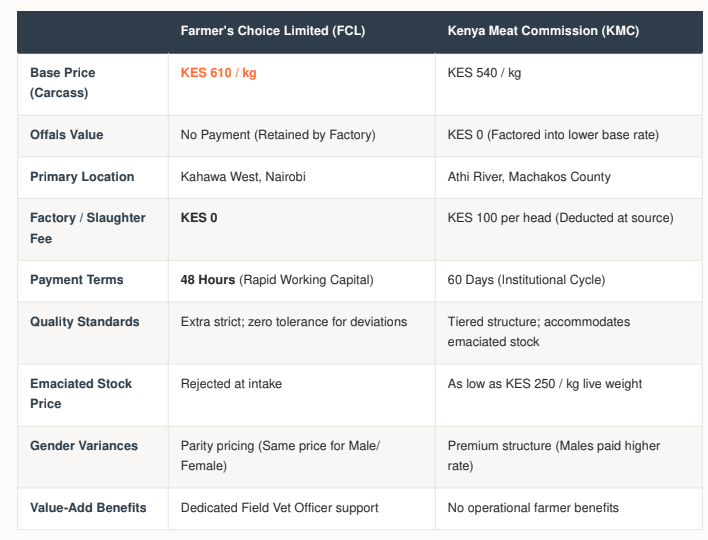
To optimize profit margins, it is crucial to analyze how localized expenses and procurement policies distort your gross profit per animal. Below is the side-by-side operational matrix compiled from active commercial data:
Base Price (Carcass): Farmer’s Choice Limited (FCL) offers a premium rate of KES 610 / kg, whereas Kenya Meat Commission (KMC) pays KES 540 / kg.
Offals Value: FCL provides no payment, retaining the offals at the factory, while KMC values them at KES 0, factoring this into their lower base rate.
Primary Location: FCL is located in Kahawa West, Nairobi, while KMC operates out of Athi River, Machakos County.
Factory / Slaughter Fee: FCL charges KES 0, whereas KMC deducts a mandatory fee of KES 100 per head at the source.
Payment Terms: FCL ensures rapid working capital with a 48-hour turnaround, compared to KMC’s 60-day institutional cycle.
Quality Standards: FCL is extra strict with zero tolerance for deviations, while KMC utilizes a tiered structure that accommodates emaciated stock.
Emaciated Stock Price: FCL rejects underconditioned animals outright at intake, whereas KMC accepts them but pays as low as KES 250 / kg live weight.
Gender Variances: FCL maintains parity pricing with the same rate for both male and female carcasses, while KMC implements a premium structure where males are paid a higher rate.
1. The Price vs. By-Product Tradeoff
On paper, FCL’s headline price of KES 610/kg carcass weight holds a clear KES 70 premium over KMC’s KES 540/kg. However, an operator must carefully compute the valuation of fifth-quarter products (offals).
FCL enforces a strict procurement model where offals yield no payment, seamlessly rolling that value into their premium meat margin. Conversely, KMC prices offals explicitly at KES 0, utilizing them as an offset against their lower carcass pricing architecture. If your business model depends heavily on processing or capturing value from hides, green offals, or red offals at local abattoirs, selling to FCL means yielding that margin entirely to the processor in exchange for a higher base carcass payout.
2. Cash Flow Velocity: 48 Hours vs. 60 Days
In intensive livestock farming—where feed costs, silage, and medical inputs demand constant liquidity—capital velocity is a make-or-break metric. This is where the two buyers represent entirely different operational worlds:
Farmer’s Choice (48 Hours): FCL operates on private-sector efficiency. Settling invoices within two days ensures a rapid cash-to-cash cycle. For a commercial feedlotter, this allows for immediate reinvestment into buying light feeder steers, purchasing cotton-seed cake or molasses, or meeting immediate labor and utility overheads.
KMC (60 Days): Operating under a government institutional framework means KMC introduces a protracted cash cycle. A 60-day lag on payments can severely choke a medium-scale farmer’s working capital. To supply KMC sustainably, operators must hold substantial cash reserves or secure revolving credit lines to bridge feedlot operational costs while waiting for settlement.
The Capital Velocity Formula: If your feedlot finishes 50 bulls per month, waiting 60 days means locking up millions in unliquidated inventory. FCL’s 48-hour terms essentially give you the agility to turn your capital over twice in the time it takes KMC to settle a single intake cycle.
3. Intake Quality and the “Emaciated Safety Net”
Your herd’s structural quality should dictate your off-taker choice. FCL runs a premium, standardized export-grade processing facility in Kahawa West. Their inspectors enforce an “extra strict on quality, no shortcuts” intake regime. If your bulls do not meet the physiological, fat-cover, and health profiles required for high-end hospitality and retail cuts, they will face outright rejection at the bay, forcing you to absorb emergency back-haul transport costs.
KMC, on the other hand, provides a vital counter-cyclical safety net. Positioned in Athi River, they are historically attuned to absorbing national herd variances, especially during drought seasons. KMC will accept low-grade, emaciated animals that FCL would never touch. However, this flexibility comes with severe financial penalties: sub-optimal or emaciated livestock are downgraded and priced as low as KES 250/kg live weight. This floor price prevents a total write-off for the farmer but represents a salvage value rather than a profitable liquidation.
4. Gender Parity and Hidden Frictions
Another profound divergence is found in gender-based carcass valuations. FCL normalizes its procurement across sexes, paying the exact same per-kilogram rate whether the carcass comes from a finished steer or a heifer, provided the strict quality ceiling is met. KMC maintains a traditional butcher-grade premium on bulls, actively valuing male carcasses higher than females. If your herd liquidation includes culled breeding heifers or non-pregnant cows that have been intensively finished, FCL will reward that weight on equal footing with your prime steers.
Furthermore, operators must factor in minor structural leakages, such as KMC’s mandatory KES 100 per head factory fee. While seemingly negligible on a single animal, across a large-scale commercial consignment of several hundred head, these source deductions chip away at the thin margins typical of primary livestock production.
5. The Knowledge Gap: Day-to-Day Extension Services and Technical Support
Beyond the core financial and risk metrics, the presence or absence of institutional extension services introduces a massive operational divergence for livestock producers. Farmer’s Choice Limited (FCL) actively bridges the technical gap by deploying dedicated field officers directly into their operational regions, providing farmers with free, day-to-day on-the-ground training and structured support on feed procurement, livestock diseases, and precise feeding formulas.
In stark contrast, the Kenya Meat Commission (KMC) offers no operational extension services or systemic farmer benefits, leaving producers to navigate production hurdles entirely on their own. This lack of technical backing is a heavy issue for commercial operators; running an intensive finishing unit or feedlot without institutional technical support significantly inflates a farm’s private veterinary costs and increases the operational risk of herd mortality or poor feed conversion ratios before the animals even reach the slaughter bay.
Strategic Verdict: Aligning Your Feedlot Model
The choice between Farmer’s Choice and the Kenya Meat Commission is not about finding the “better” company; it is about matching your specific operational reality to the right off-taker:
Choose Farmer’s Choice (FCL) if: You run a high-tech, precision-ration feedlot specializing in high-grade young bulls or finished heifers. You operate on tight working capital, require instantaneous settlement to purchase your next batch of feeders, and value the support of a dedicated veterinary officer who can integrate into your biosecurity workflow.
Choose the Kenya Meat Commission (KMC) if: You are liquidating large, pastoral, or mixed-grade herds, managing extensive ranching systems where bulls command a premium over heifers, or clearing out lower-condition stock during climate shocks. You must also have the balance sheet strength or alternative commercial banking facilities to absorb a 60-day payment cycle without stalling your operations.
Strategic Risk: Credit Risk vs. Price Volatility
Beyond standard pricing tables and logistics, a multi-season investment plan must weigh the fundamentally different risk profiles of these two off-takers. An operator must choose whether to anchor their farm against market price fluctuations or shoulder institutional counterparty risk.
Kenya Meat Commission (KMC): Severe Credit Risk
The overarching hazard when dealing with KMC is systemic credit risk. While their official policy mandates a 60-day payment term, KMC has been notoriously known in the past to delay payments far beyond the 60-day window, stretching into multiple months.
Currently, the commission carries significant payment arrears to suppliers. This means that instead of a predictable cash cycle, farmers face rolling balance-sheet gridlock. Supplying KMC effectively requires you to act as an involuntary financier to a state corporation, running the risk that your capital is frozen just when you need to purchase feed rations or lock in your next batch of feeder steers.
Farmer’s Choice Limited (FCL): Market Price Volatility
Conversely, Farmer’s Choice represents a complete elimination of counterparty credit risk. FCL is highly reliable, paying promptly and consistently throughout the entire year, allowing you to project cash turnover with near-perfect certainty.
However, FCL replaces credit risk with intense price volatility. Because they operate strictly on private corporate economics and respond directly to changing macro market demands, their off-take pricing shifts dynamically. A producer anchored to FCL is protected from payment delays but vulnerable to sudden market margin squeezes, requiring an agile feeding structure that can stay profitable even when the factory base rate dips during peak supply seasons.
The Sultan’s Investor Takeaway
The Verdict: High Credit Risk — Avoid or Price Safely
The contrast between Farmer’s Choice and the Kenya Meat Commission (KMC) highlights a classic corporate finance lesson: Revenue is vanity, profit is sanity, but cash is reality.
While KMC secures massive volumes by anchoring itself to the Kenya Defence Forces (KDF), its financial plumbing is fundamentally broken. Operating as a government-to-government supplier exposes KMC entirely to the state’s erratic exchequer releases.
When your anchor customer takes over six months to settle a bill, you aren’t just a supplier anymore—you are an involuntary lender to the state.
📉 The Financial Anatomy of the Squeeze
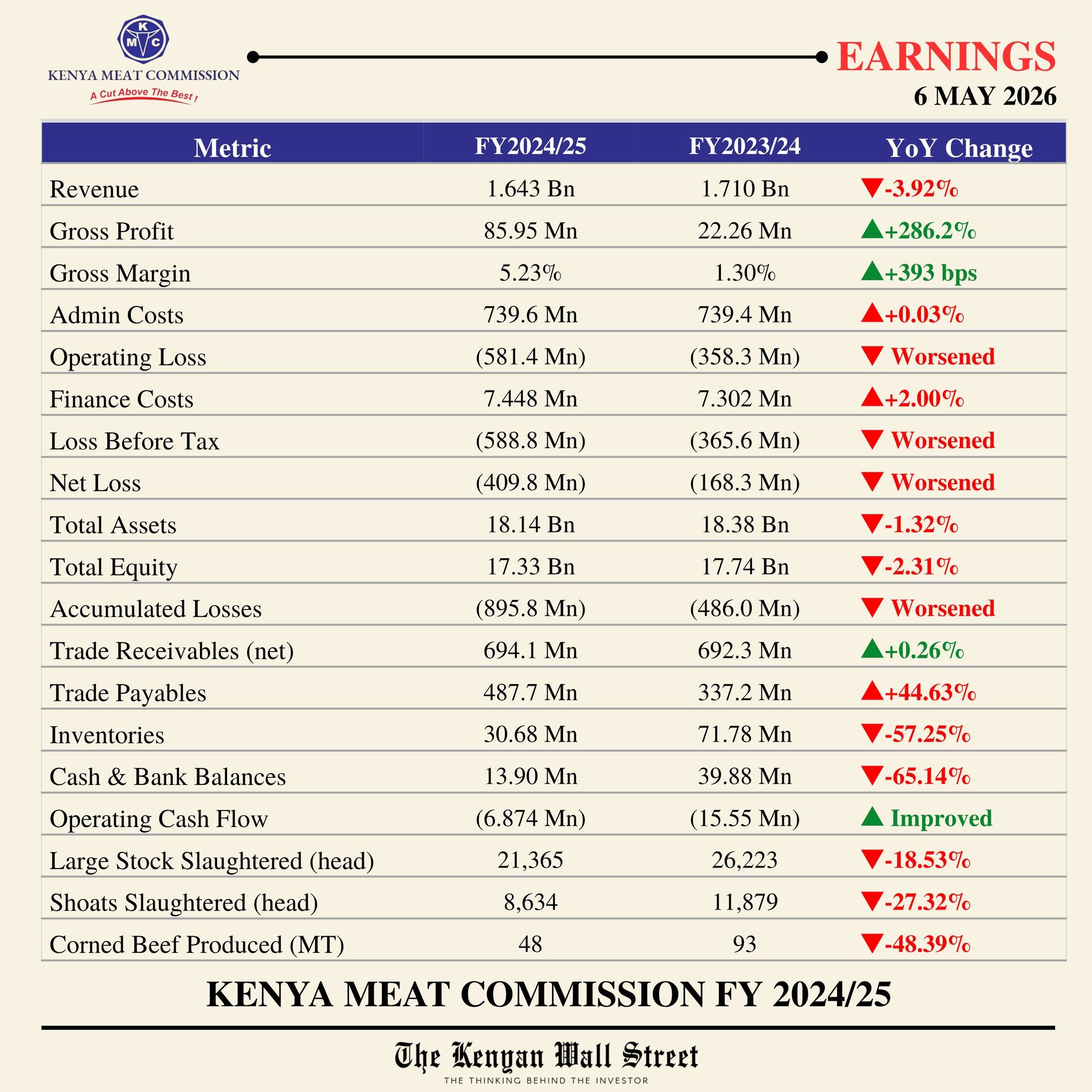
The FY25 financials paint a sobering picture of a classic cash-crunch domino effect:
The Chokehold: KES 695 Million is currently trapped in KMC’s receivables, sitting idle for over six months.
The Spillover: Because the government is failing to pay KMC on time, KMC is passing that liquidity strain directly down the value chain, currently owing suppliers KES 489 Million.
💡 Strategy for Investors & Suppliers
For Agribusiness Investors: Companies like Farmer’s Choice, which rely on diversified B2C and structured corporate B2B cash cycles, offer much higher earnings quality and cash predictability compared to state-dependent entities.
For Current/Prospective KMC Suppliers: If you must supply KMC, you must factor a minimum 180-day working capital cycle into your margins. If your business cannot survive a 6-month payment delay without triggering your own credit distress, you should immediately reconsider your exposure.
Bottom Line: Do not mistake government backing for creditworthiness. In the current fiscal environment, supplying KMC without massive cash cushions is a fast track to a working capital crisis.
Am Setting up a 25-Head (500 Litres/day) dairy Farm at Kenol Muranga county; Step by Step

The Anatomy of a Kenol Dairy Engine: Precision Lactation Economics and Commercial Zero-Grazing (Ayrshire Edition)
I did research on how to set up a 150-Head Goat Feedlot step by step

The Anatomy of a Kajiado Goat Feedlot: Precision Caprine Economics and Commercial Fattening