
The East African economic landscape is undergoing a profound structural metamorphosis, signaling the definitive end of the “patriarchal industrialist” era. Kenya’s most influential dynastic families are aggressively rotating their capital away from high-friction, labor-intensive manufacturing and volatile agricultural holdings. In their place, they are constructing highly liquid, tax-insulated “financial fortresses.” By centralizing wealth into Tier-1 banking equity, leveraging the fiscal shields of Special Economic Zones (SEZs) like Tatu City, and replacing informal family management with institutional trust frameworks, these dynasties are insulating their fortunes from both market volatility and the reach of the national tax collector.
Table of Contents
Introduction: The De-Risking Playbook .............................................................. 1
Chapter 1: The Financial Fortresses & Capital Rotations .............................. 3
1.1 The Kenyatta Family Office: NCBA & The Regional Banking Engine
1.2 The James Mwangi Family Strategy: The Closed-Loop Financial Loop
1.3 The Naushad Merali Family Strategy: Structural De-risking & Exit
Chapter 2: The Hard Exits from Brick & Mortar .............................................. 7
2.1 The Philip Ndegwa Family: CBD Retreat & Retail Supply Chain Lessons
2.2 The Naushad Merali Estate: Commodity Volatility & Operational Liquidation
2.3 The Pius Ngugi Portfolio: Generational Land Banking & Institutional Exits
Chapter 3: Industrial Relocations & Generational Handovers ..................... 11
3.1 The Bidco Africa Capital Shift: Tatu City Decentralization
3.2 Next-Gen Operational Leadership: Mihir Shah’s Marketing Pivot
Chapter 4: The Media & Dynastic Legacies ..................................................... 15
4.2 The Simeon Nyachae Estate: Multi-Branch Distribution & Milling Roots
Chapter 5: Conclusion—The New Paradigm of East African Wealth ............ 18
The Four Pillars of the Modern Dynasty
Introduction: The De-Risking Playbook
The landscape of private capital in East Africa has reached a mature, defensive turning point. The early era of rapid asset acquisition and sweeping land banking is giving way to a disciplined paradigm of capital preservation. Facing a volatile macroeconomic climate, aggressive fiscal taxation, and complex generational handovers, the region’s premier family business dynasties are executing a systemic retreat from high-friction, capital-intensive legacy operations. In their place, they are erecting ring-fenced financial fortresses designed to isolate wealth from operational shocks, demonstrating that agility and liquidity are now the ultimate markers of financial strength.
The Macro Overview: Why East Africa’s Legacy Wealth is Migrating
For the founding patriarchs of East Africa’s largest conglomerates, corporate identity was deeply sentimental, rooted in physical asset ownership.
Compressed Operating Margins: Persistent currency volatility and fluctuating inflation are squeezing profits across traditional brick-and-mortar sectors like heavy manufacturing and real estate due to rising energy tariffs and supply chain shocks.
The Demise of Over-Diversification: The legacy model of simultaneously managing retail, agriculture, and hospitality is fracturing under its own administrative weight. Major retail collapses over the past decade exposed deep downstream supply chain vulnerabilities.
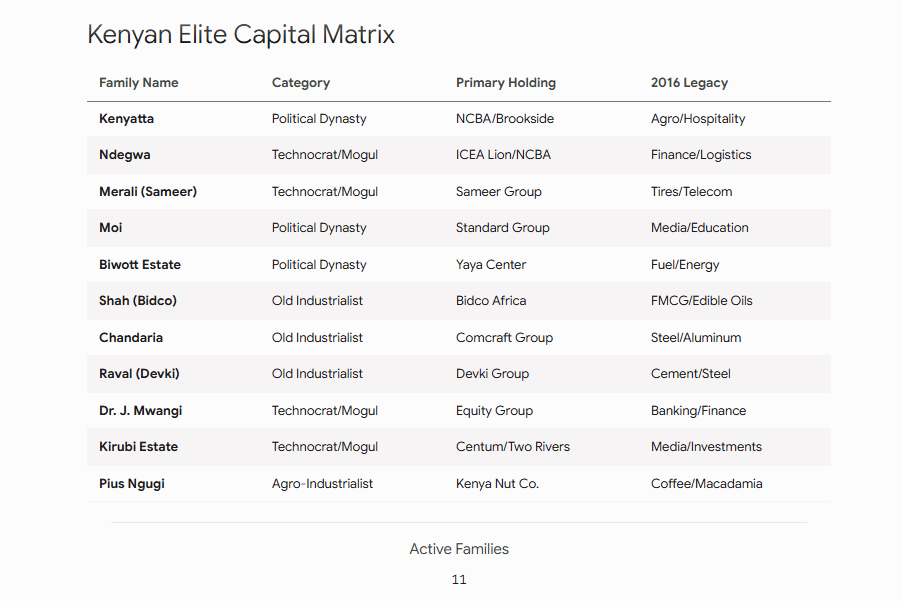
Consequently, family offices are removing sentimentality from their balance sheets. Prominent names like the Philip Ndegwa family, the Naushad Merali estate, and the Peter Munga family are actively liquidating non-performing legacy divisions. Rather than fighting localized operational battles, they are rotating capital into tightly insulated, high-yield financial assets or specialized infrastructure nodes where the cost of doing business is completely predictable.
The Tactical Shift: High-Friction Assets vs. Financial Fortresses
The execution of the de-risking playbook requires a complete reallocation of assets, shifting capital away from high-friction operating models and into protected financial structures that prioritize steady dividend cash flows and high liquidity.
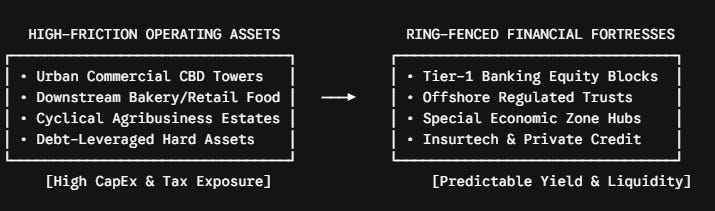
This structural shift is highly visible across four prominent family portfolios:
The Real Estate Rotation (The Ndegwa Family): Operating through First Chartered Securities, the family recognized structural declines in the Nairobi CBD. They sold the iconic 21-story ICEA Centre to JKUAT for KSh 1.85 billion, freeing up massive cash reserves to anchor within their highly liquid tier-1 financial holdings at NCBA Group PLC.
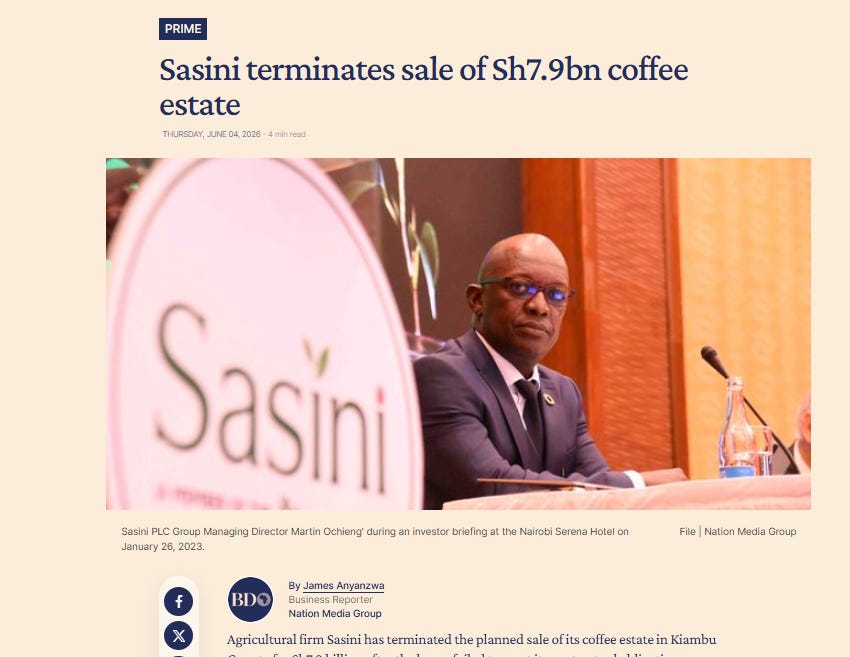
The Agribusiness Clean-Up (The Merali Estate): Led by son Sameer Merali, the family office is cleaning up highly cyclical commodity exposures within Sasini PLC. The estate initiated a KSh 7.9 billion ($61 million) divestment of its Gulmarg coffee estate in Kiambu. The same is happening at Sameeer Africa.
Central to this shift is Pius Ngugi, who is currently exiting the family's 10,000-acre real estate ventures in Juja and Thika through Kenya Nut Company. This divestment is being driven primarily by the need to streamline and manage succession planning effectively. By consolidating these property interests, the family is refocusing its portfolio toward more resilient, export-backed hard assets, such as Equatorial Nut Processors, which remain better positioned to ensure long-term stability and weather macroeconomic volatility for the next generation.
The Closed-Loop Financial Strategy: The James Mwangi Family
Operating through Filimbi Limited, the family employs a highly specialized strategy that avoids traditional manufacturing and retail sectors. Instead, their wealth is systematically rotated within a tightly controlled, regulated financial ecosystem. This “closed-loop” is anchored by a massive equity block in Equity Group Holdings PLC ($249,783,048$ shares) and strategically extended through Britam and HFCB (Housing Finance Company of Kenya). By cycling capital through these core entities and reinforcing the structure with Equity Life Assurance Kenya (ELAK), the family has created a heavily insulated, high-yielding financial loop that minimizes external exposure.
To see a broader breakdown of how these banking consolidations and corporate maneuvers are impacting the wider East African capital markets, you can watch this analysis of the Nedbank Acquisition of a Majority Stake in NCBA.
The Special Economic Zone (SEZ) Catalyst
For private capital looking to scale or transition into light manufacturing, the ultimate operational de-risking tool is now the Special Economic Zone (SEZ), which allows regional wealth to legally opt out of the standard tax regime through three key pillars:
The Fiscal Shield: Corporate income tax is reduced to just 10% for the first 10 years (down from 30%), withholding tax on dividends is fixed at 0%, and businesses enjoy complete exemption from 16% VAT and import duties on capital inputs.
Regulatory Arbitrage: SEZs operate under a centralized One-Stop-Shop Manager framework, handling all permits and utility connections under a single authority while legally insulating enterprises from unpredictable municipal and county-level levies.
Strategic Logistics: Modern SEZs are privately managed and positioned along major infrastructure spines with dedicated internal inland container depots, completely eliminating port demurrage, transport delays, and public utility failures.
A Case in Corporate Evolution:
BIDCO Africa Group (The Bhimji Shah Family): BIDCO
The most striking validation of this strategy is being executed by The Bhimji Depar Shah Family. Recognizing that expanding within standard municipal boundaries in Thika exposed them to severe logistical bottlenecks and mounting local taxes, Bidco structurally shifted its primary new-age manufacturing and processing plants directly into the Tatu City SEZ. This protects their consumer FMCG dominance (Kimbo, Elianto, White Star) under an ironclad fiscal shield.
Crucially, this operational migration runs parallel to Bidco’s ongoing third-generation succession. Mihir Shah, son of co-founder Tarun Shah, has stepped squarely into core corporate governance as a Director, taking direct charge of Bidco’s strategy, sales, and marketing verticals. Backed by top-tier academic foundations from University College London (UCL) and Columbia Business School, Mihir Shah is utilizing the modern infrastructure of the Tatu City SEZ to drive product innovation, scale up digital e-commerce channels, and aggressively expand Bidco’s pan-African export reach. By pairing an SEZ structural moat with fresh, highly trained third-generation leadership, the Shah family is rewriting the definitive playbook on wealth preservation.
Chapter 1: The Financial Fortresses & Capital Rotations
The migration of legacy wealth in East Africa is defined by prominent family offices moving capital out of high-friction structures and into heavily defended, liquid corporate positions.
1.1 The Kenyatta Family Office
Primary Anchor Vehicle: Enke Investments (NCBA Group PLC).
Core Sectors: Financial Services, Agribusiness, Real Estate, Media, Hospitality.
The Anchor: NCBA Group PLC and the Regional Corporate Banking Engine
The financial foundation of the Kenyatta family portfolio is a 13.2% anchor stake in NCBA Group PLC held via Enke Investments. Corporate disclosures tied to regional banking maneuvers confirmed that Muhoho Kenyatta stands as the largest individual investor on the Nairobi Securities Exchange, holding 227.3 million shares of NCBA worth approximately KSh 20 billion ($153.8 million). This single position generated an estimated KSh 1.6 billion ($12.3 million) in cash dividends for FY2025 alone.
By anchoring their liquid wealth within NCBA, the family positions itself at the center of East Africa’s tier-1 corporate banking and mobile micro-lending infrastructure via the cross-border M-Shwari platform. This engine delivers highly liquid, predictable cash yields while keeping core capital insulated from localized macroeconomic shocks.
FMCG and Agribusiness Dominance: The Brookside
Monopoly
In consumer markets, the family maintains a commanding position through Brookside Dairy, which controls more than 50% of Kenya’s formal processed milk market—a dominance solidified by the historical acquisition of leading local brands including Molo Milk, Ilara, Delamere, and Tuzo. Crucially, the family has significantly de-leveraged its exposure to this capital-intensive sector by introducing Danone as a strategic equity partner. This global institutional partnership has provided Brookside with a more resilient balance sheet, allowing the family to mitigate the risks of intense operational cycles.
Governance Safeguards & Trust-Based Infrastructure
To protect these financial holdings across generational transitions, the family utilizes offshore asset structures, private family trusts, and regulated equity registries. This infrastructure minimizes the risk of sudden asset freezes, probate disputes, or public valuation shocks.
The Governance Blueprint: By avoiding low-margin operational businesses, this closed-loop model turns variable operational risks into predictable, compounding financial returns. However, it introduces a significant key-man concentration risk, tying the long-term direction of the family office to the executive vision of its patriarch.
1.2 The Naushad Merali Family Strategy
Primary Anchor Vehicle: Sameer Group & Yana Investments.
Core Sectors: Commodity Export, Real Estate Restructuring, Financial Consolidation.
The Spire Bank Exit & Financial Consolidation
Historically, the Naushad Merali family straddled multiple tiers of the financial sector. However, managing low-tier banking operations proved highly friction-intensive. In a definitive structural exit, the family completed the phased multi-billion-shilling sale of its majority and remaining stakes in the struggling Spire Bank (formerly Equatorial Commercial Bank) to Mwalimu National Sacco, which eventually cleared the path for the asset’s final liabilities and operations to be absorbed by Equity Bank.
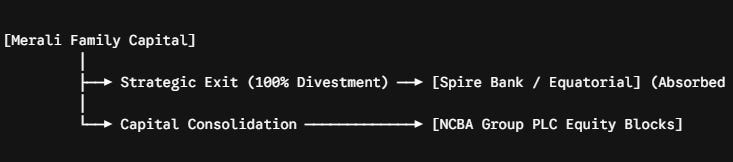
This exit was an intentional move toward structural de-risking and asset clean-up. Rather than tying up valuable family office liquidity to support a capital-deficient, third-tier commercial bank, the estate liquidated its interest. This move allowed the family to clean up historical liabilities and focus its capital into core, highly liquid equity concentrates—specifically consolidating their foundational financial holdings within the tier-1 NCBA Group PLC corporate banking ecosystem.
Chapter 2: The Hard Exits from Brick & Mortar
Chapter 2: The Hard Exits from Brick & Mortar
This chapter details the operational execution of the de-risking playbook across three of Kenya’s most prominent family dynasties, exposing the financial pressure points forcing a systematic migration away from high-friction physical asset exposure. Recognizing that traditional real estate has become an increasingly stagnant and illiquid burden, these families are aggressively liquidating long-held property positions as market windows open.
This is not a mere divestment, but a calculated pivot: by unlocking capital trapped in brick-and-mortar assets, these dynasties are aggressively reallocating liquidity into tax-protected financial fortresses and specialized economic enclaves, effectively trading the volatility of the physical market for the structural insulation of modern, tax-efficient financial instruments.
2.1 The Philip Ndegwa Family (First Chartered Securities)
Operating through First Chartered Securities (FCS), the family of former Central Bank Governor Philip Ndegwa is aggressively pruning high-friction, low-margin legacy assets to optimize their portfolio for the current macroeconomic environment.
The CBD Retreat (ICEA Centre Sale): Recognizing structural declines in the Nairobi CBD, the family sold the iconic 18-story ICEA Centre to JKUAT for KSh 1.85 billion. This transaction converted an increasingly illiquid property into immediate cash reserves.
The REIT Pivot: Rather than reinvesting in volatile, management-heavy direct property, the family has funneled capital into the ILAM Fahari I-REIT (Greenspan Mall). By restructuring the fund to restrict ownership to professional investors and moving toward a private, regulated framework, they have secured a tax-insulated vehicle that provides stable, dividend-yielding returns.
The Retail Cascade (Ennsvalley Bakery): The fragility of downstream commercial asset exposure hit the family through Ennsvalley Bakery, whose growth strategy relied heavily on supplying the retail giant Nakumatt. When Nakumatt collapsed, compelling Unga Group PLC to exit the unit.
The Milling Standoff (Unga Group): To completely isolate their wealth from volatile, low-margin milling, the Ndegwas and global partner Seaboard Corporation attempted to delist Unga Group PLC via a KSh 40-per-share buyout. However, minority shareholders blocked the transition, leaving the family stranded in a protracted corporate standoff amid intense regional grain pricing wars.
2.2 The Naushad Merali Estate (Sameer Group)
Following the patriarch’s passing, the family office—steered by Sameer Naushad Merali via Legend Investments—has faced significant friction while attempting to monetize massive land holdings to stabilize group cash flow.
The Coffee Disruption (Sasini PLC): Agricultural giant Sasini PLC suffered a major setback when its KSh 7.9 billion ($61 million) sale of the Gulmarg coffee estate in Kiambu completely collapsed due to buyer liquidity defaults. Sasini was forced to terminate the contract and revert the estate to operational use, leaving the group to manage a widening financial deficit.
The Avocado Processing Exit: In a highly strategic, counter-current move, Sasini Avocado EPZ Limited advertised the total sale of its state-of-the-art processing and packing plant in Nairobi. Despite a booming global avocado market, the family office chose to exit the operational value chain entirely, avoiding continuous capital expenditure and input machinery overheads to free up liquid cash.
The Mombasa Road Stagnation (Sameer Africa): Sameer Africa PLC has faced multi-year delays closing the KSh 919.7 million sale of a prime 3.75-acre parcel on Mombasa Road.
Why Sameer Africa's KSh 9.19Bn in Properties Sit in Its Books at KSh 933Mn https://kenyanwallstreet.com/sameer-africa-real-estate-2026
2.3 The Pius Ngugi Portfolio (Kenya Nut Company)
Pius Ngugi represents a masterclass in shifting heavy agricultural cash flows directly into massive, generational land banking and institutional real estate, converting primary industries into dominant urban township and financial assets.
Generational Land Banking & Agribusiness: Operating over 8,000 acres under the Kenya Nut Company, his agricultural empire provides a robust economic cushion. Deeply integrated global export channels for macadamia nuts and Leleshwa Wines generate steady, dollar-denominated revenue.
Commercial Property & Financial Anchorage: Beyond his suburban township ventures, Ngugi maintains a diversified portfolio of high-value commercial holdings in Nairobi’s central business nodes, such as Amazon Volvo House on Loita Street. Crucially, he has expanded his reach into the financial services sector through a significant shareholding in Kenya Alliance Insurance Company, an institution with an asset base exceeding KSh 6.8 billion.
Chapter 3: Industrial Relocations & Generational Handovers
This chapter details how East Africa’s largest family-owned manufacturing empires are executing major structural transitions to survive modern macroeconomic shifts.
3.1 The Bidco Africa Capital Shift: The Tatu City Decentralization
Operating through Bidco Africa, the Bhimji Depar Shah family has executed a multi-billion-shilling logistics and manufacturing relocation away from their congested legacy hub in Thika.
The Relocation Drive: To bypass urban gridlocks and space constraints, Bidco anchored its next-generation consumer products complex within the master-planned Tatu City Special Economic Zone (SEZ) in Kiambu County. This move provides direct access to regional bypasses and critical SEZ fiscal benefits, including preferential corporate tax rates, zero-rated VAT, and import duty exemptions.
The $3 Billion Ownership Dispute Resolution: This relocation took place amid a protracted ownership battle over the 5,000-acre township between local investors (including Bidco Chairman Vimal Shah) and international developer Stephen Jennings. The dispute concluded definitively when Mauritius’ highest court—the Privy Council—dismissed the local group’s legal challenges, ruling that their liquidated holding vehicle lacked standing. Long-term corporate lease safeguards successfully insulated Bidco’s physical infrastructure from the shareholder litigation.
The Kiambu Land Syndicate: How a Local Coffee Farmer, a CBK Governor, and Bidco Billionaire Triggered a 10-Year War for Tatu City, and Lost

THE BOARDLOT SULTAN • CAPITAL INTELLIGENCE
3.2 Next-Gen Operational Leadership: Mihir Shah’s Marketing Pivot
Day-to-day operational execution at Bidco has transitioned to the next generation, with Mihir Shah (an alumnus of University College London) taking the helm as Director of Marketing and Brand Strategy.
Modernizing the Portfolio: Mihir Shah has shifted Bidco’s 60+ regional brands from traditional commodity-push sales to data-driven consumer-pull strategies. He has overseen the rollout of dedicated e-commerce platforms to bypass distributor bottlenecks, modern digital brand overhauls, and the launch of high-margin health, hygiene, and premium food lines.
Regional Expansion: Applying lean Kaizen principles, the next-gen corporate office drives cross-border growth and targeted mergers and acquisitions (M&A) to protect margins against aggressive local and multinational consumer brands.
Chapter 4: The Media & Dynastic Legacies
This chapter examines how two of Kenya’s most prominent families use strategic media dominance and structured estate planning to preserve multi-generational wealth and influence.
4.1 The S.K. Macharia Family (Royal Media Services)
Operating through Royal Media Services (RMS), the family of Dr. S.K. Macharia maintains the most dominant media house in East Africa by securing massive audience shares and defending ad revenues from digital shifts.
Broadcasting Dominance: RMS commands a powerful media moat through Citizen TV (capturing over 50% of national prime-time viewership) and a network of 13 vernacular radio stations (such as Inooro FM and Ramogi FM). This multi-tiered model locks in premium corporate ad spends while securing an advertising monopoly within rural micro-economies.
The Digital Pivot: To counter the migration of advertising budgets to global tech platforms, the family office has aggressively built out internal digital revenue channels:
Viusasa: A localized Video-On-Demand platform that monetizes content directly via M-Pesa micro-transactions.
Citizen Digital Super-App: A unified application consolidating all video, radio, and news streams, allowing RMS to capture first-party consumer data and run its own programmatic ad networks.
4.2 The Simeon Nyachae Estate: A Masterclass in Institutional Preservation
Multi-Branch Distribution & The NCBA Anchor: Unlike many political dynasties that succumb to probate chaos, the Nyachae family secured their wealth by integrating into the highest tier of Kenyan finance. As a major shareholder in the now-consolidated NCBA Group PLC, the family benefits from the dividend-yielding “financial fortress” that serves as the cornerstone of their generational wealth. This institutional anchor provides the family with high-liquidity, low-friction returns that are fundamentally detached from the operational volatility of the family’s traditional agricultural interests.
The Credit Bank Exit: In a strategic pivot toward balance sheet optimization, the family has been actively seeking to divest their stake in Credit Bank. This move is largely driven by the necessity to meet the banking sector’s tightening regulatory capital requirements. By exiting this smaller, capital-intensive institution, the family is effectively recycling capital away from high-compliance-cost legacy banking and into more efficient, diversified instruments.
Real Estate Monetization (Thika Flower Farm): Reflecting the broader dynastic trend of liquidating stagnant land assets, the family recently sold their significant flower farm in Thika. This asset, previously tethered to the volatile horticulture export market, was liquidated for subdivision into high-value residential plots. This transaction demonstrates the estate’s shift from operational agribusiness—which requires constant labor and logistics management—to the passive, high-margin capture of urban land value.
The Sansora Operational Structure:
Raw Grain Sourcing (Western Kenya): Maize & Wheat.
Sansora Milling Infrastructure: Industrial-Scale Processing & Value Addition.
Regional Retail Distribution: Consolidated supply chain control.
Legacy Protection: To insulate his multi-billion-shilling fortune from public probate battles, Nyachae established a highly formalized estate plan. Assets are kept intact under the central holding conglomerate, Sansora Group, with family branches holding specific equity shares managed via structured private family trusts. Professional executors and independent trustees oversee the estate to ensure operational continuity and prevent the litigation that has plagued other major Kenyan houses.
[Western Kenya Agricultural Hubs] ──► Raw Grain Sourcing │ [Sansora Milling Infrastructure] ──► Value Addition │ [NCBA Dividend Fortress] ◄─────── [Family Trust Management] ───────► [Thika Land Subdivision] ──────► [Credit Bank Exit]
Chapter 5: Conclusion—The New Paradigm of East African Wealth
As this investigation into East Africa’s industrial and financial dynasties concludes, a clear trend emerges: the era of the “sentimental empire”—defined by sprawling, physical, and high-friction assets—is ending. In its place, a new, cold-eyed paradigm of capital management has taken root. The families that will dominate the coming decade are not those with the largest land banks or the most visible factories, but those with the highest degree of structural agility.
The Four Pillars of the Modern Dynasty
To survive the pressures of aggressive fiscal consolidation, currency volatility, and complex succession, the region’s elite are standardizing their wealth into four distinct strategic pillars:
The Ring-Fenced Financial Fortress: The systematic rotation of capital out of operating assets and into tier-1 financial equity blocks (e.g., NCBA Group, Equity Group Holdings). These positions offer high liquidity, predictable dividend yields, and rigorous regulatory insulation.
Special Economic Zone (SEZ) Arbitrage: The strategic migration of active business operations into enclaves like Tatu City. This shifts variable regulatory and tax risks into fixed, predictable operational costs, effectively shielding bottom-line growth from municipal and national fiscal hunting.
Institutionalized Governance: The total decoupling of family influence from operational management. Whether through the Chandaria/Comcraft model of external professional C-suites or the Nyachae estate’s trust-based distribution, the modern dynasty treats its business as an institutional entity, not a personal extension of the patriarch.
Digital Value Chain Monetization: The aggressive pivot from commodity-push models to data-driven consumer-pull models. By owning the distribution platforms—whether through Royal Media’s super-app or Bidco’s digital e-commerce push—families are capturing the data and ad revenues that were previously surrendered to third-party intermediaries.
The Definitive Takeaway: The ultimate regional asset is no longer the factory floor or the commercial office block. It is the ability to move capital at the speed of the global market, free from the drag of geography, bureaucracy, and legacy sentimentality.
For a deeper dive into the sheer physical scale of this capital transition, this detailed breakdown of the Kenyatta Family's Northlands City project visualizes exactly how 11,000 acres of agricultural land banks are being converted into a 500-billion-shilling private economic enclave.