
This report provides a strategic examination of the shifting landscape in the Kenyan insurance industry, highlighting the transition toward market consolidation and the critical risks facing policyholders and investors alike.
Article Table of Contents
I. The Underwriting Trap: Why Legacy Models Are Failing
II. The Digital-Regulatory Pivot
III. The Closed-Loop Ecosystem: The Equity Model
IV. Market Concentration Dynamics
V. Strategic Product Innovation: The Hunt for New Revenue
VI. The Vulnerability Zone: The Consolidation Reckoning
VII. The “Opacity” Trap: Regulatory Omissions as a Warning Sign
VIII. The Verdict: Investable vs. Value Traps
The Underwriting Trap: Is Kenyan Insurance Investable?
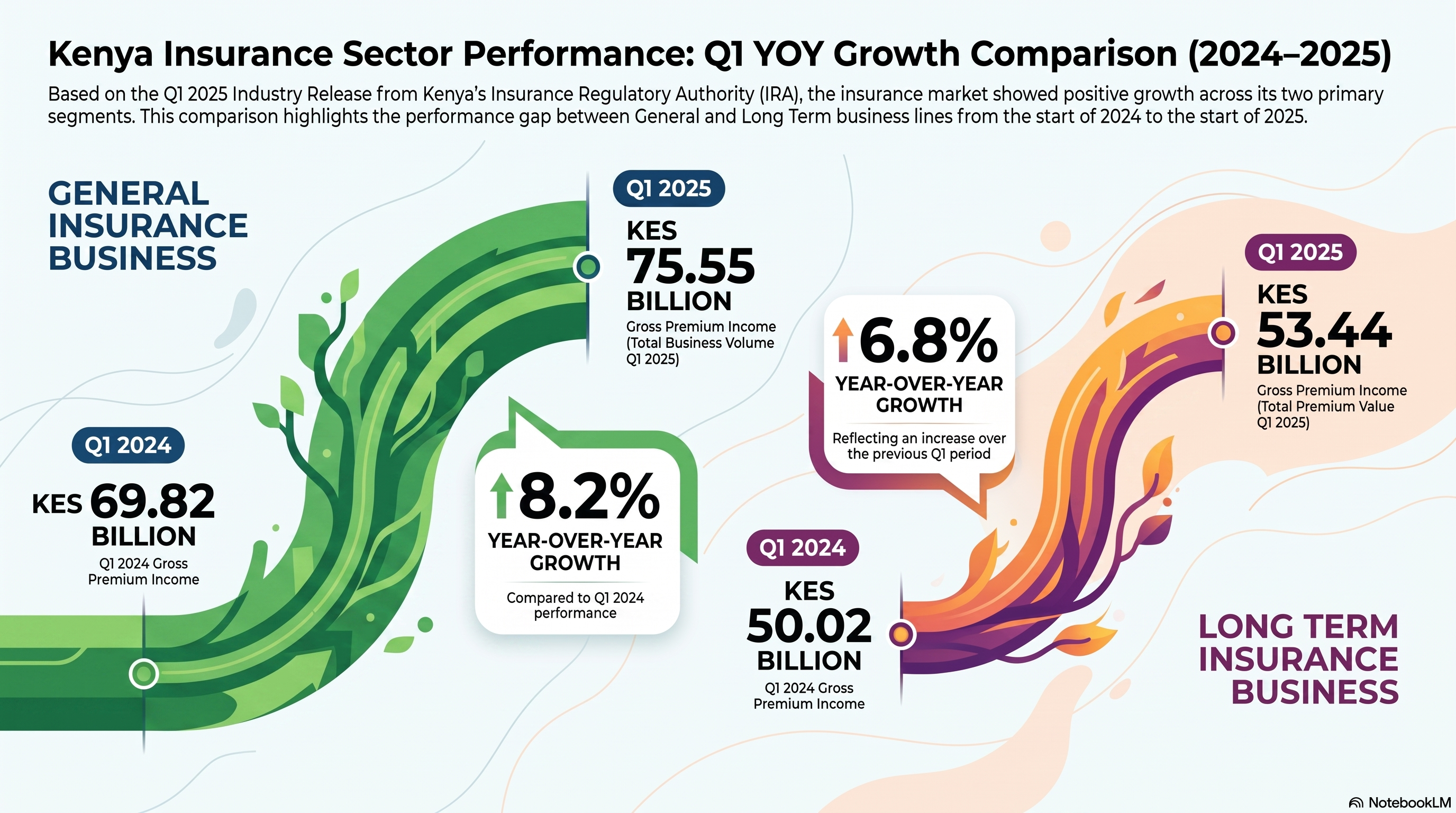
On the surface, the Kenyan insurance industry is a picture of steady, predictable expansion. In Q1 2025, the industry showcased its resilience, with long-term insurance business recording a 6.8% year-over-year (YoY) growth to reach KES 53.44 billion, while the general insurance segment demonstrated even stronger momentum, expanding by 8.2% YoY to hit KES 75.55 billion in gross premium income. If you look only at this top-line growth, it is easy to build a bullish case for these listed entities—they appear to be the engines of formal financial services, capturing the rising tide of economic activity across the region.
But look beneath the polished executive summaries, and a more unsettling story emerges.
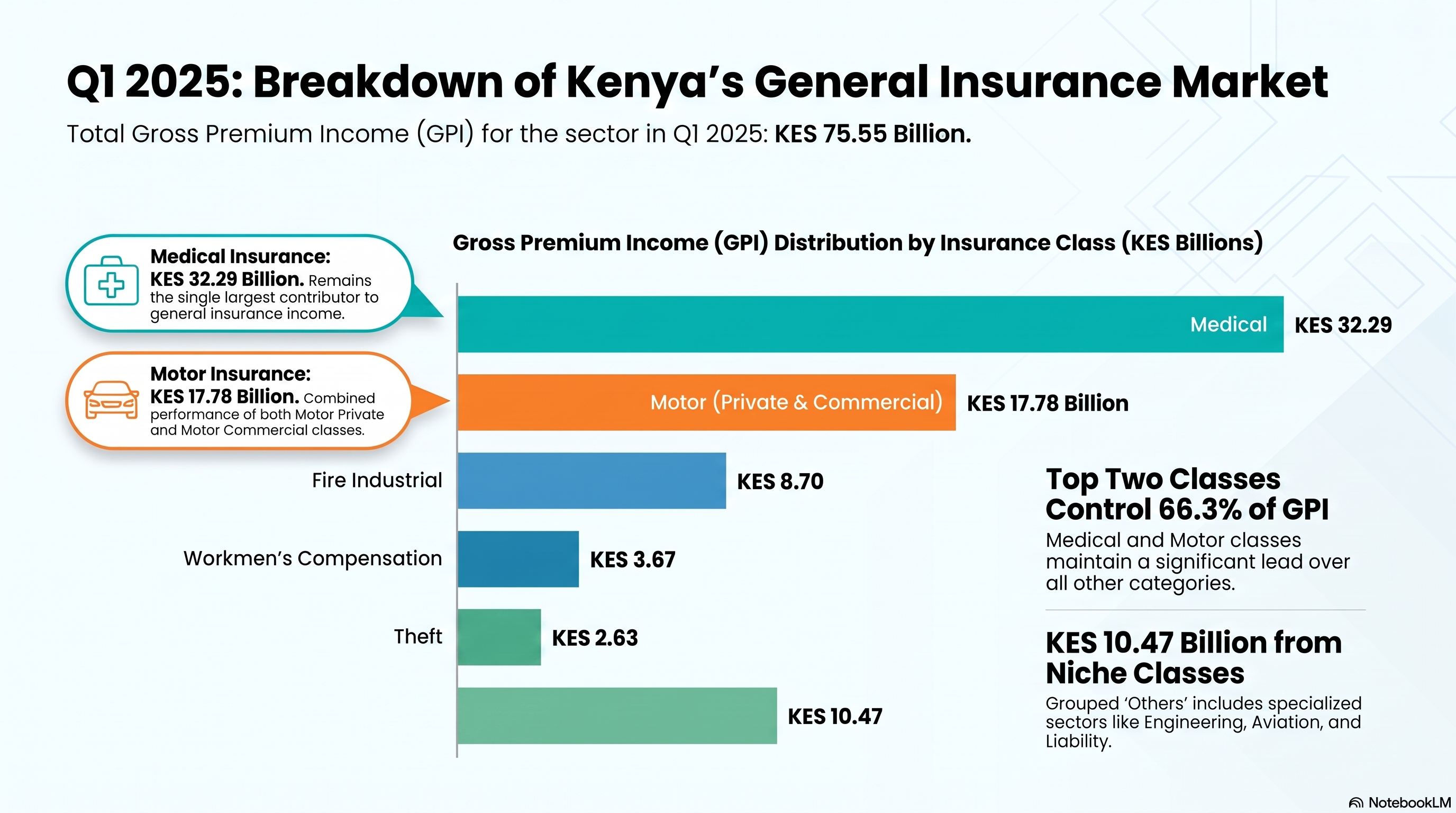
The industry is currently caught in an “Underwriting Trap.” For decades, insurers here have relied on a comfortable formula: collect premiums, manage high-friction claims in the volatile Motor and Medical segments—which together command over 66% of general insurance premiums—and use investment income to paper over the gaps. That formula is breaking. With the industry’s combined ratio now sitting at 105.9%, it is clear that for every KES 100 collected, insurers are paying out more than KES 105 in claims and operating expenses before a single shilling of profit is even considered.
In a low-trust society where claims are treated with suspicion and loss ratios are spiraling, the “safety net” of investment income is no longer enough to mask this underlying operational reality. As investment returns contract and underwriting losses mount, investors are left with a critical question: Are we looking at a long-term compounder, or a value trap hiding behind a mountain of government debt?
It is time to look at why the industry’s dominant business model may be fundamentally misaligned with the reality of its profit margins—and whether the path to recovery lies in innovation, or simply a long-overdue reckoning.

II. The Structural Reality: The 66% Problem
The core of the “underwriting trap” lies in the industry’s product mix. Currently, the general insurance landscape is heavily skewed toward Motor and Medical insurance, which combined account for over 66% of all gross premiums. While these classes are intended to be the backbone of mass-market volume, they have become the primary battlegrounds for high claims frequency, complex fraud, and intense price competition.
This dominance forces insurers into a perpetual cycle of revenue chasing, where they prioritize premium volume over underwriting discipline. As a result, the industry’s combined ratio—a critical measure of profitability where any figure over 100% indicates that the core business is losing money—has ballooned to 105.9%. In this environment, insurers are effectively subsidizing their core operations with investment income, leaving them vulnerable to market volatility
III. The “Trust” Deficit
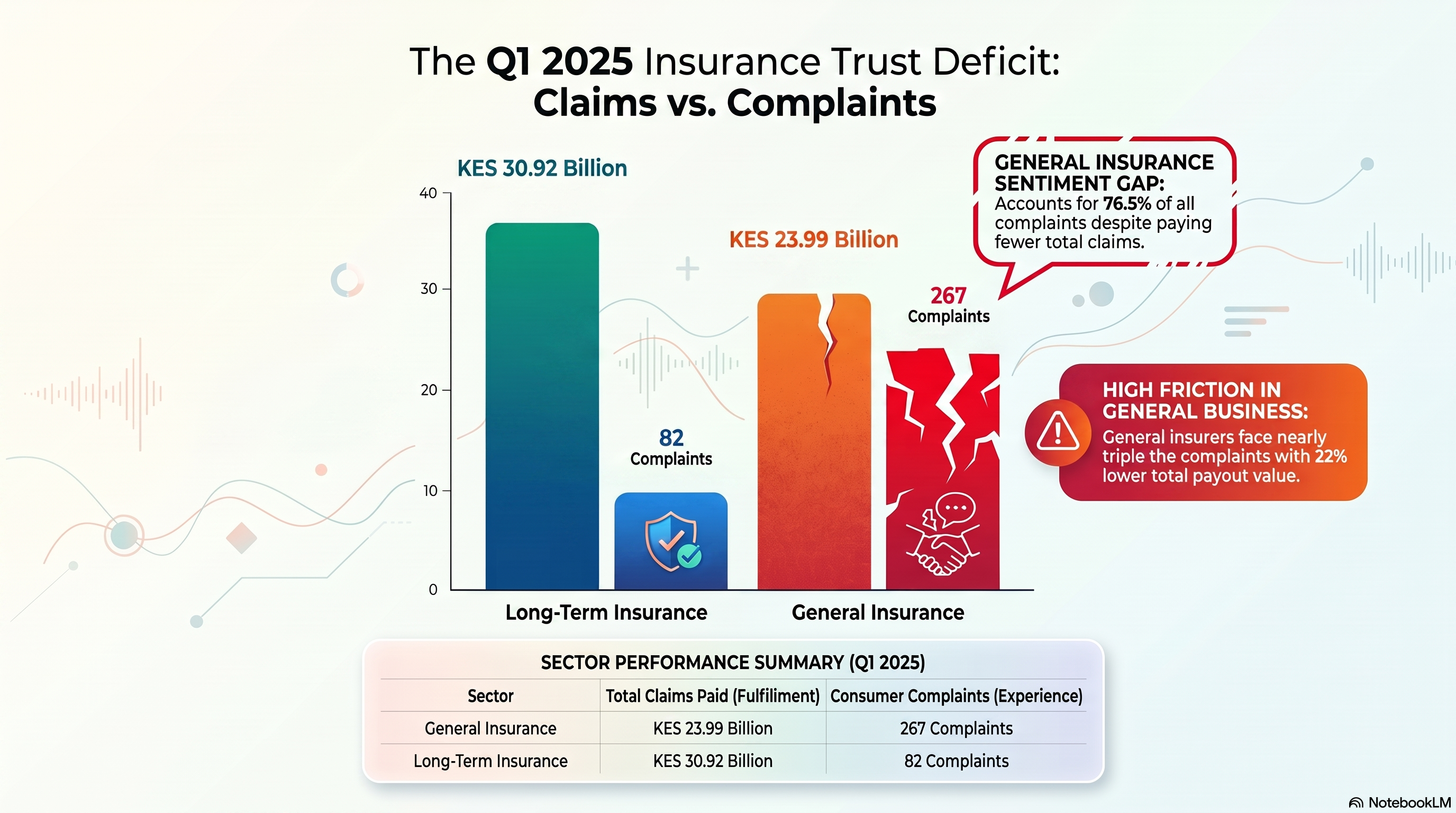
The operational struggle in insurance is not just about pricing; it is a symptom of a systemic trust deficit. In a market where insurance is often perceived by consumers as a “tax” rather than a financial shield, every claim becomes a battleground. This friction prevents insurance from becoming a core household product, keeping market penetration stuck at low levels and forcing insurers into a race to the bottom on price.
When consumers feel that coverage is difficult to trigger or that the claims process is designed to obfuscate rather than support, trust evaporates. This lack of faith creates a cycle where insurers face higher administrative costs to verify claims, and customers—suspecting the worst—become more likely to inflate their own claims. The result is a toxic feedback loop that erodes the margins of even the most well-intentioned providers.
Key insights:
Trident Insurance recorded the highest number of complaints in the sector, with a total of 52 cases (32 resolved and 20 unresolved).
Monarch General and Directline followed with 25 and 22 total complaints respectively.
Companies like APA Gen, GA General, and Madison General demonstrated high resolution rates, with all reported complaints being resolved during the quarter.
The “Others” category, representing companies with 5 or fewer complaints each, accounted for 43 total cases.

IV. Market Concentration Dynamics
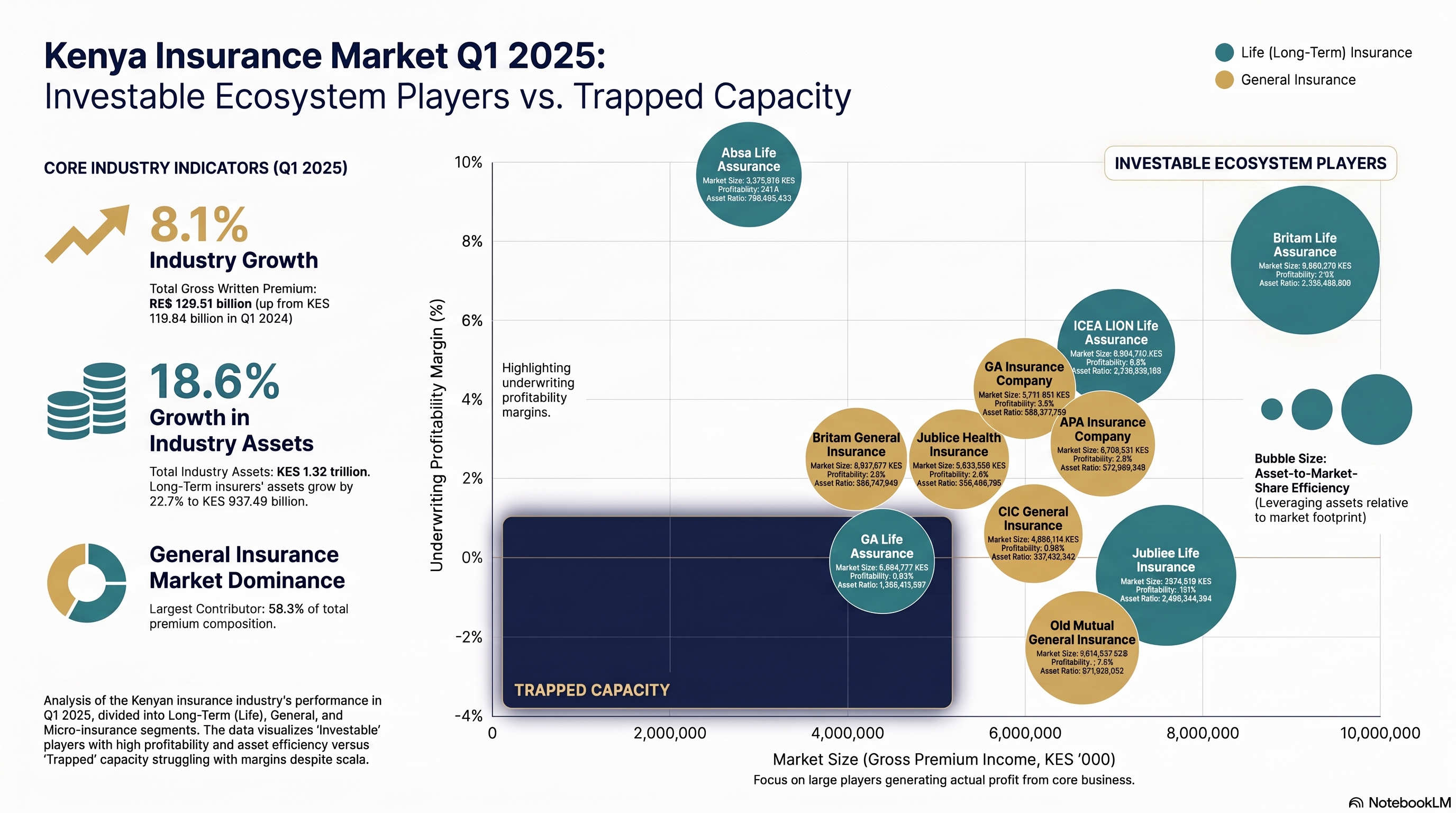
The Kenyan insurance industry is defined by a high degree of concentration, where a small cohort of dominant players dictates market trends, pricing strategies, and product innovation. This structure presents significant barriers to entry for smaller firms and reinforces the influence of established legacy insurers.
As of the most recent 2025 performance data, this concentration remains pronounced across both major insurance segments. While the industry comprises numerous participants, the top five entities in each segment act as the primary engines of industry performance, collectively commanding a majority share of the market.
Market Share Concentration: Top 5 Insurers (2025 Data)
Long-Term
Britam Life Assurance 22.6%
ICEA Lion Life Assurance 13.9%
Jubilee Life Insurance 13.0%
Kenindia Assurance 7.7%
APA Life Assurance 6.2%
General
CIC General 9.1%
APA Insurance 8.5%
Old Mutual General 8.1%
GA Insurance 7.5%
Jubilee Health 7.5%
Source: Adapted from 2025 Industry Turnover Data.
Strategic Implications
The concentration of market share among these few giants has several critical implications for investors and the industry at large:
Economies of Scale: Dominant players leverage their extensive distribution networks—often through bancassurance or widespread physical branches—to capture premium volume at costs smaller insurers cannot match.
Pricing Power vs. Price Wars: While concentration theoretically grants pricing power, the industry is currently trapped in a “volume-chasing” cycle. Large players often initiate price wars in Motor and Medical segments to protect their market share, which inadvertently suppresses the underwriting margins for the entire industry.
The “Barrier” Effect: For the smaller firms, the struggle is not just in acquiring customers but in maintaining the capital adequacy ratios (at least 200%) required by the Insurance Regulatory Authority (IRA). This regulatory environment creates a “survival of the biggest” dynamic, further cementing the current market leaders’ positions.

Beyond the Raids: Analyzing the Structural Failures of the SASRA and the Capital Markets Authority.
IV. The Investment Pivot: Searching for Alpha
For years, the Kenyan insurance industry has operated on a convenient, albeit flawed, “subsidy model.” Underwriters accepted slim margins—or outright losses—on their core insurance products, confident that they could bridge the gap with generous returns from their investment portfolios.
That crutch is now breaking.
The industry’s reliance on high-yield Government of Kenya (GOK) securities—which currently account for 76.7% of the long-term insurance asset portfolio—has become a vulnerability rather than a strength. As yields on GOK paper have softened, the era of “easy” investment income is fading. This was evidenced in Q1 2025, where overall gross investment income contracted by 22.5% to KES 43.37 billion.
This decline creates a dangerous “scissor effect.” On one side, underwriters are struggling with a combined ratio of 105.9%, and on the other, the investment income that historically papered over these losses is retreating. When the sovereign-backed returns that insurers rely on for stability fall, they are left exposed to the raw, unmasked volatility of their core underwriting business.
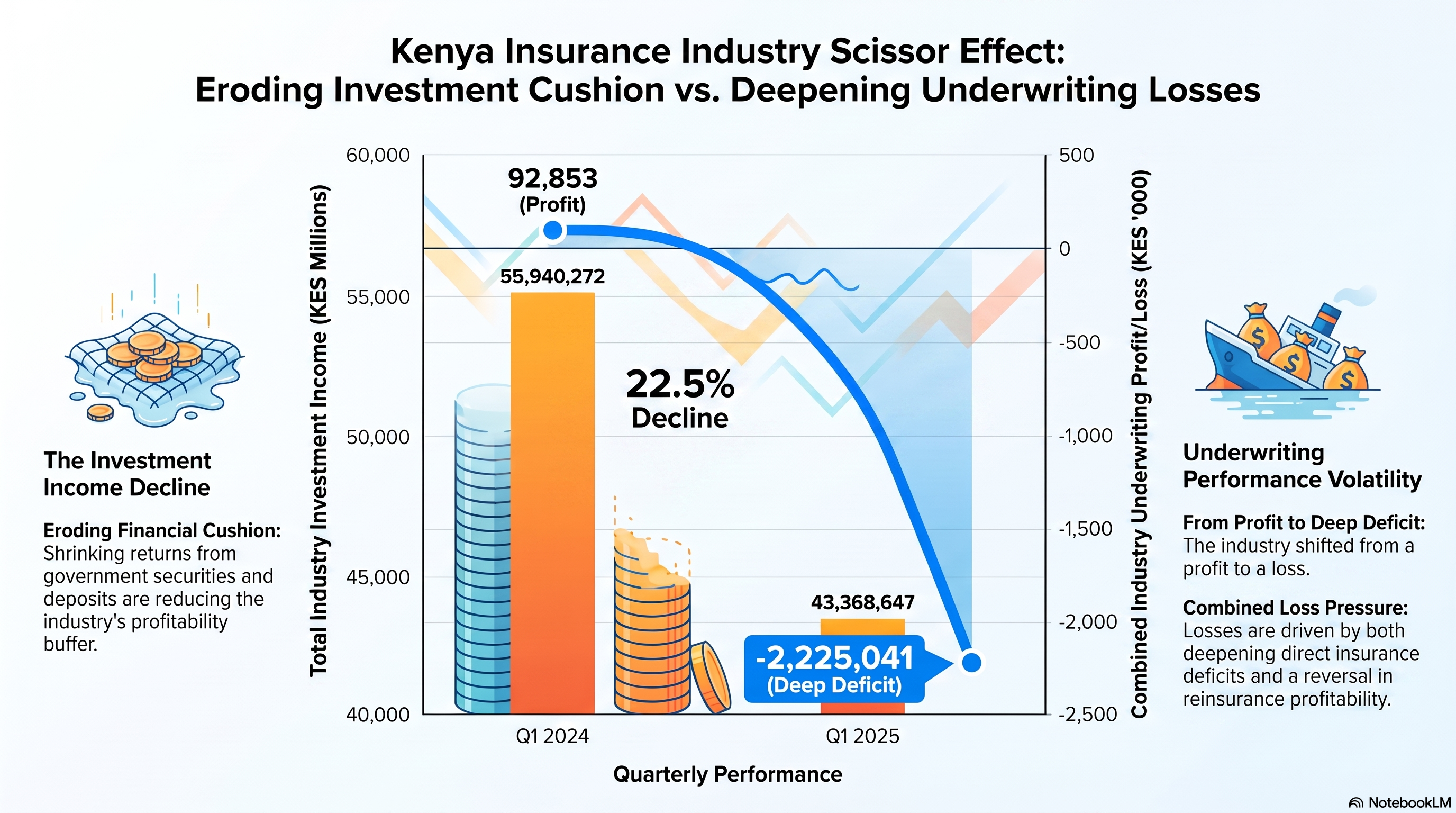
As yields on GOK paper decline, the ability of insurers to subsidize their underwriting losses vanishes, leaving them with nowhere to hide.

V. Strategic Product Innovation: The Hunt for New Revenue
The stagnation of traditional Motor and Medical segments has forced a frantic pivot toward product diversification. In a clear signal that insurers are attempting to break out of their legacy product traps, the regulator approved 26 new or repackaged products during Q1 2025.
The most significant shift is occurring within the Long-Term segment, where the “Investments” class has exploded, recording a staggering 154% growth in just one quarter. This surge highlights a desperate—and potentially lucrative—attempt by insurers to capture the growing appetite for savings-linked and investment-linked life products, moving the industry away from simple risk-protection models toward wealth-creation services.
The Innovation Monopoly
Crucially, the innovation landscape is not a broad-based industry awakening; it is an exclusive club. Aside from the vertically integrated “closed-loop” model pioneered by Equity Group—which is effectively building a new infrastructure rather than just launching products—the vast majority of these 26 innovations are emerging solely from the top five market leaders.
Britam Life: Dominating the “Investments” growth through diversified Unit-Linked products.
ICEA Lion: Expanding in pension-linked life insurance and digital-first savings products.
Jubilee Life: Leading in health-integrated life products and digital micro-insurance.
CIC Insurance: Pioneering cooperative-linked investment products and micro-insurance.
Equity/Equimed:The outlier: Redefining health via a vertically integrated “closed-loop” ecosystem.
The “Banking” Precedent: Consolidation is Coming
This dynamic of innovation-led consolidation mirrors the transformation of the Kenyan banking sector over the last decade. Just as smaller banks were eventually squeezed out of the market when they could no longer match the technological and capital requirements of the giants, the insurance industry is heading toward a similar reckoning.
The Moat: By monopolizing innovation, the top five players are creating a “technological moat.” They have the capital to invest in digital platforms, the reach to acquire customers at scale, and the regulatory standing to survive the transition.
The Squeeze: Smaller insurers, burdened by high claims ratios and lack of investment income, are essentially being starved of the resources needed to compete in this new, digitized landscape.
For investors, the takeaway is clear: the market is not just consolidating in terms of premium volume—it is consolidating in terms of capability. The “middle-tier” of the insurance industry is increasingly looking like a value trap. Just as in the banking sector, the future of the insurance industry will be defined by a handful of entities that can afford to innovate, while the small players will likely face acquisition or exit.

The New Frontier: Microinsurance
While traditional premiums in the Motor and Medical sectors struggle with volatility and high loss ratios, microinsurance has emerged as the industry’s most significant growth lever for financial inclusion. By leveraging mobile-first distribution and partnerships with last-mile agents (such as cooperatives and credit unions), insurers are finally tapping into the mass market—a segment that has remained largely uninsured due to the high cost of traditional agency models.
The Microinsurance Growth Play
Microinsurance is transitioning from a CSR initiative to a core revenue driver. Growth in this space is propelled by the integration of insurance with mobile money platforms and the “partner-agent” architecture, which reduces acquisition costs by 20%–40% compared to traditional models.
Market Dynamics: Digital distribution now controls a significant share of premium flows, appealing to first-time policyholders who require low-touch, instant onboarding.
Segment Focus: Life products (credit-life, funeral cover) and Health/Hospital cash plans remain the most active areas, with health coverage expected to sustain a strong compound annual growth rate (CAGR) as demand for affordable protection rises.
Key Players in the Microinsurance Space
The firms dominating this frontier are those that have successfully pivoted their distribution strategies toward digital ecosystems and mobile money partnerships:
Britam: Extensive use of mobile-linked micro-products and bancassurance.
CIC Group: Leverages cooperative movements and SACCOs as “partner-agents” for deep rural reach.
Jubilee Insurance: Focuses on digital health-integrated micro-plans and hospital cash products.
AAR Insurance: Active in low-cost health/medical micro-cover via digital gateways.
Equity Group: The ecosystem leader: using its banking infrastructure to bundle micro-insurance directly into the customer’s daily financial life.
Investment Perspective: Why Microinsurance Matters
For investors, microinsurance offers a hedge against the stagnation of the “top-end” market. While the average ticket size per policy is small—often less than Kes 1000—the volume and scalability are transformative.
The “Volume” Hedge: As traditional sectors like Motor face “price wars” and claims-related battles, microinsurance provides a diversified stream of premiums with lower individual claim complexity.
Consolidation Catalyst: Similar to the trends seen in banking, the winners in microinsurance will be the firms that can achieve the highest “cost of acquisition” efficiency. Players who cannot build the necessary digital infrastructure to support high-volume, low-value policies will likely find this segment cost-prohibitive, further accelerating the market consolidation toward the “Top 5” giants who can afford to play at scale.

VI. The Path Forward: Can the Industry Pivot?
If the traditional model of subsidizing underwriting losses with government-backed investment gains is dying, insurers are forced into a binary choice: modernize or succumb to consolidation. The industry is frantically attempting to diversify—as seen in the 26 new or repackaged products approved in Q1 2025—but product innovation alone is insufficient when the underlying operational machinery remains archaic.
The exit strategy from the “Underwriting Trap” is bifurcating into two distinct paths:
1. The Digital-Regulatory Path
The regulator’s push for digital integration—such as digital marine insurance certificates and automated customs bond monitoring—is more than an administrative exercise. By reducing human interaction in high-leakage areas, these digital gates act as a direct filter against the fraud that currently inflates claims ratios. For the broader industry, moving toward risk-based pricing rather than volume-driven “price wars” is the only way to restore underwriting margins.
2. The “Closed-Loop” Ecosystem (The Equity Model)
The most compelling alternative to the industry’s fragmentation is the vertically integrated “closed-loop” model pioneered by Equity Group. Rather than operating as a passive insurer that fights with service providers over costs, Equity has moved to own the entire value chain:
Distribution & Financing: Bundling insurance with banking to lower barriers to entry and make coverage a financial utility.
Service Delivery (Equity Afia): By operating over 140 medical centers, the group controls the “ground truth” of care, reducing administrative friction and managing quality directly.
Pharmaceutical Control: Managing its own pharmacy supply chain limits over-prescription and inflated drug costs, which are the primary drivers of “claims leakage” in the medical segment.
Unified Data: A central electronic health record (EHR) layer enables continuous care and facilitates preventative wellness, which, in turn, keeps inpatient claim frequency low.
This model is a game-changer for “investability.” While traditional insurers struggle with a 105.9% combined ratio because they have no leverage over external providers, the closed-loop system captures the margin at every stage, removes the middleman, and builds the one thing the industry desperately lacks: trust through physical presence.

VII. The Vulnerability Zone: The “Bottom 10” and the Consolidation Reckoning
The Kenyan insurance market is undergoing a structural “cleansing.” As capital requirements become more stringent and top-tier players solidify their dominance, the industry’s long-tail of smaller, under-capitalized players faces an existential threat. For policyholders and investors, this is no longer a theoretical risk—it is a live market event.
The Reality of Market Exit
The vulnerability of smaller insurers has moved from risk to reality. On 11th March 2026, the Insurance Regulatory Authority (IRA) placed three companies under statutory management
Trident Insurance Company,
KUSCCO Mutual Assurance Limited
Corporate Insurance Company
This action, taken to safeguard policyholders and stop the further accumulation of liabilities, was the direct result of these companies failing to meet mandatory solvency requirements and demonstrating an inability to restore compliance despite extensive regulatory intervention. The Policyholders Compensation Fund (PCF) has since assumed control of their operations to manage liabilities and ensure an orderly resolution of obligations.
The High-Risk Tier: Remaining Vulnerable Entities
Following these recent interventions, the spotlight remains on other firms that share similar profiles: lower premium volumes, limited capital buffers, and difficulty absorbing claims volatility.
Trident Insurance Non-Life Under Statutory Management (Mar 2026)
KUSCCO Mutual Life Under Statutory Management (Mar 2026)
Corporate Insurance Life Under Statutory Management (Mar 2026
Star Discover Life Life High Risk
Cannon Life Life High Risk
The Kenyan Alliance Life High Risk
Takaful Insurance of Africa: Non-Life High Risk
Kenya Orient Non-Life High Risk
Definite Insurance: Non-Life High Risk
Capex Life Life High Risk
Why Consolidation is Inevitable
The recent regulatory move by the IRA confirms that the industry is following the “Banking Precedent”—an era where under-capitalized entities are systematically removed from the market.
Regulatory Enforcement: The IRA has signaled a zero-tolerance policy for insolvency, prioritizing the protection of policyholders and public confidence over the survival of failing brands.
Capital Suffocation: Firms unable to maintain solvency ratios are now being forced into statutory management, leaving little room for them to “trade out” of their financial difficulties.
The Innovation Gap: Smaller players lack the capital to invest in the digital fraud-prevention tools that the top five players use to protect their margins.
The “Flight to Quality”: As news of statutory management spreads, policyholders are accelerating their migration toward “Too Big to Fail” insurers, further starving the remaining small players of the premium revenue they need to survive.
Verdict for Stakeholders:
For Investors: The “Bottom 10” are increasingly radioactive. The risk of sudden regulatory intervention is high, and the potential for capital loss is absolute.
For Policyholders: Counterparty risk is the primary concern. In the wake of the March 2026 interventions, it is critical for policyholders to assess their insurer’s financial stability. Relying on a firm that cannot meet solvency requirements—and is thus at risk of being placed under statutory management—is a significant, often overlooked, financial risk.
VII. The “Opacity” Trap: Regulatory Omissions as a Warning Sign
As the industry pushes toward consolidation, the “Vulnerability Zone” is not just defined by those already placed under statutory management, but by those who fail to meet the most basic transparency standards.
When the Insurance Regulatory Authority (IRA) releases its quarterly industry reports, the omission of specific firms is a flashing red light for both investors and policyholders. Omission typically signals a failure to submit mandatory quarterly returns—a foundational requirement that allows the regulator to monitor financial health.
The Cost of Non-Compliance
In the most recent industry disclosures, several firms were excluded from quarterly analyses due to non-compliance with submission requirements. These omissions effectively blind the market, as they limit the regulator’s ability to assess financial performance and prevent policyholders from making informed decisions based on verified data.
The following insurers have recently faced scrutiny or exclusion for failing to meet these critical reporting standards:
Definite Assurance Company
The Kenyan Alliance Insurance Company (General & Life)
The Monarch Insurance Company (General & Life)
Star Discover Micro Insurance Limited
Birdview Micro Insurance
Why “Omission” Equals Risk
For an investor, an omitted company is not just a company “missing” from a report—it is a company that has effectively disconnected itself from the regulatory safety net.
Reduced Oversight: Failure to submit returns limits regulatory oversight, making it difficult to ascertain if the company maintains the required solvency margins.
Information Asymmetry: When financial data is unavailable, investors and policyholders cannot verify the company’s ability to settle claims, significantly increasing counterparty risk.
The Path to Statutory Management: History shows that sustained non-compliance and reporting breaches are often the precursors to more severe interventions, such as being placed under statutory management—a fate recently met by companies like Trident Insurance and Corporate Insurance.
Verdict: In a consolidating market, transparency is a proxy for stability. Insurers that cannot (or will not) report their numbers are signaling their own obsolescence. Stakeholders should view these reporting omissions as a definitive “Exit” signal, as the regulatory environment becomes increasingly intolerant of firms that hide behind opaque operations.
About Boardlot Africa Research
Boardlot Africa is a premier financial intelligence and corporate governance publication dedicated to unpacking the mechanics of capital, market strategies, and structural shifts across East Africa’s corporate landscape. By bridging the gap between raw economic data and actionable market intelligence, we deliver deep-dive research, independent corporate analysis, and policy insights designed for institutional investors, boardrooms, and sharp market observers.
Get in Touch
Email: boardlot.research@gmail.com
Phone: +254 753 133 901
Substack: Subscribe to Boardlot Africa
X (Twitter): BoardLotSultan