
What’s In This Article
1.0 Introduction: The Sovereign Gatekeeper
1.1 The Architect of Stability
1.2 The Executive Genesis
1.3 The Core Thesis
2.0 Shifting the Paradigm: From Private Profit to Public Sanity
2.1 The Stanchart Frontier
2.2 The MPC Foundations
2.3 The Leap to the Central Bank
3.0 The Great Banking Cleanout: Enforcing Macro-Prudential Discipline
3.1 Dismantling Insider Lending Vulnerabilities
3.2 Weaponizing the Balance Sheet Audit
3.3 Consolidation over Chaos
4.0 The AML Firewall: Ring-Fencing the Sovereign Ledger
4.1 Choking Illicit Capital Flows
4.2 The “Know Your Customer” (KYC) Ultimatum
4.3 International De-Risking Defenses
5.0 Regulating the Leapfrog: Mobile Money and Fintech Sovereignty
5.1 The “Born Digital” Balancing Act
5.2 Reining in the Digital Wild West
6.0 Data Feature: The Anatomy of a Forced Consolidation (Analysis of Chart 4 from Screenshot 2026-06-02 192527.png and Screenshot 2026-06-02 192826.png)
7.0 The Sole Sentinel: Navigating the Apex Burden
8.0 Conclusion: The Dividend of Discipline
The First Lady of Macro-Prudential Discipline and the Fortification of Kenyan Banking
1.0 Introduction: The Sovereign Gatekeeper
1.1 The Architect of Stability
In the high-stakes theater of macroeconomic policy, stability is rarely the product of polite consensus; it is carved out through administrative grit and structural enforcement.
Sheila M’Mbijjewe did not merely occupy an office at the apex of regulatory power; she operated as a sovereign gatekeeper. Co-steering Kenya’s financial sector through its most turbulent era of regulatory tightening, she stood as the institutional counterweight to a banking industry that had grown dangerously accustomed to lax boundaries, comfortable self-regulation, and speculative excesses.
1.2 The Executive Genesis
As a UK-trained Chartered Accountant, her professional foundations were built on the cold, uncompromising realities of balance sheet audits and asset-quality verification.
Moving from the clinical frontline of commercial credit risk management to become the first female Executive Director of a publicly listed commercial bank in Kenya, she observed the financial ecosystem from the inside out.
1.3 The Core Thesis
The analytical framework of this profile rests on a singular, defining thesis:
A sustainable, competitive regional financial hub cannot be built on the fragile foundations of shadow lending, regulatory leniency, or opaque capital structures. Long-term market value requires an unyielding, institutional blueprint where systemic safety permanently overrides private corporate profit.
M’Mbijjewe’s legacy is defined by this hard-nosed philosophy. For value investors, her macro-prudential discipline provided a critical, structural guarantee: she proved that a central bank’s primary duty is not to protect individual banking institutions from their own bad decisions, but to protect the integrity of the sovereign ledger itself.
2.0 Shifting the Paradigm: From Private Profit to Public Sanity
2.1 The Stanchart Frontier
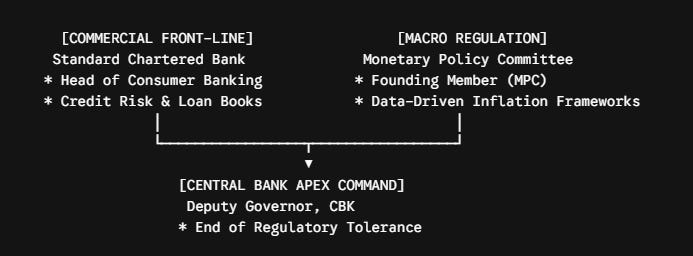
To understand M’Mbijjewe the regulator, one must first deconstruct her tenure on the commercial frontline as Executive Director and Head of Consumer Banking for East Africa at Standard Chartered.
At Stanchart, she observed firsthand how aggressive retail loan book expansion, shifting interest rate spreads, and retail consumer behavior reacted to macroeconomic shocks.
2.2 The MPC Foundations
M’Mbijjewe’s transition from commercial banking to public policy began in earnest when she was appointed as a founding member of the newly minted Monetary Policy Committee (MPC) of the Central Bank of Kenya.
Alongside her fellow committee members, M’Mbijjewe helped engineer a profound structural shift in how the nation managed its money. This structural foundation effectively insulated monetary policy from short-term market panics, sending a clear signal to international capital markets that Kenya was adopting global standards of central banking discipline.
2.3 The Leap to the Central Bank
In 2015, M’Mbijjewe made the definitive leap to the absolute apex of regulatory authority, being appointed as the first female Deputy Governor of the Central Bank of Kenya, serving alongside Governor Patrick Njoroge. Her arrival signaled an immediate, seismic paradigm shift across the local banking sector.
For years, the industry had operated under a regime of implicit “regulatory tolerance,” where poorly capitalized, insider-heavy, and structurally weak Tier-3 commercial banks were allowed to persist on the fringes of the system.
3.0 The Great Banking Cleanout: Enforcing Macro-Prudential Discipline
3.1 Dismantling Insider Lending Vulnerabilities
The true test of a banking regulator occurs when the illusion of systemic stability collides with the reality of hidden structural rot. In mid-2015 and early 2016, Kenya’s financial sector suffered a series of severe macro-prudential shocks that threatened to trigger a domino-effect run on the country’s mid-tier banks. Within a short period, Dubai Bank, Imperial Bank, and Chase Bank collapsed into receivership.

Sheila M’Mbijjewe, freshly minted at the Central Bank apex, co-led a swift and aggressive counter-offensive. Rejecting the traditional policy of treating failing institutions with endless liquidity lifelines, she shifted the CBK’s stance toward immediate intervention and strict, non-negotiable Asset-Quality Reviews (AQRs).
3.2 Weaponizing the Balance Sheet Audit
M’Mbijjewe’s primary weapon in this cleanout was the clinical, aggressive balance sheet audit. M’Mbijjewe weaponized regulatory compliance, forcing commercial banks to look directly into their loan books and aggressively provision for Non-Performing Loans (NPLs). This regulatory tightening permanently altered how Tier-1 and Tier-2 banks report corporate earnings.
The sudden, mandatory spike in NPL provisioning initially dented paper profits across the street, but it achieved a critical structural goal: it flushed out the hidden risks, forced banks to hold genuine capital reserves, and injected absolute transparency into the public ledger.
3.3 Consolidation over Chaos
In reality, M’Mbijjewe was engineering a deliberate, long-term structural pivot: consolidation over chaos. By strictly enforcing high capital-adequacy ratios and unwavering institutional compliance, she made it impossible for weak, under-capitalized, and poorly governed Tier-3 players to survive on the fringes of the exchange.

This consolidation phase fundamentally stabilized the market plumbing. It allowed larger, highly institutionalized Tier-1 banks to absorb smaller books, creating the hyper-resilient, pan-African banking conglomerates—such as KCB, Equity Bank, and Co-operative Bank—that value investors rely on today. M’Mbijjewe’s discipline proved that true market depth requires a smaller group of fortress-like banks over a chaotic multitude of fragile institutions.
4.0 The AML Firewall: Ring-Fencing the Sovereign Ledger
4.1 Choking Illicit Capital Flows
M’Mbijjewe understood that macro-prudential stability is directly tied to national security and global financial integrity. To protect Kenya’s sovereign ledger from being weaponized by shadow networks, she took on an aggressive role as a founding member of the Crime and Anti-Money Laundering Act (CAMLA) Advisory Committee and exercised rigorous strategic oversight on the board of the Financial Reporting Centre (FRC).
Under her direction, the CBK turned its focus toward choking illicit cash flows. M’Mbijjewe pushed for a complete institutionalization of Anti-Money Laundering (AML) and Counter-Terrorism Financing (CTF) frameworks across the banking sector. Under-the-table cash transfers and anonymous high-value transactions were systematically targeted, forcing commercial banks to move away from light-touch onboarding toward real-time transaction monitoring and strict algorithmic tracking of money trails.
4.2 The “Know Your Customer” (KYC) Ultimatum
The most visible and controversial battlefield of this cleanout occurred when the CBK introduced its strict, non-negotiable “Know Your Customer” (KYC) directives on large cash transactions. The mandate placed a strict oversight threshold on any cash withdrawals or deposits exceeding 1 million KES (approx. $10,000 USD). Anyone moving cash at this level was legally required to provide absolute, documented proof of the source of the funds, the justification for using cash over electronic channels, and the exact identity of the end beneficiaries.

This ultimatum met intense, bitter resistance from the political class, high-net-worth shadow operators, and cash-reliant trading networks accustomed to complete anonymity.
By enforcing the 1 million KES rule without exception, she permanently disrupted the cash-based shadow economy and forced high-value trade into the transparent, auditable digital banking pipeline.
4.3 International De-Risking Defenses
The stakes of this AML campaign extended far beyond local politics; it was a battle to secure Kenya’s access to global trade. In the modern financial architecture, international clearing networks use an aggressive practice known as “de-risking.” If a regional financial hub is perceived as having weak AML controls or high levels of illicit financial flows, global correspondent banks in New York, London, and Frankfurt will simply cut ties with that country’s local banks to avoid regulatory fines.
M’Mbijjewe’s fierce enforcement of international AML compliance served as the ultimate defensive shield. By proving to global bodies like the Financial Action Task Force (FATF) that Kenya’s regulatory oversight was world-class, she protected local financial institutions’ untainted access to the international SWIFT clearing network, ensuring that the country remained securely connected to global capital flows.
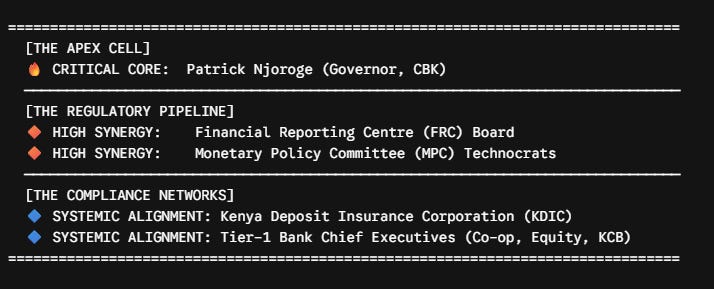
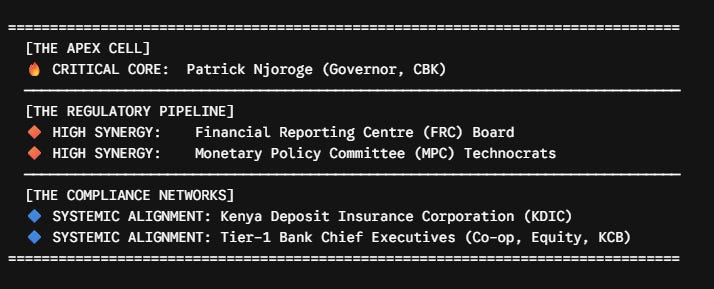
🗺️ COLLABORATION HEATMAP: The Macro-Prudential Support System
The heatmap below ranks her key workplace relationships based on Operational Alignment (how closely they worked on a daily basis) and Strategic Leverage (the systemic impact of their joint decisions).
🧱 Breakdown of Her Core Collaborators
1. The Apex Command Partner: Dr. Patrick Njoroge (Governor, CBK)
Relationship Dynamic:. Appointed at the same time in 2015.
2. The Enforcement Pipeline: The Financial Reporting Centre (FRC) Board
Relationship Dynamic: Direct strategic oversight and policy implementation.
The Joint Mandate: M’Mbijjewe worked hand-in-hand with anti-money laundering (AML) directors and financial intelligence analysts. The FRC
3. The Analytical Grid: Monetary Policy Committee (MPC) Technocrats
Relationship Dynamic: Foundational peers and data analysts.
4. The Cleanout Cleaners: Kenya Deposit Insurance Corporation (KDIC)
Relationship Dynamic: Crisis management and restructuring execution.
The Joint Mandate: When M’Mbijjewe’s balance sheet audits exposed terminal rot in insider-heavy institutions (like Imperial Bank and Chase Bank), she closely coordinated with the KDIC.
5.0 Regulating the Leapfrog: Mobile Money and Fintech Sovereignty
5.1 The “Born Digital” Balancing Act
Kenya completely leapfrogged conventional financial infrastructure. The explosive growth of mobile money platforms—most notably M-Pesa—and a subsequent wave of unregulated digital micro-lenders completely rewritten the rules of retail capital flow.
For Sheila M’Mbijjewe, this “born digital” landscape presented a highly complex regulatory balancing act. On one hand, mobile financial services were a powerful engine for genuine financial inclusion, bringing millions of unbanked citizens into the formal economic grid. On the other hand, the sheer velocity and volume of peer-to-peer micro-transactions created unmonitored alternative pipelines that bypassed traditional monetary policy transmission mechanisms.
5.2 Reining in the Digital Wild West
By the late 2010s and early 2020s, the fintech landscape had morphed into a digital Wild West. Hundreds of unregulated mobile credit apps flooded the market, harvesting personal user data, operating outside the scope of interest-rate caps, and using aggressive, predatory collection practices. These shadow lenders were functioning as un-licensed, high-cost credit houses, pulling billions of shillings from vulnerable retail consumers without maintaining statutory liquidity pools or reporting to Credit Reference Bureaus (CRBs).
Under the amended Central Bank of Kenya Act, the CBK stripped rogue digital lenders of their anonymity. Fintechs were legally mandated to seek formal CBK licensing, subject their pricing models to central bank approval, and strictly adhere to national consumer data privacy laws.
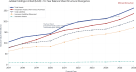
6.0 Data Feature: The Anatomy of a Forced Consolidation
The ultimate, enduring legacy of Sheila M’Mbijjewe’s macro-prudential enforcement is the undeniable structural transformation of Kenya’s banking sector from a fragmented, tier-three heavy landscape into an ironclad, large-tier oligopoly. This historic paradigm shift is vividly captured when comparing
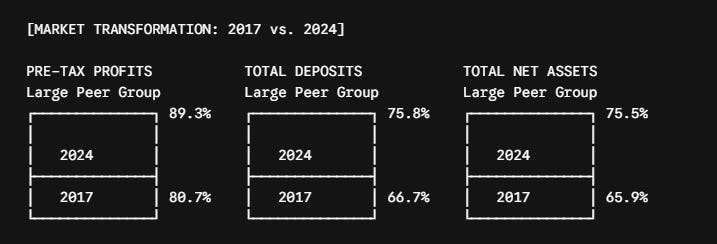
The statistical reality of this consolidation tells the entire story:
Pre-Tax Profits: The large peer group’s share of total industry pre-tax profits expanded from an already dominant 80.78% in 2017 to an absolute stranglehold of 89.3% by 2024, effectively leaving small-tier banks with a microscopic 0.5% slice of the sector’s profitability.
Total Deposits: Driven by depositors seeking unassailable balance sheets, total deposits anchored within large banks surged from 66.74% in 2017 to 75.8% in 2024.
Asset Size: The large peer group’s command over total net assets grew from 65.97% to 75.5% over the same period, systematically deflating the market share of medium-tier players from 26.31% down to 16.4%.
For value investors on the exchange, this was the defining endgame of M’Mbijjewe’s blueprint. She did not just patch up weak banks; she engineered a harsh regulatory climate that starved out sub-scale, high-risk operations, pushing capital directly into the arms of the hyper-resilient, cash-rich Tier-1 conglomerates that now form the bedrock of the region’s capital markets.
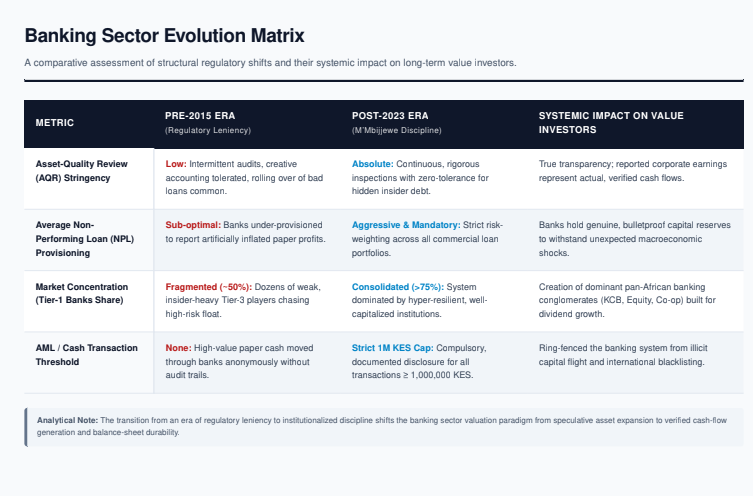
7.0 Data Feature: The Anatomy of a Clean Balance Sheet
To fully appreciate the impact of this macro-prudential tightening on your investment portfolio, you have to look at the cold, hard numbers. The table below outlines how the structural integrity of the Kenyan banking sector shifted from the high-risk, volatile environment of Pre-2015 to the fortress-like stability of the Post-2023 era
The Sole Sentinel: Navigating the Apex Burden
To truly appreciate the sheer scale of M’Mbijjewe’s influence, one must look at the structural anomaly of the Central Bank’s executive suite during her tenure. While the Central Bank of Kenya (CBK) Act statutorily mandates that two deputy governors must be in office to share the immense administrative and regulatory load, M’Mbijjewe spent virtually her entire eight-year tenure (2015–2023) operating as the only serving Deputy Governor.
Despite repeated queries from the Office of the Auditor General regarding the vacant second seat, the apex command structure remained a two-man firewall consisting solely of Dr. Patrick Njoroge and Sheila M’Mbijjewe. It was only in March 2023—a mere three months before her final, non-renewable term expired—ed that a second deputy, Dr. Susan Koech, was brought on board.
For the value investor, this structural detail changes how we view her legacy:
Unprecedented Centrality: During the critical 2015/2016 banking cleanouts, the aggressive rollout of the 1 million KES KYC ultimatum, and the tightening of the AML firewall, M’Mbijjewe bore the entire operational oversight of banking supervision alone.
The Ultimate Stress Test: She didn’t just co-steer the ship; she managed the entire regulatory machinery of a transitioning, multi-trillion-shilling financial sector without a secondary deputy to absorb the systemic pressure.
When we talk about the fortification of Kenyan banking, we are not talking about a bloated bureaucratic committee. We are talking about an institutional blueprint executed, defended, and anchored by a single, unyielding sentinel at the apex of the reserve bank.
The Sole Sentinel: Navigating the Apex Burden
To truly appreciate the sheer scale of M’Mbijjewe’s influence, one must look at the structural anomaly of the Central Bank’s executive suite during her tenure. While the Central Bank of Kenya (CBK) Act statutorily mandates that two deputy governors must be in office to share the immense administrative and regulatory load, M’Mbijjewe spent virtually her entire eight-year tenure (2015–2023) operating as the only serving Deputy Governor.
Despite repeated queries from the Office of the Auditor General regarding the vacant second seat, the apex command structure remained a two-man firewall consisting solely of Dr. Patrick Njoroge and Sheila M’Mbijjewe. It was only in March 2023—a mere three months before her final, non-renewable term expired—ed that a second deputy, Dr. Susan Koech, was brought on board.
For the value investor, this structural detail changes how we view her legacy:
Unprecedented Centrality: During the critical 2015/2016 banking cleanouts, the aggressive rollout of the 1 million KES KYC ultimatum, and the tightening of the AML firewall, M’Mbijjewe bore the entire operational oversight of banking supervision alone.
The Ultimate Stress Test: She didn’t just co-steer the ship; she managed the entire regulatory machinery of a transitioning, multi-trillion-shilling financial sector without a secondary deputy to absorb the systemic pressure.
When we talk about the fortification of Kenyan banking, we are not talking about a bloated bureaucratic committee. We are talking about an institutional blueprint executed, defended, and anchored by a single, unyielding sentinel at the apex of the reserve bank.
8.0 Conclusion: The Dividend of Discipline
8.1 Why the Boardlot Demands a Safe Vault
As a value investor tracking long-term compounding returns on the Nairobi Securities Exchange, it is easy to focus exclusively on dividend yields, price-to-earnings ratios, and corporate growth strategies. But these metrics are completely meaningless without a stable macroeconomic backdrop. You cannot compound dividends in peace if the underlying banking sector holding your cash or financing your companies is fundamentally fragile.
Sheila M’Mbijjewe’s legacy provides that safe, institutional vault. Her macro-prudential discipline established the foundational framework that keeps the entire financial system stable. By forcing banks to absorb short-term pain, expose their bad loans, and shut down illicit cash highways, she insulated the wider market from catastrophic, systemic collapses.
8.2 The Blueprint Survives
When M’Mbijjewe retired from the Central Bank of Kenya, she left behind an entirely transformed financial landscape. She stands as the definitive institutional architect who ensured that Kenya’s banking sector matured from an insular, insider-dominated network into a highly sophisticated, fortress-like regional financial anchor.
Following her retirement from the Central Bank of Kenya in June 2023, where she successfully capped off her second and final four-year term, Sheila M’Mbijjewe transitioned her macro-prudential expertise back into global corporate governance.
Current Apex Corporate Placement
Independent Non-Executive Director: She joined the Board of Directors of ASA International Group plc (a prominent London Stock Exchange-listed multinational microfinance institution).
Chair of the Audit Committee: Leveraging her precision as a UK-trained Chartered Accountant, she acts as the Audit Committee Chair (A-Ch) for the global group, overseeing financial integrity across its extensive microfinance banking footprint.