
“Kulipa Ushuru ni Kujitegemea” (Paying Taxes is Self-Reliance). - Mwai Kibaki
What’s In This Story
1.0 Introduction: The Architect of Fiscal Sovereignty
1.1 The Technocrat at the Pump
1.2 The Sovereign Engine
2.0 The Executive Genesis: From Ernst & Young to the State House Hotline
2.1 The Global Accounting Engine Room
2.2 The Trans-Century Network
2.3 The “Technopol” and the Hotline
3.0 The Revenue Metamorphosis: Deconstructing the Numbers
3.1 The Baseline Shift
3.2 Broadening the Tax Net
3.3 The Corporate Compliance Culture
4.0 The ETR Revolution: Weaponizing Technology against the Shadow Economy
4.1 The 2005 Paradigm Shift
4.2 The Retail Resistance
4.3 The Digital Blueprint
5.0 The Master Communicator: Rewriting the Psychology of the Taxpayer
5.1 From Extortionists to Partners
5.2 The 2004 Genesis: Institutionalizing “Taxpayers Week” and the Hero Paradigm
5.3 Demystifying the Tax Code
6.0 “Kulipa Ushuru ni Kujitegemea”: The Kibaki-Waweru Fiscal Synergy
6.1 The Ideological Rallying Cry
6.2 Starving the Donor Complex
6.3 Breaking the Debt Cycle
7.0 The Uncompromised Pen: A Clear Conscience in an Opaque World
7.1 The Exclusive Memoir
7.2 The Philosophy of a Clear Conscience
7.3 Surviving the Audit of History
8.0 Beyond Times Tower: The Private Sector Re-Entry
8.1 Cultivating the Seed of Corporate Governance
9.0 Conclusion: The Blueprint for Modern Sub-Saharan Fiscal Policy
9.1 The Safety Dividend of Domestic Capital
9.2 The Benchmark for Capital Markets
A Note on the Ledger: Sources and Research Methodology
1.0 Introduction: The Architect of Fiscal Sovereignty
1.1 The Technocrat at the Pump
In the corporate folklore of Kenyan economic history, the year 2003 marks a massive structural inflection point. Prior to this era, the leadership of the Kenya Revenue Authority (KRA) was largely treated as a political dumping ground.
When the newly elected President Mwai Kibaki took office, he discarded the old playbook. Instead of a career politician or a pliant bureaucrat, he deliberately headhunted Michael G. Waweru, a seasoned, heavy-hitting private-sector corporate elite.
Waweru did not look at the country through the lens of political patronage; he looked at it through the cold, forensic discipline of an auditor’s balance sheet. His entry into the Times Tower was a declaration of war against structural inefficiency. He took over an organization crippled by systemic corruption and transformed it into the highly disciplined financial engine room that would fund the greatest economic renaissance in East African history.
1.2 The Sovereign Engine
Developing nations bowed to the Washington Consensus, drafting their national budgets based on the whims, handouts, and painful structural adjustment conditions of the IMF, World Bank, and Western donors.
The Kibaki administration changed that trajectory forever, and Michael Waweru was the chief engineer of that sovereign breakout. The sweeping infrastructural expansions of the 2000s—from the transformation of the Thika Superhighway to the nationwide revitalization of public healthcare Free Primary Education (FPE) —were not built on a foundation of foreign debt. They were funded by aggressive, institutionalized domestic resource mobilization.
Waweru’s tenure proved a fundamental market truth: real economic independence cannot be borrowed; it must be collected.
2.0 The Executive Genesis: From Ernst & Young to the State House Hotline
2.1 The Global Accounting Engine Room
Michael Waweru was not manufactured in the civil service. He spent decades rising through the elite ranks of high finance, eventually serving as the Managing Partner of global auditing giant Ernst & Young (EY). This tier-one corporate pedigree provided him with a forensic mastery of international corporate accounting, tax auditing, and organizational efficiency long before he ever set foot in a government office.
At EY, Waweru internalized a strict rule of compliance: numbers do not lie, and a lack of documentation is an active invitation to failure.
“If you are in business, whether running a kiosk or a big company, you have to keep your records such as sales, purchases, and other costs and tax. Being asked to pay is not being killed.”
2.2 The Trans-Century Network
Waweru’s understanding of capital deployment was further sharpened by his role as an entrepreneurial pioneer. He was one of the legendary elite founders who grew Trans-Century PLC from an informal investment club (chama) of wealthy, brilliant professionals into an aggressive, multi-billion-shilling infrastructure conglomerate listed on the Nairobi Securities Exchange (NSE).
2.3 The “Technopol” and the Hotline
Waweru’s ultimate weapon was his direct line of absolute political trust to President Mwai Kibaki. Kibaki, a London School of Economics (LSE) trained economist and an uncompromising institutionalist, deeply disdained the politically compromised tax collectors of the previous regime. He wanted a transformation leader who possessed iron-clad corporate integrity, and he found that in Waweru.
This alignment created a rare elite class of policymaker: the Technopol. Because Waweru possessed a direct hotline to State House, he operated with absolute institutional autonomy. When powerful cabinet ministers, politically connected billionaires, or entrenched corporate barons attempted to bully or intimidate Times Tower auditors, Waweru slammed the door. The hotline ensured that the political cost of tax evasion was far too high for anyone to pay, giving KRA the teeth it needed to audit the “untouchables” of the Kenyan market.
This video capturing Michael Waweru’s Autobiography Launch is relevant because it features direct reflections from his historic 9-year tenure as Kenya’s “Tax Czar” and contextualizes his strategy to establish domestic fiscal self-reliance
3.0 The Revenue Metamorphosis: Deconstructing the Numbers
3.1 The Baseline Shift
To understand the sheer velocity of the economic engine Michael Waweru built, one must look directly at the raw fiscal ledger of his decade-long tenure (2003–2012). When he walked through the doors of Times Tower in 2003, he inherited an agency collecting roughly KES 201 Billion annually. By the time he handed over the keys of the exchequer in 2012, annual revenue collections had expanded to a staggering KES 707 Billion.
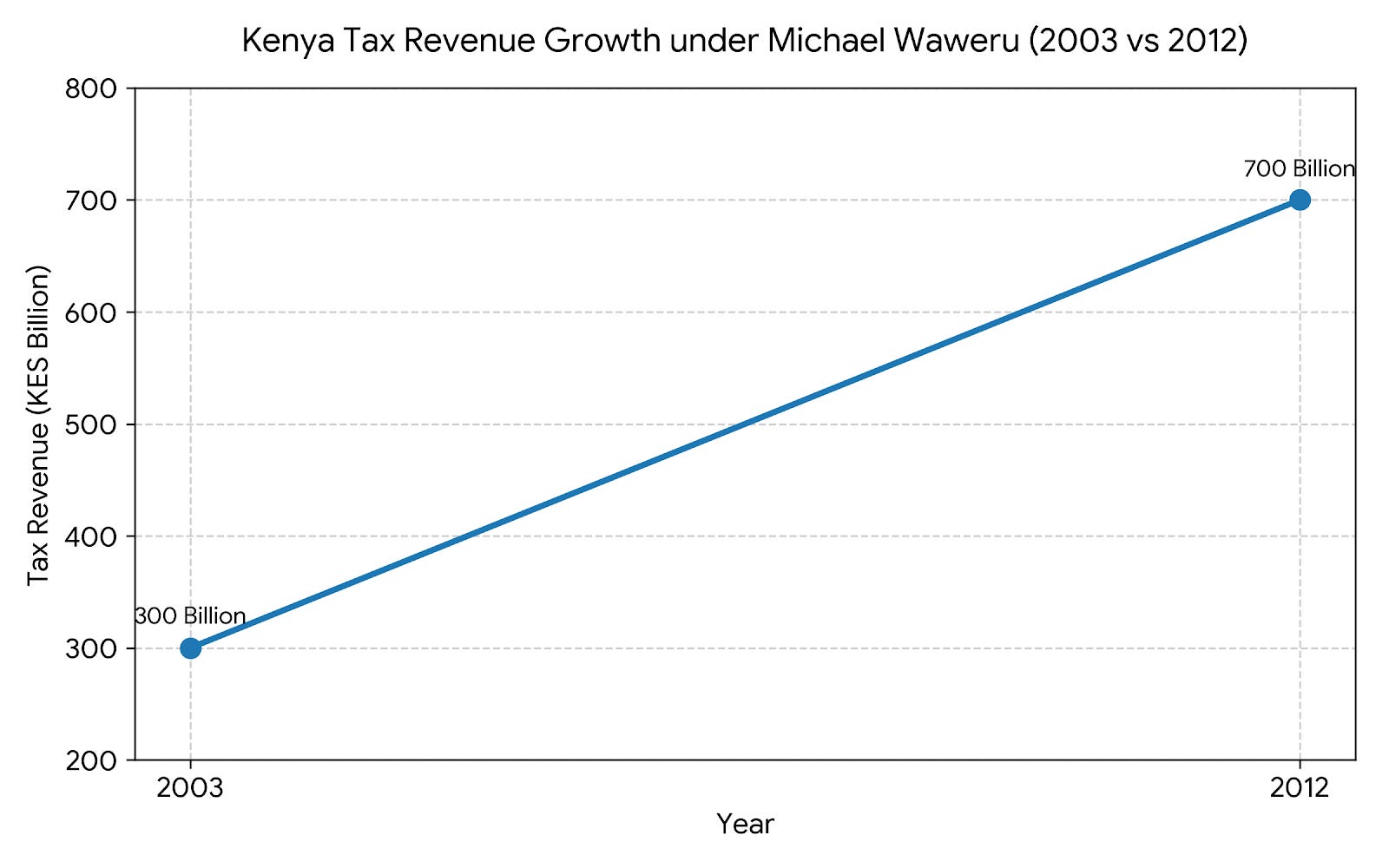
The transformation of Kenya’s revenue collection under Michael Waweru’s tenure at the Kenya Revenue Authority (KRA) is widely considered a major economic milestone.
Kenya Tax Revenue Growth (2003 vs. 2012)
Key Takeaways from the Data
The Leap: Revenue collections grew from KES 300 Billion to KES 700 Billion, marking a massive 133% increase over a 9-year period.
The Strategy: This “Tax Revolution” wasn’t just about raising rates; it was driven by modernizing tax administration, introducing electronic systems (like early versions of electronic tax registers), and aggressive compliance campaigns to bring the informal sector into the tax bracket.
Economic Impact: This rapid expansion in local revenue collection significantly reduced Kenya’s reliance on foreign aid for its recurring budget, funding major infrastructure projects like the Thika Superhighway largely from internal resources.
3.2 Broadening the Tax Net
Waweru’s primary target was the deep, institutionalized tax evasion occurring within sectors previously deemed entirely “untouchable” by previous regimes. He began by standardizing and digitizing customs valuations at the Port of Mombasa—historically the country’s largest black hole for uncollected duties and smuggled transit cargo. By introducing strict, automated verification protocols, he cut out the human discretion that had fueled multi-billion-shilling bribery rings for decades.
Simultaneously, he formalized corporate tax audits across the domestic landscape. Large corporate entities that had historically used political patronage as a shield against the taxman suddenly found their books subjected to forensic, private-sector standard reviews. Waweru’s approach, however, was uniquely balanced: it was softly executed but firmly backed by state authority.
He did not send armed police to raid corporate offices; instead, he sent polite, highly trained auditors armed with undeniable transactional data. The message to the corporate elite was implicit: The old protective networks are gone. Let us look at the ledger.
3.3 The Corporate Compliance Culture
Waweru radically shifted the narrative of tax compliance from a punitive, terrifying cat-and-mouse game with corrupt state agents into a predictable, structured civic duty. He understood that to build a sustainable fiscal model, he had to win the psychological war within Kenya’s blue-chip corporate sector.
Under his leadership, KRA stopped behaving like an aggressive extortion racket and started operating like a professional service provider. By making tax filing guidelines transparent and predictable, he gave businesses the stability they needed to plan long-term capital investments. Compliance became a badge of corporate honor. Blue-chip giants began realizing that working within a transparent tax framework was far more profitable than hiding in the shadows of an unpredictable underground economy.
4.0 The ETR Revolution: Weaponizing Technology against the Shadow Economy
4.1 The 2005 Paradigm Shift
The defining operational battle of Waweru’s early tenure came in 2005 with the aggressive roll-out of the Electronic Tax Register (ETR) machines. Prior to this, Value Added Tax (VAT) collection in Kenya was purely honor-based, reliant on easily manipulated manual paper receipts. Retailers routinely collected 16% VAT from unsuspecting consumers and simply pocketed the cash, creating a massive, invisible hemorrhage in public finances.
The introduction of ETR machines was a technological masterstroke designed to plug these point-of-sale leakages in real-time. By embedding fiscal memory devices directly into cash registers, Waweru established a direct, immutable data line from every commercial transaction straight back to the KRA servers. It was the first structural attempt to map out the true scale of Kenya’s cash-driven shadow economy.
4.2 The Retail Resistance
The pushback was immediate, fierce, and highly coordinated. Wholesalers, retail traders, and powerful business lobbies—particularly from the sprawling commercial hubs of downtown Nairobi—staged massive street protests and business shutdowns. They argued that the ETR gadgets were too expensive, structurally unreliable, and a form of state harassment designed to collapse small enterprises.
Political figures quickly capitalized on the unrest, threatening to block the implementation in parliament. For a moment, the country faced a massive standstill as the trading community bet that the government would blink first, just as it always had in the past.
4.3 The Digital Blueprint
This is where Waweru’s unique leadership style—the velvet glove over the iron fist—permanently broke the gridlock. Where previous tax chiefs would have used heavy-handed police crackdowns or completely capitulated to political pressure, Waweru deployed a masterclass in soft but unyielding negotiation.
He didn’t argue with the traders in public forums; instead, he held endless, patient boardroom meetings with their association leaders. He softly listened to their grievances, demystified how the technology worked, and compromised on timelines—even arranging for the cost of the ETR machines to be fully tax-deductible for businesses.
But beneath that soft diplomacy lay an unshakeable, firm line. Waweru made it clear that while the method of adoption could be discussed, the fact of adoption was entirely non-negotiable. Backed by President Kibaki’s unwavering political cover, he outlasted the protests.
As the business community realized that the KRA would not bend, the strikes fizzled out. The ETR revolution succeeded, permanently re-wiring the retail ecosystem and laying the foundational digital plumbing for every modern fiscal platform Kenya uses today. Waweru had successfully proven that real-time transactional visibility was the ultimate antidote to systemic retail tax evasion.
5.0 The Master Communicator: Rewriting the Psychology of the Taxpayer
5.1 From Extortionists to Partners
Before the year 2003, the relationship between the ordinary Kenyan business owner and the Kenya Revenue Authority was defined by absolute terror. Times Tower was viewed not as a state treasury engine, but as an aggressive extortion arm of the government. Revenue officers routinely descended on enterprises unannounced, utilizing arbitrary tax assessments and the threat of indefinite closure to extract bribes.
Michael Waweru recognized that this predatory environment was structurally unsustainable. To double collections, he had to fundamentally re-engineer the psychology of the taxpayer.
Waweru systematically retooled KRA’s internal culture, transitioning his staff from aggressive enforcers into professional, service-oriented institutional partners. He introduced standardized service charters, penalized rent-seeking behavior among auditors, and humanized the tax collection process. The message to the market shifted from “We are coming to destroy your business” to “We are here to help you compute your fair share.”
5.2 The 2004 Genesis: Institutionalizing “Taxpayers Week” and the Hero Paradigm
Waweru understood that to permanently alter taxpayer behavior, he needed a high-profile, symbolic break from the punitive past. In October 2004, he pulled off his finest masterstroke in corporate diplomacy by launching the inaugural National Taxpayers Week and the accompanying Distinguished Taxpayer Awards.

Deliberately timed to coincide with Kenya’s national heroes’ celebrations (then Kenyatta Day), the climax of this historic rollout took place on October 21, 2004. For the very first time in East African history, a state revenue agency stopped treating tax compliance as a secretive, defensive obligation and transformed it into a prestigious, public badge of honor.
Instead of keeping their heads down to avoid arbitrary state audits, Kenya’s corporate giants were suddenly marched into the limelight. Waweru used these high-profile galas to celebrate top taxpayers—such as Safaricom and East African Breweries Limited (EABL)—as bona fide national heroes, with awards handed out directly by President Mwai Kibaki.
The campaign rolled out under the powerful psychological theme of “Kulipa Ushuru ni Kulinda Uhuru” (Paying Taxes is Protecting Freedom), explicitly framing compliance as a patriotic act that would liberate Kenya from donor dependency. This initiative was so profoundly successful at melting corporate resistance that it triggered an intense corporate rivalry, where blue-chip boards actively competed to be recognized at State House rather than scheming to evade the exchequer. What began as a single week in October 2004 permanently shifted the country’s economic culture, eventually expanding into the month-long national celebration Kenya marks every October.
5.3 Demystifying the Tax Code
Simultaneously, Waweru realized that tax resistance often stems from basic opacity. The average taxpayer simply did not understand how direct and indirect taxes were calculated or where the money went.
Under his direction, the KRA took to the airwaves with clear, accessible, and aggressive media campaigns. Waweru decentralized the tax discourse, organizing public town halls, engaging directly with informal trader associations, and deploying clear educational literature to demystify the tax code for a rapidly growing middle class. By systematically dismantling the dense legalese surrounding PAYE, VAT, and corporate tax, he took away the excuses of ignorance and fear, making compliance an accessible, routine operational process for the everyday entrepreneur.
6.0 “Kulipa Ushuru ni Kujitegemea”: The Kibaki-Waweru Fiscal Synergy
6.1 The Ideological Rallying Cry
Every successful economic revolution requires a powerful psychological anchor, and for the Kibaki-Waweru era, it was captured in four iconic words: “Kulipa Ushuru ni Kujitegemea” (Paying Taxes is Self-Reliance).
This was not merely a catchy government slogan; it was a profound national rallying cry that weaponized post-independence patriotism. President Mwai Kibaki used his massive public platform to frame tax payment as an act of true patriotism and anti-colonial sovereignty. Waweru brilliantly operationalized this political mandate. By explicitly tying every shilling collected to visible, tangible public goods—like the funding of Free Primary Education or the construction of the Thika Superhighway—the administration created an unwritten social contract. Kenyans could see their money working on the roads and in the schools, which naturally dissolved traditional tax resistance and fueled a massive wave of voluntary compliance.
6.2 Starving the Donor Complex
The immediate geopolitical byproduct of this domestic revenue explosion was the systematic starvation of the international donor complex. Throughout the 1980s and 1990s, Western nations and multilateral lenders used foreign aid as a geopolitical leash, forcing Kenya to endure painful, structurally destructive IMF and World Bank conditionalities just to keep the government running.
As Waweru’s collection engine hit its stride, scaling toward the KES 700 Billion mark, the tables turned completely. The explosive surge in domestic revenue effectively broke Kenya’s addiction to foreign handouts. The Kibaki administration famously began telling Western donors that their funds were no longer required to balance the national checkbook. By mobilizing local capital, Waweru bought Kenya the rare luxury of policy autonomy, allowing the country to chart its own economic destiny for the first time since independence.
6.3 Breaking the Debt Cycle
The ultimate testament to the Kibaki-Waweru fiscal synergy was written into the national budget books. During this golden era of economic growth, domestic tax revenues consistently funded between 90% and 95% of the national budget.
By aggressively minimizing the state’s reliance on external commercial debt and high-interest foreign loans, Waweru built an unassailable macro-fiscal buffer. This debt aversion paid massive dividends when the global economy fractured during the 2008 financial crash. While other frontier markets collapsed under the weight of dollar-denominated debt and freezing international credit lines, Kenya stood remarkably resilient. Funded quietly, efficiently, and sustainably by its own citizens, the country kept building its infrastructure, keeping interest rates stable and insulating local capital markets from external shocks.
.0 The Uncompromised Pen: A Clear Conscience in an Opaque World
7.1 The Exclusive Memoir
In the high-stakes theater of East African public finance, the position of Kenya Revenue Authority Commissioner General is historically viewed as a professional danger zone. It is a seat where one accumulates explosive secrets, encounters immense political pressures, and witnesses firsthand the underworld of corporate tax maneuvers. Consequently, when former tax chiefs exit Times Tower, they traditionally retreat into a life of quiet anonymity, choosing the absolute safety of institutional silence.
Michael Waweru aggressively broke this code of omertà. With the publication of his autobiography, “Kenya’s Tax Czar,” he became the first—and remains the only—former KRA Commissioner General to openly document and publish his memoirs. While his predecessors and successors have left the public to speculate on the inner plumbing of the exchequer, Waweru laid his ledger bare for the public, financial analysts, and historians to audit.
7.2 The Philosophy of a Clear Conscience
Viewed through a raw capital markets lens, writing a memoir in a frontier economic ecosystem is the ultimate corporate risk. You cannot safely put pen to paper in an environment as transparently tracked as Nairobi unless your professional conscience is completely clear.
The very act of authorship serves as a definitive testament to his uncompromised tenure; he could openly discuss the tax brackets, corporate audits, and structural enforcement mechanisms he deployed because he never operated with a hidden, parallel ledger.
7.3 Surviving the Audit of History
By documenting the systemic political interferences he neutralized, the retail cartels he dismantled, and the exact boardrooms where Kenya’s economic independence was negotiated, Waweru successfully survived the ultimate audit—the audit of history. He left public office without the looming vulnerabilities that typically compel tax administrators to seek a quiet retirement.
8.0 Beyond Times Tower: The Private Sector Re-Entry
8.1 Cultivating the Seed of Corporate Governance
Michael Waweru’s story did not conclude when he handed over the keys to the exchequer in 2012. True to his technocratic roots, he immediately transitioned back into the upper echelons of corporate Kenya, proving that an uncompromised public record is the highest currency in private-sector governance. His post-KRA career has been defined by anchoring institutional stability across major corporate boards.
9.0 Conclusion: The Blueprint for Modern Sub-Saharan Fiscal Policy
9.1 The Safety Dividend of Domestic Capital
Looking back at the trajectory of the Kibaki-Waweru era, the overarching lesson for frontier economies is undeniably clear: true sovereignty cannot coexist with foreign debt dependency. Waweru provided Sub-Saharan Africa with a bulletproof blueprint for domestic resource mobilization. He proved that a nation does not need to mortgage its critical infrastructure or future tax revenues to international capital markets or aggressive external lenders. I
9.2 The Benchmark for Capital Markets
For investors and financial analysts on the Nairobi Securities Exchange (NSE), Waweru’s tax reforms delivered the ultimate macroeconomic gift: predictable stability. By aggressively expanding the tax net and reducing the government’s need for aggressive domestic and external commercial borrowing, his administration engineered a low interest-rate environment.
This fiscal discipline kept the state from crowding out the private sector. It left commercial banks hungry to lend to businesses rather than simply hoarding risk-free government paper. The predictable monetary baseline, combined with massive, tax-funded infrastructure rollouts, provided the exact macroeconomic rocket fuel that allowed the NSE to enjoy its greatest historic bull run. Michael Waweru did more than just collect taxes; he built the liquid, self-sustaining financial ecosystem that defined the golden age of Kenyan capitalism.
A Note on the Ledger: Sources and Research Methodology
To build this deep-dive profile into the architectural plumbing of the Kibaki-era fiscal miracle, we bypass political conjecture and rely strictly on corporate filings, first-hand executive literature, and raw macroeconomic data. This analysis is constructed using the following primary and secondary records:
Primary Literary Source: Kenya’s Tax Czar: An Autobiography by Michael G. Waweru. This published memoir serves as the foundational text for this article, offering an uncompromised, behind-the-scenes account of his executive decisions, corporate philosophies, and the internal restructuring of the KRA.
Media & Video Archives: The Official Launch and Briefing of Michael Waweru’s Autobiography. Captured live reflections, media campaigns, and keynote insights from his historic nine-year tenure at the helm of the tax authority.
Public Policy & Government Records: Kenya Revenue Authority (KRA) Annual Performance Ledgers (2003–2012). These provide the hard, unassailable data points tracking the historic revenue trajectory from the KES 200 Billion baseline to the KES 700+ Billion exit mark.
Historical Corporate Campaign Data: The 2004–2005 KRA Public Relations Archives. Specifically referenced to trace the exact rollout timelines of the National Taxpayers Week (introduced October 21, 2004) and the strategic messaging behind the “Kulipa Ushuru ni Kujitegemea” and “Kulipa Ushuru ni Kulinda Uhuru” media campaigns.
NSE & Corporate Governance Records: Nairobi Securities Exchange (NSE) Historical Listing Books and Board Composition Profiles. Utilized to verify Waweru’s private-sector footprint, spanning his early entrepreneurial days as a co-founder of Trans-Century PLC to his post-KRA