
Welcome to Boardlot Africa, where we pull back the curtain to reveal the untold stories, power dynamics, and strategic maneuvers shaping the boardrooms of Corporate Africa—subscribe for free to join the conversation. join 1000 other subscribers
We publish Kenya’s Most Consequential Legal, Governance & Labor Disputes and A Series on the 100 Most Influential Kenyan Captains of Industry
The Landlord of Kampala: Sudhir Ruparelia and the Architecture of an Empire
Introduction Sudhir Ruparelia’s transformation from a 1972 refugee to the architect of Uganda’s most formidable business conglomerate offers a masterclass in opportunistic growth, strategic resilience, and the navigation of a complex post-conflict economic landscape.
Table of Contents
I. The Billion-Dollar Return
II. The Genesis: From London Factories to Kampala Markets
III. The Architecture of the Empire: Ruparelia Group
IV. The Power Matrix: Navigating Ugandan Politics
V. Personal Tragedy and Continuity
VI. Conclusion: The “Sudhir Model”
The Landlord of Kampala: The Billion-Dollar Return
In September 1972, a 16-year-old boy boarded a cargo plane at Entebbe Airport, bound for the uncertain chill of a British winter. Like tens of thousands of others, Sudhir Ruparelia was being expelled from the only home he had ever known, cast out by a decree that stripped him and his family of their assets, their dignity, and their future in Uganda. He left with little more than the clothes on his back and the stinging reality of a life dismantled by political upheaval.
Fast forward five decades, and that same boy stands as the undisputed titan of the Ugandan economy.
Today, the skyline of Kampala is, in many ways, an extension of his own portfolio. From the sprawling commercial complexes that house the city’s elite to the institutions educating its future workforce, Ruparelia’s influence is woven into the very fabric of the nation’s capital. He is no longer the refugee; he is the landlord, the financier, and the hospitality mogul whose name has become synonymous with Ugandan capitalism.
But to view Sudhir Ruparelia merely as a story of “rags to riches”—a popular trope in business journalism—is to miss the far more significant analytical point.
Ruparelia is not just an outlier or a lone survivor; he is the ultimate barometer of Uganda’s post-conflict trajectory. His rise from a factory worker in the UK to the head of a multi-sectoral conglomerate mirrors the trajectory of the Ugandan state itself: a journey from total systemic collapse to cautious, high-stakes liberalization.
His genius—and the engine of his empire—has always been his uncanny ability to identify arbitrage opportunities in a rebuilding state. While others saw risk in a nation struggling to stabilize, Ruparelia saw the precise gaps in the market left by the vacuum of infrastructure. When the country lacked foreign currency liquidity, he built the first bureau. When it lacked modern retail space, he laid the concrete. When it lacked professional education, he built the schools.
This is the story of how a refugee returned to transform the ruins of an expulsion into the blueprint of a billion-dollar empire, and why his journey remains the most accurate lens through which to understand the complex, often volatile, economics of modern Uganda.
II. The Genesis: From London Factories to Kampala Markets
The UK Crucible
If Kampala is the theater where Sudhir Ruparelia built his monument, London was the gymnasium where he forged the discipline to do it. The transition from a comfortable life in Uganda to the harsh reality of 1970s Britain was jarring. As a young refugee, Ruparelia didn’t have the luxury of settling into academia or white-collar transition programs. He took what the market offered: factory floors, supermarket aisles, and butcheries.
He famously recalled his time handling molten wax on test tubes in a factory—an environment defined by unbearable heat and zero protection. It was the “most sickening job,” he would later note, yet it served as the crucible of his business philosophy. This period of survival did more than just provide a paycheck; it instilled a permanent “scarcity mindset.” Every pound earned was a calculated step toward autonomy. By the time he reached his late 20s, he had scraped together $25,000—a modest sum by Western standards, but in his mind, it was the “war chest” required to stake a claim in a country that was just beginning to breathe again.

The 1985 Pivot
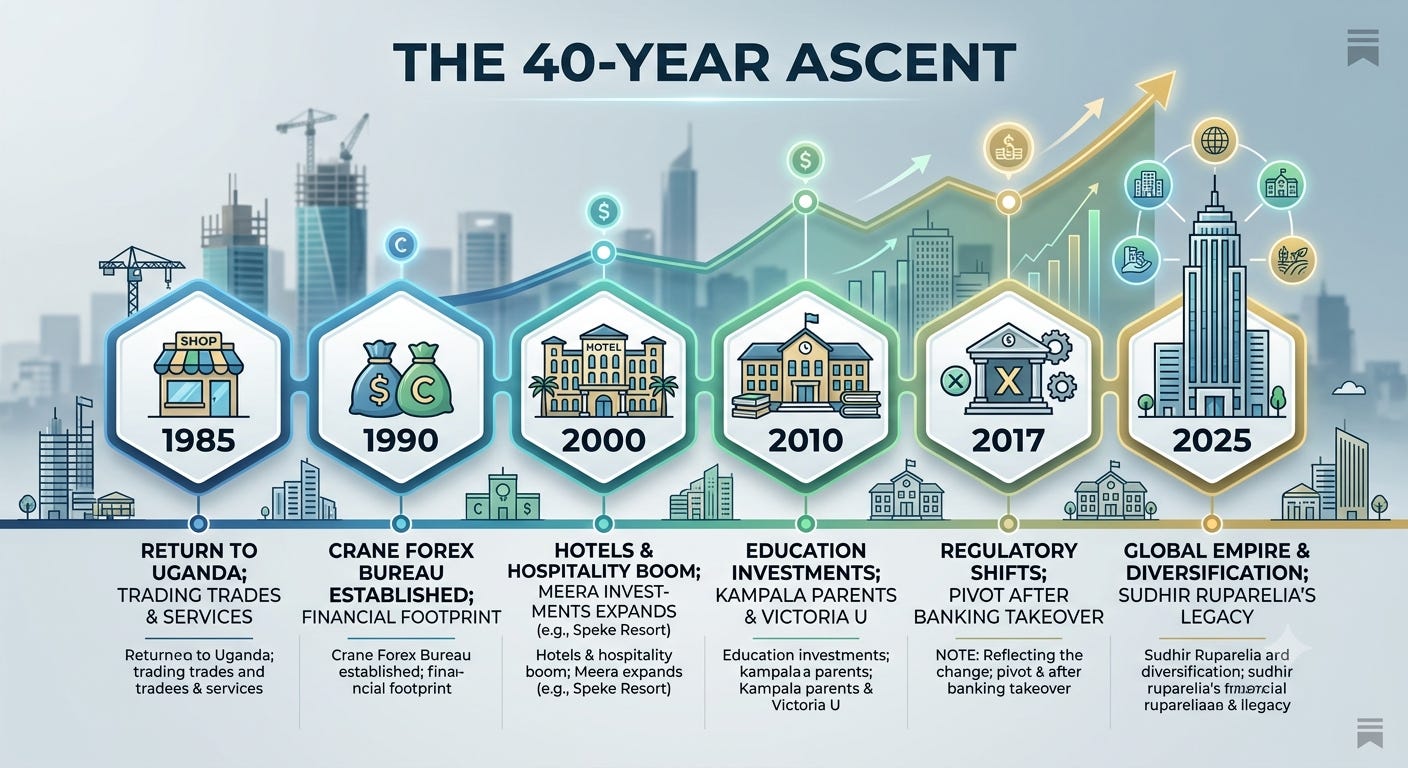
When Ruparelia returned to Uganda in 1985, he found a nation emerging from the wreckage of civil war and economic collapse. The state apparatus was hollowed out; the industrial base was nonexistent; and the shelves were bare. While most observers saw only risk, Ruparelia saw a perfect void.
He didn’t try to reinvent the wheel; he simply bridged the gap. Uganda was a country starved of basic comforts, while Kenya, just across the border, had a functioning, albeit recovering, consumer market. Sudhir’s “coup” was the realization that he could become the essential conduit for the Ugandan consumer. He began importing staples—beer, salt, and spirits—from Kenya, leveraging his nascent capital to secure the supply chains that nobody else was organized enough to manage.
This wasn’t just trade; it was high-stakes arbitrage. In a post-war economy where foreign exchange was a closely guarded luxury, Sudhir positioned himself as a trusted partner to both importers and retailers. He struck deals that allowed him to take inventory on credit, flip it rapidly, and settle his debts, creating a high-velocity cash flow cycle that functioned like a private bank long before he ever opened one. By the time he formalised his distribution structure, he was the primary gatekeeper for the goods that fueled Kampala’s social and domestic life. This initial wholesale success provided the liquidity—and, more importantly, the regulatory credibility—to pivot into foreign exchange, marking the transition from a trader of goods to a broker of capital.

III. The Architecture of the Empire: Ruparelia Group
The First Mover Advantage
Sudhir Ruparelia’s entry into the financial sector in 1989 with the founding of Crane Forex Bureau was a masterstroke of regulatory timing. In a post-liberalization Uganda, where currency volatility was high and formal financial institutions were scarce, the bureau wasn’t just a shop; it was the plumbing of the economy. By securing one of the first private licenses, Ruparelia tapped into the “flow of capital”—the critical nexus between traders, NGOs, and the emerging business class who needed reliable, accessible foreign exchange. This was the moment he moved from trading goods to trading value, establishing the trust and liquidity that would become the foundation of his banking empire.
Banking & The Crane Bank Saga
Crane Bank, established in 1995, was built on the premise of being the “largest privately owned Ugandan bank.” Its meteoric rise—driven by customer-friendly services and a relentless focus on SMEs—made it a national titan. However, its 2016 takeover by the Bank of Uganda remains a seminal moment in Ugandan corporate history. The regulator cited under-capitalization, leading to the bank’s sale to DFCU in 2017.
For many, this could have been the end. Instead, it highlighted Ruparelia’s profound resilience. Rather than retreating, he leveraged his deep-rooted real estate portfolio as a buffer, using the stable, non-financial assets of the Ruparelia Group to weather the regulatory storm. His subsequent legal battle, which culminated in a 2022 Supreme Court ruling in his favor, proved his ability to navigate both the courtroom and the boardroom, reinforcing his stature as an operator who treats business crises as long-term pivots rather than terminal failures.
Diversification Strategy: The Moat Portfolio
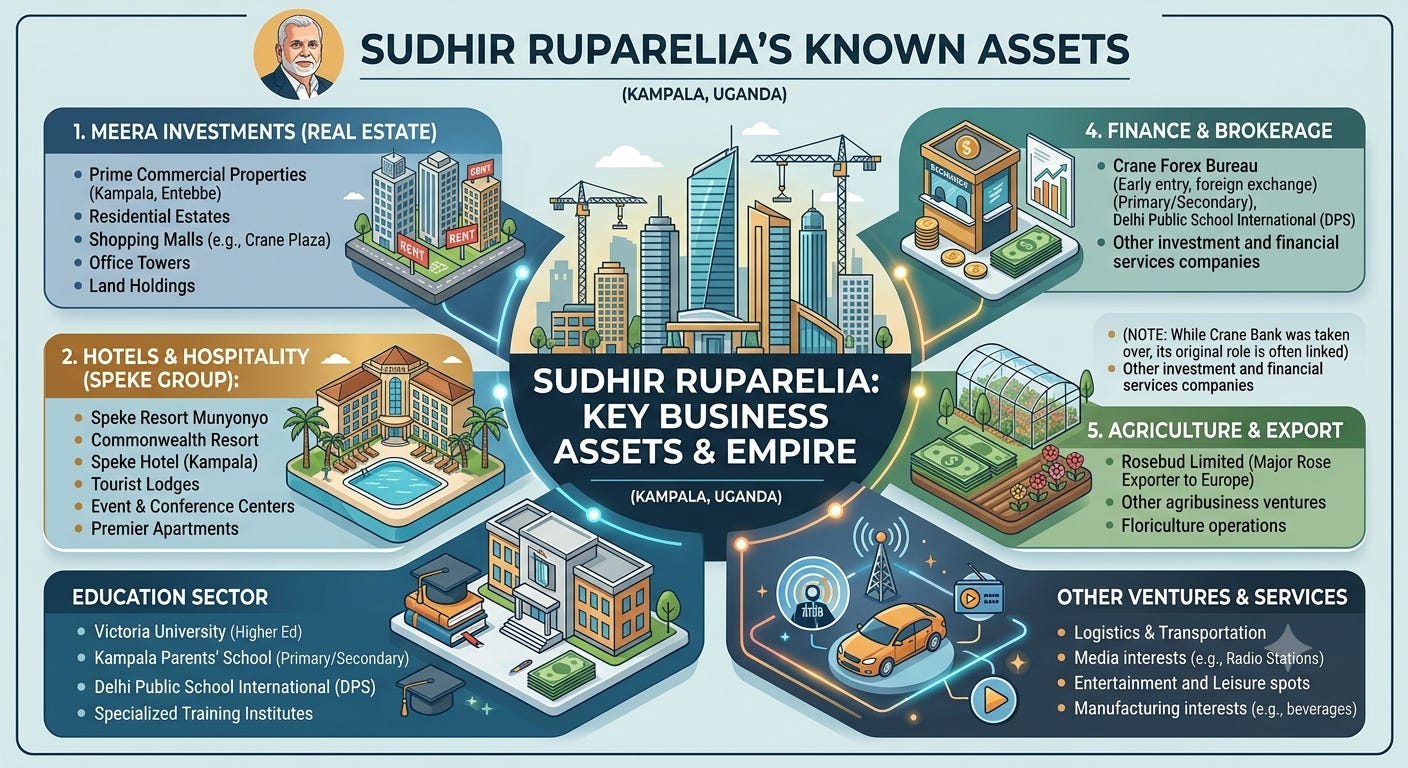
Ruparelia’s genius lies in his obsession with “moats”—sectors where infrastructure and scale provide a nearly insurmountable barrier to entry.
Real Estate (The Landlord of Kampala): Through Meera Investments, Ruparelia holds the largest commercial and residential portfolio in Uganda. He understood early that in a developing city, land is the ultimate store of value. By controlling prime locations across Kampala, he effectively taxes the city’s growth; every business that needs office space or retail access eventually becomes his tenant.
Education (Social Infrastructure): Institutions like Victoria University and Kampala Parents School are more than just businesses; they are long-term investments in the human capital of the nation. By embedding his brand into the country’s educational fabric, he secures a unique social license to operate that transcends standard corporate boundaries.
Hospitality & Agri-business: This division exemplifies his push for export-led revenue and high-end services. The Speke Group (including the flagship Munyonyo Commonwealth Resort) dominates the high-stakes conference and tourism market, while Rosebud Ltd has quietly become one of the region’s largest floriculture exporters, shipping millions of roses to the UK annually. These businesses provide a crucial hard-currency hedge, insulating the Group from the fluctuations of the local shilling.

This podcast provides a detailed look at the rise of the Ruparelia Group and the controversial history of Crane Bank
IV. The Power Matrix: Navigating Ugandan Politics
Proximity to Power

In the Ugandan context, the line between private enterprise and state stability is often blurred. Sudhir Ruparelia’s ascent is not merely a parallel to the Museveni era; it is deeply intertwined with it. When Ruparelia returned in 1985, he didn’t just find a market; he found a regime in the early stages of consolidating a post-conflict state. His business expansion—spanning high-visibility sectors like real estate, banking, and hospitality—has functioned in tandem with the state’s drive for modernization and infrastructure development. The “Sudhir Model” involves positioning his assets to serve the state’s most pressing needs: providing luxury accommodation for international summits (the Speke Resort at Munyonyo), facilitating foreign exchange when the central bank was lean, and building educational facilities that complement the state’s human capital goals. His receipt of the Golden Jubilee Presidential Medal and various state acknowledgments serve as public markers of this alignment, signaling that his empire is viewed as an essential component of the national economic framework.
The Indian-Ugandan Business Model
Ruparelia occupies a unique, high-stakes position as a bridge for international capital. Historically, the Ugandan-Indian business community has been a conduit for trade linkages between East Africa and the global markets, but Ruparelia has institutionalized this role. By building a group that is robust enough to act as a partner for international firms—while remaining deeply rooted in the local Kampala soil—he has insulated himself against the xenophobic or nationalist sentiments that plagued earlier generations of Asian-owned businesses in Uganda. He has effectively navigated the socio-political fabric by positioning his group as the “local face” of international-grade business, proving to foreign investors that there is a secure, reliable partner in Kampala capable of executing large-scale, western-standard projects.
Risk Management: The Philanthropy Shield
In a volatile political climate, visibility can be a liability. To manage this, Ruparelia employs a sophisticated risk-mitigation strategy centered on the Ruparelia Foundation. Philanthropy here is not just an act of altruism; it is a vital “license to operate.” By focusing on health, sports, and education, the Foundation generates immense grassroots goodwill that acts as a buffer against political shifts. When the Foundation supports a community eye camp or sponsors a sports tournament, it reinforces the narrative of the “citizen-magnate”—a figure who gives back as much as he extracts from the economy. Furthermore, his strategic use of these social initiatives allows him to build deep-rooted alliances across the non-profit, government, and business sectors. In the event of regulatory challenges, this network of beneficiaries and partners provides a layer of social and political defense that a purely profit-driven conglomerate would lack. It transforms his business from a private interest into a public institution, making it significantly harder for any regime to move against him without incurring a significant cost in public sentiment.

V. Personal Tragedy and Continuity
The 2025 Loss
In May 2025, the Ruparelia Group and the wider Ugandan business community were struck by the tragic passing of Rajiv Ruparelia, the group’s Managing Director, in a fatal car accident. His death at the age of 35 was a profound personal loss for his father, Sudhir, and the family, but it also sent shockwaves through the corporate landscape of Uganda. Rajiv, who had served as Managing Director since 2017, was widely viewed as the architect of the group’s modern expansion and a key figure in driving its diverse portfolio forward. His sudden absence forced an immediate conversation about the fragility of family-led empires and the critical importance of institutionalizing leadership beyond the singular vision of one family line.
Legacy and the Question of Succession
The tragedy of 2025 serves as a somber case study in business continuity for emerging market empires. For decades, the Ruparelia Group was synonymous with the singular, driven vision of Sudhir Ruparelia, and Rajiv had spent years positioning himself as the bridge to the next generation. The loss has brought into sharp relief the challenges of transitioning an empire built on a founder’s personal relationships, strategic acumen, and daily involvement into a sustainable, independent corporate entity.
For the Ruparelia Group, this moment necessitates a shift in corporate governance. The focus has moved from personal stewardship to the implementation of broader structural safeguards—such as clear governance frameworks, robust contingency planning, and the development of professional management tiers. The group’s future now rests on its ability to evolve from a “founder-led” model into a “governance-led” institution. For observers and investors, the next phase of the Ruparelia story is less about the singular success of one individual and more about whether the infrastructure—both human and corporate—that Rajiv helped cultivate is resilient enough to endure without the direct guidance of the two men who built it.
VI. Conclusion: The “Sudhir Model”
Synthesis: A Product or an Architect?
Sudhir Ruparelia’s career defies a binary categorization. He is neither purely a product of the system nor its sole designer; rather, he is the ultimate “adaptive occupant.” He arrived in 1985 at a moment of profound national fragility, acting as a structural filler in the economic voids left by years of conflict. While he certainly benefited from the stability and liberalization policies of the Museveni era, he simultaneously defined the contours of Uganda’s private sector by aggressively filling the gaps in banking, retail, and real estate where the state could not tread. His brilliance was not in creating the system, but in anticipating its evolution and ensuring the Ruparelia Group was the inevitable partner in every major growth phase of the nation.
The Bottom Line: Building in Africa
For the investor or the investigative observer, the Sudhir story offers a masterclass in the realities of “building in Africa”:
Patience is an Asset Class: His $1.2 billion fortune was not an overnight windfall. It was built over 40 years of meticulous, brick-by-brick asset accumulation. His trajectory proves that in emerging markets, longevity and the ability to weather regulatory or political shocks are as valuable as capital.
The Moat is Physical: In markets where financial or digital moats can evaporate due to policy shifts, hard assets (real estate) and social infrastructure (education and hospitality) provide the most enduring defense. By owning the physical space of the economy, he insulated his wealth from the volatility that destroyed his peers.
The License to Operate: Perhaps the most critical lesson is that in an environment where the political and the commercial are intertwined, “business” cannot exist in a vacuum. Ruparelia’s use of philanthropy and his strategic alignment with the state’s national development goals illustrate that in Africa, sustainable wealth requires a social license as much as a commercial one.
Ultimately, the “Sudhir Model” teaches that to build at scale in Africa, one must be prepared to be more than a capitalist—you must become a permanent, indispensable feature of the nation’s physical and social landscape.
This video provides an excellent visual overview of Sudhir Ruparelia’s rise, tracing the development of his empire alongside the broader shifts in Ugandan economic history
About Boardlot Africa Research
Boardlot Africa is a premier financial intelligence and corporate governance publication dedicated to unpacking the mechanics of capital, market strategies, and structural shifts across East Africa’s corporate landscape. By bridging the gap between raw economic data and actionable market intelligence, we deliver deep-dive research, independent corporate analysis, and policy insights designed for institutional investors, boardrooms, and sharp market observers.
Get in Touch
Email: boardlot.research@gmail.com
Phone: +254 753 133 901
Substack: Subscribe to Boardlot Africa
X (Twitter): BoardLotSultan