
1.0 Introduction: The Architecture of Risk
Market integrity is not merely a product of regulatory oversight; it is often forged by the internal courage of individuals who chose transparency over career stability. These whistleblowers are the only figures with the forensic access to uncover “inside secrets”—the hidden balance sheet anomalies that auditors and regulators frequently miss. Their decision to step forward acts as a binary financial calculation, where they consciously exchange their personal security and professional trajectory for the collective health of the Nairobi Securities Exchange (NSE) and the broader financial ecosystem.
2.0 The Pillars of Exposure
2.1 David Munyakei (Goldenberg): The Father of Kenyan Whistleblowing
Inside Secrets: In the early 1990s, David Sadera Munyakei, a 23-year-old clerk at the Central Bank of Kenya (CBK), noticed that the government was paying massive subsidies to Goldenberg International—a company formed by James Kanyotu—for gold and diamond exports, despite Kenya having no viable mines. He realized that the enterprise was a scam, with the government eventually paying out approximately Ksh 60 billion, an amount equivalent to a fifth of the country’s GDP at the time.
The Act of Valour: In 1993, Munyakei approached two opposition MPs with hard evidence, which was then tabled in Parliament, sparking a national outcry.
Life After Whistleblowing: Following his disclosure, Munyakei was arrested and charged under the Official Secrets Act. After his release, he discovered he had been sacked by the CBK and had become a target of the “deep state”. He fled to Mombasa to lay low, eventually emerging to testify before the Goldenberg Commission of Inquiry in 2003. Despite his patriotism, no significant accountability followed the inquiry, and he returned to hiding. He died in Narok in 2006, reportedly due to a lack of access to essential medicine.
2.2 John Githongo (Anglo Leasing): The Institutional Purge
John Githongo’s career is a testament to the high cost of transparency in a system designed for opacity. Before he became the central figure in the Anglo Leasing scandal, Githongo established himself as a meticulous observer of Kenyan governance.
Education and Early Career: Educated in Kenya and the United Kingdom, Githongo’s early career was defined by journalism. He rose to prominence as a sharp, investigative voice, most notably as an editor for The EastAfrican, where he gained a reputation for deep analysis of the political and economic landscape. Before joining the government, he was a key figure in the anti-corruption movement, serving as the head of Transparency International (TI) Kenya. His work there focused on data-driven advocacy, laying the groundwork for his transition into the public sector.
Government Appointment: Following the election of Mwai Kibaki in 2002, Githongo was appointed in 2003 as the Permanent Secretary for Governance and Ethics in the Office of the President. The appointment was viewed as a bold move by the new administration to signal a genuine shift toward integrity and accountability.
Inside Secrets: Once inside the machinery of government, Githongo began to uncover the “inside secrets” of state contracting. He unearthed a web of fraud known as the Anglo Leasing scandal, which involved massive government security contracts awarded to fictitious, offshore entities. These contracts were designed to siphon public funds under the guise of national security procurement.
The Fallout: As Githongo attempted to escalate these findings, he faced immediate and intense pushback from within the highest echelons of government. He realized that the corruption he was hired to purge was being orchestrated by the very individuals he served. His refusal to remain silent made him an internal target.
Personal Risk: By 2005, the pressure became untenable. Githongo received direct and credible death threats, which ultimately forced him to flee to the United Kingdom for safety. His departure was a seismic event that exposed the internal rot of the Kibaki administration and led to a temporary freeze in international aid, as donors lost confidence in the government’s anti-graft rhetoric.
Life After Fallout: Following his exile, Githongo remained a prominent anti-corruption campaigner. His life after the fallout became a permanent, high-profile crusade against institutional graft. He faced relentless smear campaigns, yet he persisted as an independent voice, continuing his work through organizations like Inuka Kenya Trust.
Market Legacy: Githongo’s legacy is foundational to modern Kenyan audit expectations. His work effectively dismantled the “security procurement” veil, forcing the state to adopt more transparent tendering processes. His revelations serve as the primary catalyst for the current regulatory focus on beneficial ownership and corporate governance, ensuring that phantom entities can no longer hide behind state contracts without facing heightened scrutiny.
The Anglo Leasing Saga: A Chronology of Corruption and Legal Litigation
The Anglo Leasing scandal is one of Kenya’s most protracted legal sagas. It originated from fraudulent government procurement contracts in the late 1990s and early 2000s, leading to a long series of investigations, political resignations, and complex, ongoing court battles.
Below is a timeline of the key events:
Phase 1: Origins and Exposure (1997–2006)
1997–2003: The initial procurement deals—intended for passport printing and police security systems—are established. These contracts are later found to be grossly overpriced and awarded to “phantom” companies.
2002: The scandal is first publicly exposed by a whistleblowing civil servant.
2004: British envoy Sir Edward Clay publicly denounces the corruption associated with Anglo Leasing, further pressuring the government.
January 2006: John Githongo, the former Permanent Secretary for Ethics and Governance, publishes a dossier detailing how top government officials and ministers attempted to bribe or threaten him to halt his investigations.
February 1, 2006: David Mwiraria becomes the first high-ranking official to resign as Finance Minister, claiming he wants to pave the way for investigations.
February 13, 2006: Kiraitu Murungi resigns as Minister for Energy following the allegations in the Githongo dossier.
Phase 2: Formal Charges and Court Drama (2015–2024)
March 2015: Several individuals, including the Kamani family and former government officials, are officially charged in court over their roles in the multi-billion-shilling scandal.
2015–2017: The case faces repeated delays. David Mwiraria is frequently excused from proceedings due to his battle with terminal cancer; he passes away on April 13, 2017.
January 19, 2024: In a major development, a trial magistrate acquits seven of the primary suspects, including the Kamani brothers and former Permanent Secretaries Joseph Magari, Dave Mwangi, and David Onyonka, citing insufficient evidence.
Phase 3: The Reversal and Current Status (2025–2026)
July/August 2025: The Director of Public Prosecutions (DPP) successfully appeals the 2024 acquittal. The High Court sets aside the previous acquittal, finding that the prosecution had established a prima facie case. The court orders the accused to be put on their defense.
February 2026: The Kamani brothers move to the Court of Appeal to contest the High Court’s order for a retrial/defense.
February 20, 2026: The Court of Appeal grants a temporary stay of proceedings for the Kamani brothers, effectively halting the defense phase of the trial while the appeal is heard.
May 2026: The court continues to monitor the status of the ongoing appeal. As of June 2026, the case remains active but is currently paused pending the resolution of the appeal in the higher courts.
Summary of Key Figures
The Kamani Family (Deepak, Rashmi, Chamanlal): Businessmen accused of receiving illegal payments linked to the security contracts.
Former Permanent Secretaries: Officials including Joseph Magari, Dave Mwangi, and David Onyonka were accused of abuse of office and failing to follow procurement laws.
David Mwiraria: Former Finance Minister who faced charges but died before the case concluded.
Note: The legal process is still technically ongoing for the surviving co-accused, as the “acquittal” was overturned and a defense phase was ordered, which is now subject to further appellate review.
2.3 Peter Odhiambo (Charterhouse Bank): The Financial Cleansing
Peter Odhiambo’s intervention at Charterhouse Bank remains one of the most clinical examples of an insider dismantling a corrupt financial engine from within. His actions forced a long-overdue reckoning for the Kenyan banking sector.
Professional Background: Before his role as a whistleblower, Odhiambo was a dedicated employee within the banking sector, possessing the technical knowledge required to navigate complex ledger systems. His position at Charterhouse Bank provided him with an unobstructed view of the institution’s internal operations and the irregularities that occurred behind the scenes.
Inside Secrets: Odhiambo exposed systemic money laundering and large-scale tax evasion at Charterhouse Bank. He provided concrete evidence that the bank operated multiple accounts under fictitious names, a practice designed to shield wealthy and politically connected clients from tax obligations and to facilitate illicit financial flows.
The Fallout and Personal Risk: Upon bringing these practices to light, Odhiambo faced significant professional hardship. He experienced a sudden collapse of his career trajectory, professional isolation, and was subjected to protracted, grueling litigation battles as he navigated the legal fallout of challenging a powerful financial institution.
Life After Fallout: Following the exposure, Odhiambo’s life was defined by the struggle to reclaim his professional reputation while continuing to cooperate with regulatory authorities. His persistence during these years was a major factor in keeping the investigation alive when powerful forces sought to sweep the bank’s closure under the rug.
Market Legacy: Odhiambo’s disclosures were the catalyst for the Central Bank of Kenya placing Charterhouse Bank under statutory management in 2006. His actions served as a critical stress test for the banking sector’s Anti-Money Laundering (AML) frameworks. Crucially, the shockwaves from this scandal directly informed the strengthening of Kenya’s financial architecture, accelerating the passage of rigorous Anti-Narcotics and Money Laundering laws, which today form the backbone of the country’s compliance ecosystem.
2.4 Njeru Kirira: The Governance Watchdog
Njeru Kirira represents the “insider-as-guardian” archetype, leveraging deep bureaucratic knowledge to expose how public resources were captured by private interests.
Professional Background: Before his role as a whistleblower, Kirira served as the Deputy Director of the Budget at the Ministry of Finance. His position gave him an authoritative vantage point over the national exchequer, allowing him to track how state funds were allocated and, more importantly, where they were being diverted.
Inside Secrets: Kirira provided pivotal evidence regarding corruption inherent in the Anglo Leasing scandal. He specifically highlighted how public funds were being misappropriated through highly inflated procurement deals, designed to funnel taxpayer money into the coffers of phantom companies under the guise of national security contracts.
The Fallout and Personal Risk: Speaking truth to power from within the Ministry of Finance carried immense consequences. By challenging the systemic misappropriation of funds, he became a target of administrative retaliation and faced intense professional isolation.
Life After Whistleblowing: His post-whistleblowing life was characterized by a difficult struggle to remain engaged in public policy. Because his public stance against systemic misappropriation made him an outlier in the rigid, patronage-heavy professional environments he had previously served, he found himself effectively sidelined from the high-level policy roles that had defined his career.
Market Legacy: Kirira’s persistence helped dismantle the perception that elite procurement deals were untouchable. By forcing a higher level of public scrutiny on government budget allocations, he paved the way for modern requirements in transparency and accountability that now govern national capital expenditure—a vital component for maintaining the stability of the national capital markets.
2.5 Jecinta Mwatela: The Regulatory Guardian
Jecinta Mwatela serves as the definitive example of the “regulatory firewall”—the individual who stands between the sanctity of the financial system and the reach of political capture.
Professional Background: Before becoming a whistleblower, Mwatela built a distinguished career within the Central Bank of Kenya (CBK), eventually rising to the position of Deputy Governor. Her deep technical understanding of monetary policy and banking supervision made her a highly respected figure in the institution.
Inside Secrets: As Deputy Governor, Mwatela famously refused to sign documents that would have facilitated the irregular acquisition of a bank. This decisive act effectively blocked maneuvers within the Charterhouse Bank saga that were intended to bypass established regulatory hurdles.
The Fallout and Personal Risk: By choosing to uphold the rule of law over political expediency, Mwatela invited the wrath of powerful interests. She faced significant professional backlash for her refusal to compromise her regulatory standards, which placed her at odds with key decision-makers at the time.
Life After Whistleblowing: Following her refusal to comply, Mwatela’s contract was not renewed, and she was largely excluded from high-level regulatory roles. This forced a difficult and abrupt transition out of the senior public sector positions she had spent her career building.
Market Legacy: Her refusal to compromise served as a defining moment for the independence of the CBK. It sent a powerful signal to both local and international institutional investors that the regulator would prioritize financial stability and institutional integrity over political pressure, thereby reinforcing the credibility of Kenya’s banking supervision frameworks.
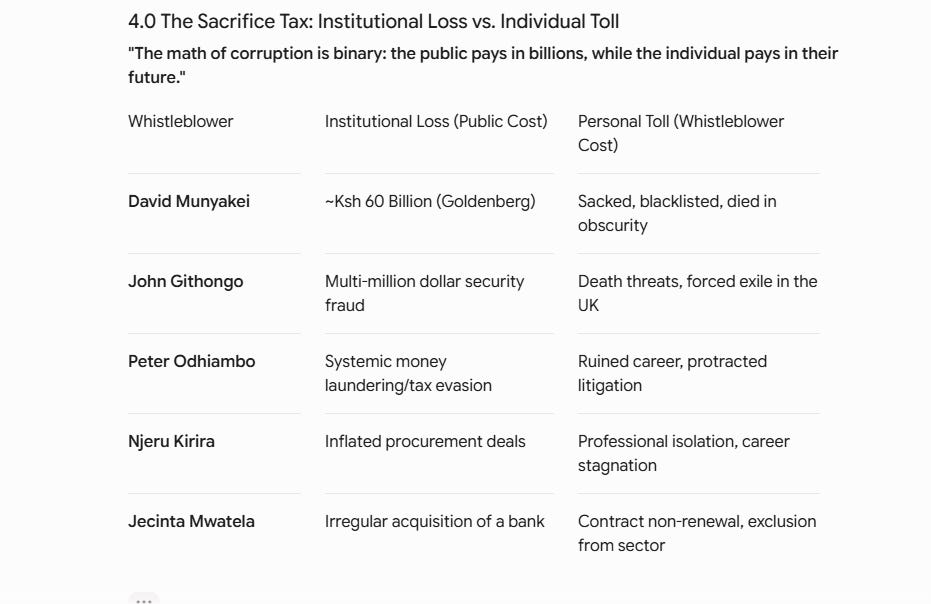
4.0 The Sacrifice Tax: Institutional Loss vs. Individual Toll
“The math of corruption is binary: the public pays in billions, while the individual pays in their future.”
5.0 The Modern Governance Gap: Investor Pro-Tips
We have moved past the era of blatant “gold-smuggling” schemes, but the underlying issue of accountability remains. Today, “Inside Secrets” are often buried in complex derivative structures, cross-shareholding agreements, and opaque offshore parent companies. As investors, we must be our own forensic analysts.
The Boardlot Sultan’s Governance Red Flag Checklist:
The “Shell Game” Indicator: Beware of major contracts awarded to entities with no public footprint, no history of operational delivery, or those that serve as “pass-through” vehicles for national projects.
The “Ledger Anomaly”: Watch for massive, unexplained cash outflows to non-commercial entities that lack a clear business justification—if the “math” doesn’t add up on the balance sheet, it rarely does in reality.
The “Institutional Squeeze”: Monitor the turnover of senior compliance or regulatory officers. If the people tasked with “regulatory firewalls” are being marginalized, pushed out, or having their contracts denied renewal, it is a high-conviction signal of governance rot.
Beneficial Ownership Opacity: In an era of digital trading, the inability to verify the ultimate beneficiary behind a block trade or a major procurement contract is the single greatest risk to your “Closed Portfolio” stability.
6.0 Conclusion: The Market’s Silent Benefactors
For the savvy investor, true corporate governance is not found in the boilerplate language of an annual report or the polite veneer of a boardroom—it is forged in the moral fiber of the people working inside the firm. The market stability and institutional trust that we enjoy today are built upon the ruins of the professional lives of David Munyakei, John Githongo, Peter Odhiambo, Njeru Kirira, and Jecinta Mwatela.
They paid the “sacrifice tax” so that the market could gain its integrity. Their legacy is the silent dividend that ensures our capital remains protected, our institutions remain accountable, and our markets remain viable for the long term. As we continue to build our portfolios, let us remember that the most valuable asset in any financial system is the courage of those who refuse to let the ledger lie.

