
Currency, Courts, and Capital: How the Pattni Legal Battles Forced the Transformation of the Central Bank of Kenya
Inside This Briefing: The Architecture of State Capture
Chapter I: The 25-Year-Old Who Broke the Treasury
Chapter II: From the Coast to Capital: The Early Foundations
Chapter III: The 1990 Sandbox: IMF Mandates and Forex Starvation
Chapter IV: The State House Alliance: Access, Patronage, and President Moi
Chapter V: Alchemy on Haile Selassie Avenue: Inside the Goldenberg Machine
Chapter VI: The Battle of the Tycoons: Swallowing the Somaia Empire
Chapter VII: The Paper Tsunami: Billions Printed and the Shilling’s Freefall
Chapter VIII: The Bosire Commission: Deconstructing the Code of State Capture
Chapter IX: The Long Wash: Commissions, Asset Seizures, and Structural Clean-Up
Chapter X: The Altar of Immunity: The Transformation into “Brother Paul”
Chapter XI: The Second Act: Exporting the Blueprint to Harare
Chapter XII: Conclusion: The Dark Blueprint of Systemic Risk
Chapter I: The 25-Year-Old Who Broke the Treasury
Central banks grow robust through international benchmarking; clearing houses modernize via technocratic foresight; and monetary law sharpens under the steady hand of seasoned jurists.
The most radical structural shifts in the country’s financial architecture—the legal insulation of the Central Bank of Kenya (CBK), the death of discretionary export subsidies, and the total overhaul of national currency management systems—were not born out of peaceful administrative planning. They were forced into existence as an act of raw institutional self-defense.
The catalyst was not a veteran financier or a central bank governor, but an ambitious 25-year-old jewelry merchant from Mombasa: Kamlesh Mansukhlal Pattni.
In the early 1990s, by securing a highly irregular 35% financial compensation package for the “export” of non-existent gold and diamonds, Pattni created a literal loop of financial alchemy.
The sheer scale of the Goldenberg operation did more than spark a hyper-inflationary crisis that sent the Kenyan Shilling into a historic freefall. The protracted litigations, the landmark judicial inquiries, and the eventual statutory clean-up of the Pattni era provided the painful, expensive blueprint upon which modern East African monetary jurisprudence is built. To truly understand why the modern Central Bank of Kenya wields its current statutory autonomy, one must first understand the day the treasury gates were completely taken over from within.

Chapter II: From the Coast to Capital: The Early Foundations
He was not a product of Wall Street, the City of London, or traditional commercial banks. His unique advantage lay in the fact that he approached the structural systems of the Central Bank of Kenya with the eyes of a traditional, multi-generational merchant.
Born in Mombasa in 1965, Pattni grew up within a close-knit, traditional Hindu family belonging to the Pattni caste—a community historically defined by their expertise as goldsmiths, jewelers, and traders. Long before he ever walked into a government ministry, Pattni understood the exact margins of the gold trade, the premium placed on raw purity, and the intricate, cross-border informal networks used to move high-value assets between East Africa, Europe, and the Middle East.
He recognized early on that a physical asset like gold was not just a luxury product to be sold in a retail shop on Biashara Street—it was a powerful financial instrument that could be used as leverage to exploit structural gaps in a developing economy’s balance sheet.

Chapter III: The 1990 Sandbox: IMF Mandates and Forex Starvation
To understand how Kamlesh Pattni systematically dismantled the integrity of the Kenyan Shilling, one must first understand the severe macroeconomic vulnerabilities of the sandbox he walked into. The early 1990s in Kenya were defined by an acute, existential crisis of state liquidity.
Under pressure from Washington Consensus institutions, the Government of Kenya had entered into complex, highly restrictive Structural Adjustment Programs (SAPs) mandated by the International Monetary Fund (IMF) and the World Bank. These programs demanded aggressive economic liberalization, the dismantling of price controls, and the reduction of direct state interference in the market.
International bilateral donors and multilateral lenders took a drastic step in late 1991: they completely suspended fast-disbursing foreign aid and balance-of-payments support to Kenya.
The impact on Kenya’s capital and currency management systems was catastrophic. The Central Bank of Kenya’s foreign exchange reserves plummeted to levels barely capable of covering a few weeks of essential national imports. Kenya was gasping for foreign exchange.
The government leaned heavily into the Export Compensation Act, a statutory mechanism designed to incentivize non-traditional exports. The logic behind the law was sound on paper: any local exporter who shipped non-traditional goods abroad and legally remitted the hard foreign currency proceeds back to the Central Bank of Kenya would receive a 20% cash subsidy from the Treasury to offset their local production costs.
This emergency trade policy, born out of economic starvation, created the exact structural loophole Kamlesh Pattni was looking for. By presenting a grand solution to Kenya’s forex crisis, a young merchant was about to turn a defensive piece of trade legislation into the ultimate financial weapon.
The lock was turned following a chance, almost mundane encounter at a high-end tailor's shop in Nairobi. There, Pattni literally bumped into James Kanyotu, the long-serving Director of the Special Branch—Kenya's dreaded and immensely powerful internal intelligence unit. Striking up a conversation, the sharp-witted 25-year-old jeweler pitched his grand solution to the national forex crisis. Kanyotu, recognizing the staggering macroeconomic utility (and personal profitability) of the proposal, did not merely endorse the idea; he became a founding co-director and shareholder in Goldenberg International Limited.

Chapter IV: The State House Alliance: Kamlesh meets Moi
No financial exploit of this magnitude can succeed through technical cleverness alone; it requires absolute political immunity. Armed with his partnership with James Kanyotu, Kamlesh Pattni did not lobby middle-tier bureaucrats or wait in line at commercial banking desks. The Director of the Special Branch bypassed every layer of state bureaucracy, walking his young protégé directly into the corridors of power at State House to present him to the absolute center of political gravity in the republic: President Daniel arap Moi.
The intersection of interests between the young tycoon and the veteran head of state was a textbook example of state capture. Entering the early 1990s, the Moi administration faced two monumental, interlocking crises: the freezing of international foreign aid and the fast-approaching 1992 general election—the first multi-party democratic contest in Kenya’s post-independence history.
Pattni walked into State House with a pitch that solved both problems simultaneously. He claimed that Goldenberg International had the unique capacity to source, process, and export massive quantities of gold and diamonds from the region to international buyers in Dubai and Switzerland. In exchange for routing hundreds of millions of dollars in hard foreign currency back into the dry vaults of the Central Bank of Kenya, Pattni demanded two extraordinary concessions:
An absolute, legally enforced monopoly on the export of Kenya’s gold and silver.
An irregular, extra-legal 15% ex-gratia top-up on top of the standard 20% export subsidy, bringing his total state-guaranteed payout to an astonishing 35%.
The deal was struck at the highest levels of political power. With the explicit, top-down backing of President Moi, the traditional institutional checks and balances of the Kenyan civil service were instantly paralyzed. High-ranking officials at the Treasury, the Ministry of Environment and Natural Resources, and the Central Bank of Kenya were given unambiguous directives from the executive: facilitate Goldenberg International without friction.
By anchoring his financial engineering scheme directly within the presidency, Pattni ensured that any internal auditor, customs official, or central bank clerk who dared to question the legitimacy of his transactions was not just challenging a private businessman—they were committing an act of political defiance against the state itself. The plumbing of Kenya’s financial system was officially tethered to a political survival machine.

Chapter V: Alchemy on Haile Selassie Avenue: Inside the Goldenberg Machine
With absolute political coverage secured, Pattni set about constructing the actual mechanics of the Goldenberg machine. The fundamental flaw that Pattni exploited was that the state’s regulatory bodies treated documentation as absolute proof of physical reality. The Goldenberg machine relied on the fiction of “virtual gold.”
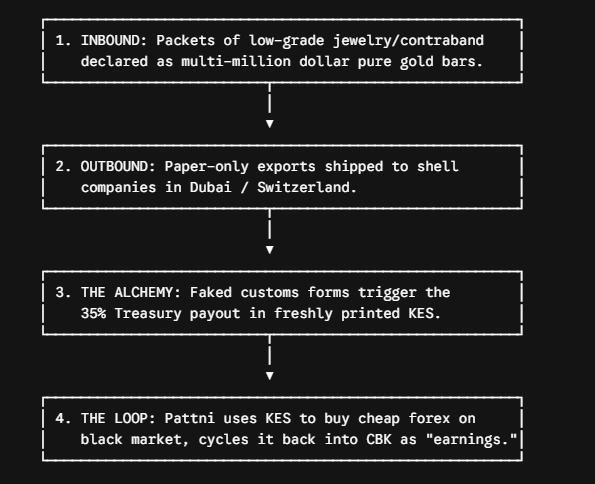
The process followed a precisely engineered, infinite loop:
The Declaration: Goldenberg International would present customs declaration documents at Jomo Kenyatta International Airport (JKIA) claiming to export massive, multi-million dollar consignments of pure gold bars and diamonds. In reality, the crates contained little more than low-grade gold jewelry, brass scrap, or absolutely nothing at all. Kenya, geologically speaking, did not even possess commercial deposits of gold or diamonds capable of generating such volumes.
The Paper Export: The phantom cargo was shipped out to shell companies controlled by Pattni and his associates in Dubai and Switzerland.
The Financial Trigger: Pattni would then march into the Treasury and the Central Bank of Kenya with the stamped customs forms and faked foreign exchange remittance certificates. Because he had the backing of State House, these documents were processed with zero physical verification. The Treasury immediately paid out the 35% export compensation subsidy in local currency.
The Arbitrage Loop: To keep the machine running, Pattni needed to show that hard foreign currency was actually flowing back into Kenya from his overseas “buyers.” He took the billions of unbacked Kenyan Shillings handed to him by the Treasury, went into the parallel black market (and later his own commercial banks), bought up genuine, scarce US dollars at a premium, and then legally deposited those dollars back into the Central Bank of Kenya as “export earnings” from Goldenberg.
This was financial alchemy in its purest form. Pattni was using Kenya’s own money to buy foreign currency, returning that foreign currency to the Central Bank, and charging the state a 35% premium for the privilege.
To maximize the efficiency of this loop, Pattni took the ultimate structural step: he established his own licensed commercial financial institution, Exchange Bank Limited. Exchange Bank gave him direct access to the Central Bank of Kenya’s overnight lending facilities, clearing houses, and foreign exchange desks, allowing him to bypass standard commercial bank scrutiny and push billions of paper shillings directly into the bloodstream of the Kenyan economy.

Chapter VI: The Battle of the Tycoons: Swallowing the Somaia Empire
As the Goldenberg machine minted unbacked billions, Kamlesh Pattni’s financial ambitions expanded far beyond shadow banking and foreign exchange arbitrage. He sought to convert his volatile paper liquidity into enduring, blue-chip capital assets. This aggressive drive for corporate consolidation inevitably set him on a spectacular collision course with another notorious billionaire of the era: Ketan Somaia.
Somaia was the reigning king of corporate Kenya in the early 1990s, sitting atop a vast conglomerate known as the Dolphin Group. His empire spanned prime real estate, the luxury hospitality sector, automotive franchises, and media. However, as Somaia’s aggressive, debt-fueled global expansions began to buckle under the weight of legal scrutiny and impending bankruptcy crises in the United Kingdom and overseas, Pattni saw a profound structural opportunity. He did not merely negotiate; he launched a predatory, hostile campaign to swallow the Somaia empire whole.
The corporate warfare between the two tycoons reached its peak not in a stuffy Nairobi boardroom or a formal court of law, but in the ultimate theater of 1990s billionaire excess. As the story goes, the definitive transfer of some of Kenya’s most prized corporate assets was finalized mid-air, aboard a private jet cruising high above East Africa.
While sipping fine wine in the pressurized luxury of the cabin, a cornered and financially bleeding Somaia signed over his empire to the young, sharp-suited Pattni. It was a scene straight out of a Hollywood corporate thriller: two titans of political patronage casually trading iconic hotels and automotive empires over a vintage glass, completely detached from the macroeconomic chaos their financial gymnastics were inflicting on the ground below.
The price tag for this mid-air surrender was as staggering as the setting. Pattni claimed to have paid a jaw-dropping 17 billion KES to acquire 95% of the shares across Somaia’s prime commercial vehicles. In 1992, that amount of liquidity was equivalent to roughly $500 million USD—an absolutely monstrous sum for a single private corporate acquisition in East Africa at the time. It represented a massive chunk of the very liquidity Pattni was siphoning out of the Central Bank of Kenya via his Goldenberg International export scheme and Exchange Bank overnight clearing loops.
Through this massive 17 billion KES transaction, Pattni stripped the Dolphin Group of its crown jewels and seized control of an extraordinary portfolio of mainstream capital assets:
Block Hotels: Pattni took over one of East Africa’s most iconic hospitality brands, gaining ownership of ultra-premium tourism properties including the historic Nyali Beach Hotel in Mombasa and the highly lucrative Keekorok Lodge in the Maasai Mara.
Marshalls East Africa: He captured the prestigious automotive hub that held the exclusive franchise for Peugeot, which at the time was the preferred vehicle brand for the entire Kenyan government fleet and corporate sector.
United Touring Company (UTC) & International Casino: He absorbed the country’s largest tourism transport fleet and prime gaming hubs in Nairobi and Mombasa.
However, this empire-grab would trigger a decade-long legal quagmire. Somaia and his corporate boards fiercely disputed the transfer in court, claiming the final share certificates were never legally executed. When the Bosire Commission of Inquiry eventually conducted its post-mortem on the transaction, it bypassed the boardroom drama and applied a cold, regulatory lens. The Commission noted a damning jurisprudential reality: even if the 17 billion KES transfer was executed, Pattni could only have done so using the direct proceeds of the Goldenberg fraud.
This aggressive corporate raid demonstrated that Pattni was far more than a transient shadow dealer hiding behind faked customs forms. By swallowing Somaia’s empire in a cloud of mid-air opulence, he had successfully converted paper fraud into systemic control over the foundational pillars of Kenya’s hospitality, tourism, and automotive sectors. He had evolved from a central bank arbitrageur into one of the largest corporate landlords and franchise owners in the republic, proving just how deeply his financial footprint had warped the ownership structure of Kenyan capital.
Chapter VII: The Paper Tsunami: Billions Printed and the Shilling’s Freefall
The mid-air wine toasting and the 17 billion KES corporate acquisitions of the elite masked a grim macroeconomic reality. The billions of shillings flowing out of the Treasury and into Pattni’s Exchange Bank were not backed by genuine economic productivity, gold reserves, or foreign currency inflows. The state was quite literally printing money to fund Pattni’s infinite arbitrage loop, unleashing a catastrophic paper tsunami into the Kenyan economy.
The raw math of the exploitation was monumental. At the peak of the scheme, Goldenberg International claimed and successfully extracted 45 million USD in raw export compensation rebates from the state. Internal Central Bank of Kenya inspectors, working alongside IMF-seconded advisors, eventually blew the whistle when they flagged a jaw-dropping 17 billion KES in highly irregular payout documentation passing through the clearing house.
When the Bosire Commission of Inquiry finally mapped the entire network of ghost exports, check-kiting loops, and overnight lending drawdowns, the total volume of tainted transactions traced to Goldenberg hit an unbelievable 158.3 billion KES—a financial hemorrhage that effectively cost Kenya more than 10% of its entire Gross Domestic Product (GDP).
The monetary consequences of dumping this unbacked volume of paper into the market were swift and merciless. Under the foundational laws of supply and demand, the sudden, artificial explosion of local currency completely broke Kenya’s monetary stability:
M . V = P . Y
As the money supply (M) expanded at an exponential rate without any corresponding increase in real economic output (Y), the price levels (P) exploded.
By 1993, inflation in Kenya breached the terrifying threshold of 100%. The purchasing power of ordinary citizens evaporated overnight. Basic commodities skyrocketed in price, and the local banking sector began to buckle under the weight of toxic, unbacked liquidity.
Before the Goldenberg exploit, the shilling had traded at relatively stable, controlled rates against major global currencies. As Exchange Bank cornered the market—mopping up genuine dollars from the interbank market and replacing them with mountains of freshly printed paper shillings—the value of the local currency collapsed. The exchange rate against the US Dollar plummeted from a stable 24 KES to a crushing 60 KES in a matter of months.
It exposed a fundamental jurisprudential flaw in the country’s legal architecture: the Central Bank of Kenya was not legally or operationally autonomous. Under the existing statutory framework, the executive branch could simply command the CBK governor to print money, expand credit, and clear irregular transactions at will.
The paper tsunami proved that without absolute statutory insulation from political interference, a central bank in an emerging market is not a regulatory guardrail—it is a hostage.
Chapter VIII: The Bosire Commission: Deconstructing the Code of State Capture
By the early 2000s, the shadow architectural masterclass designed by Kamlesh Pattni could no longer be contained within the silent vaults of Exchange Bank or the confidential files of the Treasury. The bubble had burst, a new administration had taken the reins of state, and Kenya was demanding a reckoning. What followed was not a quiet, behind-the-scenes regulatory audit, but a full-blown judicial theater that transfixed the entire country: The Judicial Commission of Inquiry into the Goldenberg Affair, universally known as the Bosire Commission.
To spearhead this historic inquest, President Mwai Kibaki appointed a team of unassailable judicial officers and legal veterans, whose bench consisted of:
The Chairman: The Hon. Mr. Justice Samuel E. O. Bosire, J.A.
The Commissioners: Senior Counsel and veteran lawyer Peter Le Pelley, alongside the Hon. Mr. Justice Daniel Aganyanya
The Joint Secretaries: Managed by Justice William Ouko (then High Court Registrar) and George M. Kepler
The Assisting Counsel Team: Led by Senior Counsel Bernard Chunga, alongside a sharp team including legal mind Dorcas Oduor
Before this bench even called its first witness, the sheer logistical and administrative scale of the tribunal signaled to the public that this was a legal leviathan unlike anything East Africa had ever seen:
◇ Duration: 2 Years, 8 Months (Appointed February 2003; Report completed October 2005)
◇ Total Public Hearings: 291 Days of continuous, live-televised legal combat
◇ Witnesses Called: 102 Oral Witnesses spanning former Vice Presidents, Cabinet Ministers, spy chiefs, and central bankers
◇ Legal Representation: Over 100 of Kenya’s Elite Lawyers packing the benches, creating the largest assembly of legal minds in national history
◇ Verbatim Transcript Pages: 18,824 Pages of recorded oral evidence and cross-examinations
◇ Exhausted Documents & Exhibits: Thousands of Primary Documents, ledgers, and faked customs forms collated into a massive multi-volume report running from Appendices A to Q
For months on end, this inquiry became a riveting national spectacle broadcast on television daily. Across towns and villages, from Nairobi boardrooms to rural homesteads, millions of Kenyans glued their eyes to TV screens every evening. It was a collective, televised autopsy of a nation’s financial plumbing. For the first time in Kenyan history, the elite class—former cabinet ministers, central bank governors, permanent secretaries, and intelligence chiefs—were forced to sit in the witness dock under the harsh glare of studio lights and answer for the missing billions.
To navigate this high-stakes arena, the commission drew the largest assembly of top lawyers ever witnessed in a single Kenyan courtroom. The benches were packed with the absolute titans of the bar—senior counsels, sharp constitutional experts, and seasoned criminal defense minds representing an intricate web of suspects, state institutions, and corporate proxies. Every morning, the chamber turned into a gladiatorial arena of procedural warfare, objections, and forensic cross-examinations.
It quickly evolved into an unprecedented, high-stakes test of wits and legal drama. At the absolute center of this storm was Kamlesh Pattni himself. Facing a relentless barrage of questions from the state’s sharpest prosecutorial minds, Pattni did not crumble. Instead, he treated the inquiry like a final, masterclass performance in survival. Armed with an encyclopedic memory, a calm demeanor, and truckloads of meticulously organized corporate files, he matched the lawyers move for move.
Pattni used the televised platform to drop explosive, calculated bombshells, casually detailing exactly which politicians received “political donations” packaged in leather briefcases, and how top state officials actively signed off on the 17 billion KES loop. The hearings blurred the lines between a formal judicial inquiry and an addictive prime-time soap opera. It was a profound psychological moment for the republic: a front-row seat to the deconstruction of state capture, proving that the law was no longer just a set of dry statutes in a book, but a dynamic, combative weapon used to unmask how a country was nearly broken from within.
The Key Findings: Codifying the Anatomy of the Fraud
When the Commission finally submitted its exhaustive, multi-volume report to President Kibaki, its findings systematically stripped away the corporate and political smoke-and-mirrors to reveal the staggering structural damage inflicted on the republic. The core judicial findings concluded that:
The Myth of the Golden Cargo: The primary pillar of Goldenberg International—the massive export of gold and diamond jewelry—was an absolute fiction. The Commission confirmed that Kenya possessed no commercial deposits of diamonds and completely insignificant gold reserves. The operation began using low-grade smuggled contraband and quickly degenerated into a pure paper scam where export declaration forms were entirely falsified to trigger state payouts.
The 158.3 Billion Shilling Bleed: The financial devastation was precisely quantified. The Commission discovered that a staggering 158.3 billion KES of public funds had been transacted and filtered through an intricate network of 487 shell companies, corrupt commercial banks, and politically exposed individuals. Out of this, Goldenberg International sat at the apex of the theft, directly pocketing 35.3 billion KES in unbacked payouts.
Executive Complicity and Top-Down Directives: The Commission explicitly pierced the veil of political immunity, establishing that the fraud was enabled by an institutional breakdown engineered from the absolute top. It concluded that Vice President and Finance Minister Prof. George Saitoti had irregularly authorized the extra-legal 15% ex-gratia subsidy despite vehement objections from internal Treasury technical advisors. Furthermore, it flagged massive, direct Central Bank drawdowns—including a single 5.8 billion KES payment in 1993—that bypassed all clearing safeguards under direct executive pressure.
Institutional Weaponization: The report detailed how Kamlesh Pattni’s Exchange Bank Limited and a network of complicit local financial institutions functioned as systemic check-kiting and money-laundering hubs. These entities deliberately weaponized the Central Bank’s overnight liquidity windows and clearing systems to funnel cash directly to the ruling party, KANU, to finance the 1992 general election, paralyzing the regulatory authority of the state.
The Bosire Commission’s findings provided the definitive historical and economic blueprint of how grand corruption operates when it is protected by the highest echelons of state power. It proved that the Goldenberg Affair was not a failure of banking systems, but a deliberate, top-down dismantling of the republic’s monetary architecture.

Chapter IX: The Long Wash: Asset Recovery, the Grand Regency, and Structural Clean-Up
With the conclusion of the Bosire Commission’s public hearings, the state was forced to pivot from public exposure to asset recovery and institutional reconstruction. This era became known as the “Long Wash”—a protracted, highly litigated decade of legal counter-offensives, forced liquidations, and deep statutory re-engineering designed to claw back billions in stolen public wealth and permanently immunize Kenya’s monetary architecture from executive capture.
The immediate, high-stakes battleground for recovery centered directly on Kamlesh Pattni’s most visible and ultra-premium capital asset: The Grand Regency Hotel in Nairobi.
The Siege of the Grand Regency Hotel
The narrative of the Grand Regency was inextricably tied to the financial plumbing of the fraud. Constructed between 1989 and 1993 under Kamlesh Pattni’s corporate vehicle, Uhuru Highway Development Limited (UHDL), the ultra-luxury hotel saw its construction costs balloon artificially from an initial estimate of 30 million USD to over 100 million USD. Central Bank investigators flagged the property as a massive money-laundering hub, built using unbacked liquidity siphoned directly from the CBK through Exchange Bank Limited clearing loops.
The legal battle for the hotel unfolded through a sequence of sharp interventions:
The Statutory Charge (October 1993): As the Goldenberg machine collapsed, the Central Bank of Kenya, under intense pressure from the IMF, forced Pattni and UHDL to execute a formal statutory charge over the Grand Regency property. This charge secured a documented debt of 2.5 billion KES owed to the CBK by the collapsing Exchange Bank Limited.
The Receivership and Seizure (1994–1996): Following the voluntary liquidation of Exchange Bank, the CBK stepped in to exercise its statutory power of sale. Pattni tied the state up in a knot of injunctions and civil appeals for more than a decade, arguing over the exact valuation of the asset and the validity of the underlying debts.
The 2008 Secret Surrender and Libyan Sale: The climax of the hotel’s recovery arrived in early 2008 under a storm of political controversy. Central Bank Governor Njuguna Ndung’u and Amos Kimunya (then Minister for Finance) overseen a deal where Pattni finally surrendered the physical asset to the state in exchange for immunity from certain outstanding economic crimes. Almost immediately, the CBK sold the hotel for a heavily disputed 45 million USD (approximately 2.9 billion KES at the time) to Laico Libya, a Libyan state-backed investment vehicle. The hotel was subsequently rebranded as the Laico Regency, marking the permanent extraction of Pattni’s crown jewel from his corporate empire.
The Systematic Dismantling of the Shadow Portfolio
Beyond the luxury hotel, the state moved aggressively to dismantle the remainder of Pattni’s 17-billion-shilling corporate portfolio. This clean-up operation required untangling legitimate commerce from the proceeds of crime, executed via the High Court and the Deposit Protection Fund Board (DPFB):
◇ Exchange Bank Limited: Placed under involuntary liquidation by the CBK. Its banking license was permanently revoked, and its internal clearing ledgers were locked away as state evidence, freezing Pattni’s primary institutional conduit to the national clearing house.
At the operational helm of Exchange Bank Limited, the traditional distinctions between executive oversight and shadow operations were entirely blurred. The institution was fundamentally anchored by its two principal founders and co-directors: the mastermind Kamlesh Pattni, who dictated the bank’s aggressive capital maneuvers, and James Kanyotu, the Director of the Special Branch, who provided the ultimate shield of political and intelligence immunity. To navigate the complex daily compliance machinery and handle the multi-billion-shilling clearing loops with the Central Bank of Kenya, the bank relied on a trusted inner circle. This included Kamlesh’s brother, Nagin Pattni, along with specialized treasury and operational managers who treated documentation as absolute proof of physical reality. Rather than functioning as a standard commercial treasury board, this tight-knit senior team operated strictly as a closed-loop command structure, perfectly positioned inside the clearing house to weaponize the country's overnight liquidity windows without external institutional friction.
◇ Marshalls East Africa & Block Hotels: The state systematically validated the claims of creditors and the original boards. After years of litigation, Pattni’s predatory mid-air share acquisitions were unwound. Control of the highly lucrative Peugeot automotive franchise and premium tourism properties like Keekorok Lodge and the Nyali Beach Hotel was stripped from Pattni’s proxies and returned to legitimate corporate management or sold off to satisfy outstanding tax and banking liabilities.
◇ Pan African Bank Group: This heavily compromised financial institution, which Pattni had used to hide related-party transactions, was placed into liquidation by the DPFB, wiping out the parallel banking networks that supported the Goldenberg machine.
The Pan African Bank Conduit: Crashing the Elite Network
Before Exchange Bank Limited was built from scratch to anchor the Goldenberg machine, Kamlesh Pattni aggressively captured an existing financial institution to pilot his clearing and check-kiting maneuvers: Pan African Bank (PAB). Incorporated in 1982, the bank was structurally anchored by its founder and Executive Chairman, Mohammad Aslam, a brilliant but controversial figure widely known at the time as “the President’s banker” due to his deep ties to Daniel arap Moi and powerful cabinet minister Nicholas Biwott. PAB’s boardroom read like a directory of political patronage; early filings at the Bosire Commission even revealed that powerful elite figures held shares in the bank through corporate proxies—including Moi himself via the acronym H.E.D.A. Moi.
The structural bridge between Pan African Bank and Kamlesh Pattni solidified into a hostile corporate seizure following the sudden, highly suspicious death of Mohammad Aslam in late 1991, just days before he was scheduled to testify at the judicial inquiry into the murder of Foreign Affairs Minister Dr. Robert Ouko. Sensing an institutional vacuum, Pattni moved in swiftly. By March 17, 1993, he formally seized absolute control of the Pan African Bank Group for a reported 14 million USD (approximately 1.2 billion KES at the time), folding it directly into his shadow network alongside Uhuru Highway Development Limited (UHDL).
The moment Pattni took the reins, he purged old operational protocols and installed his own trusted employee, Nadir Akrami, as the bank’s Managing Director. Under Akrami’s executive management, Pan African Bank stopped acting as a commercial lender and became a highly weaponized clearing pipeline. Alongside Exchange Bank, Transnational Bank, and Delphis Bank, Akrami and Pattni used PAB to execute a relentless, multi-billion-shilling cheque-kiting ring between March and May 1993. The bank ran a massive, highly irregular 4.5 billion KES overdraft with the Central Bank of Kenya.
By advancing enormous “overnight” credit lines backed by completely non-existent paper balances belonging to Goldenberg International, Pan African Bank manufactured artificial interest and siphoned massive public liquidity out of the CBK. The capture was total: Pattni bought the bank to secure its clearing code, Akrami rewired its treasury compliance, and the legacy of Aslam’s elite political network provided the initial administrative cover required to blindside central bank inspectors.
Statutory Re-Engineering: Shielding the Shilling
The ultimate legacy of the “Long Wash” was not found in recovered hotel rooms or liquidated bank accounts, but in a sweeping, constitutional overhaul of Kenya’s financial jurisprudence. The Bosire Commission had exposed a fatal flaw: the Central Bank was operationally vulnerable to the whims of the executive branch.
To ensure that a paper tsunami of this scale could never be engineered again, the state introduced profound statutory guardrails:
The Central Bank of Kenya (Amendment) Acts: The law was fundamentally re-written to strip the Ministry of Finance of its arbitrary powers over monetary policy. The Governor’s tenure was insulated from political dismissal, and strict legislative limits were placed on the volume of direct credit or overnight lending the CBK could extend to the Treasury or commercial clearing banks.
The Constitution of Kenya (2010): The definitive structural clean-up was cast in stone within the new constitutional dispensations. Under Article 231, the Central Bank of Kenya was established as an autonomous constitutional commission. The supreme law explicitly mandated that in the performance of its functions, the Central Bank “shall not be under the direction or control of any person or authority.”
Modern Anti-Money Laundering Frameworks: The Goldenberg post-mortem directly inspired the creation of the Proceeds of Crime and Anti-Money Laundering Act (POCAMLA) and the establishment of the Financial Reporting Centre (FRC). Financial institutions were legally mandated to audit the source of funds, eliminating the “virtual gold” documentation loops that Pattni had so effortlessly deployed.
Through the painful, expensive lessons of the Goldenberg Affair, the Kenyan Shilling evolved from a highly vulnerable currency subject to executive manipulation into a heavily insulated asset backed by constitutional autonomy. The “Long Wash” proved that true economic recovery is not merely about seizing the assets of a rogue tycoon—it is about rebuilding the legal infrastructure of the state so that the institution itself can never be captured again.
The Bosire Commission’s final report, handed over in October 2005, served as a stark diagnostic manual on how a centralized, politically subservient monetary authority could be systematically weaponized to bleed a nation’s GDP. In immediate response, the state embarked on an aggressive, multi-phase legislative overhaul through a series of Central Bank of Kenya (Amendment) Acts and wider constitutional changes to permanently insulate the local banking system.
Major Post-Bosire Statutory Changes
Stripping Arbitrary Executive Directives: The legal amendments systematically dismantled the Ministry of Finance’s power to issue arbitrary operational mandates to the central bank. The Governor was granted security of tenure, protecting the office from immediate political dismissal for resisting extra-legal directives.
Establishment of the Monetary Policy Committee (MPC): The legal authority over monetary policy was decentralized away from the single office of the Governor. The amendments formally created the MPC, composed of internal bank experts and independent external professionals, ensuring that decisions regarding interest rates and money supply were strictly data-driven and insulated from political business cycles.
Strict Statutory Limits on Treasury Lending: The amendments placed rigid, unbreakable statutory caps on the volume of direct credit, emergency advances, and overnight liquidity facility drawing lines that the CBK could extend to both the national Treasury and commercial clearing banks. This permanently killed the infinite check-kiting and overnight overdraft loops used by Exchange Bank and Pan African Bank.
Criminalization of Compliance Failures: Internal audit mechanisms and supervisory structures were drastically upgraded. Central Bank inspectors were given expanded statutory powers to look beyond paper documentation and verify physical asset balances. Failing to flag suspicious, large-volume clearing anomalies was heavily criminalized for both internal CBK staff and commercial bank executives.
Absolute Constitutional Autonomy: The ultimate structural climax of these legislative efforts was later codified directly into supreme law, establishing the CBK as an independent entity that “shall not be under the direction or control of any person or authority” in the performance of its functions.
The Evolution Timeline of Post-Bosire Monetary Law
Phase 1: The First Legal Fires (2008)
The Milestone: Enactment of the Central Bank of Kenya (Amendment) Act, 2008.
The Implementation: This was the direct statutory child of the Bosire Commission’s primary recommendations. It formally established and institutionalized the Monetary Policy Committee (MPC) to dilute the unchecked powers of the Governor’s office and introduced stricter regulatory reporting standards for commercial banking supervision.
Phase 2: The Constitutional Shield (2010)
The Milestone: Promulgation of the Constitution of Kenya, 2010.
The Implementation: Under Article 231, the Central Bank was officially elevated to an autonomous constitutional commission. This provided the supreme statutory armor that the previous individual acts lacked, rendering it unconstitutional for the executive branch or State House to command central bank printing or currency manipulation.
Phase 3: The Macroprudential and AML Reinforcements (2009–2012)
The Milestones: Enactment of the Proceeds of Crime and Anti-Money Laundering Act (POCAMLA), 2009 and the Revised Banking Act amendments.
The Implementation: These parallel pieces of financial legislation fully locked down the loops exposed in the 1990s. They established the Financial Reporting Centre (FRC), forced commercial banks to strictly declare the source of large cash transactions, and empowered the Kenya Deposit Insurance Corporation (KDIC) to aggressively liquidate rogue financial institutions without protracted political interference.
Phase 4: Modern Technical Expansion (2021)
The Milestone: Enactment of the Central Bank of Kenya (Amendment) Act, 2021.
The Implementation: This modern amendment explicitly expanded the CBK’s oversight beyond traditional banking brick-and-mortar networks to formally license, regulate, and supervise Digital Credit Providers (DCPs). This addressed the new digital shadow frontier of unregulated liquidity and consumer exploitation, finalizing the bank’s transition into a modern macroprudential regulator.
The Gladiators of the Bar: A Chronological Matrix of the Accused and Their Legal Defenders at the Goldenberg Commission
Rather than a conventional criminal trial, the Bosire Commission of Inquiry functioned as a massive chronological unraveling of state power. As the hearings progressed from 2003 to 2005, the commission systematically called and adversely mentioned the most powerful figures of the previous political dispensation.
Because the stakes involved potential asset forfeiture and criminal prosecution, these individuals hired the absolute elite of the Kenyan bar.
The chronological progression of the major accused persons mentioned, alongside the legal titans who defended them, reveals the staggering scale of the inquiry:
1. The Operational Architects (The 1990 Core)
At the very beginning of the timeline, the inquiry focused on the primary individuals who physically signed the incorporation papers and opened the clearing pipelines.
Kamlesh Pattni & James Kanyotu (Directors, Goldenberg International)
The Adverse Mention: Positioned at the apex of the multi-billion-shilling fraud. They were accused of engineering faked gold export forms, executing massive check-kiting schemes, and siphoning billions through Exchange Bank.
The Legal Representation: Pattni initially represented himself in a display of forensic chess, backed intermittently by veteran criminal defense lawyers like Bernard Kalove. James Kanyotu was heavily defended by Muriithi Mureithi.
2. The Treasury Technocrats (1990–1991 Pipeline)
The timeline then shifted to the high-ranking bureaucrats at the Treasury who received the initial executive memos and formally authorized the illegal payouts.
Charles Mbindyo (Permanent Secretary, Treasury — 1990 to Nov 1991)
The Adverse Mention: Accused of writing the foundational letters to Goldenberg International authorizing the initial, extra-legal 20% export compensation rate.
The Legal Representation: Represented by senior administrative defense lawyers who argued he was merely executing top-down policy directives from the cabinet.
Dr. Wilfred Koinange (Permanent Secretary, Treasury — Dec 1991 to 1993)
The Adverse Mention: Flagged for personally signing off on massive, highly irregular Treasury drawdowns—including a single historic 5.8 billion KES payment in 1993 that completely bypassed the Controller and Auditor-General.
The Legal Representation: Defended by Dr. John Khaminwa, who fiercely litigated the position that Koinange was acting under intense, coercive executive pressure from State House.
3. The Central Bank Guardians (1991–1993 Liquidity Drain)
By mid-timeline, the Commission dissected the collapse of monetary oversight at the Central Bank of Kenya, targeting the regulators who looked away.
Eric Kotut (Governor, Central Bank of Kenya — 1990 to 1993)
The Adverse Mention: Accused of gross negligence and systemic complicity for allowing Exchange Bank and Pan African Bank to run massive, multi-billion-shilling overnight overdrafts without invoking regulatory sanctions.
The Legal Representation: Represented by Waweru Gatonye, who navigated the defense that the CBK lacked statutory independence at the time and was legally bound to executive directives.
Eliphas Riungu (Deputy Governor, Central Bank of Kenya)
The Adverse Mention: Directly implicated in the daily clearance of unbacked clearing loops and failing to stop the fake customs documentation traffic passing through the CBK vaults.
The Legal Representation: Defended by sharp procedural lawyers who attempted to split the blame between Treasury mandates and commercial bank fraud.
4. The Political Front (The 1992 Election Backers)
As the hearings reached their climax, the Commission boldly moved into the political sphere, targeting the Cabinet ministers who held the purse strings of the state.
Prof. George Saitoti (Vice President and Minister for Finance)
The Adverse Mention: Heavily criticized for irregularly approving the additional 15% ex-gratia payment scheme for Goldenberg’s “virtual gold” exports despite written warnings from internal technical advisors.
The Legal Representation: Represented by the legendary Fred Ngatia, SC. Ngatia mounted an incredibly aggressive legal defense, later using the findings to secure a historic High Court order that completely expunged Saitoti’s name from the final report’s indictment list.
Musalia Mudavadi (Minister for Finance — Appointed 1993)
The Adverse Mention: Mentioned for presiding over the Treasury during the tail-end of the scheme when the final clearing bills and promissory notes were still being honored.
The Legal Representation: Represented by Fred Ojiambo, SC of Kaplan & Straton, who successfully argued that Mudavadi was the reformist minister brought in to actually cancel the Goldenberg contracts and implement IMF-mandated clean-ups.
5. The State House Inner Circle
At the definitive tail-end of the chronological chain sat the ultimate power brokers of the Moi regime.
Joshua Kulei (Personal Assistant to President Daniel arap Moi)
The Adverse Mention: Accused of acting as the primary financial proxy for the ruling elite, allegedly managing properties, vehicles, and billions in cash siphoned from Goldenberg to fund KANU’s 1992 general election campaign.
The Legal Representation: Heavily defended by Mutula Kilonzo, SC, who shielded the executive inner circle from direct criminal liability through masterclass constitutional objections
Chapter X: The Structural Post-Mortem: Lessons in Macroeconomic Resilience and Institutional Autonomy
The true climax of the Goldenberg saga is not found in the dramatic, televised clashes of the Bosire Commission, nor in the subsequent asset seizures that stripped Kamlesh Pattni of his corporate crown jewels. The lasting legacy of The Litigated Shilling is carved deeply into the structural architecture of Kenya’s modern financial ecosystem. The multi-billion-shilling bleed of the 1990s served as a painful, multi-decade stress test that forced the republic to entirely rewrite its economic playbook, fundamentally transforming the country from a vulnerable, executive-dominated monetary regime into a heavily fortified regional financial hub.
The Cost of the Lessons: Macroeconomic Scarring
To appreciate the scale of the subsequent legal and regulatory fortifications, one must first look at the sheer magnitude of the macroeconomic devastation left in Goldenberg’s wake. The exploit was not a victimless white-collar crime; it was a systemic shock that altered the trajectory of the Kenyan economy for a generation:
The Monetary Tsunami: By flooding the banking system with unbacked liquidity through the Central Bank’s overnight windows and fake export compensation loops, the scheme expanded the local money supply by over 40% in a matter of months.
The Hyperinflationary Spiral: This artificial capital injection sent the local currency into freefall. By 1993, annual inflation in Kenya crossed the devastating 100% threshold. The purchasing power of ordinary citizens was decimated overnight, collapsing livelihoods and driving poverty rates to unprecedented levels.
The Foreign Exchange Asymmetry: While Goldenberg International claimed to be bringing in vital foreign exchange, it was actually draining the country’s hard currency reserves. The Central Bank was forced to print billions of unbacked shillings to purchase “virtual dollars” that existed only on falsified bank ledgers, triggering a severe balance-of-payments crisis that locked Kenya out of international capital markets for years.
The Three Pillars of Modern Resilience
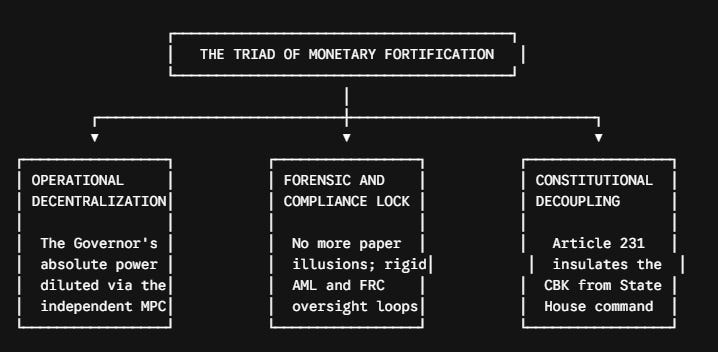
The structural post-mortem conducted by economic planners, reformist legislators, and central bank technocrats in the wake of the Bosire Commission report yielded three non-negotiable pillars designed to ensure that state capture could never again weaponize the national currency.
1. The Decentralization of Monetary Command
Under the old framework, the Governor of the Central Bank of Kenya held near-absolute, centralized control over the country’s monetary instruments—rendering the office highly vulnerable to direct, coercive telephone calls from State House. The introduction of the Monetary Policy Committee (MPC) radically broke this command structure. By transferring the authority over interest rates, reserve ratios, and liquidity management to a diversified board of internal economists and independent external financial experts, the law permanently insulated monetary policy from the short-term political pressures of executive election cycles.
2. The Death of Paper Illusions: Forensic Oversight
Kamlesh Pattni’s primary operational weapon was the exploitation of a compliance system that prioritized paperwork over physical reality. If the customs form had the correct stamp, the state paid out the cash.
Modern Kenyan financial jurisprudence completely reversed this vulnerability. Armed with the Proceeds of Crime and Anti-Money Laundering Act (POCAMLA) and the statutory teeth of the Financial Reporting Centre (FRC), the regulatory regime moved from passive paper-shuffling to proactive forensic auditing:
Know Your Customer (KYC) and Anti-Money Laundering (AML) protocols became strict, legally binding statutes rather than optional bank guidelines.
Commercial banks were legally mandated to flag and justify any cash transactions exceeding 10,000 USD (or its equivalent in KES), with severe criminal liabilities attached directly to the compliance officers and board directors who fail to report anomalies.
The Kenya Deposit Insurance Corporation (KDIC) was granted sweeping powers to swiftly seize, stabilize, or liquidate rogue financial institutions, cutting off the protracted, injunction-heavy legal stall tactics that Pattni used to protect Exchange Bank and Pan African Bank for over a decade.
3. Constitutional Decoupling
The definitive crown of this long, painful evolution arrived with the promulgation of the Constitution of Kenya (2010). Reformers understood that individual legislative acts could easily be amended, repealed, or bypassed by a compliant parliament. To prevent this, the autonomy of the monetary authority was elevated into a supreme constitutional directive.
Under Article 231(4), the supreme law explicitly declares:
“The Central Bank of Kenya shall not be under the direction or control of any person or authority in the exercise of its mandate.”
This single sentence effectively decapitated the infrastructure of state capture. It transformed the Central Bank from a subservient bureaucratic arm of the Treasury into an independent constitutional commission, drawing a sharp, legal line between the political executive and the printing presses of the republic.
The Verdict of History
The story of the Goldenberg Affair is often told as a tale of spectacular heist and courtroom theater. But its true historical value lies in the profound institutional maturity it forced upon Kenya’s financial architecture. The Kenyan Shilling survived an absolute macroeconomic meltdown because the state was ultimately forced to build a legal fortress around it.
Through the painful lessons of The Litigated Shilling, Kenya proved that the ultimate defense against grand corruption is not the goodwill of political leaders, but the unyielding, independent autonomy of statutory institutions. By studying the sophisticated exploits of the past, the nation built the resilient, transparent, and globally respected financial ecosystem that anchors East Africa today.
This concludes our exhaustive, multi-chapter deep dive into The Litigated Shilling: The Goldenberg Autopsy and the Remaking of Kenyan Monetary Law.
Chapter XI: The Altar of Immunity: The Transformation into “Brother Paul”
As the legal and statutory dragnet of the “Long Wash” tightened across his sprawling corporate empire, Kamlesh Pattni executed what would become his most audaciously fluid asset deployment: the complete reconstruction of his public persona. Facing the prospect of asset forfeiture and criminal indictments under the looming shadow of the Bosire Commission, Pattni recognized that judicial and political immunity in Kenya could not merely be bought with a check—it had to be manufactured culturally and spiritually.
In the mid-2000s, the secular, sharp-suited corporate mastermind of Exchange Bank vanished. In his place emerged a charismatic, white-robed, Bible-wielding televangelist known to millions of Kenyans simply as “Brother Paul.”
The Architecture of the Spiritual Pivot
Pattni’s transformation was neither sudden nor accidental; it was a highly calculated, macro-level rebranding strategy executed with the exact same procedural precision he once used to navigate the clearing house of the Central Bank. The strategy was anchored by several key pillars:
The Altar of the Church: Pattni formally founded Hope International Ministries, an evangelical church operating right in the heart of Nairobi. By establishing himself as a self-ordained pastor, he instantly weaponized the powerful social and spiritual capital of Kenya’s deeply religious populace. The pulpit provided an unassailable sanctuary, transforming his legal battles from an investigation into a state heist into a spiritual war of “persecution” against a born-again believer.
The Media Conduit: He did not rely on local pulpits alone. Pattni acquired and funded media airtime, broadcasting his high-energy, emotional sermons across television networks. On screen, “Brother Paul” wept, prayed, and offered financial breakthroughs to his followers. This created an immediate, grassroots constituency of thousands of ordinary citizens who viewed him as a spiritual benefactor rather than the architect of a macroeconomic collapse.
The Philanthropic Shield: Massive, highly publicized donations to charitable causes, children’s homes, and vulnerable communities quickly followed. The proceeds of a multi-billion-shilling currency exploit were systematically laundered through the machinery of public philanthropy, making any state action against him appear vindictive and anti-poo
The Grand Compromise: The 2008 Surrender
The ultimate test of the “Brother Paul” persona arrived in April 2008. The state, exhausted by over a decade of civil injunctions and procedural gridlock, was desperate to reclaim its most premium symbolic prize: the Grand Regency Hotel.
Leveraging his newfound status as a spiritual elder who had “seen the light,” Pattni engaged in high-level, backroom settlement talks with Central Bank Governor Njuguna Ndung’u and Finance Minister Amos Kimunya. Presenting himself as a reformed citizen seeking national reconciliation rather than a cornered litigant, Pattni agreed to unconditionally surrender the physical asset of the hotel back to the Central Bank of Kenya.
In return for handing over the multi-billion-shilling crown jewel, the state made a staggering concession. Under a cloud of intense political controversy, the Attorney General and the anti-corruption apparatus granted Pattni a form of functional immunity, staying several core criminal prosecutions related to the Goldenberg siphoning.
The strategy had worked flawlessly. By placing the hotel on the altar of a state compromise, “Brother Paul” walked out of the clearing house of justice with his freedom intact, leaving the state to flip the property to Libyan investors for 45 million USD.
The Verdict on the Rebrand
The transformation into “Brother Paul” remains one of the most fascinating chapters in East African corporate history. It demonstrated that in a highly fluid legal environment, corporate defense is not limited to the courtroom.
Kamlesh Pattni understood that a document is only as good as the political environment holding it, and an accused person is only as vulnerable as their public standing. By trading the secular boardroom for the evangelical altar, the architect of Goldenberg proved that the ultimate shield against structural clean-up is the complete rewriting of the offender’s identity.
Chapter XII: The Second Act: Exporting the Blueprint to Harare
If the Kenyan state believed that the judicial concessions of the mid-2000s and the surrender of the Grand Regency Hotel had retired Kamlesh Pattni, they fundamentally misunderstood the nature of macroprudential exploitation. The regulatory walls erected around the Central Bank of Kenya through modern anti-money laundering frameworks and constitutional autonomy did not destroy Pattni’s operational blueprint; they merely forced its geographic migration.
By the late 2000s, Pattni shifted his geographic focus to Southern Africa, establishing a powerful presence in Zimbabwe. In Harare, he discovered an economy undergoing the exact same structural agony Kenya endured in 1990: a crippling, systemic shortage of foreign exchange (US Dollars), a collapsing local currency unit, severe hyperinflation, and a ruling political elite desperate for liquidity under the weight of international isolation. It was the perfect ecosystem to deploy the Goldenberg playbook on an international scale.
The Architecture of the Zimbabwean Conduits
Operating under his spiritual moniker, “Brother Paul,” Pattni integrated himself directly into the highest echelons of Zimbabwean state power. He befriended then-President Robert Mugabe and later maintained deep access into the administration of his successor, Emmerson Mnangagwa.
His blueprint for Harare was a mirror image of the 1990 Nairobi scheme, heavily optimized to exploit the unique weaknesses of the Reserve Bank of Zimbabwe (RBZ):
The Export Incentive Arbitrage: Pattni established Suzan General Trading (and a complex web of Dubai-based shell entities), securing a license to legally export Zimbabwean gold and jewelry to the United Arab Emirates. Just like the 35% Goldenberg loop, Pattni’s operations received a lucrative financial incentive from the Zimbabwean government to sell gold overseas.
The Closed-Loop Cash Carousel: In an economy desperate for physical greenbacks, Pattni offered a sophisticated money-laundering mechanism for global actors. Undercover forensic investigations by Al Jazeera’s Investigative Unit (”Gold Mafia”) revealed that international syndicates looking to clean illicit cash could fly physical US dollars into Harare Airport.
Overreporting and Sovereign Clearance: Once the physical cash landed, it was falsely declared on official Customs and Central Bank paperwork as legitimate proceeds from Suzan General Trading’s gold exports. The network routinely overreported the cash brought back into the country to secure government payout incentives and mask the true origin of the funds.
The Refining Wash: The physical cash was used to purchase raw, artisanal gold within Zimbabwe through corrupted channels, including Fidelity Gold Refinery (a subsidiary of the Reserve Bank of Zimbabwe). This gold was then flown to refineries in Dubai owned or controlled by Pattni’s proxies. The refining process scrubbed all geographic traces of the metal’s origin, allowing it to be sold cleanly on the global market. The untraceable proceeds were deposited into Dubai bank accounts as pristine, legitimate trading revenue
The Global Takedown
Pattni’s second act demonstrated the borderless, highly adaptive nature of grand corruption. He openly boasted to undercover journalists about his corporate and political methods, infamously noting that to survive in frontier markets, “When you work, you must always have the king with you, the president.”
However, the international financial intelligence architecture of 2024 was radically different from the porous global systems of 1993. The exposure of the Zimbabwean operation triggered a massive, coordinated trans-Atlantic regulatory strike.
On December 9, 2024 (International Anti-Corruption Day), the United States Department of the Treasury’s Office of Foreign Assets Control (OFAC), acting in strict coordination with the United Kingdom government, issued sweeping economic sanctions against Kamlesh Pattni. The Western powers froze his global assets, instituted international travel bans, and blacklisted 28 entities across his corporate web—spanning Zimbabwe, Dubai, Singapore, Kenya, the British Virgin Islands, and London.
The US Treasury explicitly noted that Pattni’s network had systematically systematically “robbed Zimbabwe’s citizens of the benefit of those natural resources while enriching corrupt government officials and criminal actors,” bringing a definitive, multi-jurisdictional halt to the ultimate evolution of the Goldenberg blueprint.
Core Sources Utilized
The material for this structural exposure is drawn from the following primary authoritative sources:
U.S. Department of the Treasury (Office of Foreign Assets Control - OFAC): Official Sanctions Registry and Press Release: “Treasury Sanctions Global Gold Smuggling Network” (Issued December 9, 2024). Documenting the explicit blacklisting of Kamlesh Mansukhlal Damji Pattni, his nephew Mishaal Hitesh Pattni, CEO Swetang Sinha, and front companies like Sun Multinational.
UK Foreign, Commonwealth & Development Office (FCDO): Anti-Corruption Sanctions Designations (December 2024), detailing coordinated freezes against Pattni, his wife Minal Damji, and brother-in-law Mukesh Vaya.
Al Jazeera Investigative Unit (I-Unit): The “Gold Mafia” Documentary Series and Accompanying Forensic Dossiers (Published March–April 2023). Providing undercover footage, internal corporate ledgers, flight manifests, and whistleblower testimonies detailing the operations of Suzan General Trading, Harare Airport smuggling routes, and bribery at Fidelity Gold Refinery.
Reserve Bank of Zimbabwe & Centre for Natural Resource Governance (CNRG): Structural oversight briefs on artisanal gold leakages, state-linked refinery compliance failures, and the macroeconomic impact of the parallel USD cash-purchasing loop in Harare
Chapter XIII: The Grand Scramble: Asset Recovery, Mutual Legal Assistance, and the Forensic Trail
The conclusion of the Bosire Commission did not mark the end of the Goldenberg saga; instead, it ignited a multi-decade, borderless chess match to claw back billions of shillings scattered across global tax havens, shell companies, and premium real estate. Asset recovery in the wake of “The Goldenberg Scam” became a masterclass in the friction between sovereign states and sophisticated financial architecture. It exposed a fundamental truth of grand corruption: stealing the money is often the easy part; anchoring it safely against a changing political tide is where the real legal war is fought.
The Forensic Blueprint: Mapping the Plunder
When specialized investigators and forensic auditors took over from the public tribunal, they confronted a dizzying maze of layered transactions. The 158.3 billion KES bled from the state had not sat idle. It had been systematically put through a multi-stage laundering process designed to break the audit trail:
The Sovereign Real Estate Conversion: A massive chunk of the immediate proceeds was parked directly into prime Kenyan real estate. This wasn’t just limited to the iconic Grand Regency Hotel (now Laico Regency). Millions were channeled into vast agricultural tracts in the Rift Valley, luxury residential complexes in Nairobi’s Muthaiga and Karen suburbs, and commercial plazas in Mombasa.
The Offshore Layering Loop: To insulate the wealth from local seizure, Pattni’s network utilized a complex web of shell companies registered in secrecy jurisdictions like the British Virgin Islands, Jersey, and Switzerland. Funds were moved via rapid-fire telegraphic transfers from Exchange Bank into European private banking accounts, heavily masked as legitimate payments for diamond and gold tooling equipment.
The Political Payout Dispersal: Portions of the cash were converted into highly liquid, untraceable bearer certificates of deposit and distributed across a vast network of political facilitators, ensuring that any attempt by the state to claw back the assets would face intense, systemic resistance from within the government itself.
The Weapon of Choice: Mutual Legal Assistance (MLA)
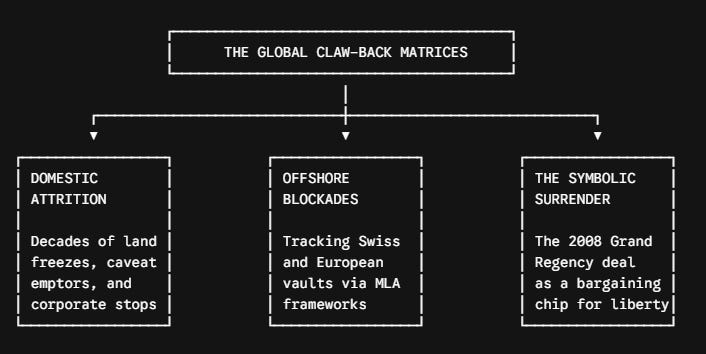
The turning point in the recovery efforts came when Kenya’s state lawyers moved past traditional domestic courts and tapped into international frameworks through Mutual Legal Assistance (MLA) requests. Armed with the newly minted Anti-Corruption and Economic Crimes Act and POCAMLA, Kenyan prosecutors initiated formal legal actions across Europe and the Middle East.
The Swiss Vault Freeze
In coordination with Swiss federal authorities, Kenya successfully initiated freezes on several high-value bank accounts tied to Goldenberg proxies. However, the international asset recovery trail hit a wall that plagues anti-graft agencies to this day: the standard of proof. Swiss courts required definitive, ironclad criminal convictions in Nairobi before they would permanently repatriate the frozen millions. Because the domestic criminal cases against Pattni and senior technocrats dragged on for decades due to endless constitutional references and stays, millions of dollars remained locked in European legal limbo.
The Domestic Siege and Caveat Emptors
Back home, the Kenya Anti-Corruption Commission (KACC)—which later evolved into the Ethics and Anti-Corruption Commission (EACC)—adopted a strategy of economic attrition. If they couldn’t easily jail the perpetrators, they would freeze their capacity to utilize the stolen wealth.
The state slapped sweeping caveat emptors (property restrictions) on hundreds of land titles linked to Goldenberg International and its subsidiaries. This completely paralyzed the network’s ability to sell, charge, or develop these premium assets, turning their ill-gotten real estate portfolios into dead capital.
The Grand Compromise: The 2008 Settlement
The apex of the asset recovery war was reached in April 2008. The state, weary of fighting a hydra-headed legal battle that had dragged on for 15 years, pivoted from pure litigation to tactical transactional diplomacy.
The prize was the Grand Regency Hotel, a ultra-luxury, 5-star standard facility built in the heart of Nairobi using funds directly traced to the central bank liquidity siphoning. Pattni had held onto the hotel through an intricate web of injunctions, using the cash flow from its operations to fund his ongoing legal defense.
In a highly controversial, closed-door deal brokered between Pattni, the Central Bank, and top Treasury officials, a grand bargain was struck:
The Asset Yield: Pattni agreed to unconditionally surrender the physical deeds and complete ownership of the Grand Regency Hotel back to the Central Bank of Kenya.
The Structural Immunity: In exchange for handing over this multi-billion-shilling crown jewel, the state facilitated the withdrawal of several principal criminal charges against him, demonstrating how high-value assets can effectively be bartered for personal liberty in complex corporate fraud cases.
The Sovereign Flipping: The Central Bank did not hold onto the asset for long. In a swift, highly scrutinized move, the hotel was flipped to Libyan sovereign wealth investors for 45 million USD, liquidating a tangible piece of the Goldenberg Scam to patch up holes in the national treasury.
The Enduring Lesson of the Claw-Back
The asset recovery phase of the Goldenberg Scam fundamentally altered how Kenya approaches financial crime. It proved that criminal prosecution without aggressive, concurrent asset tracing is entirely teethless.
The structural frameworks built out of this exhaustion—specifically the creation of the Asset Recovery Agency (ARA)—were explicitly designed to skip the decades-long wait for a criminal conviction. Modern Kenyan law now allows for civil asset forfeiture, meaning the state can seize property simply if the owner cannot prove it was acquired through legitimate funds.
The long, agonizing chase for the Goldenberg billions forced the republic to realize that to truly defeat grand corruption, you must take away the prize
The Ultimate Status Ledger: Where Are They Now?
1. Kamlesh Mansukhlal Damji Pattni (”Brother Paul”)
The Status: Globally Sanctioned & Operationally Isolated
The Reality: While Pattni successfully used his “Brother Paul” persona and the tactical surrender of the Grand Regency Hotel to permanently insulate himself from domestic criminal prosecution in Kenya, the global anti-money laundering net caught up with him. Following explosive forensic exposures revealing that he had exported his Goldenberg playbook to Zimbabwe (operating gold smuggling and cash-laundering loops through Dubai), the international hammer fell.
The Sanctions: The United States Treasury (OFAC) and the United Kingdom government issued severe, coordinated global economic sanctions against Pattni, his wife, and his close corporate proxies. His assets across Dubai, London, Singapore, and Harare have been frozen, and he faces a comprehensive international director disqualification and travel ban—effectively bringing a multi-jurisdictional halt to his borderless financial operations.
2. James Kanyotu (The Intelligence Shield)
The Status: Deceased (2008); Estate Trapped in a 10 Billion KES Legal War
The Reality: Kenya’s most feared and longest-serving spy chief passed away in 2008, but his sprawling estate remains a battleground of high-stakes litigation.
The Current Tussle: The crown jewel of his remaining wealth—a prime, 500-acre land parcel in Ruiru (Kangaita Coffee Estates) valued at 10 billion KES—is currently the center of one of the biggest real estate crises in the country. In July 2025, the Environment and Land Court declared that fraudulent actors had illegally sold and subdivided the land in blatant violation of succession court orders, ordering the cancellation of all titles. However, the Court of Appeal stepped in, granting a temporary stay of execution to protect over 1,000 families who had unknowingly bought plots and built homes there, leaving the entire multi-billion-shilling estate entirely frozen in judicial limbo.
3. Prof. George Saitoti (The Finance Minister)
The Status: Deceased (2012)
The Reality: The brilliant mathematician turned Vice President and Finance Minister signed off on the critical 35% ex-gratia compensation that fueled the Goldenberg printing presses. Though heavily indicted by the findings of the Bosire Commission, Saitoti successfully fought the report’s conclusions in the High Court, which cleared his name and nullified the direct legal recommendations against him. He later reinvented himself as a powerful Internal Security Minister and a top-tier presidential contender before tragically dying in a police helicopter crash in the Ngong Hills in June 2012.
4. Eric Kotut (The Central Bank Governor)
The Status: Retired / In Low-Profile Private Business
The Reality: As the CBK Governor who presided over the clearing house floor while billions in unbacked kited checks were processed, Kotut resigned under immense international pressure in 1993 as the economic wheels came off. Like Saitoti, Kotut aggressively fought the legal fallout of the Bosire Commission through his legal teams, successfully obtaining High Court orders that insulated him from direct prosecution. He completely retreated from public life, quietly managing his private commercial interests away from the financial sector.
5. The Central Bank of Kenya (The Guardian)
The Status: Institutionally Fortified and Structurally Sovereign
The Reality: The greatest institutional victim of the Goldenberg Scam ultimately underwent the most profound evolution. The absolute vulnerability of the early 1990s—where a single executive order could force the clearing house to inject billions of unbacked liquidity into private banks—was treated as a fundamental threat to national survival.
The Ultimate Shield: The scars of Goldenberg directly shaped the drafting of Article 231 of the 2010 Constitution of Kenya, which explicitly grants the Central Bank complete structural autonomy from executive control, stating that the CBK “shall not be directive or subject to the control of any person or authority.” The porous clearing system of 1992 has been replaced by the ironclad, real-time gross settlement (RTGS) frameworks, making the specific mechanics of the original Goldenberg scam structurally impossible today.