
Welcome to Boardlot Africa, where we pull back the curtain to reveal the untold stories, power dynamics, and strategic maneuvers shaping the boardrooms of Corporate Africa—subscribe for free to join the conversation. join 1000 other subscribers
We publish Kenya’s Most Consequential Legal, Governance & Labor Disputes and
A Series on the 100 Most Influential Kenyan Captains of Industry
The following article dissects the systemic dismantling of WPP Scangroup, framing its current decline not as a victim of market volatility, but as a textbook case of corporate self-liquidation driven by the catastrophic loss of its intellectual and relational assets.
Table of Contents
I. The Illusion of Replaceability
Challenging the “Cog in the Machine” fallacy.
II. The Anatomy of an Exodus (2021–2026)
Tracking the systematic loss of human capital and client mandates.
III. The Relational Capital Deficit
A department-by-department breakdown of the domino-style collapse.
IV. The Competitive “Brain-Drain” Loop
How former Scangroup alumni are “unbundling” the firm from the outside.
V. The Post-Mortem
Analyzing the transition from market leader to hollowed-out shell.
VI. Conclusion: The Warning to the Boardroom
The high cost of failing to protect intellectual assets.
I. The Illusion of Replaceability
The “Cog in the Machine” Fallacy
In the traditional industrial model, the value of a firm is derived from its tangible assets—machinery, logistics, and real estate. In that world, an employee is a “cog”; if a gear wears out, you swap it for a standardized replacement of equal dimensions, and the machine continues to hum.
WPP Scangroup, however, does not manufacture goods; it manufactures influence, strategy, and narrative. It is a quintessential “knowledge business,” where the machinery is entirely human. The boardroom, having treated this agency like a traditional manufacturing concern, committed the fatal error of believing that intellectual capital is fungible. They assumed that a Director, a Creative Lead, or a Media Head was simply a placeholder—a set of responsibilities that could be transferred to any qualified successor with minimal disruption to the client’s output.
This is a profound misunderstanding of the agency model. In advertising, “knowledge” is not a static database that stays behind when a person leaves; it is a dynamic, evolving synthesis of deep client history, unspoken brand nuances, and long-term relational trust. When the executive exodus began in 2021, the firm didn’t just lose bodies; it lost the unique context that allowed it to speak the language of clients like Equity Bank or KCB. By viewing talent as interchangeable cogs rather than proprietary assets, the leadership effectively dismantled the very engine of the company’s competitive advantage.

The Valuation of Experience: Why the Balance Sheet is a Lie
If one were to look solely at the audited financial statements of WPP Scangroup, one might see a company struggling with the cyclical pressures of a challenging economic environment. But these figures are a mask—a lagging indicator that fails to account for the catastrophic evaporation of the company’s “soft equity.”
In a knowledge-based service industry, the balance sheet is, quite frankly, a lie. It captures the cost of physical assets and historical cash flows, but it is blind to the most critical line item: Relational Capital.
The true value of an agency is the sum of its institutional memory. This is the accumulated trust earned through years of managing campaigns, navigating crises, and delivering results. When a veteran leader like Bharat Thakrar or a senior creative director departs, they do not merely take their skills; they take the “permission” the client granted them to guide their brand strategy.
For the shareholders of Scangroup, the real liquidation event didn’t happen in the markets—it happened in the resignation letters of key executives. Every departure was a capital withdrawal, draining the firm of the experience necessary to defend its market share. When the “talent roster” is treated as an expense to be optimized rather than an asset to be protected, the inevitable result is the slow, systematic hollow-out of the company. The balance sheet might still show assets on paper, but the firm has effectively become a shell—a vessel whose most valuable contents have already been offloaded to the competition.

II. The Anatomy of an Exodus (2021–2026)
The Departure Timeline: A Systematic Thinning
The timeline of executive departures at WPP Scangroup post-2021 is not merely a chronicle of career moves; it is a ledger of institutional depletion. What we have witnessed is not the standard attrition rate of a large corporate entity, but a sustained, multi-year hemorrhage of the firm’s central nervous system.
Beginning with the leadership shift in 2021, the firm entered a phase of constant, high-velocity turnover. From the C-suite to the creative floor, the departures read like an index of the firm’s collective IQ:
2021–2022: The departure of core leadership (Thakrar, Das) and the exit of key PR management signaled the beginning of a shift in corporate DNA.
2023: The churn accelerated, with major leadership shifts in the Commercial, Digital, and Creative wings (Sandeep Madan, Serah Katusya, Deepesh Jha). This was the year the “brain trust” began to look noticeably frayed.
2024–2025: The exodus became pervasive. With the departure of long-standing figures like Cathy Gathu and the subsequent turnover in HR and Talent management, the firm lost the gatekeepers of its culture.
2026: The arrival of new C-suite leadership (Ithau, Mehkta, Kagwwa) represents an attempt to reset, yet the underlying reality remains: the “architects” of the company’s most successful era have long since exited the building.
By mapping this timeline, we see a clear correlation between the destabilization of executive leadership and the subsequent weakening of the agency’s defensive moat.

The Knowledge Gap: Quantifying the Loss
In a business where capital is defined by experience, we must ask: What is the total value of the expertise that has walked out the door? If we calculate the aggregate industry experience of the departing individuals—men and women who spent decades understanding the specific, nuanced requirements of the East African advertising landscape—we are looking at a loss of over two centuries of institutional intelligence.
This isn’t just about “experience” in a general sense; it is about the loss of contextual intelligence.
The Loss of “Institutional Playbooks”: The departing executives held the internal, proprietary knowledge of how to navigate complex client relationships, from the regulatory environment of Kenyan banking to the high-stakes marketing requirements of major telecommunications providers.
The Severing of Client Memory: Every time a lead account manager or a Creative Director left, they took with them the “institutional memory” of how those clients liked to be handled, their past failures, their hidden preferences, and their long-term strategic goals.
When an agency loses this much collective experience in such a short window, it loses the ability to provide strategic foresight. It becomes reactive, struggling to service the basic needs of current accounts because the “institutional knowledge base”—the people who built those relationships—is no longer there to anchor the strategy. For a listed company, this “knowledge gap” is the invisible liability that eventually surfaces in the form of missing revenue targets and lost blue-chip mandates.

III. The Relational Capital Deficit: A Cascade of Structural Collapse
In a knowledge-based enterprise, the organization is a network of trust. When that network is systematically dismantled, the failure cascades through every department, falling like a row of dominos. The following breakdown maps the structural decay of WPP Scangroup through the lens of the specific talent that anchored each department.

1. Senior Management: The Loss of the “Strategic North Star”
The departure of founding-era stalwarts like Bharat Thakrar and the subsequent high-velocity churn of successors—including Sandeep Madan, Sally Sawe, Cathy Gathu, Patricia Ithau, and Vika Mehkta—left the firm without a consistent vision. In the agency world, senior management is the ultimate guarantor of client stability. When the “face” of the agency changes every eighteen months, blue-chip clients like Equity Bank and KCB see a high-risk, transactional partner rather than a strategic ally.
The “Saviour” Fallacy: Leadership as an Accelerator of Attrition
The appointment of Patricia Ithau in March 2022 was heralded by the board as a “steadying hand”—a transition from the turbulent departure of Bharat Thakrar toward a new era of corporate governance and operational stability. However, the internal reality was a stark departure from the narrative. Her tenure did not stabilize the firm; instead, it acted as a high-velocity catalyst for the very exodus it was meant to prevent.
Patricia Ithau: The Saviour Mentality vs. Organizational DNA
Ithau arrived with a pedigree steeped in multinational FMCG and academic-led development. The fatal miscalculation was the importation of a “Saviour Mentality”—the assumption that the agency’s problems were merely process-based inefficiencies that could be corrected through top-down mandates and standard corporate restructuring.

Rather than engaging in the difficult, granular work of harnessing the existing energy of the firm’s veteran creative and account leads, the leadership team prioritized bureaucratic consolidation. By attempting to impose standardized multinational frameworks onto a bespoke, relationship-driven creative agency, the firm began to alienate the very people who held its market value together.

The Exodus Catalyst
For senior talent—those who had built the agency’s reputation over decades—this new management style felt like an imposition of “foreign” logic onto their craft. The leadership’s focus on the WPP Open platform and generative AI tools as the solution to revenue decline backfired spectacularly. To the veteran staff, this was not innovation; it was a signal that their institutional knowledge—the “human” component of the business—was no longer valued.
The attrition was not random; it was a systemic rejection of this new leadership paradigm. As Ithau’s team sought to overhaul the culture, the “old guard” found their influence diminished and their agency neutralized. This created a vacuum where senior creative directors, heads of media, and account anchors felt their expertise was being replaced by corporate checklists. The result was a mass migration of talent who chose to exit rather than witness the dilution of the firm’s creative soul.
Institutional Decapitation
Ultimately, the leadership’s approach turned an existing, albeit challenged, agency into a transient space. The “saviour” strategy fundamentally misunderstood the agency’s greatest asset: relational capital. By failing to foster an environment where existing talent felt empowered to adapt, the board ensured that the firm would suffer from a “decapitation” of its leadership ranks. When Ithau stepped down in 2025, she left behind not a revitalized agency, but a shell where the institutional memory had been systematically purged, and the remaining staff were left to navigate a landscape already being dismantled by the firm’s own former architects.
A Visionary Leader Committed To Positive Impact
This video captures the leadership philosophy Patricia Ithau championed during her tenure, which stands in stark contrast to the resulting internal exodus and the decline of Scangroup’s market position.

2. Business Development & Client Service: The Breach of Trust
This department—the agency’s front line—collapsed under the weight of an unprecedented exodus. The loss of Catherine Karanja (MD PR), Serah Katusya (CEO, Media - SSA), and Pranav Kamat (Commercial Manager - Africa) signaled a total withdrawal of regional authority. This was compounded by the departure of Tom Windows (MD SCANAD Uganda), George Ojin (Head of Client Service, Ogilvy), and Ndungu Kiriro (Head of Media). These leaders were the custodians of the firm’s “Institutional Memory.” They held the deep-rooted relationships and strategic blueprints for giants like NCBA and Airtel. When these figures departed, they took the “permission” the client granted them to act as their strategic partner, leaving a vacuum that no new hire could bridge.
3. Creative Team: The Loss of the Agency’s “Soul”
The creative department, once the powerhouse of Scangroup, was hollowed out as key talent like Deepesh Jha (Chief Creative Officer) and Megha Dutty (Senior Creative Director) exited. In advertising, “creative” is the product. When you strip away the people who know how to synthesize a client’s vision into market-moving campaigns, you are left with mere administrative staff. This creative vacuum was the primary reason clients felt the agency’s work became “generic,” leading directly to the loss of mandates that demanded top-tier creative excellence.
4. Digital Client Service: The Innovation Vacuum
With the core account teams in disarray, the digital arm—which should have been the firm’s competitive edge—lost its ability to innovate. The exodus of digital lead, Francis Karugah left the agency incapable of managing the high-velocity, tech-first demands of the modern marketing landscape. The loss of this department ensured that Scangroup could no longer compete for the digital-heavy mandates of telcos and banks, effectively forcing these clients into the arms of more agile, digital-native competitors.
5. Human Capital: The Final Pillar of Decay
Perhaps the most ironic collapse was in HR and Talent. When architects of company culture like Catherine Bukachi (HR Director), Emma Kirigia, and Elaine Wanja left, the firm lost its last line of defense against the exodus. This was the domino that made the others impossible to reset; once the company lost the ability to identify, cultivate, and retain talent, it lost the mechanism to stop the bleeding.
6. Finance: The Illusion of Solvency
Finally, the Finance department collapsed under the weight of the departing leadership, including Satyabrata Das, Hemang Shah, and Timothy Muriuki. Finance in a knowledge business is about tracking the ROI of intellectual capital. As these directors exited, the firm’s ability to price services effectively and defend its margins evaporated. The financial reports began to reflect a company that was no longer managing business, but merely tallying the cost of its own disintegration.

The Domino Summary: Talent and Consequence
Senior Mgmt: Thakrar, Madan, Sawe, Ithau, Mehkta, Gathu: Loss of board-level trust and stability.
Business Dev: Karanja, Katusya, Kamat, Windows, Ojin, Kiriro Erosion of “Institutional Memory” and client mandates.

Creative Jha, Dutty Loss of “Soul” and product quality.
Digital: Francis Karugah; Internal Digital Leads Inability to compete in high-velocity tech.
The Kenyan Marketer Who Cracked The Code
This video provides professional insight into the career and leadership strategies of Francis Karugah, highlighting the expertise he carried from WPP Scangroup into his current ventures.
Human Capital: Bukachi, Kirigia, WanjaInability to stem the exodus.
Finance: Das, Shah, MuriukiLoss of margin control and fiscal reality.
By the time the final domino fell, the agency had become a hollowed-out vessel. The cumulative loss of these specific individuals did not just result in “staffing gaps”—it resulted in the permanent destruction of the agency’s capacity to serve the Kenyan market’s most demanding titans.

IV. The Competitive “Brain-Drain” Loop: Scangroup’s Alumni as the New Market Architects
The diaspora of WPP Scangroup’s former leadership is the most compelling evidence of the firm’s strategic decline. When an agency of this stature loses its top-tier talent, it does not just face a staffing shortage; it effectively cedes its market dominance to the very people who built it. These former executives have not left the industry—they have decentralized it, launching agile, specialized firms that are now aggressively capturing the market share Scangroup left behind.
The New Competitive Map: From Alumni to Architects
The individuals who once steered the “Scangroup machine” are now the architects of the competition. By failing to incentivize retention, the firm inadvertently bankrolled the creation of its own rivals.
Sandeep Madan CEO, The Partnership Agency: Leverages deep brand/telco knowledge to win mandates.
Sally SaweCOO, The Partnership Africa: Drives operational efficiency modeled on “best-in-class” systems.
Megha Dutta ECD, The Partnership Africa: Brings global-award-winning creative pedigree to a boutique setup.
Serah Katusya CEO, Belva Digital: Leads a MarTech powerhouse that dominates digital transformation.
Vika Mehkta: Founder, ASK Tech Ventures: Focuses on AI and platform-based growth in the African market.
Catherine Karanja: Principal, Quil House Limited: Pivots institutional legal/PR acumen into specialized advocacy.
Francis Karugah: VP (Kenya), indaHash: Dominates the high-growth influencer marketing space.
Grace Waweru: Leadership, Social Enterprise KenyaDrives purpose-led, high-impact storytelling and strategy.
Why These Agencies Are “Unbundling” Scangroup
The success of these ventures is not a coincidence; it is a clinical application of the “Scangroup Blueprint.” These leaders have stripped away the bureaucratic bloat of the holding-company structure and kept the essence of what made Scangroup powerful: intimate client relationships, high-velocity digital execution, and top-tier creative talent.
Boutique Agility vs. Legacy Inertia: Firms like The Partnership Africa and Belva Digital are winning because they offer the same level of expertise Scangroup once provided, but with the responsiveness of a startup.
The “Insider” Advantage: Founders like Sandeep Madan and Serah Katusya don’t need to “pitch” clients like KCB or Equity; they already understand their internal culture, historical brand challenges, and executive pain points. They are effectively poaching the agency’s former blue-chip roster by offering a “premium version” of the service Scangroup can no longer reliably deliver.
The Technology Pivot: By moving into MarTech (Belva) and AI/Venture capital (ASK Tech Ventures), these alumni are not just playing the advertising game; they are reinventing it, leaving Scangroup to compete for shrinking traditional budgets.
In the knowledge economy, loyalty is the only currency that matters. When that currency is devalued, the result is exactly what we see today: a former titan being systematically eclipsed by its own “children.”
Francis Karugah: From Blogging Controversy to Advertising Success
This video provides a candid look at the evolution of industry leaders like Francis Karugah, highlighting how they translated their experience from legacy structures into specialized, high-impact influencer marketing platforms.
The Competitive “Brain-Drain” Loop: Scangroup’s Alumni as the New Market Architects
In the corporate world, there is a fundamental difference between losing market share to an established competitor and suffering the indignity of having your own talent “unbundle” your business. WPP Scangroup did not merely experience an exodus; it inadvertently acted as a subsidized training ground for its own usurpers.
By failing to retain its intellectual architects, the firm facilitated the birth of a new, agile competitive landscape—one that is currently leveraging Scangroup’s own playbooks, client insights, and strategic methodologies to systematically dismantle its remaining market share.
The “Unbundling” Phenomenon: The Partnership Africa
The most striking example of this “unbundling” is The Partnership Africa. Founded by three former Scangroup C-suite executives—Sandeep Madan (CEO), Sally Sawe (COO), and Deepesh Jha (CCO)—this firm did not just enter the market; it leapfrogged dominant players in under 12 months.
What the WPP Scangroup board perceived as “attrition” was, in reality, a transfer of competitive advantage. These founders took the “institutional map” of Scangroup’s operations and used it to launch a boutique, high-performance agency. They have successfully attracted a powerhouse team of alumni, including Megha Dutta (Executive Creative Director) and Serah Katusya (Digital/Belva Digital), effectively consolidating the very expertise that once made Scangroup invincible.
Weaponizing Institutional Memory
The Partnership Africa is not competing against a stranger; it is competing against a former employer whose vulnerabilities, internal structures, and client pain points its founders know intimately. Their strategy is simple and devastatingly effective:
Targeting the “Anchor” Accounts: By focusing on high-stakes clients like KCB, Diageo (KBL/UDV), Isuzu, and Capwell Industries, they have successfully diverted the most lucrative revenue streams away from legacy agencies.
The Publicis Leverage: Through a critical partnership with Publicis Groupe, they have bridged the gap between local agility and global scale, offering a “premium version” of the services Scangroup once monopolized.
The Talent Exodus: The firm has become a magnet for other Scangroup alumni, including Catherine Karanja (Quil House Limited), Francis Karugah (indaHash), Grace Waweru (Social Enterprise Kenya), and Vika Mehkta (ASK Tech Ventures), each of whom is now carving out market share in specialized niches—PR, influencer marketing, social enterprise, and MarTech—that Scangroup can no longer adequately defend.
The Paradox of the Knowledge Business
This is the ultimate paradox of the “knowledge economy”: the more you professionalize the process and commoditize the work, the less loyalty you inspire in the people who actually do it. By treating these leaders as interchangeable, the board failed to recognize that in advertising, the individual is the competitive moat.
When that moat is dismantled, the fortress isn’t just breached—it’s abandoned. The current advertising landscape in Nairobi is effectively a “Scangroup 2.0” ecosystem, populated by firms that are not just “competing” but are actively “unbundling” the giant. For the shareholders, this is a grim reality: the firm is no longer just fighting for market share; it is fighting against a market share that it spent years and millions of shillings helping its own former executives build.
V. The Post-Mortem: A Dead Shell and the Mirage of Recovery
By mid-2026, WPP Scangroup has transitioned from a market-defining titan into a hollowed-out corporate vessel. The departure of Miriam Kaggwa (COO/Acting CEO) in June 2026 was the final, definitive signal of a total leadership decapitation. Having cycled through three critical roles in three years—CFO, COO, and Acting CEO—her exit serves as a grim punctuation mark on a five-year period of systemic disintegration.
The Anatomy of a “Dead Shell”
When we examine the firm today, we aren’t looking at a company “transitioning” or “right-sizing.” We are looking at a dead shell. The indicators are no longer speculative; they are written in the cold, hard data of a firm that has lost its reason for being:
Leadership Vacuum: The company currently lacks a clear, experienced C-suite to steer the ship. The revolving door of executive leadership—from the post-Thakrar vacuum to the interim management eras—has left the organization without an institutional memory or a strategic north star.
The Governance Abyss: With a board reshuffle in May 2026 and only two independent directors remaining, the governance structure is effectively gridlocked. The ongoing shareholder revolt led by Bharat Thakrar—representing a 13.59% stake—against the parent company’s 56% control, exposes a firm at war with itself, paralyzed by a standoff between British majority control and the local minority shareholders who watched 62% of their market value evaporate.
Financial Irrelevance: With a market capitalization now hovering around the KES 900 million – 1 billion mark, the firm has lost its status as a “blue-chip” participant. The fourth consecutive year of losses, culminating in the 2025 net loss of KSh 713.67 million, confirms that the business model is not merely struggling—it is obsolete.
The Illusion of AI-Enabled Recovery
The board’s current public stance—that future growth will be anchored by the WPP Open platform and AI-enabled solutions—is a desperate attempt to substitute technical jargon for real business substance. In a “knowledge business,” AI cannot replace the relational infrastructure of an agency. AI can optimize a media buy, but it cannot repair a severed relationship with a CEO at Equity Bank; it cannot replace the trust that Cathy Gathu or Sandeep Madan once commanded in a boardroom.
The strategy to “leverage AI” is the hallmark of a firm that has forgotten what it does for a living. They are attempting to automate the delivery of a service that they no longer have the human expertise to define.
VI. The Revolt of the Abandoned: Governance in a Vacuum
The recent shareholder upheaval at WPP Scangroup is not merely a financial dispute; it is a desperate last stand against a parent company that has become a distant, indifferent landlord. When minority shareholders, led by founder Bharat Thakrar, mobilized to requisition a Special General Meeting in June 2026, they were not just seeking board seats—they were registering their protest against a structural imbalance that has left the Nairobi-based firm drifting without a captain.
The London-Nairobi Disconnect
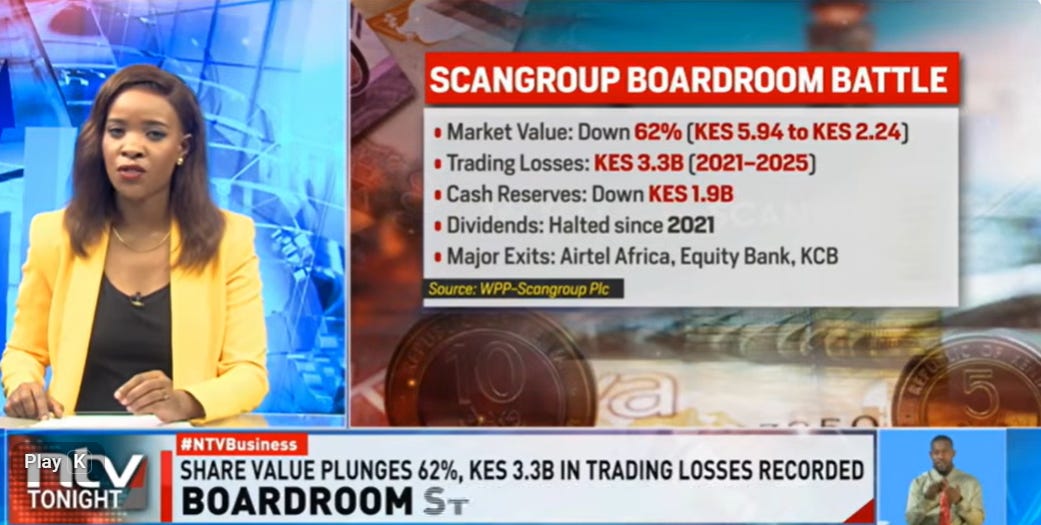
As the company recorded its fourth consecutive year of losses—widening to a staggering KSh 713.67 million in 2025—the perception in Nairobi is that London-based parent company WPP plc is operating in a vacuum of “aloof neutrality.” While the local firm’s market capitalization has evaporated by 62% since 2021, and its cash reserves have plummeted, the parent company’s interventions have been limited to board reshuffles that feel more like cosmetic corrections than structural rescues.
The voting outcome of the June 8, 2026, Annual General Meeting was the ultimate illustration of this disconnect:
The Independent Consensus: Over 99% of independent, minority shareholders voted to oust the board, signaling a near-unanimous rejection of the current status quo.
The Majority Mandate: The parent company, wielding its 56% controlling stake, overruled the minority, effectively silencing the very people whose capital has been eroded by the agency’s disintegration.
The Future of the “Hollowed-Out” Entity
For the investors left holding the bag, the future of Scangroup is grim. The company’s pivot to “AI-enabled” solutions via the WPP Open platform is viewed by local stakeholders as a profound misunderstanding of the firm’s core problem. You cannot fix a relationship-based business through centralized automation when the fundamental issue is a lack of local leadership and the departure of the talent that held the clients’ trust.
The isolation of the firm is now absolute:
Strategically: It is being out-maneuvered by boutique firms founded by its own alumni.
Financially: It is burning through its remaining cash reserves (dropping from KSh 2.14 billion to KSh 864 million in a single year) with no clear path to profitability.
Politically: It has alienated its local investor base, ensuring that any future attempt at a turnaround will be met with profound skepticism and internal resistance.
Conclusion: A Final Warning to the Boardroom
WPP Scangroup has become a cautionary tale of institutional suicide. By allowing its competitive moat—the talent, the culture, and the relational history—to be stripped away, and by ignoring the growing clamor from its local stakeholders, the firm has signaled that it is no longer interested in competing for the East African market.
Unless the board moves beyond cost-cutting and “restructuring” to address the governance crisis and the talent exodus, the company will continue its slide into total irrelevance. A firm that cannot hold the loyalty of its people will never hold the loyalty of its clients. The writing is on the wall: the “Scangroup” name may remain on the door, but the business has long since checked out.
Minority shareholders demand board removal
This video provides critical context regarding the ongoing shareholder revolt and leadership crisis, highlighting the public fallout from the systemic loss of value and talent at WPP Scangroup.
The Final Verdict: A Managed Liquidation
The “transition” of the Tanzanian business to a partnership model and the continuous cost-cutting measures are not pivots toward growth; they are the mechanics of a managed liquidation. The firm is shedding assets, trimming overhead, and narrowing its scope because it no longer has the internal muscle to perform.
Scangroup today is a company that exists in the past tense. It maintains the name, the listing, and the global affiliation, but the engine that generated value—the creative fire, the account-anchoring talent, and the executive vision—has been fully transferred to the new market architects. For shareholders, the question is no longer “How will they recover?” but rather “How much of the remaining capital can be salvaged before the shell is shuttered entirely?”
About Boardlot Africa Research
Boardlot Africa is a premier financial intelligence and corporate governance publication dedicated to unpacking the mechanics of capital, market strategies, and structural shifts across East Africa’s corporate landscape. By bridging the gap between raw economic data and actionable market intelligence, we deliver deep-dive research, independent corporate analysis, and policy insights designed for institutional investors, boardrooms, and sharp market observers.
Get in Touch
Email: boardlot.research@gmail.com
Phone: +254 753 133 901
Substack: Subscribe to Boardlot Africa
X (Twitter): BoardLotSultan
Too many Own goals for the AI to create a comeback unless the Competition blunders WPP are heading to the grave!