
The Architectural Blueprint of East Africa’s Premier Asset Allocator
In this Article
1.0 Introduction: The Architect of Capital
1.1 The Legacy of the 50 Men Who Shaped East Africa’s Capital Markets
1.2 From a KES 600,000 Loan to a Multi-Billion Shilling Empire
1.3 The Core Investment Philosophy: Contractual Architecture vs. Operational Execution
2.0 The Command Center: Sameer Investments Limited
2.1 Centralizing Control at the Riverside Family Office
2.2 The Proxy Army: Delegated Board Governance and Forensic Oversight
2.3 The Merali Boardroom Rule: Flagship Engines vs. Subsidiary Delegation
3.0 The Macro-Strategy: The Indigenization Arbitrage
3.1 Capitalizing on the Retreat of Post-Colonial Multinationals
3.2 Phase 1: Building the Automotive and Industrial Foothold
3.3 Phase 2: The Banking Coup and Institutional Alignment
3.4 Phase 3: Financial Services and Risk Captivity
3.5 The Genius of the Playbook: The Double Multi-National Exit
4.0 The Sector Breakdowns: Operational Engines & Asset Monetization
4.1 Merali in Telecommunications
4.1.1 The Kencell (Airtel) Venture: Setting Up the Telecom Infrastructure
4.1.2 The Vivendi Flip: The $20 Million Handshake in a Single Day
4.1.3 Maintaining Equity and Managing Cross-Border Partner Dynamics
4.2 Merali in Agriculture
4.2.1 The Flight to London: Buying Sasini PLC on a Cocktail Napkin
4.2.2 Shifting Bulk Raw Commodities to Branded Consumer Retail
4.2.3 Agribusiness Integration: The Sameer Agriculture & Livestock Supply Chain
4.2.4 The Soil as a Landbank: Strategic Re-Zoning for Real Estate Yields
4.3 Merali in Manufacturing
4.3.1 Firestone East Africa & Eveready: The Import-Substitution Play
4.3.2 Industrial Monopolies and State Tariff Protections
4.3.3 Confronting Trade Liberalization: The Hard Shift to Distribution
4.3.4 Monetizing the Assembly Floor: The Sameer Business Park Real Estate Play
4.4 Merali in Banking
4.4.1 From First American Bank & Equatorial Commercial Bank to Tier-1 Banking
4.4.2 The 2019 NIC-CBA Merger: Unlocking Institutional Synergies
4.4.3 Yana Investments Limited: Managing the Consolidated Block in NCBA Group PLC
4.4.4 Dividend Capture and Liquidity Velocity
4.5 Merali in Insurance
4.5.1 First Assurance & Fidelity Shield: Building a Captive Underwriting Pipeline
4.5.2 Retaining Commercial Risk Within the Sameer Group Matrix
4.5.3 The KES 2.8 Billion Absa Exit: Crystallizing Peak Value
4.6 Merali in Industrial & Construction
4.6.1 H. Young & CO. (East Africa) Ltd: The 1981 Foundational Civil Buyout
4.6.2 Warren Enterprises & Aristocrats Concrete: Vertical Integration of Heavy Industry
4.6.3 Dominating Regional Infrastructure Tenders and Aggregate Quarry Supply
5.0 The Spire Bank Chapter: Anatomy of a Cold Corporate Exit
5.1 Reorganizing Equatorial Commercial Bank Amidst Capital Adjustments
5.2 The KES 2.6 Billion Transaction with Mwalimu National SACCO
5.3 The Liquidity Pull-Out: Protecting the Family Treasury First
5.4 Institutional Fallout, Systemic Risk, and the Rule of No Sunk Costs
6.0 Social Architecture & Philanthropic Machinery
6.1 The Disdain for Handouts: Institutionalizing Sustainable Impact
6.2 The Sameer Trust: Building Cross-Generational Medical Infrastructure
6.3 The Jaffery Sports Club: Community Scaling and Asset Endowment
7.0 The Modern Family Office: Succession and Private Equity
7.1 The Passing of the Icon: Strategic Continuity Under Sameer Naushad Merali
7.2 Shifting from 20th-Century Heavy Factories to Agile Private Equity Capital
7.3 The Permanent Playbook: Never Marry an Asset, Read the Fine Print, and Command the Exit
1.0 Introduction: The Architect of Capital
1.1 The Legacy of the 50 Men Who Shaped East Africa’s Capital Markets
The architectural history of East Africa’s financial ecosystem is rarely written by passive spectators or index-tracking investors. Instead, it was forged by a small, highly calculated echelon of market architects who viewed corporate entities not as permanent monuments, but as fluid conduits for capital reallocation. Within this elite circle of the 50 men who shaped regional capital markets, Naushad Merali stands as arguably the most sophisticated asset allocator Kenya has ever seen. While contemporary titans focused on organic building and long-term operational scaling, Merali operated in an entirely different dimension—one driven by macro-structural arbitrage, regulatory navigation, and systemic monetization. His boardroom footprint didn’t merely follow the growth of the Nairobi Securities Exchange (NSE); it actively anticipated and engineered the structural transitions of post-independence enterprise.
1.2 From a KES 600,000 Loan to a Multi-Billion Shilling Empire
The origin story of the Sameer Group empire provides a fundamental lesson in high-leverage asset acquisition. In 1975, at just 24 years of age, Merali did not possess vast multi-generational wealth or an institutional corporate backer. Instead, he possessed an acute sense of timing and a rare level of financial audacity. Securing a bank loan of exactly KES 600,000, he executed a complete buyout of Ryce Motors from its departing German founder, Frank Ryce. This singular transaction became the launchpad for a multi-billion-shilling conglomerate that would ultimately span banking, telecommunications, insurance, heavy manufacturing, and vast agricultural landbanks. The KES 600,000 deployment established a permanent operational truth that Merali would exploit for the next four decades: real wealth is built by stepping into the valuation vacuums left by exiting foreign owners, restructuring the underlying corporate plumbing, and letting domestic monopolies scale under ironclad governance.
1.3 The Core Investment Philosophy: Contractual Architecture vs. Operational Execution
Ordinary corporate executives often fall victim to the romance of the product, spending decades perfecting assembly lines, retail distribution, or day-to-day service execution. Merali disdained this operational myopia. His core investment philosophy was built on a clinical, unshakeable maxim: contractual architecture beats operational execution every single day. He understood that the true battle for capital dominance is won or lost before a single factory floor opens, dictated entirely inside the legal fine print of shareholder agreements, preemptive rights, valuation multiples, and exit clauses. By delegating heavy day-to-day management to a trusted proxy army of elite technocrats, Merali left himself completely free to focus on macro strategy. He never married an asset, nor did he care about the product on the factory floor; he cared exclusively about the capital yield, the structural moat, and the ultimate velocity of the corporate exit.
2.0 The Command Center: Sameer Investments Limited
2.1 Centralizing Control at the Riverside Family Office
At the apex of Naushad Merali’s sprawling multi-billion-shilling empire sat Sameer Investments Limited. Far more than a passive holding company, this specialized family office operated out of the quiet, high-security enclave of Riverside in Nairobi, acting as the centralized nervous system and command center for the entire conglomerate. From this single vantage point, Merali maintained an unshakeable grip on capital allocation across every subsidiary. The Riverside office stripped away traditional corporate bureaucracy, ensuring that critical investment decisions, cross-border treasury movements, and macro-strategic pivots could be executed with absolute speed and confidentiality. It was here that complex international transactions were structured, and where the family’s private wealth was systematically isolated and protected from the operational liabilities of individual trading companies.
2.2 The Proxy Army: Delegated Board Governance and Forensic Oversight
While Merali held absolute ultimate authority, he disdained the operational fatigue of micromanagement. To project his power across dozens of diverse industries, he engineered a highly sophisticated system of delegated board governance, executing forensic oversight through a deeply trusted, fiercely loyal “proxy army.” Foremost among this elite vanguard of corporate proxies were elite financial technocrats and legal minds, most notably the legendary corporate strategist Akif Hamid Butt. Merali positioned these trusted lieutenants as his eyes, ears, and voices on the boards of both his private and publicly listed entities. They were tasked with enforcing the family office’s strict capital discipline, monitoring balance sheets with clinical precision, and ensuring that minority shareholders or foreign joint-venture partners never compromised the core strategic intent of the Sameer Group.
2.3 The Merali Boardroom Rule: Flagship Engines vs. Subsidiary Delegation
The foundational rule of the Sameer Group boardroom was built on a stark operational bifurcation: the rigid separation of flagship cash engines from everyday subsidiary delegation. Merali classified his corporate empire into two distinct buckets. On one side were the high-velocity flagship engines—the core banking, telecom, and agricultural pillars that generated massive, steady dollar and shilling liquidity loops. These engines received Merali’s direct macro-strategic attention and tightest capital controls. On the other side were the operationally heavy manufacturing, distribution, and services subsidiaries. For these, Merali established the rule of strict administrative delegation: local managers and board committees were given full operational autonomy to run the day-to-day businesses, but they were bound by an unyielding mandate to consistently upstream profits to the family office. If a subsidiary failed to meet its efficiency metrics or became a drain on corporate focus, Merali’s boardroom rule dictated immediate restructuring or an aggressive, clinical divestment.
3. 3.0 The Macro-Strategy: The Indigenization Arbitrage
Every great financial empire requires a structural catalyst. For Naushad Merali, that catalyst was indigenization—the post-independence economic shift where the newly sovereign state sought to transfer economic leverage, corporate ownership, and resource control from colonial or foreign multinationals into the hands of local, prominent entrepreneurs.
While ordinary market participants viewed this policy era through the lens of political rhetoric, Merali read the landscape with the clinical precision of an arbitrageur. He recognized that Western multinationals—facing shifting domestic regulatory frameworks, complex geopolitical risks, and escalating pressure from local authorities—were actively searching for reputable, politically stable, and sophisticated local exit partners.
3.1 Capitalizing on the Retreat of Post-Colonial Multinationals
The foundation of Merali’s wealth was built on structural timing rather than greenfield industrial development. In the 1980s and 1990s, global conglomerates that had dominated East Africa’s colonial and early post-colonial commerce began re-evaluating their direct equity exposure in emerging African markets.
Merali understood that these multinationals valued clean, quiet exits over maximizing asset prices. By leveraging his immense corporate network and deep political capital, he presented Sameer Investments Limited as a friction-free localization vehicle. He systematically acquired commanding equity blocks in dominant companies at deep structural discounts, transforming foreign-controlled operations into local corporate engines that aligned perfectly with state indigenization policies.
3.2 Phase 1: Building the Automotive and Industrial Foothold
The indigenization blueprint was perfected in the automotive and industrial manufacturing sectors, where Merali capitalized on the retreat of major American and European franchises.
The Ryce Motors Pre-Condition: In 1975, at just 24 years old, Merali executed a KES 600,000 buyout of Ryce Motors from its departing German founder. Through this vehicle, he locked down premium global industrial and automotive franchises (including Komatsu and Daihatsu), establishing the operational credibility required to partner with global industrial giants.
The Firestone Buyout (1985): When the American multinational Firestone Tire and Rubber Company sought to reduce its direct operational risks in Africa, Merali used Sameer Investments Limited to execute a KES 165 million buyout for a 51% controlling majority stake in Firestone East Africa.
Insulating the Monopoly: Rather than opening the business to raw market forces, Merali masterfully engaged with state policymakers to maintain high import tariffs on foreign-manufactured tires. Insulated from cheap global competition, the Mombasa Road factory rolled out Yana Tyres, capturing nearly the entire domestic commercial and transit market for decades.
The Eveready Duplication: He deployed the exact same import-substitution playbook with Eveready East Africa PLC, locking down the dry-cell battery market under a highly protected, localized industrial framework.
3.3 Phase 2: The Banking Coup and Institutional Alignment
In 1985, Merali realized that heavy industrial empires require deep, captive financial plumbing. He engineered a banking coup that moved his operations into the inner sanctum of East African capital.
The Bank of America Exit: As Bank of America looked to wind down its direct retail and commercial banking footprint in Kenya, Merali stepped into the vacuum with surgical speed.
The Birth of CBA: He acquired Bank of America’s local operations and transformed them into the privately held Commercial Bank of Africa (CBA).
Institutional Alignment: Localizing CBA did far more than add a financial asset to his balance sheet. It gave Merali a permanent seat at the table with Kenya’s elite founding dynasties. It established a sophisticated, deep credit pipeline that could fund his high-value public tenders and heavy engineering units without leaking margins or running into standard institutional friction.
3.4 Phase 3: Financial Services and Risk Captivity
By the early 1990s, the momentum of Merali’s indigenization arbitrage shifted toward capturing the broader financial services and underwriting sectors.
The Prudential Buyout (1991): Prudential Assurance Company PLC, a British multinational insurance titan that had managed colonial market underwriting since 1930, was facing immense pressure to localize its equity structure. On January 1, 1991, Merali’s Sameer Investments Limited bought out the British parent company entirely, instantly rebranding the entity as First Assurance Company Limited.
The Captive Underwriting Loop: Merali disdained the volatile, low-margin public retail insurance lines. Instead, he repositioned First Assurance to capture and retain the general and commercial lines generated by his own massive industrial, agricultural, and logistics subsidiaries. First Assurance underwrote the vehicle fleets of Ryce Motors, the infrastructure machinery of H. Young & CO., and the processing estates of Sasini, keeping the premium velocity entirely within the family office treasury.
3.5 The Genius of the Playbook: The Double Multi-National Exit
The ultimate proof of Merali’s genius as an asset allocator was that he never treated these acquired monopolies as permanent legacy family heirlooms. He treated them as undervalued capital pools. Once he had localized them, stabilized them, and scaled them under protected domestic market dynamics, he ran his signature play: the high-valuation liquidity exit to a completely different set of global multinationals.
The Firestone Public Capitalization: In 1994, after decades of domestic market dominance, Merali listed Firestone East Africa on the Nairobi Securities Exchange (NSE) via a massively oversubscribed IPO. This allowed the family office to crystallize immense capital gains from the public markets while seamlessly maintaining ultimate board control.
The KES 2.8 Billion First Assurance Exit: In April 2015, when First Assurance achieved peak market valuation with assets clearing KES 7 billion, Merali sold a 63.3% controlling majority stake to South Africa’s financial services giant, Barclays Africa Group Limited (now Absa Group), for KES 2.8 billion—shifting the asset back into high-velocity private equity cash.
The NCBA Group Listed Block: His 1985 localization of CBA quietly compounded for over three decades. When the monumental 2019 NIC-CBA merger went live, it instantly flipped Merali’s illiquid 5.6% private banking stake into a highly liquid, publicly traded 5.41% equity block in NCBA Group PLC via Yana Investments Limited, worth over KES 2.4 billion. Merali masterfully extracted premium multi-national value coming and going.
4.0 The Sector Breakdowns: Operational Engines & Asset Monetization
4.1 Merali in Telecommunications
4.1.1 The Kencell (Airtel) Venture: Setting Up the Telecom Infrastructure
In the late 1990s, Naushad Merali anticipated that wireless connectivity would fundamentally rewrite the economic architecture of East Africa. Securing the license for Kenya’s very first private mobile cellular network required an extraordinary combination of deep institutional trust and high-level political networking. The state was not willing to hand a groundbreaking telecom monopoly to just anyone; Merali leveraged his unmatched corporate relationships to anchor the localized bid. Partnering with French multinational Vivendi, he established Kencell in 1999 and launched commercial operations in 2000, breaking the early monopoly grip of the state-owned telecom apparatus and pioneering the region’s initial private communications infrastructure.
4.1.2 The Vivendi Flip: The $20 Million Handshake in a Single Day
By 2004, Vivendi underwent a global strategic pivot and sought an immediate exit from its 60% majority stake in Kencell. South Africa’s MTN aggressively moved in, tabling a formal $250 million bid to acquire the French multinational’s shares. Rather than allowing an outside entity to dictate terms within his territory, Merali weaponized the legal fine print of his shareholder agreement. He exercised his contractual pre-emptive rights, blocking MTN’s bid dead in its tracks. In an absolute masterclass of high-velocity corporate arbitrage, Merali bought Vivendi’s 60% stake for $230 million and, within a matter of mere hours on the exact same day, flipped it to Celtel International for $250 million. He walked away from the desk making a clean $20 million cash profit in a single day without expending a single shilling of his own capital.
4.1.3 Maintaining Equity and Managing Cross-Border Partner Dynamics
The true brilliance of the Vivendi flip was that Merali did not dilute his own position during the transaction. While the majority foreign partner changed from Vivendi to Celtel (and later Zain and Airtel), Merali kept his original 40% equity block completely intact. He understood that foreign telco giants needed a sophisticated local partner to navigate local regulatory currents, license renewals, and political governance. By maintaining this substantial minority stake through changing corporate regimes, Merali ensured that his family office extracted continuous board leverage and dividend yields from the country’s rapidly compounding telecom boom.
4.2 Merali in Agriculture
4.2.1 The Flight to London: Buying Sasini PLC on a Cocktail Napkin
Merali’s entry into large-scale agriculture is one of the most legendary acquisition anecdotes in East African corporate history. In 1989, while traveling on a commercial flight to London, Merali struck up a conversation with the passenger seated next to him. The gentleman happened to be the chairman of Mercanta, a UK-listed conglomerate that held the ultimate majority ownership blocks of a historic plantation company in Kenya called Sasini PLC. Prior to takeoff, Merali reportedly did not even know what Sasini was. However, as the executive detailed the company’s vast asset base of pristine, high-yield tea and coffee estates, Merali’s forensic deal radar lit up. The two men spent the flight haggling over corporate valuations and asset backing on a cocktail napkin, shaking hands on a multi-million-shilling cross-border buyout before the plane landed. On June 6, 1989, Merali officially took his seat on the Sasini Board of Directors.
4.2.2 Shifting Bulk Raw Commodities to Branded Consumer Retail
Under the Sameer Group umbrella, Merali treated agriculture not as a legacy pastime, but as a sophisticated exercise in value-add monetization. Through flagship vehicles like Sasini PLC and Kipkebe Limited, he anchored his family office to steady, export-driven dollar cash flows. His overarching strategy was built on structural transformation: systematically shifting underperforming or bulk raw commodity exports into high-margin, branded consumer retail lines. By processing, packaging, and branding the tea and coffee locally, Sasini captured the premium margins typically lost to international blenders and middlemen, insulating the company’s bottom line from volatile global commodity price cycles.
4.2.3 Agribusiness Integration: The Sameer Agriculture & Livestock Supply Chain
To fully integrate his agribusiness value chain, Merali expanded his footprint to include Sameer Agriculture & Livestock (Kenya) Limited. This entity optimized processing, dairy, and commercial livestock production loops across the region. By linking commercial livestock operations with dairy processing and export networks, the family office systematically locked down and commanded a highly lucrative majority block of the agricultural cash flows generated across the group’s vast estates. The agribusiness division operated as a self-sustaining ecosystem where processing plants, distribution channels, and export logistics fed directly back into the core financial holdings of Sameer Investments Limited.
4.2.4 The Soil as a Landbank: Strategic Re-Zoning for Real Estate Yields
Merali viewed agriculture through the forensic lens of a landbanker. While he appreciated the steady cash flows from tea, coffee, and macadamia crops, he knew that the ultimate value lay in the underlying asset: the soil. The moment Nairobi’s urban fringes began expanding outward, Merali did not hesitate to aggressively re-zone vast, historic agricultural tracts near urban borders for premium residential and commercial real estate developments. Crops were temporary cash generators; re-zoning thousands of acres of agricultural landbanks into commercial property hubs like the multi-billion-shilling Riviera developments unlocked astronomical, cross-generational capital appreciation that far outpaced standard farming yields.
4.3 Merali in Manufacturing
4.3.1 Firestone East Africa & Eveready: The Import-Substitution Play
Merali’s core manufacturing strategy was built entirely on the classic economic blueprint of import substitution. In 1985, he executed a KES 165 million buyout to acquire a 51% controlling majority stake in Firestone East Africa from its parent American multinational. He duplicated this exact play with Eveready East Africa PLC, capturing the dominant domestic dry-cell battery market. Rather than competing globally, Merali focused on dominating the domestic frontier, ensuring that everyday essentials like automotive tires and household batteries were produced locally under his corporate banner.
4.3.2 Industrial Monopolies and State Tariff Protections
The profitability of Merali’s manufacturing operations was heavily anchored by his immense political capital. After localizing Firestone and Eveready, Merali masterfully engaged with state policymakers to erect stiff tariff barriers and import restrictions against cheap foreign alternatives. Insulated from global competition by protective state walls, the Mombasa Road tire factory rolled out Yana Tyres, establishing an effective commercial monopoly. This regulatory moat allowed his manufacturing entities to dictate local pricing, commanding nearly the entire local commercial, agricultural, and public transit transit market for decades.
4.3.3 Confronting Trade Liberalization: The Hard Shift to Distribution
By the late 1990s and early 2000s, the forces of global trade liberalization, escalating domestic energy costs, and the influx of cheap, second-hand imports began eroding local manufacturing margins. Merali refused to fall for the sunk-cost fallacy. Realizing that running heavy manufacturing plants in a liberalized economy was becoming capital-inefficient, he made a hard strategic pivot. He systematically shut down the active Firestone tire assembly lines, downsized the factory workforce, and transitioned the business model of Sameer Africa PLC from high-overhead local production to a high-margin distribution and dealership model for imported global brands.
4.3.4 Monetizing the Assembly Floor: The Sameer Business Park Real Estate Play
The final act of Merali’s manufacturing playbook was the physical monetization of the industrial asset itself. After decommissioning the heavy tire manufacturing machinery on Mombasa Road, the family office re-evaluated the prime industrial real estate sitting beneath the old factory floors. Merali converted the historic assembly grounds into Sameer Business Park, a massive, ultra-modern commercial complex featuring Grade-A offices, show rooms, and industrial warehouses. By shifting the asset class from a declining manufacturing operation to premium commercial real estate, he locked in stable, long-term rental cash flows, ensuring the old industrial footprint remained a core cash engine for the group.
4.4 Merali in Banking
4.4.1 From First American Bank & Equatorial Commercial Bank to Tier-1 Banking
Merali recognized early on that heavy industrial and agricultural conglomerates require deep, captive financial plumbing to thrive. His banking journey began in earnest with the establishment of First American Bank, which he later consolidated into Equatorial Commercial Bank (ECB). While these niche operations served as excellent private treasuries, Merali’s primary banking anchor was forged in 1985 when he engineered a swift buyout of Bank of America’s local operations, transforming them into the privately held Commercial Bank of Africa (CBA). This institutional alignment placed him squarely in the inner sanctum of the nation’s financial elite.
4.4.2 The 2019 NIC-CBA Merger: Unlocking Institutional Synergies
In 2019, the financial landscape shifted permanently with the monumental corporate merger between the privately held Commercial Bank of Africa (CBA) and the listed NIC Bank. Merali’s family office unlocked massive asymmetric advantages through this consolidation. The merger created NCBA Group PLC, a Tier-1 financial powerhouse with a massive regional footprint. For the Sameer Group, this unlocked unprecedented institutional synergies: it created a massive credit pipeline capable of backing high-value public tenders for heavy industrial units like H. Young & CO., effectively bypassing tight regulatory single-borrower lending caps that restricted smaller banks.
4.4.3 Yana Investments Limited: Managing the Consolidated Block in NCBA Group PLC
The NIC-CBA merger served as a brilliant liquidity crystallization window for the family office. It instantly flipped Merali’s historic, illiquid 5.6% private stake in CBA into highly liquid, publicly traded equities on the Nairobi Securities Exchange (NSE). This consolidated ownership block was anchored under Yana Investments Limited, a specialized family holding vehicle. Holding a dominant 5.41% equity stake in the newly merged NCBA Group PLC, Yana Investments consolidated the family’s banking power into a single, clean boardroom seat backed by billions of shillings in market capitalization.
4.4.4 Dividend Capture and Liquidity Velocity
Under the management of Yana Investments, the family office shifted its focus from active banking operations to high-yield dividend capture. NCBA Group PLC’s aggressive digital banking dominance (via M-Shwari) turned the bank into a prolific cash engine. By holding a highly liquid, multi-billion-shilling publicly listed block, Merali—and subsequently his family office successors—maximized liquidity velocity. The steady torrent of bi-annual dividend payouts from NCBA provided the family treasury with non-dilutive, liquid capital that could be instantly reallocated to fund emerging private equity plays or real estate developments.
4.5 Merali in Insurance
4.5.1 First Assurance & Fidelity Shield: Building a Captive Underwriting Pipeline
On January 1, 1991, Merali executed a full indigenization buyout of the British multinational Prudential Assurance PLC, rebranding the historic 1930 entity into First Assurance Company Limited. Alongside his interest in Fidelity Shield Insurance, Merali built a highly sophisticated captive underwriting pipeline. He explicitly disdained competing head-to-head in the volatile, low-margin public retail insurance space, choosing instead to focus almost exclusively on general, corporate, and structural commercial risk lines.
4.5.2 Retaining Commercial Risk Within the Sameer Group Matrix
First Assurance and Fidelity Shield were systematically positioned to act as the internal risk shields for the entire Sameer Group conglomerate. Instead of paying millions of shillings in annual insurance premiums to external third-party underwriters, Merali directed all commercial insurance business inward. First Assurance underwrote the vehicle fleets of Ryce Motors, the massive asset-heavy infrastructure machinery of H. Young & CO., and the extensive agricultural estates and factories of Sasini. This internal loop ensured that premium cash flows and underwriting profits remained entirely trapped within the family office treasury.
4.5.3 The KES 2.8 Billion Absa Exit: Crystallizing Peak Value
True to the Merali playbook, he spent over two decades scaling First Assurance’s corporate balance sheet before engineering the ultimate liquidity exit. In April 2015, when the business achieved a peak market valuation with total assets clearing KES 7 billion, Merali struck a deal with South Africa’s Barclays Africa Group Limited (now Absa Group). He sold a 63.3% controlling majority stake to the multinational giant for KES 2.8 billion cash. By selling a localized company back to a global financial multinational at peak valuation, Merali crystallized immense private equity gains while cleanly extracting his family office from active insurance operations.
4.6 Merali in Industrial & Construction
4.6.1 H. Young & CO. (East Africa) Ltd: The 1981 Foundational Civil Buyout
Within the heavy infrastructure landscape of East Africa, Merali’s entry began in 1981 with the structural buyout of H. Young & CO. (East Africa) Ltd. This marked his very first major corporate acquisition, transitioning the colonial-era engineering firm into a wholly local powerhouse. Under his direction, H. Young & CO. was transformed from a basic contractor into a massive civil and structural engineering titan. Merali leveraged his deep political capital and corporate network to position the firm at the apex of public procurement, securing high-stakes tenders for regional energy infrastructure, geothermal power plants, cross-border road networks, and structural steel fabrications across East Africa.
4.6.2 Warren Enterprises & Aristocrats Concrete: Vertical Integration of Heavy Industry
Rather than stopping at a single civil firm, Merali built out a fully integrated heavy-industry supply chain designed to eliminate margin leakage to third-party subcontractors. He added Warren Enterprises Limited to dominate the group’s water technology, industrial piping, and precision steel fabrication arms. Simultaneously, he established Aristocrats Concrete Limited, a massive commercial quarrying and precast concrete supplier. This industrial matrix allowed the Sameer Group to self-source raw aggregates, fabrications, and premix concrete, capturing every single layer of profit from bulk excavation up to final structural handover.
4.6.3 Dominating Regional Infrastructure Tenders and Aggregate Quarry Supply
The market power of this division was anchored by massive physical asset backing. By combining a 62-acre commercial ballast quarry (holding an additional 81-acre aggregate reserve in Mlolongo) with extensive engineering workshops covering over 6,800 square meters, the family office systematically locked down the raw supply chain of Kenyan construction. Whether the state was building new rail corridors, expanding highways, or erecting urban bypasses, Merali’s industrial matrix extracted deep yields. Centralized strategically under Sameer Investments Limited, the construction division operated as an absolute heavy-industry monopoly that fueled both public infrastructure tracks and the family’s private commercial real estate developments.
5. The Spire Bank Controversy: The Toxic Corporate Hand-off
If the Kencell flip represents Naushad Merali’s masterclass in capitalizing on a premium asset exit, the saga of Spire Bank stands as the most controversial chapter of his career. It serves as a stark reminder of his core philosophy: a master allocator knows exactly when an asset has peaked, how to package it for an unsuspecting buyer, and when to sever ties before the ship slips beneath the waves.
5.1 The Foundations of Equatorial Commercial Bank (ECB)
The story began with Equatorial Commercial Bank (ECB), a boutique mid-tier lender that Merali built into the captive financial engine of the Sameer Group. For years, ECB served a highly specialized function. It lubricated trade finance, issued guarantees, and handled treasury management for his vast matrix of subsidiaries, including Sasini, Firestone, and H. Young.
However, by the early 2010s, Kenya’s banking landscape began to undergo a structural shift. The Central Bank of Kenya (CBK) was tightening capital adequacy ratios, and tier-1 giants were aggressively cannibalizing mid-tier corporate lenders. Merali, looking at ECB’s internal numbers, recognized a looming horizon: the bank was saddled with a deeply troubled portfolio of non-performing insider loans, and keeping it afloat would soon require massive injections of family office liquidity. He needed a clean, highly structured exit strategy.
5.2 The Mwalimu National SACCO Deal: Selling a Hidden Loan Portfolio
In 2014, Merali found his perfect counterparty: Mwalimu National SACCO, the largest savings and credit cooperative in Kenya, which was flush with billions of shillings in teachers’ contributions and aggressively looking to buy their way into a commercial banking license.
Merali engineered a multi-staged deal to sell his controlling stake in ECB to the SACCO. By 2015, Mwalimu National SACCO had institutionalized its entry, acquiring a 75% majority stake in the bank for KES 2.6 billion, later rebranding the entity as Spire Bank.
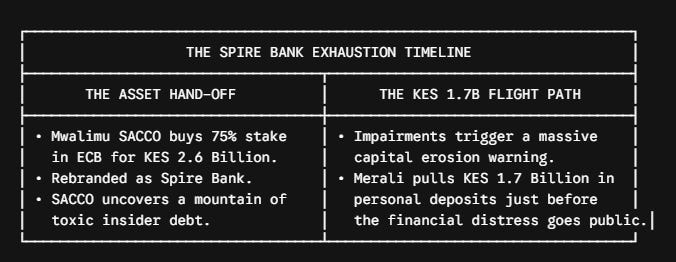
The controversy exploded soon after the ink dried on the final regulatory approvals. As the SACCO’s incoming management began conducting deep forensic audits of their new balance sheet, they discovered a catastrophic structural nightmare. The bank’s historical portfolio was heavily impaired by an immense mountain of non-performing insider loans linked to Merali’s past corporate networks and associate companies. The asset Mwalimu SACCO had purchased was essentially a hollow shell, and the toxic debt quickly began eating away at the SACCO’s hard-earned capital reserves.
5.3 The KES 1.7 Billion Sudden Exit: The Liquidity Run and Regulatory Warfare
The definitive turning point of the Spire Bank crisis arrived in 2016. As the bank’s internal distress began leaking into the market, Merali executed a lightning-fast capital preservation move. Recognizing that the lender was on the verge of a structural collapse, he abruptly withdrew KES 1.7 billion of his own private deposits from Spire Bank’s treasury vaults.
The impact was immediate and devastating:
The massive withdrawal triggered a severe liquidity freeze, starving the bank of its operational cash cushion overnight.
Panicked depositors and teachers’ unions watched in horror as the bank’s capital ratios crashed far below the legal statutory minimums set by the CBK.
The withdrawal sparked a bitter, decade-long regulatory and political war, with parliamentary committees demanding investigations into how Merali was permitted to exit his deposits while ordinary sacco members’ funds remained locked inside a failing institution.
Spire Bank spent the next several years in a state of financial zombiehood, kept alive purely on life support through emergency capital injections from Mwalimu National SACCO to prevent outright liquidation. By the time the dust settled, the bank was eventually sold to regional lender Equity Bank for a symbolic single shilling just to preserve its remaining deposits. Merali had once again proven his cold operational rule: when a deal goes toxic, you do not stay to fight the fire—you save your capital first and let the counterparty handle the debris.
6.0 Social Architecture & Philanthropic Machinery
6.1 The Disdain for Handouts: Institutionalizing Sustainable Impact
Naushad Merali approached philanthropy with the exact same clinical and structural precision that defined his multibillion-shilling corporate buyouts. He held a deep-seated disdain for fleeting political handouts, unstructured harambees, or temporary corporate social responsibility gimmicks. To Merali, unanchored capital injection was inefficient, whether in a balance sheet or a community. Instead, he sought to institutionalize sustainable impact. He treated philanthropic endeavors as long-term social investments that required robust organizational governance, sustainable operational frameworks, and clear asset endowment strategies. By applying his sharp corporate lens to social causes, he ensured that family-backed initiatives could self-fund and operate independently of continuous capital injections from his core commercial engine.
6.2 The Sameer Trust: Building Cross-Generational Medical Infrastructure
The primary vehicle for the family’s institutionalized philanthropy was established as the Sameer Trust. True to Merali’s preference for asset-heavy, long-term infrastructure, the trust bypassed short-term relief projects to focus heavily on erecting self-sustaining, cross-generational medical and social infrastructure. Through the Sameer Trust, the family office quietly directed millions of shillings toward building modern hospital wings, funding state-of-the-art diagnostic equipment, and establishing specialized medical treatment centers across the region. By anchoring the trust’s capital directly to tangible healthcare infrastructure, Merali ensured that the community’s most vulnerable had access to structural, long-term support systems that outlived fluctuating economic and political cycles.
6.3 The Jaffery Sports Club: Community Scaling and Asset Endowment
Beyond healthcare, Merali recognized the power of social capital and community cohesion. He channeled substantial resources into the development and scaling of the Jaffery Sports Club, transforming it into a premier, world-class community and sports hub in Nairobi. Rather than running the club as a subsidized luxury, it was designed with a sustainable asset-endowment model—utilizing sports infrastructure, premium facilities, and localized community programming to generate its own operational liquidity. The club served as the physical manifestation of Merali’s social architecture playbook: build high-quality, centralized infrastructure, establish strict governance, and let the asset self-sustain while serving thousands of community members for generations.
7.0 The Modern Family Office: Succession and Private Equity
7.1 The Passing of the Icon: Strategic Continuity Under Sameer Naushad Merali
The true test of any generational empire is the transition of power. Following the passing of Naushad Merali, the ultimate strategic control of the sprawling family office seamlessly transitioned to his son, Sameer Naushad Merali. Having been groomed inside the inner sanctum of the Riverside headquarters, the younger Merali assumed leadership alongside a highly disciplined, deeply familiar proxy vanguard—most notably the veteran financial strategist Akif Hamid Butt. This trusted inner circle ensured absolute operational continuity. Sameer took his place directly on the boards of premier family holdings, such as Sasini PLC, while concurrently steering the overarching macro investment strategy as the Chief Executive Officer of Sameer Investments Limited.
7.2 Shifting from 20th-Century Heavy Factories to Agile Private Equity Capital
Under the new generation of leadership, the family office has executed a calculated, modern financial pivot. While the senior Merali built his fortune in the 20th-century landscape of heavy industrial setups, local assembly plants, and capital-intensive manufacturing monopolies, the modern market demanded a lighter, faster touch. Sameer Naushad Merali has systematically steered the family office away from low-margin, operationally heavy factory floors and repositioned the empire as a highly agile, sophisticated private equity engine. Today, the family office prioritizes liquidity velocity and capital mobility. They maintain dominant, liquid dividend engines in tier-1 institutions like NCBA Group PLC and Sasini PLC, using the steady cash flows to dynamically deploy capital into high-growth, modern asset classes across the digital and financial frontiers.
7.3 The Permanent Playbook: Never Marry an Asset, Read the Fine Print, and Command the Exit
While the choice of industries has evolved from heavy rubber tires to liquid private equity blocks, the foundational Merali playbook remains completely untouched. The enduring corporate legacy of the Sultan of the Boardroom is distilled into three permanent institutional rules:
Never Marry an Asset: A company is never a legacy heirloom; it is a temporary vehicle for capital accumulation. When valuation peaks or a market shifts, sentimentality must be discarded in favor of liquidity.
Read the Legal Fine Print: Absolute dominance is not won on the factory floor, but within the ironclad architecture of contracts. Weaponizing shareholder agreements and preemptive rights will defeat raw capital size every single day.
Command the Exit: The ultimate measure of a transaction is not the entry price, but the flawless execution of the exit. True corporate mastery lies in knowing exactly how to package a deal, protect the core family treasury first, and walk away from the table with crystallized, liquid cash.