
This is an account of how a corporate outsider, tasked with salvaging a nation's cratering currency, dismantled the entrenched patronage networks of the 1990s and redefined the autonomy of the Central Bank of Kenya
Table of Contents
1. The Crisis Call: From the Private Sector to Haile Selassie Avenue
1.1 July 1993: An Economy in Hyper-Inflationary Freefall
1.2 The Unilever Outsider: Why Moi Bypassed the Bureaucracy
2. Inheriting the Wreckage: The Forensic Battle Against Goldenberg
2.1 Deconstructing the Ledger of Ghost Exports
2.2 The Exchange Bank Standoff: Dismantling the “Political Banks”
3. Corporate Warfare: The Capture of the Grand Regency Hotel
3.1 The Cat-and-Mouse Game: Countering Kamlesh Pattni’s Legal Caveats
3.2 Mopping the Liquidity: How Cheserem Saved the Kenya Shilling
4. The Constitutional Blueprint: Securing Central Bank Autonomy
4.1 The 1996 CBK Amendment Act: Setting the Precedent for Tenure Security
4.2 Shifting the DNA: Automating the Nairobi Clearing House
5. The Contradictions: The Karura Forest Documentation Controversy
5.1 The Bosire Commission Testimony: The Destruction of the CD3 Forms
5.2 The Reformer in the Crossfire: Surviving the Political Patronage Machinery
6. The Second Act: Life After the Central Bank
6.1 Arresting the Broker Collapse: Restoring Market Integrity at the CMA (2009–2011)
6.2 Designing the Devolution Blueprint: The Inaugural CRA Chairmanship (2010–2016)
6.3 The Mathematical Formula for Equity: Eliminating Patronage from Resource Allocation
7. Legacy Check: The Technocratic Blueprint for Modern Frontier Markets
1. The Crisis Call: From the Private Sector to Haile Selassie Avenue
1.1 July 1993: An Economy in Hyper-Inflationary Freefall
In July 1993, Kenya stood on the precipice of an unprecedented macroeconomic cataclysm. The financial system was reeling from the immediate aftermath of the 1992 general election, during which the ruling political elite had injected billions of unbacked, liquid shillings into the economy to fund political campaigns. This massive, artificial monetary expansion shattered the country’s fiscal stability and triggered a vicious, self-reinforcing inflationary spiral.
The indicators on the Central Bank of Kenya’s (CBK) dashboard were flashing catastrophic red:
Hyper-Inflation: The annualized inflation rate was rocket-launching toward an all-time historic peak of 101%. The purchasing power of ordinary Kenyans was evaporating on a weekly basis.
Interest Rate Shock: To mop up the ocean of excess liquidity sloshing through the commercial banking sector, the yield on short-term Treasury bills was aggressively driven upward, peaking at an astronomical 26% to 30%, completely paralyzing private sector credit growth.
Currency Collapse: The Kenya Shilling was in a state of absolute freefall against major global hard currencies. The foreign exchange reserves at Haile Selassie Avenue were depleted, drained by a sophisticated network of politically connected local banks.
At the heart of this systemic rot was the Goldenberg International export compensation scheme. Operated by Kamlesh Pattni, this fictitious loop involved the state paying out massive 35% financial ex-gratia incentives for non-existent gold and diamond jewelry exports. When an International Monetary Fund (IMF) mandated forensic audit conducted by Price Waterhouse exposed that the CBK clearinghouse had been systematically compromised, the international donor community froze structural adjustment funding. Under intense global pressure, CBK Governor Eric Kotut was forced to resign, leaving behind an institutional vacuum and a ruined balance sheet.

1.2 The Unilever Outsider: Why Moi Bypassed the Bureaucracy
President Daniel arap Moi found himself facing an existential economic ultimatum from the World Bank and the IMF: clean up the central bank or face a total sovereign default. Moi recognized that appointing a career civil servant or an institutional insider from within the existing Treasury apparatus would fail to appease international creditors. The system was too deeply captured; what the country needed was a structural “cleaner” completely untainted by Nairobi’s political patronage networks.
Moi made a pragmatic, highly unconventional corporate raid. He looked far beyond Kenya’s borders to Malawi, where Micah Cheserem, a 44-year-old corporate accountant, was serving as the Commercial Director for Unilever (Lever Brothers Malawi).
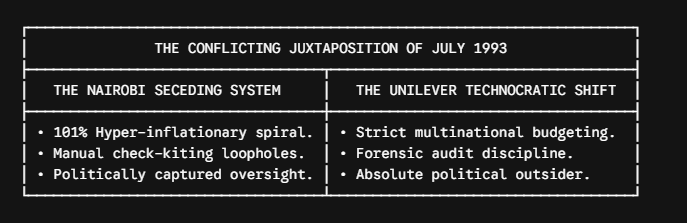
Cheserem was the antithesis of the traditional central banker. He did not possess a PhD in economics, nor had he spent decades climbing the ladder of state bureaucracy. He was a hard-nosed, private-sector corporate executor whose career had been built on strict cost accounting, supply-chain margins, and multinational corporate governance.
When Cheserem accepted the call and arrived at the Central Bank of Kenya in July 1993, he treated the sovereign crisis not as a political balancing act, but as a corporate restructuring assignment. He bypassed the diplomatic pleasantries of high finance and immediately initiated a ruthless audit of the bank’s internal ledgers, setting the stage for a historic, high-stakes showdown with the architects of the Goldenberg conspiracy.

2. Inheriting the Wreckage: The Forensic Battle Against Goldenberg
2.1 Deconstructing the Ledger of Ghost Exports
Upon taking the oath of office, Micah Cheserem’s first task was to expose the exact mechanics of the financial pipeline that had brought the state to its knees. Goldenberg International was not merely a case of political bribery; it was a highly sophisticated, multi-layered accounting fraud that leveraged the central bank’s own institutional weaknesses to extract hard currency.
The fraud rested on a fictitious loop of ghost exports:
The Valuation Lie: Goldenberg International claimed to be exporting massive volumes of gold and diamond jewelry to custom-designed shell companies overseas. In reality, Kenya had negligible domestic gold deposits and virtually no diamond mining.
The CD3 Form Manipulation: To claim the state’s lucrative 35% export compensation incentive, Pattni’s agents had to present signed Custom Declaration (CD3) forms to the CBK, proving that foreign currency from the buyers had been received and deposited into local banks.
The Paper Loop: The fraud loop was entirely self-contained. No physical gold ever left the country. Instead, the same limited pool of foreign cash was repeatedly wired in and out of the country through proxy banks, generating mountains of fraudulent CD3 forms. Each paper pass triggered an immediate, massive payout of taxpayer money from the CBK directly into Pattni’s accounts.
Cheserem approached the crisis with the eye of a forensic corporate auditor. He ordered an immediate freeze on all pending export compensation claims and initiated a sweeping manual audit of the CD3 ledger lines. For the first time in years, the central bank demanded physical, verifiable proof of air waybills, customs clearance logs, and genuine international bank settlement confirmations before a single shilling was disbursed.

2.2 The Exchange Bank Standoff: Dismantling the “Political Banks”
Pattni had established his own commercial outfit, Exchange Bank, which sat alongside a network of weak, politically connected indigenous lenders dubbed the “political banks.”
The most critical emergency Cheserem faced was a staggering KES 13.5 billion liability left behind by Exchange Bank for the sale of undelivered foreign exchange ($210 million). Exchange Bank had pocketed the shillings from the CBK under the pretext of delivering dollars to the national reserves, dollars that simply did not exist.
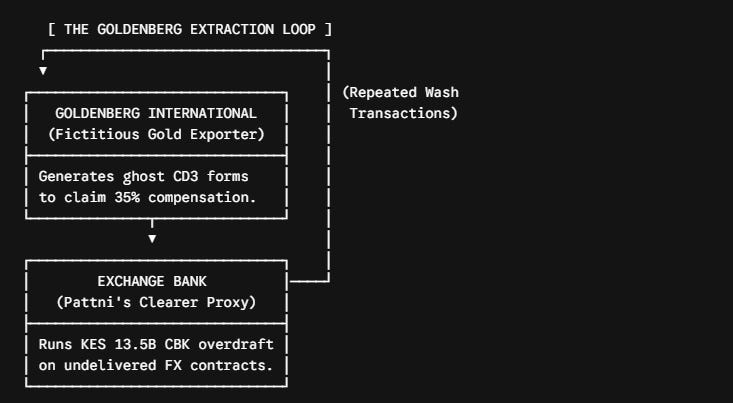
Cheserem, backed by Finance Minister Musalia Mudavadi, realized that stabilizing the financial sector required corporate decapitation. In August 1993, breaking away from years of regulatory leniency, Cheserem used his statutory powers to revoke the banking license of Exchange Bank and placed it into liquidation.
The central bank didn’t stop there. Cheserem systematically shut down the clearing privileges of the remaining political banks, cutting off their access to the CBK’s overnight lending window.
3. Corporate Warfare: The Capture of the Grand Regency Hotel
3.1 The Cat-and-Mouse Game: Countering Kamlesh Pattni’s Legal Caveats
With Exchange Bank forced into liquidation, Micah Cheserem’s priority shifted from containment to asset recovery. He was determined to claw back the billions of shillings extracted from the public purse. The crown jewel of Kamlesh Pattni’s empire was the newly constructed, ultra-luxurious Grand Regency Hotel (now the Laico Regency) in Nairobi, an asset valued at approximately 2.5 billion KES at the time.
Cheserem retained elite corporate litigators, led by senior counsel George Oraro, to haul Pattni to the negotiating table. In September 1993, facing the threat of immediate criminal prosecution and asset forfeiture, Pattni capitulated. He signed an agreement to hand over the title deeds of the Grand Regency Hotel to the Central Bank of Kenya as a charge to secure the missing 13.5 billion KES.
However, obtaining a signature was only the beginning of a prolonged corporate cat-and-mouse game. The moment the agreement was signed, Pattni launched a sophisticated rearguard legal battle:
The Proxy Caveats: Pattni’s legal team immediately began filing a barrage of court injunctions and property caveats through an intricate web of offshore shell companies and domestic proxies, most notably Pansal Investments Limited.
Paralyzing the Charge: The strategy was simple: paralyze the CBK’s ability to formally register its legal charge against the hotel’s title deed, thereby preventing Cheserem from putting the property up for public auction.
The Counter-Strike: Cheserem refused to be bogged down by judicial bureaucracy. Cheserem personally attended court sessions, signaling to the judiciary that the state viewed the recovery of the hotel as a matter of national economic survival.

3.2 Mopping the Liquidity: How Cheserem Saved the Kenya Shilling
While the battle for the physical real estate raged in the courts, Cheserem had to simultaneously fight a macroeconomic war on the streets of Nairobi. The billions of rogue shillings printed during the Goldenberg era were still sloshing through the economy, threatening to completely devalue the Kenya Shilling and lock the country into a permanent hyper-inflationary trap.
Cheserem implemented a brutal, highly effective private-sector “liquidity mop-up” operation:
Aggressive T-Bill Issuances: The CBK flooded the financial markets with high-yield Treasury bills, deliberately keeping interest rates elevated between 26% and 30%.
Raising Cash Reserve Ratios: He repeatedly adjusted the statutory Cash Reserve Ratio (CRR), forcing commercial banks to deposit a higher percentage of their total assets with the CBK. This drastically reduced the banks’ lending capacity, immediately cooling down speculative currency trading.
Enforcing Settlement Discipline: Cheserem completely re-engineered the rules of the central bank’s clearinghouse. For decades, favored banks had been allowed to run massive debit balances overnight. Cheserem stopped this practice entirely: if a bank did not have a positive cash balance at the end of the day, its clearing privileges were suspended on the spot.
The combination of seizing Pattni’s flagship physical assets and aggressively squeezing the money supply achieved the impossible. By late 1994, the Kenya Shilling stabilized, foreign exchange reserves began to slowly rebuild, and the hyper-inflationary spiral was successfully broken, pulling the country back from the edge of total economic collapse.
4. The Constitutional Blueprint: Securing Central Bank Autonomy
4.1 The 1996 CBK Amendment Act: Setting the Precedent for Tenure Security
Prior to 1996, the Governor of the Central Bank of Kenya served entirely at the pleasure of the President. This structural vulnerability was precisely what allowed the “political banks” to operate with absolute impunity under previous regimes.
Cheserem recognized that to permanently fix the system, he had to insulate the office of the Governor from political blackmail. He leveraged the leverage he held with international donors—who were refusing to release structural adjustment credits without deep institutional reforms—to camp at the Attorney General’s office and draft a comprehensive legislative overhaul.
This culminated in the landmark passage of the Central Bank of Kenya (Amendment) Act of 1996. The structural shifts introduced by this piece of legislation redefined Kenyan public finance:
Security of Tenure: For the first time in Kenyan history, the Governor was granted a fixed, statutory four-year term, renewable only once. The President could no longer summarily dismiss the Governor without setting up a formal judicial tribunal to investigate gross misconduct or physical incapacity.
Operational Autonomy: The Act explicitly mandated that the primary objective of the CBK was to maintain price stability and formulate monetary policy independent of short-term political cycles.
Capping Government Borrowing: To prevent future administrations from simply printing money to cover fiscal deficits, the 1996 Act placed a hard statutory ceiling on the government’s overdraft facility at the CBK, limiting it to a small, fixed percentage of the state’s latest audited recurrent revenue.
4.2 Shifting the DNA: Automating the Nairobi Clearing House
When Cheserem took over, the Nairobi Clearing House—where commercial banks met daily to exchange checks and settle balances—was a slow, manual, paper-driven bureaucracy.
This manual processing delay was the exact structural loophole that Kamlesh Pattni’s Exchange Bank exploited. In a process known as “check-kiting,” rogue banks would present massive checks drawn on accounts with zero balances. Because it took days to manually route, verify, and clear those physical pieces of paper between bank branches, these politically favored lenders were able to extract billions of shillings in free, overnight credit from the CBK clearing house before the fraud was discovered.
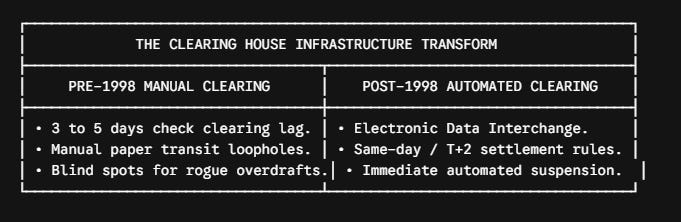
In 1998, Cheserem brought in private-sector IT experts to completely overhaul this system, executing the automation of the Nairobi Clearing House.
Electronic Settlement: The manual sorting of paper checks was replaced with an Electronic Data Interchange (EDI) system, slashing clearing times from nearly a week down to a standardized two days.
Real-Time Balance Checks: The new system automatically cross-referenced a commercial bank’s clearing account balance before honoring any transaction. If a bank’s account dipped into the red, the automated system flagged it instantly, shutting down its clearing privileges for the day.
By embedding rigid, automated technology into the clearing house, Cheserem systematically stripped away the human discretion and manual blind spots that corrupt actors had weaponized for a decade, permanently modernizing the operational DNA of Kenya’s capital markets.
5. The Contradictions: The Karura Forest Documentation Controversy
5.1 The Bosire Commission Testimony: The Destruction of the CD3 Forms
For Micah Cheserem, the most significant shadow cast over his reformist tenure emerged years later during the monumental Bosire Goldenberg Commission of Inquiry, set up by the Kibaki administration to unearth the full parameters of the multi-billion-shilling fraud.
Insiders testified under oath that between late 1993 and 1994—the exact height of Cheserem’s audit campaign—truckloads of vital financial documents were quietly moved out of the Haile Selassie Avenue headquarters.
According to the commission archives, these documents were transported to the deep recesses of Karura Forest, where they were systematically soaked in fuel and burned in massive bonfires. Crucially, the destroyed files reportedly included thousands of original Customs Declaration (CD3) forms, the very pieces of paper that mapped out the fake gold and diamond jewelry exports and identified the specific commercial banks and regulatory gatekeepers who had cleared the fraudulent payouts. Critics and political adversaries immediately pounced on this testimony, alleging that the document bonfire was an intentional, high-level cover-up designed to incinerate the paper trail before independent forensic investigators could link the wider political establishment to Kamlesh Pattni’s network.
5.2 The Reformer in the Crossfire: Surviving the Political Patronage Machinery
When Micah Cheserem took the stand at the inquiry to defend his integrity, he faced an aggressive cross-examination. He fiercely defended his record, offering a completely different perspective on the events of the 1990s and detailing the immense, often invisible pressures of acting as a corporate reformer inside a captured state
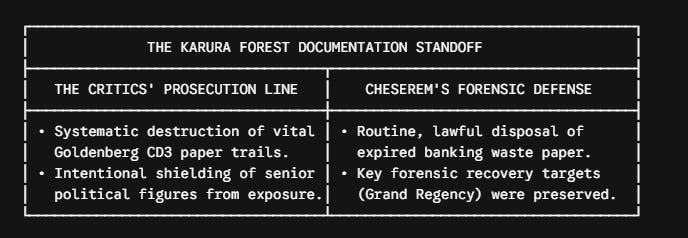
Cheserem completely dismissed the narrative of a calculated cover-up:
The Routine Disposal Argument: He maintained that the burning of documents was a routine, lawful administrative exercise to dispose of old, non-essential banking waste paper and duplicate ledger copies that were clogging the central bank’s physical archives.
Preservation of the Core Evidence: He pointed out that all the primary financial evidence required to prosecute the primary architects of the fraud—including the critical settlement sheets, the Exchange Bank liquidation records, and the title deeds for the Grand Regency Hotel—had been meticulously preserved and handed over to legal authorities.
Political Sabotage: Cheserem argued that the accusations were being aggressively weaponized by political adversaries who were desperate to discredit his structural achievements.
Ultimately, despite the intense political crossfire and the lingering debates over the Karura Forest bonfires, the consensus among financial historians remained intact: Cheserem’s aggressive methods, however controversial in the political arena, were the sole reason the state’s foundational financial architecture survived to see a new millennium.
6. The Second Act: Life After the Central Bank
When Micah Cheserem exited the Central Bank of Kenya in April 2001, he did not fade into quiet retirement. The technocratic execution style that he used to pull the economy back from the Goldenberg liquidity abyss became highly sought after by subsequent administrations. His post-CBK career solidified his status as one of the preeminent structural architects of Kenya’s modern financial ecosystem, stepping into key institutional vacancies when investor confidence or statutory frameworks needed urgent reinforcement.
6.1 Arresting the Broker Collapse: Restoring Market Integrity at the CMA (2009–2011)
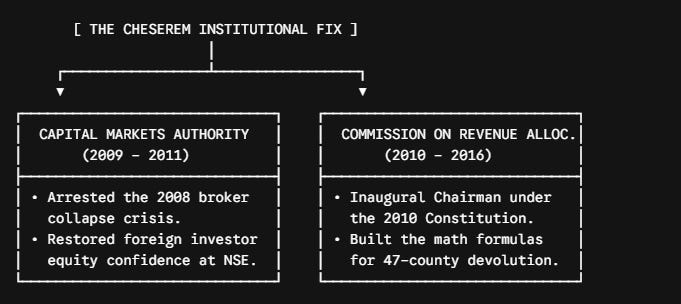
By late 2008, the Nairobi Stock Exchange (NSE) was facing a severe confidence crisis. A series of high-profile collapses and fraudulent malpractices by rogue stockbrokers—including the spectacular insolvencies of Nyaga Stockbrokers and Discount Securities—caused the retail investor market index to plunge by nearly 50% in a six-month window. The market regulator, the Capital Markets Authority (CMA), was widely criticized for passive oversight and failing to protect investor funds.
The Call to Action: In February 2009, Finance Minister Uhuru Kenyatta appointed Micah Cheserem as the Chairman of the CMA. The appointment was a deliberate, strategic signal to international and domestic institutional investors that the state was deploying its most experienced “cleaner” to restore market integrity.
The Reforms: During his short but intense tenure at the helm of the CMA, Cheserem applied the same uncompromising private-sector playbook he used at the CBK. He championed aggressive corporate governance reforms, accelerated the tightening of capital adequacy requirements for market intermediaries, and laid the regulatory foundations to transition the NSE from a closed broker-controlled club to a transparent, demutualized public entity.
6.2 Designing the Devolution Blueprint: The Inaugural CRA Chairmanship (2010–2016)
Cheserem’s crowning post-CBK assignment arrived with the promulgation of the landmark 2010 Constitution of Kenya. The new supreme law introduced a devolved system of government, shifting immense fiscal power from the centralized treasury in Nairobi out to 47 newly created counties. To manage this friction-prone financial transition, the state required an independent referee who was entirely untainted by tribal or partisan politics.
The Appointment: In late 2010, Cheserem resigned from his post at the CMA to be sworn in as the inaugural Chairman of the Commission on Revenue Allocation (CRA), a position he held until the completion of his term in late 2016.
The Mathematical Formula for Equity: The historical friction of Kenyan politics had always centered on the opaque, discretionary allocation of national resources. Cheserem’s commission eliminated this subjectivity by engineering a highly structured, data-driven mathematical formula to share billions of shillings equitably among counties. The foundational formula factored in specific weightings:
Population: 45%
Basic Equal Share: 25%
Poverty Index: 20% (to intentionally lift historically marginalized or underdeveloped regions)
Land Area: 8%
Fiscal Responsibility: 2%
The Clash for County Funding: As CRA Chairman, Cheserem frequently stood as the thin line defending the financial autonomy of devolved units. He regularly clashed with hardliners at the National Treasury and the National Assembly, aggressively pushing for vertical revenue allocations to the counties well above the statutory 15% minimum threshold, insisting that “money must follow functions” to make devolution a functional reality.
7. Legacy Check: The Technocratic Blueprint for Modern Frontier Markets
Micah Cheserem’s career trajectory—from managing multinational supply chain ledgers in Malawi to dismantling Kamlesh Pattni’s shadow banking networks, and ultimately designing the mathematical parameters of county budgeting—left an indelible mark on how capital moves through East Africa. His 47-year-old corporate ethos transformed him into the ultimate institutional firefighter, creating a blueprint for public sector governance that remains highly relevant today.
When analyzing the modern architecture of the Nairobi Securities Exchange (NSE), the Central Bank of Kenya (CBK), and the Commission on Revenue Allocation (CRA), three definitive legacies stand out:
The Supremacy of the Corporate Outsider: Cheserem proved that a background in strict cost accounting, multinational fiscal discipline, and corporate executive leadership is often a more potent weapon against systemic corruption than a career spent in political diplomacy or abstract economic academia.
Institutional Autonomy over Patronage: The 1996 CBK Amendment Act set a baseline for institutional design in East Africa. By legally securing the Governor’s tenure and placing a hard statutory cap on government borrowing, Cheserem demonstrated that economic stability can only be guaranteed when regulators are legally insulated from the short-term transactional pressures of the Executive.
The Mathematical De-politicization of Public Funds: Through his inaugural work at the CRA, Cheserem took the most contentious issue in Kenyan history—the distribution of the national resource pie—and stripped it of tribal and regional bias by converting it into a hard, data-driven mathematical formula.
Ultimately, Micah Cheserem’s decade of public service laid down a critical structural reality for modern frontier markets: to build resilient, transparent capital markets capable of attracting global institutional equity, a nation must first empower uncompromising, independent gatekeepers who are willing to treat the public purse with the absolute forensic accountability of a private-sector balance sheet.
This was a good read.