
Whats in this Article:
1. Executive Summary: The Anatomy of a Collapse
2. The Architecture of Deception: The Iman Window & Parallel Operations
3. The Camouflage Strategy: “Other Assets” and Joint-Venture Exploitation
4. Quantifying the Extraction: The Unreported Arbitrage Gap
5. The Unraveling: The Restatement Shock of 2016
5.1 The Auditor Paradox: Deloitte’s Entry and the Changing of the Guard
5.2 The Midnight Revisions: The High-Stakes Boardroom Showdown with CBK
5.3 The Public Rupture: Deconstructing the Infamous Restated Balance Sheet
6. The Tsunami: The WhatsApp Run and the Lockout
6.1 The Virality of Panic: How Social Media Weaponized a Liquidity Deficit
6.2 The M-Pesa Drain: The Mechanics of the Digital Flight to Safety
6.3 The Lockout: The Morning of April 7, 2016, and the Statutory Iron Curtain
7. The Aftermath: Restructuring, KDIC, and the SBM Takeover
7.1 The Stabilization Phase: KDIC’s Intervention and the Partial Thaw
7.2 Enter SBM Holdings: The Anatomy of a Carve-Out Acquisition
7.3 The Forensic Post-Mortem: Lessons in Frontier Market Corporate Governance
8. The Institutional Reset: How the Chase Collapse Remade the Financial Regulatory Architecture
8.1 Hardening of the “Other Assets” Audit Framework
8.2 Standardized Oversight of Shariah-Compliant Windows
8.3 The Shift to Real-Time Electronic Surveillance (EDS)
8.4 Overhaul of the Kenya Deposit Insurance Corporation (KDIC)
8.5 Heightened Personal Liability for Directors and Gatekeepers
9. The Decade-Long Legal War: Criminal Trials, Precedents, and Property Clashes
9.1 The First Asset Frost: Civil Clawbacks and the LSK Injunction Bid
9.2 The State Strikes Back: Criminal Arraignments of Executive Gatekeepers
9.3 The Quistclose Trust Precedent: Elevating Equity in Banking Liquidation
9.4 Clash of the Titans: The 2026 Equity Bank Headquarters Auction Showdown
10. Sources and Forensic Records
1. The Mirage of the “A-Class” Darling
1.1 The Scene: April 2016 and the Sudden Asymmetry of Crowds at Riverside Drive
The morning air along Riverside Drive in Nairobi is usually characterized by the quiet, disciplined hum of corporate wealth. But in the first week of April 2016, the rhythm broke.
Lining the pavements were not the disenfranchised or the economically marginalized, but the bedrock of Kenya’s rising economic engine: tech entrepreneurs, middle-class professionals, local investment groups (chamas), and clearing agents. They stood in winding, anxious queues that spilled onto the tarmac, clutching smartphone screens reflecting frantic WhatsApp alerts.
Cashiers stared blankly at screens as the interbank liquidity lines completely dried up. Within a matter of hours, the neat, digital ledgers representing billions of shillings of public and corporate savings had frozen, exposing a stark reality: the vault was empty.
1.2 The Corporate Hipster: How Chase Bank Re-engineered the Aesthetic of Kenyan Banking
Chase Bank was not merely a financial intermediary; it was a cultural phenomenon—the definitive “corporate hipster” of the banking sector. For decades, Kenyan banking had been defined by the austere, stiff, and often intimidating architecture of traditional Tier-1 powerhouses like Barclays, Standard Chartered, or the early iterations of Kenya Commercial Bank (KCB).
Chase Bank completely flipped the script. They realized that the true growth engine of the Kenyan economy lay in the informal and semi-formal Small and Medium-Sized Enterprise (SME) sector—the agile traders in Biashara Street, the tech start-ups in Kilimani, and the boutique real estate developers in Machakos.
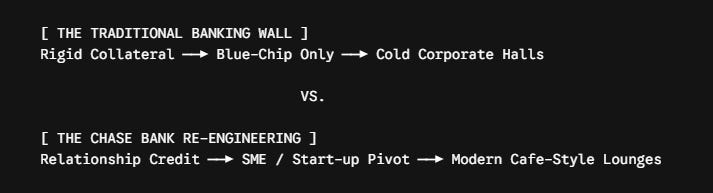
Chase Bank re-engineered the banking experience to match this demographic:
They replaced bulletproof glass and cold, grey counters with warm, open-plan, cafe-style lounges.
Their staff did not wear the rigid, dark suits of legacy bankers; they spoke the language of collaboration, relationship management, and modern venture capital.
They aggressively championed niche demographics, launching tailored facilities for women entrepreneurs through products like the Strand She Business account and aggressively backing youth-led enterprises.
By aligning its brand with the narrative of a rising, modern, entrepreneurial Kenya, Chase Bank became the darling of international development finance institutions (DFIs) and local high-net-worth investors alike. It grew at a blistering, compounding rate, swiftly climbing the ranks to become a dominant Tier-2 powerhouse on the cusp of entering the elite Tier-1 circle.
1.3 The Visionary Persona: Zafrullah Khan as the Anti-Establishment Banker
At the center of this financial renaissance stood a singular, magnetic force: Zafrullah Khan.
Suave, highly articulate, and projecting an aura of effortless intellectual sophistication, Khan was the co-founder and Group Managing Director who built Chase Bank from a defunct, minor outfit into a multi-billion-shilling empire. In a market dominated by conservative, risk-averse accountants, Khan positioned himself as an anti-establishment visionary.
He was a master of corporate rhetoric. In economic forums and media features, Khan spoke passionately about financial inclusion, structural agility, and the democratization of capital. This cultivated persona created an ironclad layer of trust. International private equity funds and European DFIs looked at Khan and saw the ideal modern African banker—progressive, transparent, and intensely capable. Local business moguls moved their operating lines to Chase because a handshake from Zafrullah Khan felt like a sovereign guarantee of growth.
But behind this impeccably styled curtain of progressive banking layout, relationship managers, and award-winning innovation lay a highly volatile, alternative plumbing system. Khan was not just matching depositors with borrowers; he was operating an intricate, off-balance-sheet capital extraction loop that was systematically hollowing out the bank’s core assets from the inside out.
2. The Genesis: Building Chase from the Rubble
2.1 The Acquisition of United Bank: Turning a Tier-3 Distressed Asset Around
To trace the true origin of Chase Bank’s meteoric rise, one must look back to the wreckage of the Kenyan banking crisis of the mid-1990s. The sector was littered with the carcasses of small, indigenous Tier-3 institutions that had succumbed to poor capitalization, political interference, and bad debt portfolios. Among these struggling entities was United Bank, a minor, distressed outfit that possessed little more than a banking license and a mountain of non-performing loans.
In 1996, Zafrullah Khan, alongside a consortium of ambitious young professionals and investors, stepped into this graveyard of capital. They acquired United Bank, swiftly renaming it Chase Bank Kenya.
Khan did not attempt to compete with the institutional momentum of the market giants. Instead, he stripped the bank down to its bare operational essentials, cleared the toxic historical legacy debt, and began rebuilding the institution block by block. It was a classic turnaround play, transforming an obscure, failing financial vehicle into a clean, nimble corporate blank slate.
2.2 The SME Arbitrage: Exploiting the Mainstream Credit Blindspots
By the early 2000s, Khan recognized a massive, unaddressed structural disconnect in the Nairobi financial ecosystem. While the traditional corporate titans remained steady, a vibrant, hyper-active tier of Small and Medium-Sized Enterprises (SMEs) was emerging as the true driver of national GDP.
However, the legacy banking sector—dominated by rigid multinational subsidiaries—was suffering from profound risk-aversion. Their credit appraisal models were built exclusively for large conglomerates with decades of audited books, or old-money families holding vast portfolios of prime urban collateral. For a mid-tier importer in downtown Nairobi, an agri-processing startup in the Rift Valley, or a logistics company looking to clear containers at the Port of Mombasa, securing a formal bank loan was an agonizing, often impossible task.
Chase Bank stepped directly into this credit void, executing an aggressive strategy of market arbitrage:
Speed Over Bureaucracy: While a credit application at a Tier-1 legacy bank could languish in regional committees for months, Chase Bank decentralized its approval lines, offering unprecedented turnaround times of a few days.
Alternative Collateral Appraisal: Khan’s relationship managers moved away from the absolute requirement of pristine land titles, accepting alternative securities such as cash flows, movable assets, and stock invoices.
The Proximity Model: Chase opened branches not in cold, distant financial districts, but right at the doorstep of the commercial hubs where the SME traders operated, directly embedded within Kenya’s fast-growing business nodes.
By demystifying credit for this highly dynamic segment of the economy, Chase Bank captured the most profitable, high-velocity deposits in the market. The margins were immense; SMEs were entirely willing to pay premium interest rates in exchange for the sheer speed, agility, and respect that Chase extended to them.
2.3 The Conduits of Capital: Attracting Development Finance Institutions (DFIs) and Private Equity
As Chase Bank’s specialized SME portfolio expanded, its balance sheet began compounding at a rate that caught the attention of the global financial markets. The bank was no longer just an indigenous success story; it had become a highly effective pipeline for international capital looking to gain exposure to East Africa’s economic growth.
Zafrullah Khan used his immense personal charm and progressive corporate rhetoric to pitch Chase Bank to international investors. He framed the bank not merely as a commercial enterprise, but as a vehicle for sustainable economic empowerment.
The strategy was wildy successful. Massive international development finance institutions (DFIs) and global private equity funds began queuing up to pump capital into the bank:
The French Development Agency (AFD) and Proparco extended multi-billion-shilling credit lines dedicated to green energy financing and SME growth.
The International Finance Corporation (IFC), the private lending arm of the World Bank, stepped in with substantial credit facilities aimed at expanding financial access to women-led enterprises.
Prominent private equity consortiums, including Germany’s DEG and Swiss-based investor ResponsAbility, took significant equity stakes, anchoring the bank’s capital tier.
By 2015, this influx of global capital, combined with a swelling local deposit base, pushed Chase Bank’s asset valuation past the 100 billion KES mark. It had successfully scaled the wall from a distressed Tier-3 outfit to a dominant Tier-2 powerhouse, universally tipped by market analysts to become the next member of Kenya’s elite Tier-1 banking club.
The acquisition of United Bank (Kenya) in 1995 was not executed by Zafrullah Khan alone, but rather by a structured consortium of local Kenyan businessmen, private entities, and professionals.
While Khan emerged as the prominent founding director, chief architect, and public face of the rebrand, the transaction was a collective buyout. A network of several local businesses and private Kenyan investors came together to pool approximately 95 million KES ($1.23 million at the time) to purchase a controlling 60% stake in the distressed lender from the Central Bank of Kenya’s statutory administration.
Among the key co-founders and early institutional partners who shaped the bank’s initial governance alongside Khan were:
Ali Cheema: A long-time associate who stepped in as the bank’s Chairman and anchored the board’s leadership for years alongside Khan.
Duncan Kabui: Another vital insider who joined the core executive leadership team early on, eventually rising to become the Group Managing Director of Chase Bank.
This tight-knit circle of local founders maintained a dominant majority control through the late 1990s and 2000s. It was this exact ownership concentration that initially gave Chase its agile, local-first corporate identity—but it also laid the groundwork for the insular executive decisions and uncollateralized insider networks that ultimately triggered its dramatic collapse two decades later
3. The Plumbing: Inside the Islamic Banking Arbitrage
3.1 The Genesis of the Iman Window: Innovation vs. Regulatory Asymmetry
As Chase Bank scaled aggressively through the late 2000s, its executive leadership encountered a structural constraint common to all rapidly growing Tier-2 banks: the statutory limit on traditional lending margins. To sustain its blistering pace of growth and maintain its high-yielding returns, Chase needed a financial vehicle that could operate outside the rigid, highly visible parameters of conventional interest-rate spreads and standard asset classification.
The solution was brilliant in its timing and packaging. In 2009, Chase Bank became one of the pioneers of Islamic banking windows in Kenya, launching its specialized Iman window.
The move was hailed as a milestone for financial inclusion, opening up sophisticated credit and deposit lines to a heavily under-banked Muslim commercial demographic in Nairobi, Eastleigh, and Mombasa.
In the early 2010s, the Central Bank of Kenya’s oversight frameworks were heavily calibrated for conventional banking. The specialized, asset-backed nature of Shariah-compliant instruments created a profound regulatory asymmetry.
Because Islamic finance explicitly bans the charging of interest (Riba), transactions must be structured as trade arrangements, asset sales, or equity partnerships. For Zafrullah Khan and his compliance architects, this alternative legal framework provided the perfect canopy.
3.2 The Mechanics of Murabaha and Musharaka Misdirection
To understand how the vault was systematically hollowed out, one must look at the specific plumbing of two core Islamic finance contracts: Murabaha (cost-plus financing) and Musharaka (joint-venture partnership).
In a legitimate Murabaha transaction, a bank purchases an asset (such as equipment or commodities) on behalf of a client and sells it back to them at a marked-up price, with the client paying in installments. It is a trade contract, not a loan.
Inside Chase Bank, however, this mechanism was fundamentally warped. The bank would approve massive “Murabaha trade financing” lines to buy physical assets—except the commodities or real estate parcels being purchased were frequently non-existent, over-invoiced, or sourced from entities directly linked to bank insiders. The capital left the bank as a legitimate trade payment, but the underlying asset was nothing more than a paper phantom.
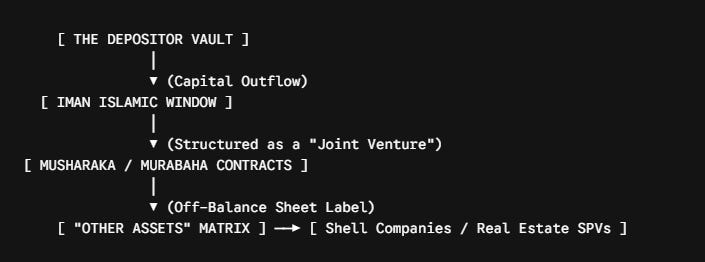
Even more potent was the manipulation of Musharaka (joint-venture) contracts. Under a standard Musharaka arrangement, the bank and an entrepreneur pool capital to fund a project, sharing both risks and profits.
Khan’s executive network utilized these contracts to establish sweeping real estate and investment partnerships. When Chase Bank advanced billions of shillings to these joint ventures, the transactions were not recorded under the standard “Loans and Advances” ledger. Instead, they were structurally routed off the conventional balance sheet and booked under an ambiguous, poorly monitored accounting line item: “Other Assets.”
3.3 Off-Balance Sheet Engineering: Moving Customer Deposits Beyond CBK Surveillance
By classifying billions of shillings in insider cash outflows as “Joint Ventures” and “Other Assets” rather than traditional loans, Chase Bank successfully blindfolded the Central Bank of Kenya’s supervisory teams for years.
In a conventional lending model, if a bank advances a large sum to an insider or a risky corporate entity, strict regulatory red flags are immediately tripped:
The loan must be backed by documented, high-quality collateral.
The transaction is subjected to strict single-borrower exposure limits (typically capped at 25% of the bank’s core capital).
If the borrower misses payments, the loan is automatically downgraded to a “Non-Performing Loan” (NPL), forcing the bank to take heavy profitability-killing provisions.
By routing these funds through the off-balance-sheet pipeline of the Iman window and labeling them as joint-venture asset investments, Khan and his inner circle bypassed every single one of these defensive tripwires. The cash was gone, but on paper, the bank’s asset base looked flawlessly healthy.
The “Other Assets” line item on the published balance sheet swelled year after year, hiding a toxic concentration of uncollateralized insider exposure. Depositors looked at the surging asset numbers and saw a thriving, secure, Tier-2 juggernaut. In reality, they were looking at a sophisticated accounting mirage. The bank’s core liquidity had been systematically drained to fund a shadow empire of private real estate plays, completely out of sight of the regulators, until the audit guard changed in late 2015.
4. The Fatal Leverage: Joint Ventures & Insider Looting
4.1 The Special Purpose Vehicle (SPV) Matrix: The Case of Lighthouse Properties
The off-balance-sheet pipeline engineered through the Islamic banking window required a destination—a network of corporate containers where the extracted liquidity could be permanently parked. To achieve this, Zafrullah Khan and his inner executive circle established an intricate matrix of Special Purpose Vehicles (SPVs) and shell companies. These entities were superficially structured as independent real estate development partners, but in reality, they were completely controlled by bank insiders.
The crown jewel of this shadow network was an entity named Lighthouse Properties. Whenever Chase Bank needed to move massive tranches of cash out of its central reserves without triggering regulatory red flags, it would structure a “Joint Venture” agreement with Lighthouse Properties or its sister subsidiaries.
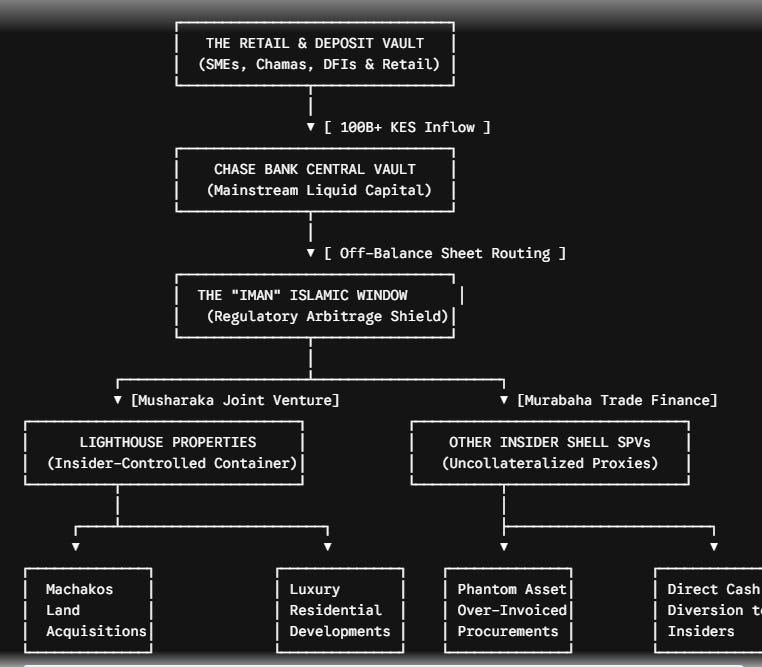
Through this singular conduit, billions of shillings were systematically drawn down. Lighthouse Properties used these uncollateralized, zero-interest cash injections to acquire vast portfolios of prime real estate across the country. This included the acquisition of sweeping agricultural and commercial land parcels in Machakos County, as well as high-end, luxury residential and commercial developments in Nairobi’s affluent suburbs. The bank’s depositors were unknowingly financing an elite private equity property fund owned entirely by the very men hired to guard their savings.
4.2 The “Other Assets” Camouflage: How Non-Performing Loans Were Capitalized
In a standard commercial banking setup, when a borrower defaults on a loan, the laws of financial gravity take over. The asset must be classified as a Non-Performing Loan (NPL), interest income recognition must be suspended, and the bank must slash its profits to provision for the bad debt. This is the metric that institutional investors and stock market analysts watch with predatory focus.
Khan’s genius—and ultimate corporate crime—lay in his ability to entirely bypass this gravitational pull. When an insider-controlled SPV received funding and failed to make repayments (which was almost always the case, as these entities generated no immediate cash flow), the facility was never downgraded to an NPL.
Instead, using creative accounting methodologies, Chase Bank capitalized these unpaid disbursements. They shifted the balances out of the loan book entirely and recorded them under the sweeping, ambiguous umbrella of “Other Assets” or “Joint Venture Investments.”
On the published balance sheets, this created a profound accounting distortion:
The Illusion: The bank appeared to have an incredibly clean, low-risk loan book with negligible NPL ratios.
The Reality: The toxic, uncollectible debt was simply sitting in a different room on the ledger, heavily camouflaged as valuable equity investments in real estate.
The bank was aggressively booking paper profits on these “investments,” allowing it to declare dividends and project an image of hyper-profitability while its actual cash reserves were dangerously close to operational zero.
4.3 The Forensic Math: Unpacking the 16.6 Billion KES Irregular Extraction
When external forensic investigators and Central Bank auditors finally cracked open Chase Bank’s internal servers, the sheer scale of the extraction shocked even seasoned market regulators. The forensic math revealed an institutional hollowing-out of historic proportions.
Auditors uncovered that a staggering 16.6 billion KES had been irregularly extracted through this insider network. To put this macroeconomic number into perspective for a frontier market layout:
Total Irregular Insider Exposure: KES 16.6 Billion
Systemic Context: This staggering extraction represented a massive chunk of the bank’s entire core capital base, completely breaking its structural foundation.
Initially Reported Insider Loans: KES 3.2 Billion
Systemic Context: This was the heavily sanitized, compliant figure intentionally presented to the public, shareholders, and central bank regulators to maintain the illusion of safety.
The Unreported Arbitrage Gap: KES 13.4 Billion
Systemic Context: The core of the fraud. This massive variance was completely stashed away and camouflaged within the “Other Assets” and “Joint Venture Investments” accounting line items to evade automated regulatory red flags.
5. The Unraveling: The Restatement Shock of 2016
5.1 The Auditor Paradox: Deloitte’s Entry and the Changing of the Guard
For years, Chase Bank’s accounting architecture had withstood routine annual audits. The creative classification of uncollateralized insider extractions as “Other Assets” and “Joint Venture Investments” had successfully kept the central bank’s automated regulatory tripwires blindfolded.
The catalyst was twofold: the collapse of Imperial Bank in October 2015 due to a massive parallel banking scheme, and the aggressive regulatory regime instituted by the newly appointed Central Bank of Kenya (CBK) Governor, Dr. Patrick Njoroge. Governor Njoroge.
When international accounting firm Deloitte & Touche took over the auditing reins at Chase Bank for the 2015 financial year, they entered with an entirely different mandate. Unlike previous cycles, Deloitte’s forensic teams began looking past the neatly typed labels of Shariah-compliant Musharaka contracts. As the audit extended into the first quarter of 2016, the corporate facade began to fracture.
5.2 The Midnight Revisions: The High-Stakes Boardroom Showdown with CBK
By late March 2016, the corporate offices at Riverside Drive had become a pressure cooker. Deloitte dropped a bombshell on the board of directors: they refused to sign off on the bank’s financial statements unless the multi-billion-shilling “Joint Venture” portfolio was pulled out of the shadows and correctly restated as Insider Lending.
This triggered a series of frantic, high-stakes midnight boardroom meetings between Chase Bank’s executive leadership, the auditors, and senior officials at the Central Bank of Kenya. Khan and his inner circle knew that reclassifying those assets would instantly expose the bank’s non-compliance with single-borrower exposure limits and obliterate its statutory capital adequacy ratios.
THE BOARDROOM COLLISION: THE 72-HOUR TIMELINE TO RECEIVERSHIP
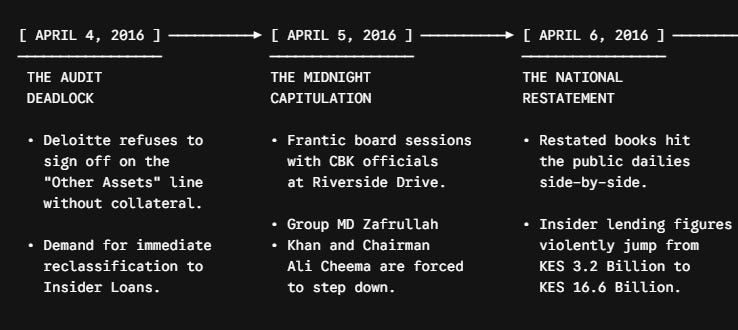
The regulators stood firm. Under intense pressure from both Deloitte and the CBK, the board was forced to capitulate. In a desperate attempt to contain the impending fallout, a frantic, late-night restructuring of the ledger was executed. Khan and his longtime associate, Chairman Ali Cheema, agreed to step aside from their executive roles in a bid to signal accountability to the market. But the accounting damage was already done, and it could no longer be contained within the boardroom.
5.3 The Public Rupture: Deconstructing the Infamous Restated Balance Sheet in the Dailies
On the morning of April 6, 2016, the Kenyan public awoke to a jarring sight in the financial pages of the national dailies. Published side-by-side were Chase Bank’s restated financial results for the year ended December 31, 2015. To the trained eyes of stock market analysts, investment managers, and corporate treasurers, the document was an absolute horror show.
The numbers laid bare a catastrophic overnight revision:
The Insider Lending Explosion: Under the “Insider Loans and Advances” line item, the figure had violently rocketed from the previously declared 3.2 billion KES to a staggering 16.6 billion KES.
The Auditor’s Disclaimer: Deloitte did not just attach a standard sign-off; they stamped the financials with a qualified audit opinion, explicitly pointing out the massive, uncollateralized internal concentrations of credit.
The Capital Adequacy Breach: The restatement revealed that the bank’s core capital-to-risk-weighted-assets ratio had plunged far below the CBK’s strict statutory minimum threshold.
For a frontier financial market, this was an unprecedented public rupture. The pristine, award-winning, Tier-2 darling of international DFIs had just admitted on national newsprint that it had allowed its insiders to bypass every risk management protocol in the book. The psychological anchor of trust that held Chase Bank’s multi-billion-shilling deposit base together had been completely severed. The stage was set for a modern, digitally accelerated bank run.
During the critical period of the 2015 financial audit and the subsequent April 2016 collapse, Chase Bank Kenya was governed by an eight-person board of directors. The board was a mix of the bank’s original founders, seasoned executive corporate paths, and representatives from the international private equity and development finance institutions (DFIs) that had bought stakes in the lender.
The boardroom roster at the center of the storm consisted of the following key figures:
1. The Executive Leadership (Inside Directors)
Zafrullah Khan (Chairman): The co-founder, mastermind, and public face of the bank. He chaired the board during the entire buildup of the off-balance-sheet pipeline until he was forced to step aside on April 6, 2016, following the publication of the restated results.
Duncan Kabui (Group Managing Director): An early insider who oversaw the day-to-day strategic operations and expansion of the Chase Bank group. Like Khan, he resigned in the final 24-hour boardroom capitulation.
Paul Njaga (Managing Director & CEO): A veteran corporate banker (formerly Chief Finance Officer at Equity Bank) who handled the mainstream management of the commercial business lines. Unlike Khan and Kabui, Njaga remained in his position during the initial transition to stabilize the bank’s operations.
2. The Independent & Non-Executive Directors
Muthoni Kuria: A career banker and Certified Public Accountant (CPA) who had served as an independent non-executive director on the board for over three years. When Khan was forced out at midnight on April 6, the board desperately appointed her as the Acting Chairperson to project stability to the central bank and the market.
Ali Cheema: A founding non-executive director and long-time associate of Zafrullah Khan who held a significant historical anchor on the board’s credit and governance committees.
3. The Institutional & DFI Representatives
Because Chase Bank had successfully courted massive global capital, several seats on the board were occupied by nominee directors representing international investment funds:
Amethis Finance (France): Held a 10.9% equity stake in the bank and maintained active board oversight to protect European private equity capital.
DEG (Germany) & ResponsAbility (Switzerland): As major institutional backers, their designated risk and investment directors sat on the board to oversee governance—though they were ultimately blindsided by the technical asymmetry of the Iman window’s off-balance-sheet routing.
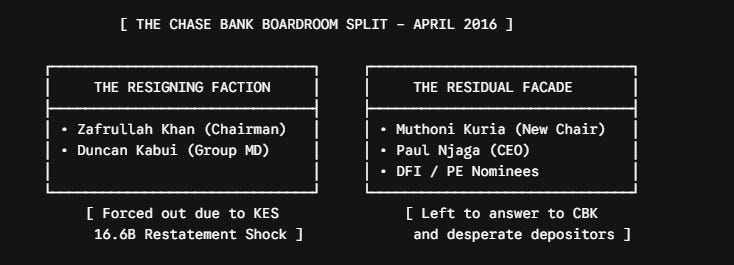
The corporate governance breakdown was total; the board’s internal audit and credit committees completely failed to register that their own chairman was using parallel structures to over-leverage the bank.
Muthoni Kuria Appointed Chase Bank Chair provides context on the leadership vacuum left when the long-serving founders were ousted.
6. The Tsunami: The WhatsApp Run and the Lockout
6.1 The Virality of Panic: How Social Media Weaponized a Liquidity Deficit
In the pre-digital era of banking, a bank run was a slow, visible, and physical phenomenon. It required depositors to read the morning papers, commute to a brick-and-mortar branch, and line up on the street. This physical friction gave bank executives and regulators a precious buffer—hours or even days to arrange emergency liquidity lines or issue calming press releases.
Chase Bank had no such luxury. It became the victim of the first fully weaponized, digitally accelerated bank run in East African financial history.
On the afternoon of April 6, 2016, immediately following the publication of the restated accounts, the financial anxiety did not simmer; it exploded in the digital space. A wave of frantic screenshots of the restated balance sheet, paired with speculative commentary, flooded X (Twitter) and WhatsApp group chats across Kenya.
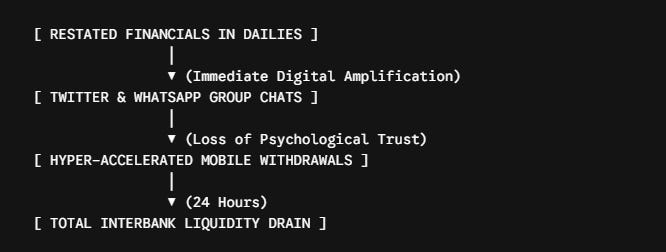
The very demographic Chase Bank had masterfully courted—the tech-savvy, hyper-connected, urban middle class—became the conduit for its destruction. Group chats belonging to tech hubs, real estate investment chamas, and corporate boards turned into echo chambers of panic.
Speculative alerts, some warning that the bank would be shut down by morning, went viral within minutes. In this high-velocity information vacuum, rational financial analysis ceased to exist. Trust, the ultimate intangible asset of any banking institution, was completely obliterated by a geometric progression of smartphone notifications.
6.2 The M-Pesa Drain: The Mechanics of the 8 Billion KES Digital Flight to Safety
What made the Chase Bank run uniquely devastating was Kenya’s hyper-advanced mobile money infrastructure. Depositors did not wait for the branches to open the next morning. Instead, sitting in their offices in Kilimani or their homes in Westlands, thousands of clients logged into their Chase Bank mobile banking apps simultaneously.
They began executing massive, systematic transfers via integrated digital pipelines:
M-Pesa Integrations: Depositors maxed out their daily mobile money transfer limits, shifting funds straight from their bank accounts into their Safaricom M-Pesa wallets.
Real-Time Gross Settlement (RTGS): Corporate entities launched urgent electronic instructions to move operating capitals to Tier-1 legacy giants like KCB and Equity Bank.
The Interbank Freeze: In the interbank market, where banks routinely lend to each other overnight to cover shortfalls, rival institutions looked at Chase’s restated books and slammed their credit windows shut. No bank was willing to risk its capital on an institution whose core assets were dissolving.
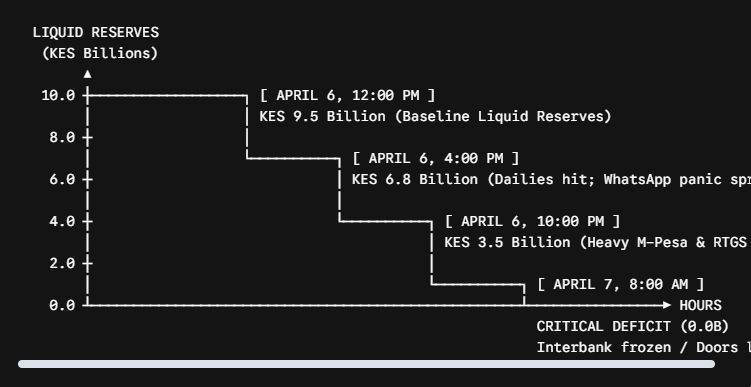
The velocity of the flight was staggering. In less than 24 hours, an estimated 8 billion KES in liquid cash reserves was drained out of Chase Bank’s digital pipes. The bank’s real-time settlement accounts held at the Central Bank of Kenya were completely cleaned out. By the morning of April 7, the bank was operationally paralyzed; it had plenty of phantom real estate assets on its ledger, but it did not have a single shilling left to clear a cheque or fulfill a counter withdrawal.
6.3 The Lockout: The Morning of April 7, 2016, and the Statutory Iron Curtain
When the sun rose on Thursday, April 7, 2016, the physical reality finally caught up with the digital panic. Thousands of retail depositors who had been unable to transfer their funds electronically overnight rushed to the branches.
At the Riverside Drive headquarters and branches across Nairobi, they were met with an absolute, uncompromising corporate wall. The glass doors were locked. The ATM screens were blank, displaying cold, automated error codes. Security guards stood outside, looking overwhelmed as they faced crowds of furious business owners demanding their money.
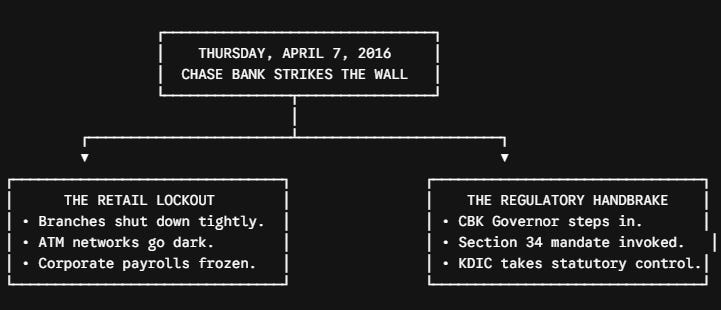
Inside the central bank offices, Governor Patrick Njoroge pulled the emergency handbrake. Recognizing that Chase Bank was completely insolvent on a liquidity basis and unable to meet its clearing house obligations, the CBK invoked its mandate under Section 34 of the Banking Act.
Chase Bank Kenya was officially placed under receivership. The Kenya Deposit Insurance Corporation (KDIC) stepped in as the statutory receiver, locking down the entire institution to preserve whatever residual assets remained. The meteoric, twenty-year rise of the ultimate SME darling had ended in a definitive, crushing shutdown, leaving billions of shillings of public and corporate wealth trapped behind a state-enforced iron curtain.
THE LIQUIDITY HEMORRHAGE: THE 24-HOUR DIGITAL BANK RUN
7. The Aftermath: Restructuring, KDIC, and the SBM Takeover
7.1 The Stabilization Phase: KDIC’s Intervention and the Partial Thaw
When the Kenya Deposit Insurance Corporation (KDIC) slammed the statutory iron curtain down on April 7, 2016, the immediate priority was not liquidation, but containment. A complete failure of a Tier-2 bank of Chase’s scale threatened a systemic contagion across the entire Kenyan banking sector, particularly for other mid-tier lenders vulnerable to a flight to safety.
In an unprecedented move to restore public confidence, the Central Bank of Kenya executed a rapid stabilization plan. Just over two weeks after the shutdown, on April 27, 2016, Chase Bank was remarkably reopened under the management of KCB Bank Kenya Limited as the appointed manager.
This initial phase provided a critical lifeline:
The Retail Thaw: Micro-depositors were granted immediate access to up to 1 million KES of their trapped funds. This effectively cleared out and satisfied over 95% of the bank’s individual retail client base.
The Corporate Freeze: For institutional depositors, large-scale SMEs, and chamas whose balances stretched far into the millions, the reality was much colder. Their capital remained heavily locked down as the central bank searched for a permanent, well-capitalized structural buyer.
7.2 Enter SBM Holdings: The Anatomy of a Carve-Out Acquisition
The permanent resolution for Chase Bank did not come from local legacy giants, but from across the Indian Ocean. In 2017, SBM Holdings—the financial services powerhouse backed by the government of Mauritius—emerged as the winning suitor. Fresh off its acquisition of the small Fidelity Commercial Bank, SBM saw the carcass of Chase Bank as a high-velocity passport to becoming a serious player in East Africa’s economic hub.
However, SBM had no intention of absorbing the toxic, insider-looted shell that Zafrullah Khan had left behind. Instead, the transaction was structured as a highly selective carve-out acquisition rather than a traditional merger.
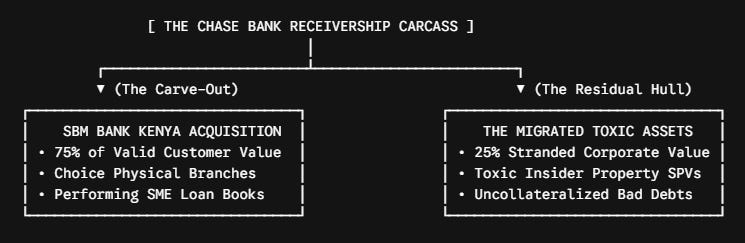
Under the terms finalized in early 2018, SBM Bank Kenya officially acquired:
75% of the value of the remaining non-insider deposits.
The majority of Chase Bank’s physical branch network and staff.
The clean, performing portions of the underlying SME loan portfolio.
By leaving the toxic real estate SPVs, the uncollateralized insider debt lines, and the remaining 25% of large corporate liabilities behind in the residual liquidation hull managed by the KDIC, SBM insulated its balance sheet from the structural rot while capturing Chase’s prized SME infrastructure.
7.3 The Forensic Post-Mortem: Lessons in Frontier Market Corporate Governance
The formal handover to SBM Bank Kenya in August 2018 marked the definitive end of the Chase Bank brand, but the forensic lessons of its collapse continue to reverberate across frontier capital markets. The 16.6 billion KES wreckage left behind offers a brutal, unambiguous masterclass in the limitations of traditional compliance frameworks.
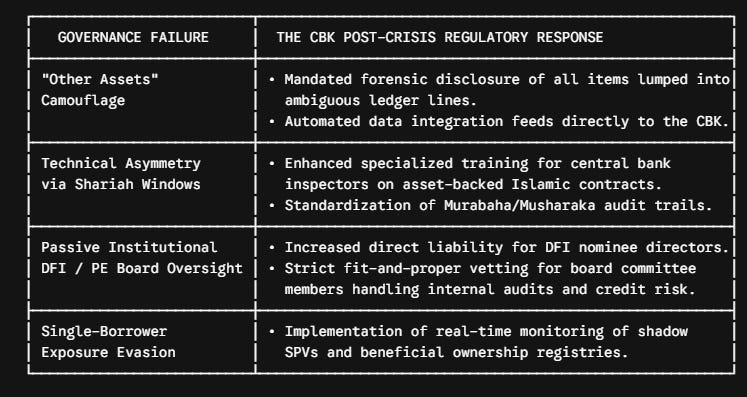
THE SYSTEMIC COMPLIANCE FALLOUT: BEFORE & AFTER 2016
8. The Institutional Reset: How the Chase Collapse Remade the Financial Regulatory Architecture
The wreckage left behind by Chase Bank’s 16.6 billion KES insider exposure did not just dissolve into the history books; it served as the ultimate catalyst for a sweeping, structural overhaul of Kenya’s financial regulatory ecosystem. Dr. Patrick Njoroge, the Central Bank of Kenya (CBK) Governor at the time, leveraged the systemic shockwaves of the 2016 banking crisis to end the era of regulatory forbearance. The regulator recognized that traditional, checklist-based compliance frameworks were entirely obsolete against sophisticated, tech-driven asset diversion.
The resulting structural, institutional, and policy shifts fundamentally altered the rules of the game for frontier market banking:
8.1 Hardening of the “Other Assets” Audit Framework
Prior to 2016, banks routinely utilized the “Other Assets” ledger line as a convenient, poorly audited repository to stash non-performing insider exposures and complex investments completely out of sight of automated supervisory tools.
The New Mandate: The CBK instituted strict, granular breakdown requirements for all items lumped under “Other Assets.”
The Enforcement: Examiners began demanding independent, verifiable valuation and legal collateral documentation for these balances. Any uncollateralized or non-performing joint-venture asset was forced to be reclassified directly into the mainstream loan book, subjecting it to immediate single-borrower exposure limits and profitability-killing provisioning.
8.2 Standardized Oversight of Shariah-Compliant Windows
The crisis exposed a profound technical asymmetry within the regulator’s own ranks. Mainstream central bank inspectors lacked the specialized training to properly audit alternative, complex, asset-backed Islamic financing structures like Murabaha and Musharaka contracts.
Closing the Canopy: The CBK completely revamped its supervisory manuals to integrate specialized Islamic finance audit trails.
Automated Exposure Tracking: Alternative trade arrangements were standardized under mandatory regulatory reporting frameworks. This ensured that off-balance-sheet insider capital extraction loops could no longer mask themselves as trade partnerships or equity joint ventures.
8.3 The Shift to Real-Time Electronic Surveillance (EDS)
To eliminate the dangerous information asymmetry where regulators only reviewed a bank’s health through highly sanitized, periodic financial statements, the CBK accelerated its digital surveillance infrastructure.
The Centralized Electronic Data System (EDS): The regulator rolled out a real-time system that plugged directly into the core banking backends of all commercial lenders.
The Impact: Instead of waiting for quarterly or annual self-reported financial statements, the central bank gained the capability to monitor large-scale exposures, daily liquidity ratios, and interbank transaction settlements in real time—effectively preventing rogue executives from hiding sudden insider drawdowns or rapid capital flights.
8.4 Overhaul of the Kenya Deposit Insurance Corporation (KDIC)
The crisis proved that the old deposit protection framework was structurally inadequate for managing the collapse of high-velocity, Tier-2 commercial banks with massive SME and corporate deposit bases.
The Capital Cushion: The statutory deposit coverage limit managed by the KDIC, which had remained stagnant at a low cap of KES 100,000 for decades, was drastically overhauled and raised to KES 500,000 to protect retail depositors and stem panic during systemic shocks.
The Resolution Blueprint: The KDIC transitioned from a passive, post-collapse liquidation body into an active, early-intervention resolution authority. The “carve-out” resolution mechanism utilized in the SBM takeover became the standard operational blueprint for handling distressed lenders without triggering industry-wide contagion.
8.5 Heightened Personal Liability for Directors and Gatekeepers
The failure of international private equity funds and development finance institutions (DFIs) to flag the blatant internal asset diversion at Chase Bank led to a massive paradigm shift in corporate governance accountability.
Strict Vetting: The CBK significantly tightened its “Fit and Proper” vetting criteria for all commercial bank board appointments, specifically targeting members of Audit and Risk committees.
Nominee Director Accountability: The regulator made nominee directors personally and legally liable for governance oversights, demanding that board members actively cross-examine executive management rather than passively relying on signed-off auditor sheets. Additionally, external audit firms faced heightened scrutiny and stricter rotation mandates to prevent long-term institutional capture.
2017: The First Asset Frost and the KDIC Recovery Campaign
Immediately following the bank’s entry into receivership, the KDIC launched an aggressive legal campaign to claw back the 16.6 billion KES extracted through the shadow Iman window and hidden under the “Other Assets” line item.
April 2017: In HCCC No. 159 of 2017 (Chase Bank Limited in Receivership v. Zafrullah Khan & 19 Others), Justice Fred Ochieng issued a sweeping, urgent injunction temporarily freezing and stopping the transfer or mortgaging of dozens of prime real estate properties belonging to former Chairman Zafrullah Khan and his inner circle of directors. The court certified the matter as urgent to prevent insiders from offloading the physical assets they had acquired using uncollateralized depositor funds.
July 2017: The Law Society of Kenya (LSK) made a dramatic bid to join the recovery suit as an interested party, citing that its members had over 2 billion KES—and the LSK itself had 38 million KES—trapped behind the bank’s closed doors. The High Court ultimately denied the LSK’s application, ruling that individual depositor agendas would collide with the KDIC’s unique statutory mandate to recover assets for all creditors universally.
2018: Criminal Arraignments and the SBM Carve-Out
As civil recovery suits progressed, the State moved to hold the bank’s executive gatekeepers criminally liable for the massive accounting distortions that misled the market.
September 2018: Former Chairman Mohammed Zafrullah Khan was formally arraigned in court before Senior Resident Magistrate Hellen Onkwani. Khan and nine other co-conspirators faced severe criminal charges for conspiracy to defraud and the irregular siphoning of 1.15 billion KES from Chase Bank accounts between January 2015 and March 2016, a chunk of which was illicitly routed to Paramount Universal Bank.
Concurrent Structural Shift: While Khan stood in the dock, the courts sanctioned the partial transfer of assets to SBM Bank Mauritius, migrating 75% of non-insider deposits and leaving the most toxic, litigated properties behind in the residual liquidation hull.
2021 – 2024: Statutory Liquidation and the Precedent of Trust
With recovery hitting diminishing returns and the bank’s brand permanently dissolved, the Central Bank of Kenya officially transitioned Chase Bank from receivership to full statutory liquidation on April 16, 2021. This triggered specialized legal actions from international creditors.
July 2024: In a landmark, precedent-setting judgment (Milimani HC.Comm/206/2019: Union De Banques Arabes Et Francaises v. Chase Bank & SBM Bank Kenya), the High Court of Kenya delivered a monumental ruling on the concept of a Quistclose Trust.
The French multinational bank sued to recover $5 million (approx. 650 million KES) tied up in a non-honored Letter of Credit. Chase Bank (in liquidation) argued that the French lender was just an ordinary creditor who must wait at the back of the line under the Kenya Deposit Insurance Act. The High Court overrode the statutory insolvency rules, ruling that the money was paid for a specific, restricted purpose and therefore constituted trust money, granting the international lender preferential, full priority recovery.
2026: The Clash of the Titans (Equity Bank v. KDIC over the HQ)
The most dramatic property showdown culminated recently in March 2026, centering on the ultimate prize of Chase Bank’s physical legacy: its sweeping corporate headquarters, the Riverside Office Block in Nairobi
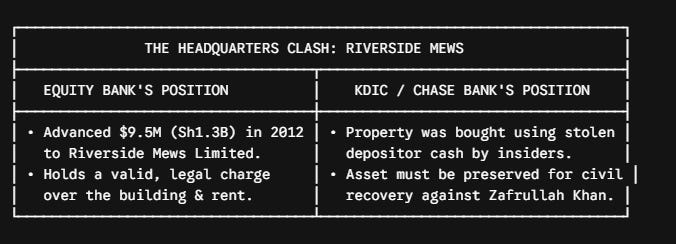
The Context: Back in 2012, long before the collapse, Equity Bank had advanced a $9.5 million (1.3 billion KES) commercial facility to an entity called Riverside Mews Limited, securing the loan using a legal charge over the Riverside Office Block and its rental income stream. When the borrower defaulted, Equity Bank initiated statutory auction proceedings to recover its cash.
The KDIC Counter-Strike: The KDIC rushed to the High Court to halt Equity’s auction hammer. The liquidator argued that the magnificent headquarters had actually been constructed and acquired using misappropriated depositor funds siphoned by Zafrullah Khan’s insider network. They insisted the building must be frozen and preserved to satisfy the wider, systemic pool of defrauded Chase Bank depositors.
The Court of Appeal Ultimate Ruling (March 13, 2026): The Court of Appeal firmly dismissed the KDIC’s application to block the sale. The appellate judges ruled that Equity Bank—as a Tier-1 legacy lender—held a valid legal charge and could not have its statutory power of sale paralyzed. The court noted that because the debt was continuously accruing interest, delaying the auction could cause the liability to surpass the actual value of the property. Furthermore, the court dryly observed that if the KDIC eventually wins its separate fraud case against Khan, Equity Bank is easily liquid enough to financially compensate them.
With this green light, Equity Bank secured the legal right to auction the former Chase Bank headquarters, marking a watershed moment where secured, arms-length commercial debt triumphed over regulatory clawback attempts
this Archive Broadcast on Zafrullah Khan's Arraignment which details the initial KES 1.15 billion fraud charges brought against the bank's leadership.
Below are the definitive sources mapping the legal aftermath, detailed with accessible cross-references:
1. The Corporate Governance & Audit Baseline
Historical Architecture & Ownership Structure: The distribution of institutional stakes (including Amethis France’s 10.9%, DEG, and ResponsAbility) and the initial structural outline of the eight-person board are verified via the corporate documentation repository.
The Board Resignations (April 2016): The immediate fallout on April 6–7, 2016, which resulted in the departure of Chairman Zafrullah Khan and Group MD Duncan Kabui, alongside the subsequent interim appointment of Muthoni Kuria, is recorded in the contemporary business press reports.
2. Civil Asset Recovery & Criminal Records
The 2017 Asset Freezes (HCCC No. 159 of 2017): The High Court injunction issued in April 2017 to stop Zafrullah Khan and 19 affiliated insiders from offloading physical real estate assets acquired via the Iman parallel window is detailed in the initial asset recovery case filings.
Criminal Arraignments & Defraud Charges: The state prosecution sheets covering the siphoning of customer deposits and subsequent criminal charges filed against the executive leadership are documented in the National Council for Law Reporting repositories and penal code reviews.
3. Precedent-Setting Insolvency Rulings
The Quistclose Trust Judgment (July 2024): The landmark ruling in Union De Banques Arabes Et Francaises v. Chase Bank Kenya Ltd (In Receivership) and SBM Bank Kenya Limited (Milimani HC.Comm/206/2019), which elevated equitable principles above standard liquidation queues for specified Letters of Credit, is sourced from the High Court Commercial Division records.
4. The Headquarters Auction Showdown (March 2026)
The Court of Appeal Ruling (March 13, 2026): The appellate bench decision (Judges Musinga, Ngugi, and Odunga) dismissing the KDIC’s injunction request and clearing Equity Bank to auction the Riverside Office Block over an outstanding Sh1.3 billion ($9.5 million) debt is documented via official commercial litigation updates:
Detailed background on the loan origin (2012) and the vehicle used (Riverside Mews Limited) can be reviewed directly via the national legal archive on The Standard Media Group Report.
The formal corporate brief detailing why Equity’s Tier-1 liquidity status protected the receiver’s contingent claims is accessible through the AllAfrica Financial Archive.
The multi-billion-shilling criminal case involving Chase Bank led the Director of Public Prosecutions (DPP) to target a wider network of conspirators. Across the amended files and parallel criminal suits, several high-profile corporate insiders, family members, and politicians were co-charged alongside the former Chairman, Mohammed Zafrullah Khan:
1. Top Executive & General Managers
Duncan Kabui Gichu: The former Group Managing Director of Chase Bank. He faced direct charges of conspiracy to defraud, money laundering, and the illegal extraction of over 700 million KES.
James Mwaura Mwenja: The former General Manager of Corporate Credit. He was charged with conspiracy and the fraudulent diversion of 56 million KES utilizing his executive position.
Makarios Omondi Agumbi: The former General Manager of Finance. He faced parallel counts of stealing by directors, conspiracy, and failing to maintain statutory records to obscure money laundering trails.
2. Family Insiders (The Khan Kin Faction)
Amira Claudia Wagner Khan: Co-charged alongside the chairman in alternative counts related to the fraudulent shielding and reception of stolen bank proceeds.
Mohammed Nasrullah Khan: Indicted within the expanded charge sheets outlining the shadow allocation of uncollateralized loans.
3. Politically Exposed Persons & Corporate Proxies
In the major 1.15 billion KES siphoning and money laundering suit linked to illegal transfers out of Chase Bank to Paramount Universal Bank, the following prominent figures were also formally arraigned:
Patrick Musimba: The former Member of Parliament (MP) for Kibwezi West. He was indicted alongside his wife for utilizing their private corporate vehicles to systematically siphon funds from the lender.
Angela Mwende (Wife to MP Patrick Musimba): Co-director of the proxy entities involved in the fraud scheme.
Lucien Sunter: An international corporate proxy linked to the special purpose investment vehicles used to mask the money laundering loop.
Ronald Vlasman: Another institutional proxy charged for acting as an external clearing agent for the illicitly routed funds