
Accumulation Zone: CARB at KES 28 - KES 31.
Treating Carbacid strictly as a pure-play income engine rather than a momentum growth asset. At the current price of KES 29.25, the stock is sitting dead center in this accumulation pocket.
The Bull Case for Income Accumulation:
Unrivaled Cash Conversion: Low capital intensity means core operations continuously spit out free cash flow.
The Sovereign Cushion: Their balance sheet holds over KES 2.3 Billion in investments (high-yielding sovereign debt and liquid blue-chip equities). They are essentially a cash-generating gas utility wrapped inside a conservative investment trust.
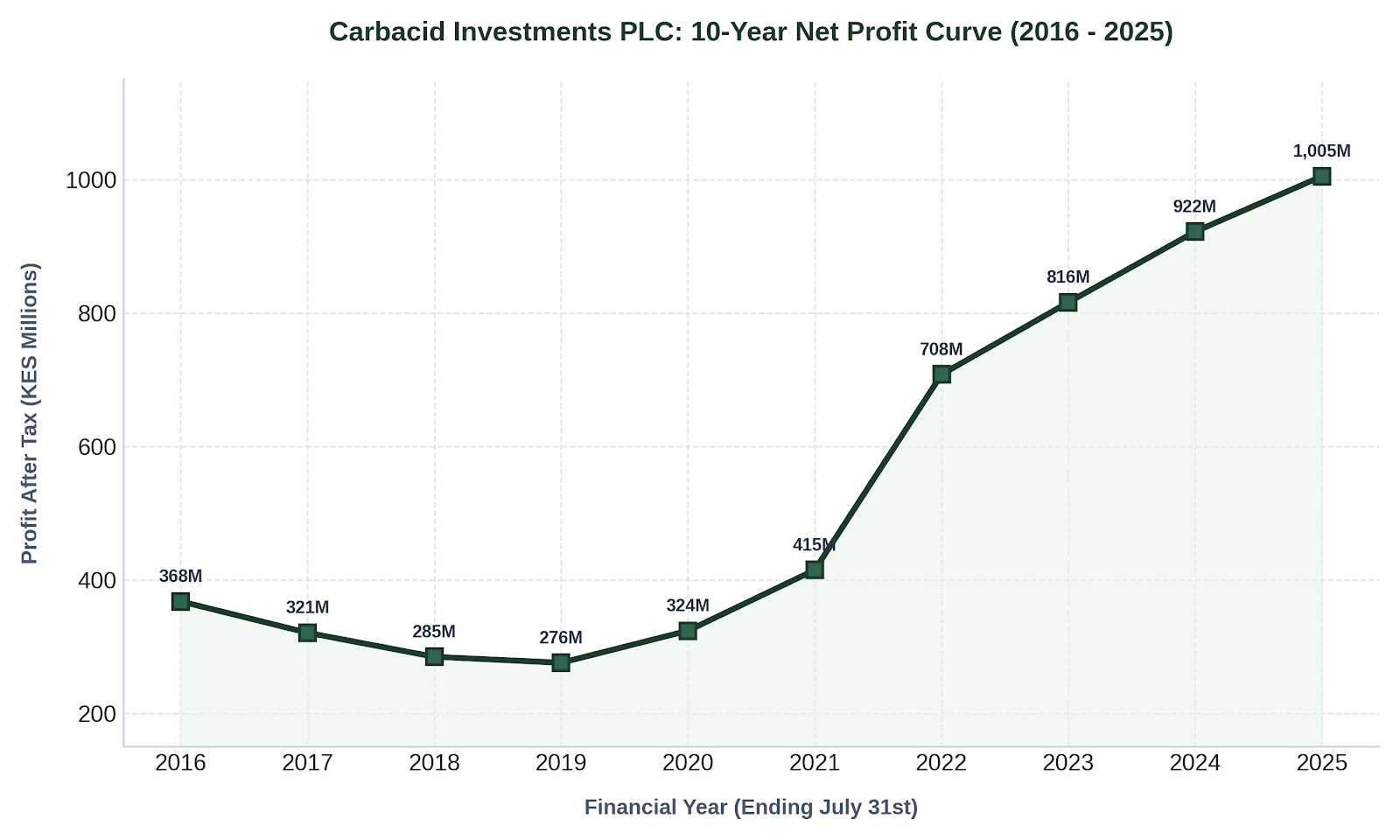
Margin Margin Margin: Net profit margins consistently hover near the 45%+ mark.
When the market loses patience with flat price action, value investors pick up reliable yields. Lock in the 6.5%+ yield in the 28-31 band and let it compound.
1. Introduction
Within the Nairobi Securities Exchange (NSE), retail investors routinely obsess over banking heavyweights or telecom giants. Yet, tucked away in the materials sector sits Carbacid Investments PLC (NSE: CARB), one of the most operationally efficient corporate structures on the continent.
Carbacid is not a flashy tech play or a speculative land venture. Its business model relies on a profound geological advantage: tapping into natural underground reservoirs of highly pure, volcanic Carbon Dioxide CO_2 in Kenya’s Rift Valley (specifically the Kereita Forest zone). By extracting this natural resource, purifying it to an elite food-grade standard (99.99 purity), and managing a heavy-duty logistical cold chain, Carbacid has established a near-impenetrable regional monopoly.
For value investors, it represents a pure, “Buffett-style” defensive asset: an essential, non-discretionary industrial component with pricing power and remarkably low structural overhead.
2. The Gas Industry in East Africa: Who Are the Customers?
The regional industrial gas landscape is driven entirely by consumer manufacturing, transport logistics, and urban consumption trends. Unlike atmospheric gases like oxygen—which must be manufactured synthetically using electricity-guzzling Air Separation Units (ASUs)—Carbacid’s CO_2 is mined. This gives the company a massive structural cost advantage over competitors across Sub-Saharan Africa.
It is important to note that Carbacid does not sell oxygen. The company is a strict CO_2 specialist. While it launched a bold, KES 1.2 billion bid to acquire BOC Kenya PLC (the country’s primary industrial and medical oxygen supplier) to build a unified industrial gas giant, that 4-year takeover saga officially collapsed and lapsed in March 2025 due to regulatory delays and strategic re-evaluations. As a result, Carbacid remains focused squarely on its highly profitable carbon dioxide kingdom.
The customer portfolio spans multiple non-discretionary economic sectors:
The Beverage Giants (Carbonation): This is Carbacid’s primary cash engine. Every major soft-drink bottler, sparkling water brand, and commercial brewery in the region—including East African Breweries PLC (EABL) and regional Coca-Cola franchises—depends on food-grade CO_2 to inject the distinct “fizz” and carbonic bite into their products.
Premium Food Processors (Modified Atmosphere Packaging): High-end food manufacturers, including specialized agricultural exporters and dairy processors like Bio Foods, utilize CO_2 to flush packaging. This eliminates oxygen, halting aerobic bacteria and preserving fresh meats, cheeses, and greens without artificial chemicals.
The Cafe and Hospitality Sectors: The rapid expansion of coffee chains like Java House across East Africa drives indirect demand for precise, consistent premium carbonation, cream whipping, and cold chain preservation.
Cold Chain Logistics (Dry Ice): When liquid CO_2 is depressurized into solid dry ice at -78.5, it becomes the default cooling medium for shipping high-value horticultural exports, fresh fish, and pharmaceuticals out of Jomo Kenyatta International Airport (JKIA) without the moisture damage of traditional ice.
Heavy Fabrication: Industrial manufacturers use CO_2 as a structural shielding gas in MIG/MAG welding to protect molten weld pools from atmospheric contamination.
3. The 10-Year Revenue Journey
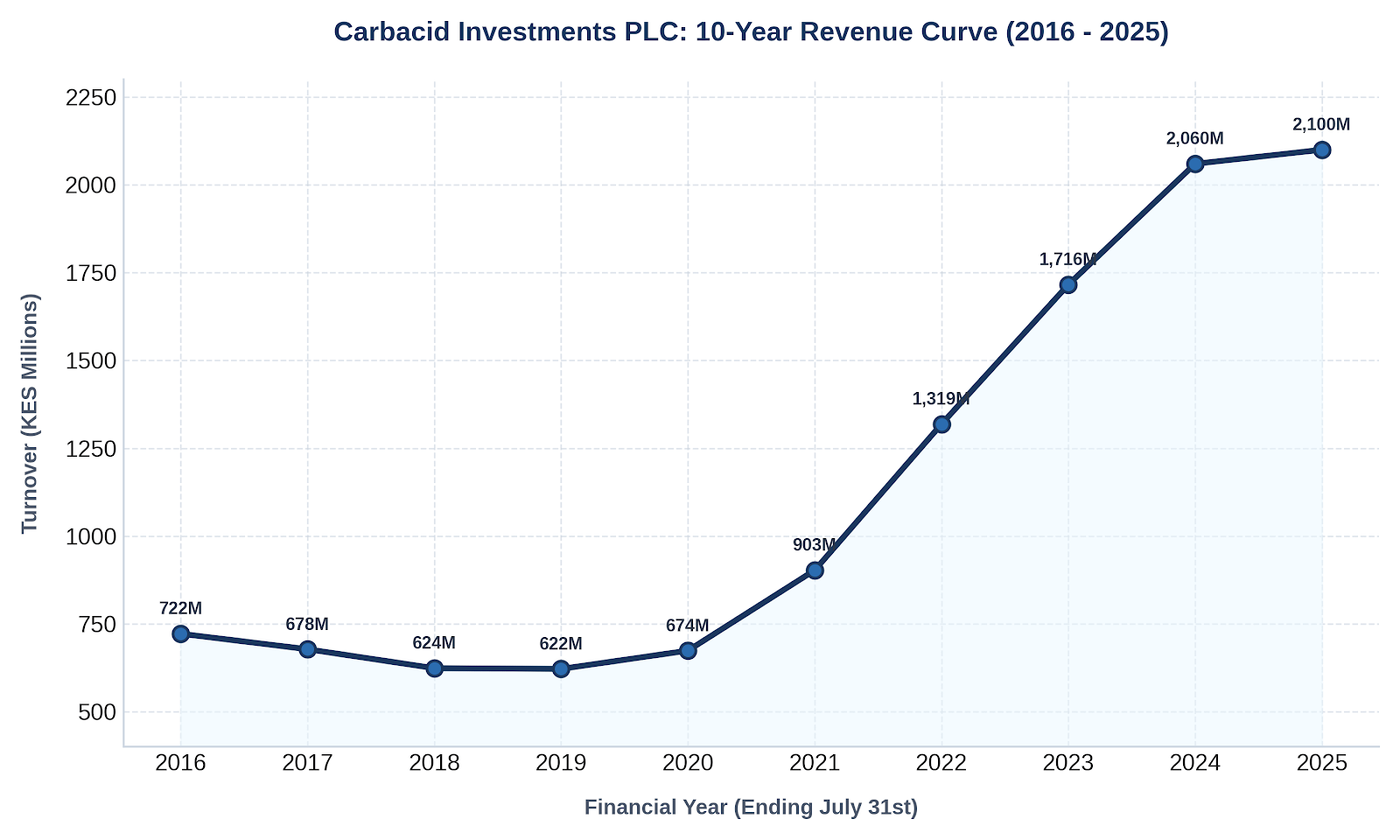
Carbacid’s top-line revenue trend over the past decade reflects both regional economic expansion and a deliberate push into non-traditional export markets to shield itself from localized shocks.
Historically, Carbacid was a steady KES 600 million to KES 900 million turnover business. However, in the 2020s, strategic market development saw the company break out of its East African Community (EAC) comfort zone. By securing logistics channels into Southern African markets (including South Africa, Namibia, Botswana, Zimbabwe, and Malawi), Carbacid successfully scaled its sales volume.
By the close of the financial year ending July 31, 2024, turnover surged past the historic milestone to KES 2.06 billion, continuing its steady trajectory to KES 2.10 billion by July 2025.
Looking at the most recent performance for the half-year ending January 31, 2026, core turnover rose another 3.8% to KES 976.35 million (up from KES 940.61 million in the previous half-year). While the Southern African market has experienced some temporary, subdued seasonal demand and localized supply competition, strong demand across East African markets has kept the revenue engine firmly anchored. Gross margins remain exceptionally healthy, sits at a highly enviable 64%.
4. The 10-Year Balance Sheet of Carbacid
If Carbacid’s income statement shows steady growth, its balance sheet is a masterclass in conservative capital allocation. The company operates an incredibly lean corporate structure. It effectively splits its financial weight into two distinct pillars: its core gas mining assets and a massive, liquid investment portfolio.
Over the past decade, Carbacid’s total asset base has expanded remarkably, scaling from roughly KES 3.08 billion in 2016 to KES 6.03 billion by July 2025, and hitting KES 6.59 billion by January 2026.
Asset Breakdown (As of January 2026):
Property, Plant, and Equipment (PPE): KES 2.24 billion (comprising the extraction wells, purification machinery, solar grids, and distribution cylinders).
Financial Assets & Liquid Reserves: Carbacid functions as a highly liquid investment trust, holding a mountainous KES 1.76 billion in government bonds, corporate papers, and treasury bills, alongside KES 627.1 million in blue-chip equities listed on the regional exchanges. In fact, for HY 2026, a KES 106.2 million revaluation gain on these equity investments pushed net profit up by 6.9% to KES 464.96 million.
Net Working Capital: Stands strong at KES 1.09 billion, keeping liquidity highly secured with a current ratio of 2.8x.
On the liability side, Carbacid carries virtually zero debilitating bank debt. Its debt-to-equity ratio sits at a highly conservative 17.6%, backed by a fortress of KES 5.10 billion in total shareholder equity.
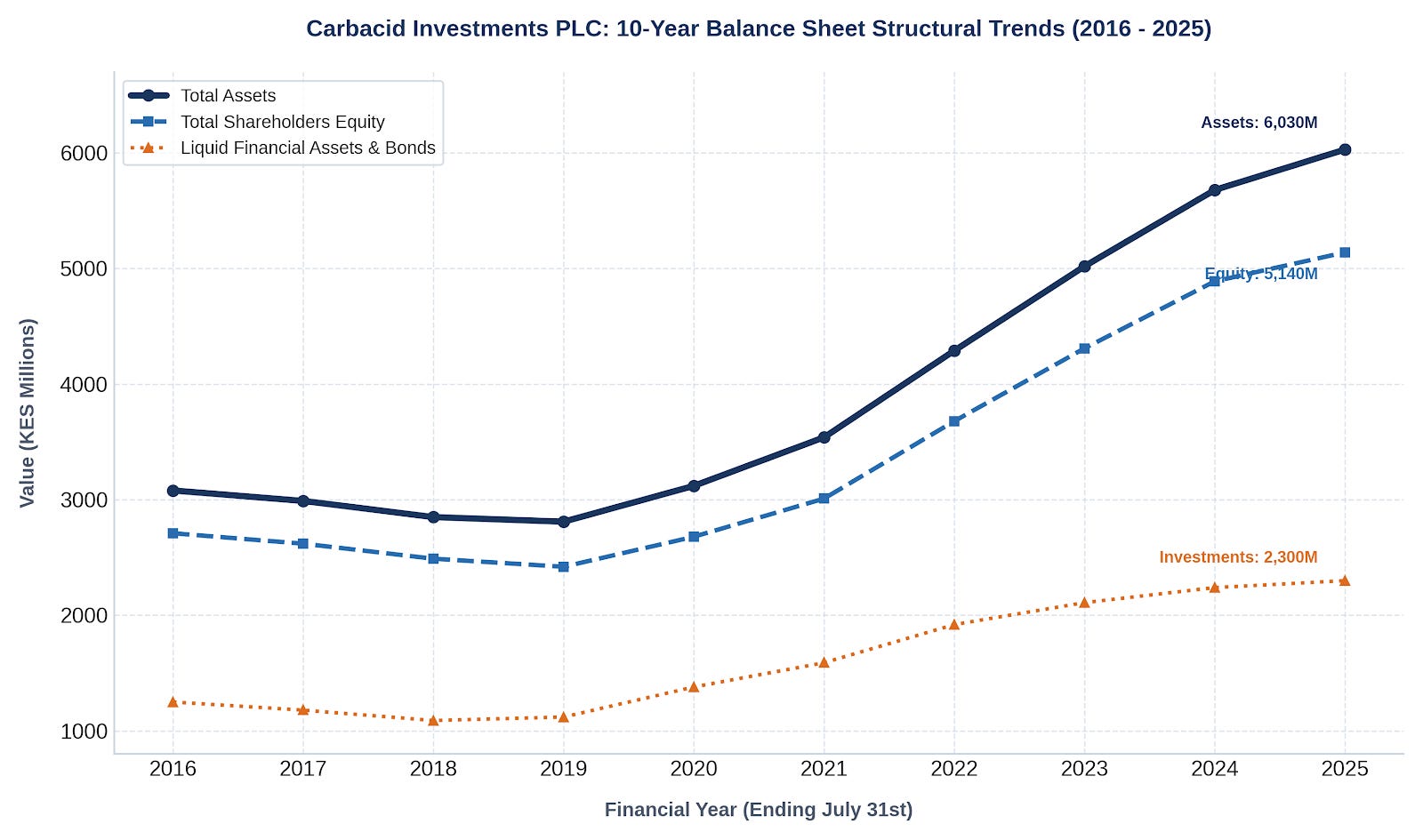
The KES 2.30 billion sitting in the financial investment line of Carbacid’s balance sheet acts as a strategic cash buffer and capital allocation engine. Because their core CO_2 extraction business has exceptionally low capital intensity and high cash conversion, the company effectively operates as a dual-entity: a gas miner and a conservative investment trust.
The allocation of these financial assets is broken down into three major asset classes:
1. Government Securities (The Core Anchor)
The vast majority of Carbacid’s liquid investments are held in Kenyan Government Treasury Bonds and Treasury Bills.
The Strategy: By locking cash into long-term infrastructure and fixed-coupon bonds when interest rates in Kenya peak, Carbacid secures a high, predictable, and virtually risk-free stream of interest income.
The Impact: This interest income alone frequently covers a significant portion of their annual corporate overheads, shielding the company from any localized operational downturns in the gas market.
2. Blue-Chip Equities (Regional Listed Stocks)
Carbacid maintains a diversified portfolio of equities listed on the Nairobi Securities Exchange (NSE) and the Dar es Salaam Stock Exchange (DSE).
The Strategy: They target high-yielding, defensive blue chips—primarily banking stocks with strong track records of paying out outsized dividends (such as Standard Chartered Bank Kenya or Co-operative Bank) and telecommunications.
The Impact: These equities serve two purposes: they generate steady dividend inflows to supplement Carbacid’s cash flow, and they expose the balance sheet to capital appreciation. For instance, in the half-year ending January 2026, a KES 106.2 million revaluation gain on these exact stock holdings was the primary catalyst that pushed Carbacid’s net profit up by 6.9%.
3. Corporate Bonds & Short-Term Commercial Paper
To balance out the long maturities of government bonds, a smaller portion of the fund is deployed into premium, high-yield corporate debt instruments and short-term liquid commercial paper. This ensures the company retains immense, immediate liquidity should a strategic capital expenditure or corporate acquisition opportunity present itself.
Strategic Takeaway for Investors
This investment portfolio means that when you buy a share of Carbacid (NSE: CARB), you aren’t just buying a utility-style gas monopoly; you are also buying into a highly liquid, cash-rich investment fund. This unique balance sheet architecture is the primary reason the company has zero net-debt anxieties and can comfortably sustain a high dividend payout ratio year after year.
5. The Dividend Story
For value-oriented income investors, Carbacid is a portfolio cornerstone due to its predictable, generous, and highly covered dividend payouts. Because the core business requires relatively low annual maintenance capital expenditure (CapEx) once extraction wells are operational, the board routinely forwards excess cash reserves directly to shareholders.
Throughout the late 2010s, Carbacid maintained a reliable base dividend of KES 0.70 per share. As export volumes and investment income scaled up, shareholder rewards followed suit:
2021: KES 0.70 regular dividend + KES 0.90 special dividend (Total: KES 1.60)
2022: Total dividend of KES 1.70 per share
2023: Total dividend of KES 1.70 per share
2024: Total dividend of KES 1.70 per share
2025: The board increased the total cash distribution to KES 2.00 per share (payout totaling KES 509.7 million).
With full-year basic Earnings Per Share (EPS) climbing to KES 3.94 in 2025, the dividend remains strongly covered by net operational earnings. Following its traditional capital conservation policy, the board did not recommend an interim dividend for the half-year ending January 2026, preserving its cash for a comprehensive final full-year payout calculation.
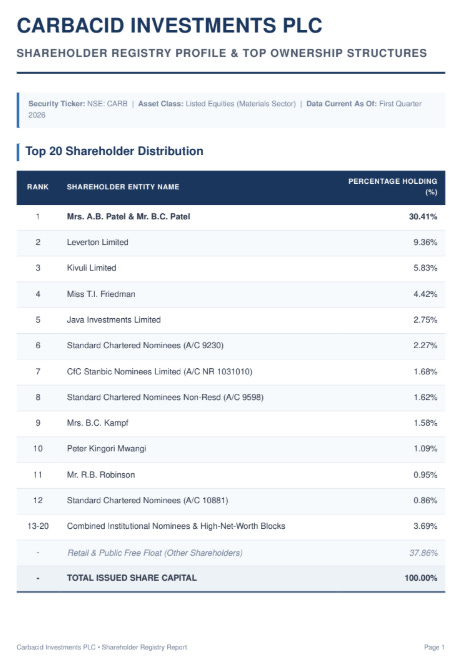
6. Top 20 Shareholders of Carbacid
Carbacid’s share registry is tightly held, dominated by high-net-worth value investors and institutional nominee accounts who treat the stock as a long-term income annuity. The presence of the legendary Patel family provides a strong anchor of stable, long-term ownership.
The ownership structure is led by the following principal blocks:
The Takeaway
Carbacid represents a rare breed on the NSE: a company with low capital intensity, an absolute regional market moat, a fortress-like balance sheet holding zero net-debt anxieties, and a clear alignment with shareholder wealth distribution. For the disciplined agribusiness and equity analyst, it remains a textbook case of how capturing a vital niche in the industrial supply chain translates into multi-decade financial stability.
What’s your take on Carbacid’s decision to walk away from the BOC Kenya oxygen takeover? Let’s discuss the allocation of cash toward bonds and equities versus geographic expansion in the comments section below. Be sure to subscribe for more deep-dives into the financial machinery of East Africa’s listed corporate giants.
Kenya’s True Warren Buffett: The Decades-Long Accumulation Playbook of Baloobhai Patel

The Patel Blueprint: Decoding the NSE’s Ultimate Value Investing Playbook
Great work, truly appreciate the information.
Great write up and analysis.