
This critical audit serves as a forensic examination of the structural and systemic shifts within the Kenyan economy from 2022 to 2026, documenting the true cost of the administration's economic experiments on the social contract.
I. Introduction: The Grand Delusion of “Optimal Policy”
For the past four years, Kenya has been the subject of a high-stakes, real-time economic experiment—a clinical trial conducted in the halls of the Treasury and the Presidential Council of Economic Advisers. In the lead role stood the “Economic Surgeon,” David Ndii, armed with a scalpel of fiscal orthodoxy and a whiteboard covered in elegant, textbook models designed to excise the perceived rot of consumption subsidies and state-sponsored graft. The pitch was seductive: a fundamental pivot from the populist, debt-fueled binge of the previous decade toward a lean, “production-first” reality. But as we reach the four-year mark, the patient is finally stirring from the anesthesia, and the view is far from the pristine recovery promised by the diagnosis.
The reality of the “Ndii Doctrine” is that the patient is only “stable” because the state has kept it under heavy fiscal sedation. We have traded the erratic volatility of the past for a suffocating fiscal stasis defined by record-breaking tax extraction, artificial liquidity crunches, and a deliberate strangulation of domestic consumption. While the formulas on the whiteboard were theoretically flawless, their real-world application has proven to be a reckless collision between academic rigidity and the visceral, messy reality of the Kenyan street. We were promised a structural transformation; instead, we have been subjected to a clinical trial where the subjects—the Kenyan people and their struggling enterprises—are being asked to foot the bill for the privilege of being part of the experiment.

II. The Scorecard: Grading the “Experiments”
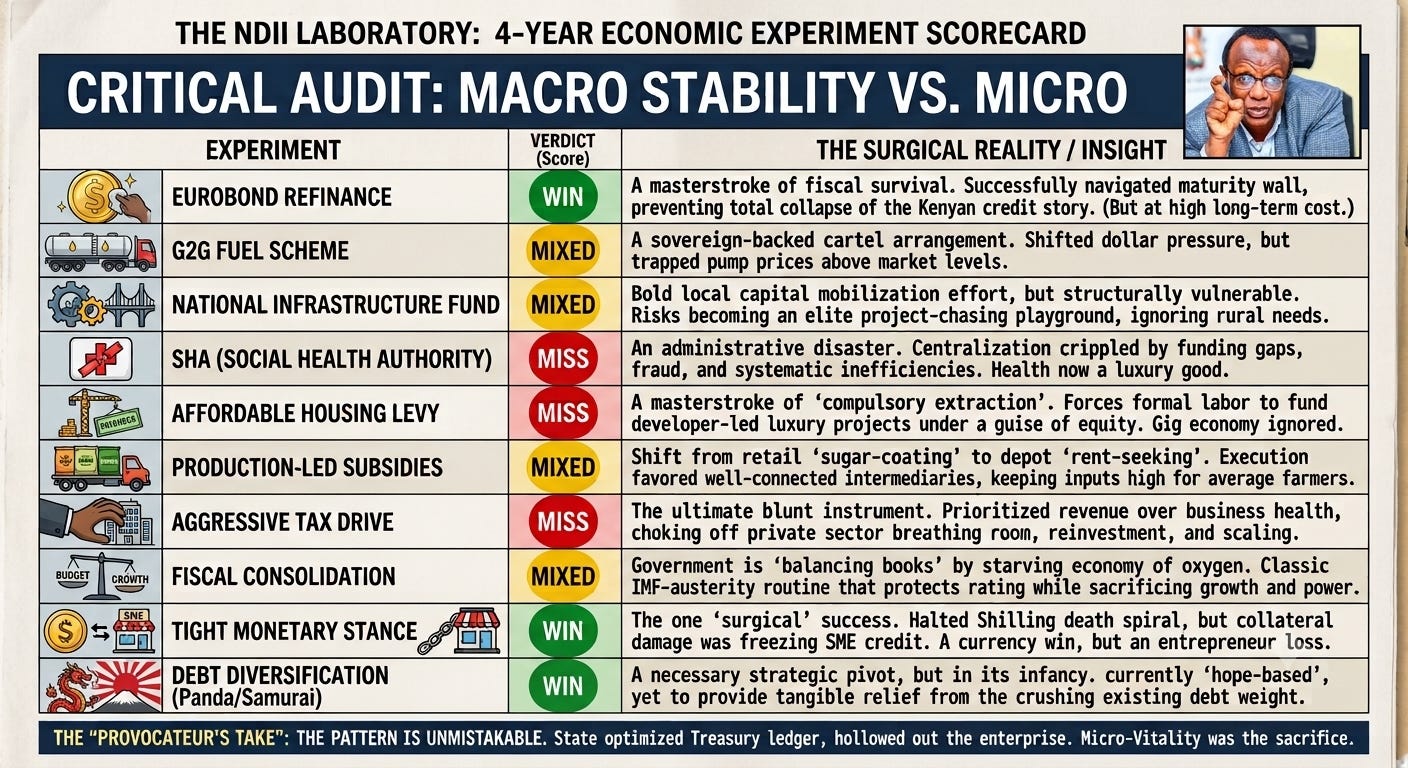
This is the balance sheet of the “Ndii Laboratory.” Each experiment was pitched as a surgical strike against inefficiency; in practice, many have been blunt instruments that optimized the Treasury’s ledger while leaving the private sector to hemorrhage.

Eurobond Refinance: WIN
A masterstroke of fiscal survival. By successfully navigating the 2024 maturity wall, the administration averted an imminent sovereign default. It was a high-cost maneuver, yes, but it prevented a total collapse of the Kenyan credit story.
G2G Fuel Scheme: MISS
A sovereign-backed cartel arrangement. It shifted the dollar pressure from the open market to a closed-loop system of fuel majors, replacing a liquidity crunch with rigid pump prices that remain detached from global market dips.
National Infrastructure Fund: MIXED
A bold effort to mobilize local capital, but structurally vulnerable. It aims to decouple infrastructure from sovereign debt, yet it risks becoming a playground for project-chasing elites while essential services in neglected regions are sidelined.
Social Health Authority (SHA): MISS
An administrative disaster. The attempt to digitize and centralize health insurance has been crippled by funding gaps, claim rejections, and systemic inefficiencies that have effectively turned healthcare into a luxury good.
Affordable Housing Levy: MISS
A masterclass in "compulsory extraction." It forces the formal employee to fund developer-led luxury projects under the guise of social equity, acting as a massive tax on labor that ignores the realities of the gig economy.
Production-Led Subsidies: MIXED
A shift from retail-level sugar-coating to depot-level rent-seeking. While theoretically superior to consumption subsidies, the execution has favored well-connected intermediaries, leaving the average farmer paying the same high prices for inputs.
Aggressive Tax Drive: MISS
The ultimate blunt instrument. By prioritizing revenue targets over business health, the state has succeeded in widening the tax net but effectively choked off the private sector’s ability to breathe, reinvest, or scale.
Fiscal Consolidation: MIXED
The government is "balancing the books" by starving the economy of oxygen. It’s a classic IMF-led austerity routine that protects the sovereign credit rating while sacrificing domestic growth and purchasing power.
Tight Monetary Stance: WIN
The one "surgical" success. The CBK’s stubborn adherence to high interest rates stopped the Shilling’s death spiral, but the collateral damage was the near-total freezing of SME credit. A win for the currency; a loss for the entrepreneur.
Debt Diversification: MIXED
A necessary pivot away from Western capital. While reaching for Panda/Samurai bonds is a smart long-term strategic shift, it is currently in its infancy—a "hope-based" policy that has yet to yield tangible relief from the crushing weight of existing debt.

III. The Subsidy Shell Game: Shifting Corruption to New Networks
If you want to understand the true anatomy of recent financial scandals, you have to look at the administration’s signature economic maneuvers: the introduction of the fertilizer subsidy and the removal of the fuel subsidy. On paper, these were presented as bold, populist reforms. In reality, this overarching subsidy policy appears to be a clever, deliberate scheme to dismantle old cartels only to shift grand corruption to entirely new networks.

The Fertilizer Subsidy and the ‘Fertile Deception’
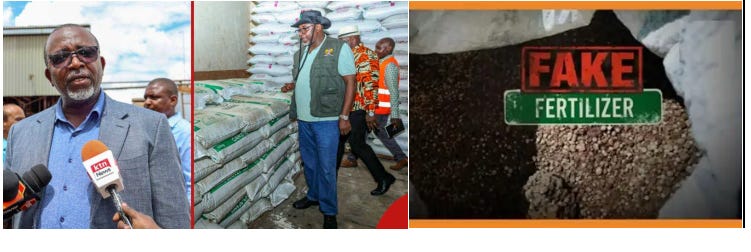
The administration’s agricultural “production-led” agenda kicked off with the heavily touted fertilizer subsidy program. But instead of bumper harvests, it birthed the 2024 fake fertilizer scandal, aptly dubbed the “Fertile Deception”.
The Scheme: Unscrupulous entities infiltrated the government’s subsidized program, selling thousands of 25kg bags filled with sand, stones, and diatomite to unsuspecting farmers during the critical planting season.
The Network: This counterfeit fertilizer wasn’t sold in back alleys; it was legitimized, branded, and distributed directly through state-run National Cereals and Produce Board (NCPB) depots. The subsidy wasn’t about lowering the cost of production; it was a state-sponsored pipeline designed to enrich a new breed of well-connected tenderpreneurs at the expense of national food security.
The Oil Subsidy Removal and the G2G Fuel Scandal
Conversely, the administration made a massive spectacle of removing the previous regime’s “corrupt” fuel subsidy, replacing it with the highly publicized Government-to-Government (G2G) oil import framework. We were promised this would stabilize supplies, ease dollar pressure, and lock out the oil cartels. Instead, the transition away from the oil subsidy culminated in the explosive 2026 fuel import scandal.
The Scheme: Senior energy sector officials—including bosses at the Kenya Pipeline Company (KPC) and the Energy and Petroleum Regulatory Authority (EPRA)—deliberately manipulated national fuel stock data to create the false impression of an imminent shortage.
The Network: This manufactured crisis was used to justify a KSh 4.8 billion emergency petrol import entirely outside the G2G framework. The cargo, brought in by the ship MV Paloma, bypassed established procedures, was priced significantly higher than G2G rates, and was later found to be of substandard quality. By bypassing the very system they championed, state officials allowed private actors to make a killing at the public’s expense.
The Illusion of Reform
When you place these two events side by side, the underlying strategy becomes glaringly obvious. The introduction of the fertilizer subsidy and the removal of the fuel subsidy were two sides of the same coin. They were structural resets designed to disrupt the existing flow of graft, re-routing the billions into the pockets of a new, politically aligned network. These scandals are not bugs in the system—they are the system working exactly as it was redesigned.
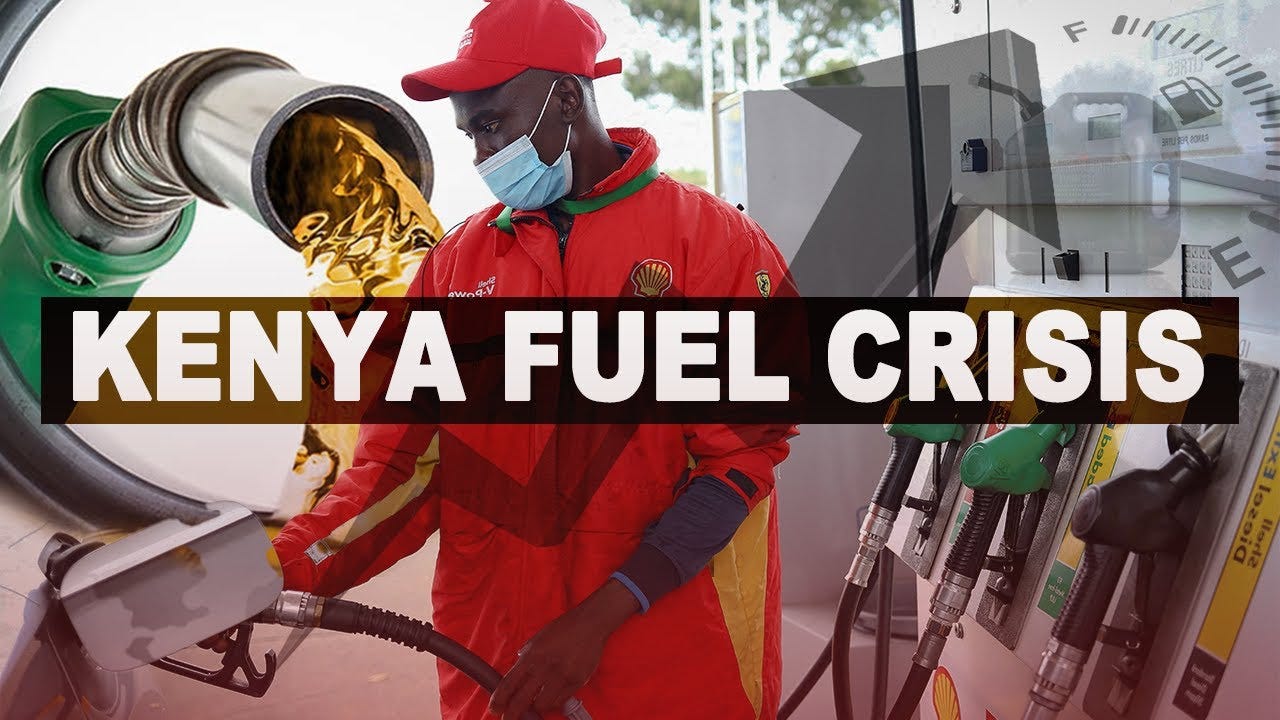
G-to-G oil deal controversy explodes
This broadcast segment provides a deep dive into the recent G2G oil deal controversy, questioning the systemic loopholes and the accountability of those manipulating the fuel supply chain.

IV. The Cost of Ndii’s Economic Experiments: Winners vs. Losers
The hallmark of the “Ndii Doctrine” has been the relentless pursuit of macroeconomic metrics—stabilizing the shilling and satisfying the IMF’s austerity benchmarks—at the cost of domestic survival. This is the “mechanics of extraction”: a deliberate strategy that has starved the broader economy of the oxygen it needs to function. By tightening monetary policy to suffocating levels and relentlessly squeezing the tax base, the state has effectively prioritized its own creditworthiness over the health of the national enterprise. This wasn’t just a miscalculation; it was a policy choice that created a stark divide between a protected elite and a squeezed majority.
The Winners: The Corporate, Institutional, and State-Backed Gentry While the rest of the economy withered, a specific tier of institutional players and state-favored insiders flourished under these conditions:
Large-Cap Banks: With high interest rates held stubbornly steady, top-tier banks have feasted on record-breaking net interest margins, essentially collecting risk-free rents while the rest of the market faced a credit freeze.
Fund Managers & Wealth Institutions: Driven by high government yields and public anxiety over economic volatility, Collective Investment Schemes have boomed. Funds under management (AUM) have increased significantly over this period, making asset managers prime beneficiaries of the cash flight from high-risk businesses to government debt.
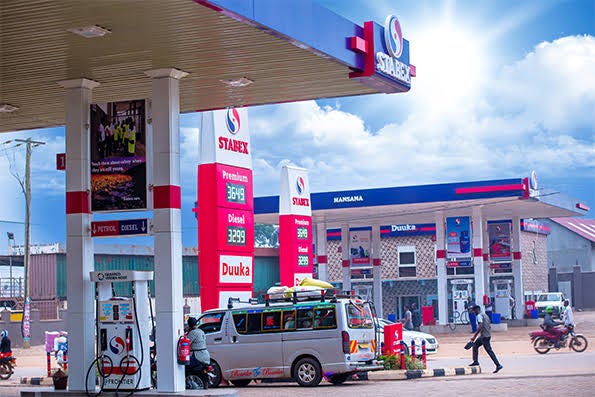
Selected Oil Marketers (The G2G Monopoly): The handpicked local oil marketing companies (OMCs) selected to execute the G2G fuel framework have effectively been gifted state-sanctioned monopolies. They lock out smaller independent players, control supply lines, and guarantee their own margins regardless of market friction.
Public Service Exploiter Networks: Rather than funding broad public infrastructure, the state has aggressively directed trillions toward specialized hubs. The entities, consultants, and contractors positioned within the Affordable Housing, National Infrastructure Fund, and medical tech spaces have captured a massive pipeline of state-guaranteed revenue.
Institutional Investors in Special Economic Zones (SEZs): Beneficiaries of tax holidays and government-backed infrastructure incentives, these entities operate in a protected bubble, largely insulated from the tax brutality visited upon the local private sector.
The Losers: The Dispossessed Engine Room of the Economy The cost of this “stability” has been borne by the very entities that provide the backbone of Kenya’s employment and daily life:
Salaried Taxpayers: The ultimate cash cows of the administration. They have watched helplessly as their pay slips are aggressively cannibalized by the Affordable Housing Levy and new health statutory deductions. The insult to this injury? They remain locked out of accessing the very houses they are forced to finance, and they are routinely turned away from hospitals because the new medical transition cannot sort out their bills.
Smallholder Farmers: Promised an agricultural renaissance through the “production-led” agenda, farmers were instead sacrificed to corrupt networks. They lost vital planting seasons, crop yields, and capital after being sold rocky, fake fertilizer directly through state-run depots.
SMEs: Small and medium-sized enterprises have been systematically crushed by the dual burden of soaring compliance costs and an aggressive, multi-layered payroll tax regime that has rendered expansion impossible.
The Informal Sector: Once the quiet harbor of the Kenyan economy, the informal sector is now being ruthlessly hunted. Aggressive tax integration efforts have forced informal traders into a formal net they cannot afford, effectively punishing the survival instincts of the most vulnerable Kenyans to feed the insatiable appetite of the Treasury.
In this theater, the government has proven that it is excellent at arithmetic, but catastrophic at economics. By cannibalizing its own middle class, shortchanging its farmers, and stifling its SMEs, the state has ensured that while the ledger might balance, the economy has no future growth trajectory—only the hollowed-out remnants of a once-vibrant marketplace.

V. The Final Scorecard: The Audit of the Kenyan Social Contract
The following table crystallizes the redistribution of wealth and opportunity that has defined the last four years of economic experimentation. It is the final audit of who effectively subsidized the state’s fiscal survival and who walked away with the spoils.
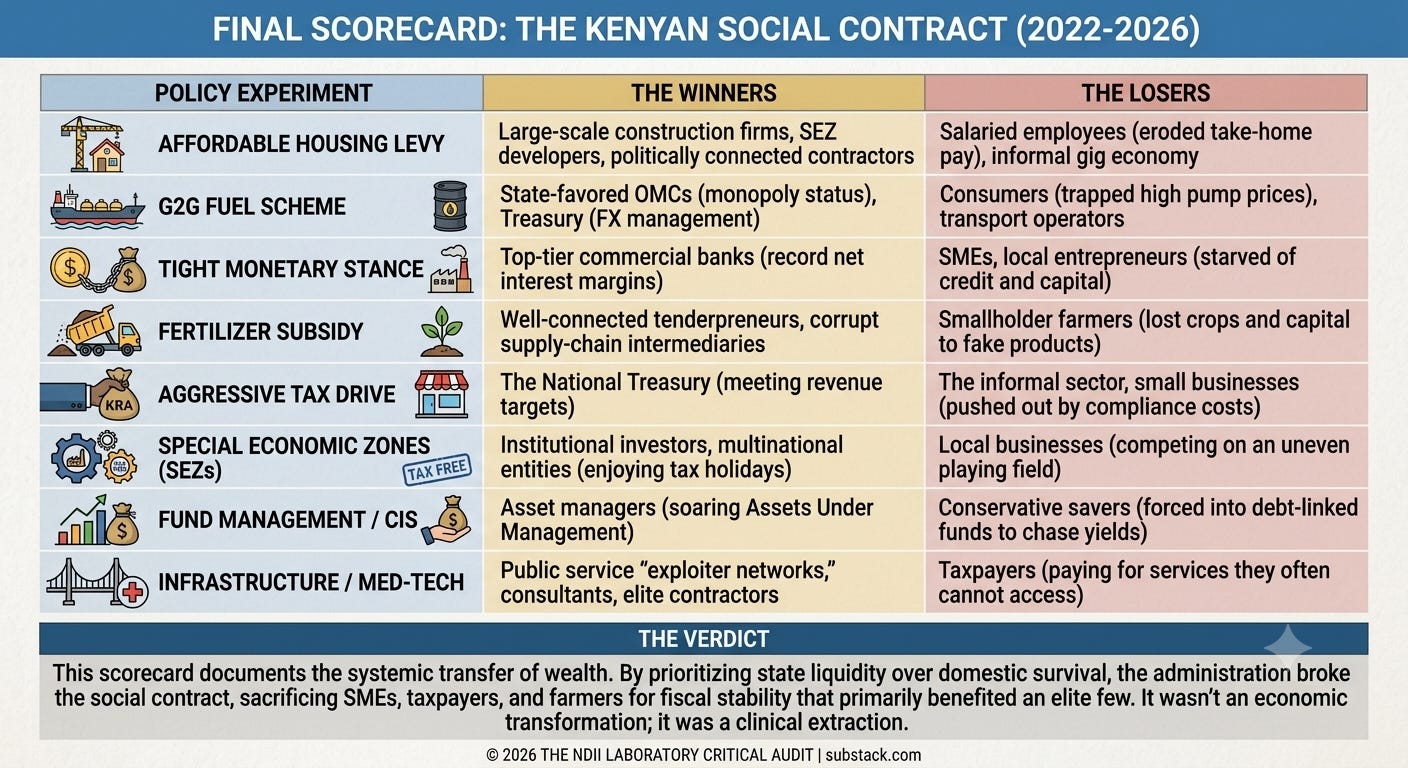
The Final Verdict
This scorecard is not merely an analysis of government policy; it is a ledger of a broken social contract. By aggressively prioritizing macro-stability and state liquidity, the administration has successfully safeguarded its own ledgers. However, it has done so by treating the Kenyan taxpayer, the small-scale farmer, and the local entrepreneur as disposable variables in an academic experiment.
When the dust finally settles on these years of radical policy shift, history will not judge these experiments by the stability of the shilling or the balance of the Treasury’s books. It will judge them by the standard of living they destroyed and the prosperity they concentrated in the hands of a few. We were promised an economic transformation; instead, we have been subjected to a clinical extraction of wealth from the many to support the stability of the few.
VI. Conclusion: The Verdict of History
The “Ndii era” will ultimately be remembered not for the structural transformations it promised, but for its cold, clinical detachment from the human cost of its own policies. By adopting the persona of an economic surgeon, the administration succeeded in a narrow, technical mission: it “saved the hospital ledger.” It stabilized the currency, appeased international creditors, and satisfied the rigid fiscal benchmarks set by the IMF. Yet, in this obsessive quest to balance the books, it failed to realize that it was sacrificing the health of the very patient it was meant to treat. The economy is not a whiteboard exercise; it is the sum of millions of individual survival stories that have been systematically eroded by four years of austerity and extraction.
As we look toward 2028, the horizon is clouded by the heavy shadow of these experiments. We are forced to confront a sobering question: when the dust finally settles, will the National Infrastructure Fund (NIF) and the administration’s other vaunted legacy projects actually justify the years of punishing economic austerity, or will history look back at this period as the moment the government decided the Kenyan social contract was nothing more than a disposable variable in a failing laboratory experiment? The stability of the Treasury is a hollow victory if it comes at the expense of a broken, impoverished, and disillusioned nation.
About Boardlot Africa Research
Boardlot Africa is a premier financial intelligence and corporate governance publication dedicated to unpacking the mechanics of capital, market strategies, and structural shifts across East Africa’s corporate landscape. By bridging the gap between raw economic data and actionable market intelligence, we deliver deep-dive research, independent corporate analysis, and policy insights designed for institutional investors, boardrooms, and sharp market observers.
Get in Touch
Email: boardlot.research@gmail.com
Phone: +254 753 133 901
Substack: Subscribe to Boardlot Africa
X (Twitter): BoardLotSultan