
Policy Proposal: The “Green Gold” Integrated Model
Formalizing the Cannabis-Hemp Value Chain—A Managed Export Strategy
Policy Proposal for the Formalization of the Cannabis-Hemp Value Chain
I. Executive Summary
II. Contextualizing the Opportunity
II. IRegulatory Architecture
IV. Operational Framework
V. Economic & Fiscal Strategy
VI. Governance & Integrity
VII. Conclusion
I. Executive Summary
The current legislative ambiguity surrounding Cannabis sativa in Kenya represents a significant missed economic opportunity. While the plant remains classified under the Narcotic Drugs and Psychotropic Substances (Control) Act, global markets are pivoting rapidly toward medical and industrial applications. This proposal outlines a shift from a criminal justice approach to a managed, export-oriented industrial strategy, positioning Kenya to capture high-value market share while formalizing livelihoods for small-scale farmers.
II. Contextualizing the Opportunity
From “Campaign Rhetoric” to “Fiscal Reality”: Recent parliamentary debates and the revival of the hemp agenda demonstrate that the political mood is shifting. The conversation is moving away from the sensationalism of the 2022 election toward a pragmatic assessment of fiscal necessity.
The Comparative Advantage: Kenya possesses the ideal climate and an established agricultural pedigree in high-value exports like tea and coffee. Leveraging this existing expertise allows for a natural transition to cannabis-hemp as a legitimate cash crop, provided it is supported by a rigorous, state-sanctioned framework.
III. The Proposed Regulatory & Operational Framework
The “Anchor-Outgrower” Architecture: We propose emulating the British American Tobacco (BAT) model and the Botanical Extraction model. Licensed “Anchors” (processors/exporters) will hold the master license and assume the compliance burden, while farmers operate as registered outgrowers, ensuring traceability and quality control.
Licensing & Compliance: We recommend the creation of a Cannabis Industry Board (CIB), modeled after the Coffee or Tea Directorates. This board will serve as the sole agency for issuing production permits, enforcing national standards, and conducting market intelligence.
Supply Chain Control: By utilizing digital “Seed-to-Sale” tracking and mandating that all extraction occur within designated Closed-Loop Zones, the state can mitigate diversion risks and ensure that every gram of product is accounted for.
IV. Economic Impact Analysis
Revenue & Taxation: Rather than taxing dispersed, small-scale farming, the fiscal model captures revenue at the point of processing and export. This centralized taxation approach is administratively efficient and scalable.
Rural Development: By formalizing the industry in regions like Kajiado, Migori, and Bungoma, the proposal creates a stable, pensionable, and regulated income stream, transitioning thousands from subsistence or illicit activity into the formal economy.
V. Risk Management & Governance
To avoid the institutional instability often seen in other sectors, the CIB must be insulated from political patronage. Operations should be governed by Public-Private Partnerships (PPP) where investors provide risk capital and technology, while the state provides oversight, ensuring that public health and safety protocols are strictly met through corporate social responsibility mandates.
VI. Conclusion: A Phased Legislative Pilot
Formalization cannot be a “big bang” event. We propose a two-county pilot program to demonstrate the feasibility of the Anchor-Outgrower model. This evidence-based approach will provide the necessary data to refine regulations and ultimately draft a comprehensive Cannabis-Hemp Industrialization Act that secures Kenya’s place in the global medical cannabis market.
Wajackoyah revives cannabis debate
This video highlights the recent political discourse surrounding the legalization debate and its place in the 2027 presidential campaign cycle.
To advance this from a mere policy concept to a viable institutional framework, we propose the Managed Anchor-Outgrower Model. This framework acknowledges the reality of Kenya’s fragmented, small-scale agricultural sector and seeks to integrate it into a high-compliance, export-oriented industrial chain.
The Managed Anchor-Outgrower Model: Operational Framework
The core philosophy of this model is to shift the regulatory and financial burden of compliance from the individual smallholder farmer to a licensed, corporate “Anchor” entity. This mirrors the successful integration models used by British American Tobacco (BAT) Kenya and various high-value botanical extraction firms.
1. The Role of the “Anchor”
The Anchor serves as the primary licensee responsible for the entire value chain. In exchange for the exclusive right to purchase output from registered outgrowers, the Anchor assumes the following mandates:
Compliance & Licensing: The Anchor holds the master license with the state. They assume full liability for regulatory adherence, environmental impact assessments, and strict adherence to THC/CBD limits as defined by the Cannabis Industry Board (CIB).
Input Financing & Provision: To overcome the “small-scale capital gap,” the Anchor provides certified, disease-resistant seeds, standardized organic fertilizers, and climate-smart irrigation technology. The cost of these inputs is recovered through a transparent, pre-agreed deduction mechanism at the point of harvest.
Extension Services: The Anchor deploys trained agronomists to provide direct, site-specific oversight to smallholders. This ensures that every acre—whether in Kajiado, Migori, or Bungoma—meets uniform international medical-grade standards (GAP - Good Agricultural Practices).
2. The Smallholder Outgrower Integration
Farmers operate as independent agricultural units under contract, transforming their current illicit or informal plots into formal, income-generating enterprises.
Farmer Grouping: Rather than dealing with thousands of unorganized individuals, the model utilizes farmer cooperatives or “blocks.” This promotes “peer policing” of quality standards and reduces the risk of “side-selling” (selling to the illicit market), as the cooperative structure incentivizes collective adherence to the contract.
Predictable Pricing: Contracts define clear, quality-based pricing schedules. By removing the volatility of the black market, farmers gain the financial security required to invest in their land and transition away from subsistence or low-value food crops.
Formalization of Labor: Each outgrower is registered, transitioning thousands of informal, vulnerable workers into a formalized tax-paying and pension-contributing workforce.
3. Closed-Loop Processing & Extraction
The “Value-Add” is captured within Kenyan borders.
Industrial Zoning: Processing and extraction facilities (the “Nucleus”) will be established in designated industrial zones. These facilities provide the heavy infrastructure—drying, curing, and complex chemical extraction—required to produce pharmaceutical-grade oils and derivatives.
Tax Capture: The state levies taxes not at the farm gate, but at the point of processing and export. This centralized taxation approach is administratively efficient, scalable, and mirrors the revenue-collection models used for tea and coffee exports.
Full Traceability: The model utilizes digital “Seed-to-Sale” tracking, ensuring that every batch of raw material is linked to a specific registered plot and farmer, satisfying the stringent international regulations required for export to medical markets in Europe and North America.
Why This is the Ideal Path for Kenya
The Managed Anchor-Outgrower Model is not a new experiment; it is the proven DNA of Kenyan agribusiness. By leveraging the structures that have sustained the tobacco and botanical industries, we can:
Mitigate Risk: Secure the product and protect the state from the risks of diversion and black-market leakage.
Drive Rural Development: Create high-margin livelihoods in rural areas that are currently reliant on stagnant agricultural sectors.
Scale Rapidly: Transition from a fragmented, illicit industry to a coordinated, high-value export sector without requiring massive, risky state-led plantation investments.
Initiate a “Managed Pilot Program” in a single agricultural county. This pilot will serve as the proof-of-concept for the Anchor-Outgrower model, providing the empirical data required to draft the comprehensive Cannabis-Hemp Industrialization Act.
1. The Model: Emulating Proven Industrial Success
To modernize the sector, we must abandon the “wild west” narrative and adopt the proven operational DNA of Kenya’s most successful agricultural exports. We propose a framework that leverages existing institutional knowledge:
The BAT (Tobacco) Blueprint: The Anchor-Outgrower System
The British American Tobacco (BAT) model in Kenya is the gold standard for managing large-scale, smallholder-dependent supply chains. It transforms the disorganized “many-to-many” market into a structured “one-to-many” system.
Centralized Compliance: The “Anchor” (the licensed processor/exporter) holds the regulatory mandate. They bear the primary burden of state oversight, tax reporting, and quality control. This allows the state to monitor a handful of corporate entities rather than thousands of dispersed, clandestine farmers.
Contractual Discipline: Through rigid contracts, the Anchor provides farmers with “certified inputs”—seeds, specialized fertilizers, and technical guidance. In exchange, farmers agree to produce strictly to the Anchor’s standards.
Traceability & Risk Mitigation: By using the BAT framework, we replace illicit market anonymity with a digital “seed-to-sale” ledger. This ensures that every harvest can be tracked back to the plot level, neutralizing concerns about product diversion, theft, or unregulated sales.
The Botanical (Artemisinin) Extraction Model: High-Value Processing
Kenya has already proven its capacity to host world-class botanical extraction industries—most notably in the production of artemisinin, a crucial ingredient for global anti-malaria medicine.
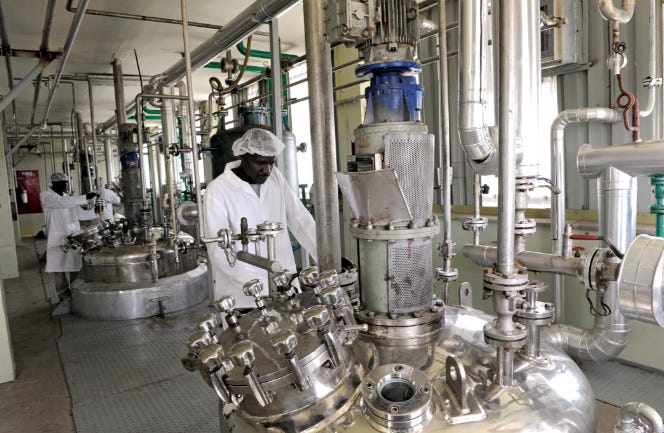
Proven Industrial Success: A prime example of this model is Botanical Extracts EPZ, located in the Athi River Export Processing Zone. The firm processes artemisinin, a high-value pharmaceutical compound extracted from Artemisia annua farmed primarily in the Meru region, specifically for the international export market.
Institutional Strength: The project is owned by IPS (Industrial Promotion Services), an affiliate of the Aga Khan Fund for Economic Development (AKFED). Their involvement underscores the viability of this model, as they have successfully operationalized a high-tech, integrated, and profitable processing chain within Kenya.
Local Value Addition: Just as Botanical Extracts EPZ processes raw biomass into high-margin pharmaceutical extracts, the cannabis industry must prioritize domestic processing. Raw cannabis is low-value and high-volume, whereas processed extracts—such as oils, isolates, and distillates—are high-value and export-ready.
Scientific Rigor: The artemisinin model relies on Good Agricultural Practices (GAP) and rigorous lab testing to meet international pharmaceutical standards. We propose that the cannabis value chain adopt these same protocols. By investing in central, high-tech extraction hubs, Kenya can capture the “middle” of the value chain, ensuring the wealth generated is not leaked through raw material exports but is instead captured through value-added manufacturing here at home.

The Strategic Integration
By combining these two models, we solve the two greatest barriers to cannabis legalization: Regulatory Enforcement and Economic Viability.
For the State: The BAT model provides the control needed to manage the crop safely, turning a security threat into a traceable agricultural asset.
For the Farmer: The Botanical model provides the market—a clear, predictable, and legal pathway to sell a high-value commodity to a sophisticated processor.
This hybrid model transforms cannabis from a social-political lightning rod into an Industrial Export Pillar, capable of rivaling our traditional cash crops in revenue generation, while formalizing the livelihoods of thousands of smallholder farmers.
II. Regulatory Architecture: From Penal Code to Commercial Code
To transform this sector, legislative reform must explicitly pivot from a criminal justice framework to a robust commercial agricultural one. We propose a binary legislative structure that categorizes the plant by its utility and chemical profile, managed by a specialized regulatory body.
1. The “Split-Class” Legislative Framework
Modern market viability depends on precise legal definitions. We propose a Cannabis-Hemp Industrialization Act that creates two distinct regulatory tracks:
Track A: Industrial Hemp (Low-THC): Defined by a THC content threshold. This track focuses on high-volume, high-fiber, seed, and CBD-isolate production. Legislation here should be light-touch, mirroring existing regulations for traditional industrial crops, to encourage rapid scaling in textile, construction, and wellness markets.
Track B: Medical Cannabis (High-Potency): Reserved for high-potency, pharmaceutical-grade output. This track requires “High-Security Production Permits.” Operations are restricted to climate-controlled, secure facilities (indoor or high-security greenhouse) to ensure potency consistency and prevent diversion. This ensures the industry maintains the strict quality standards required by international export markets.
2. The Cannabis Industry Board (CIB): Centralized Governance
We recommend the establishment of a Cannabis Industry Board (CIB), an autonomous regulatory agency modeled after the Coffee and Tea Directorates. The CIB will serve as the single point of contact for the industry, centralizing licensing, quality assurance, and export logistics. Its core mandates include:
Geospatial Permitting: The CIB will issue “Production Permits” linked to verified Global Positioning System (GPS) coordinates of specific agricultural plots. This creates a transparent, “ground-truthed” database of all land under cultivation, preventing the growth of unregulated or illicit plots.
Standardized Compliance: The CIB will act as the arbiter of Good Agricultural Practices (GAP). By setting mandatory protocols for planting, harvesting, and post-harvest handling, the board ensures the Kenyan product meets the stringent quality benchmarks required for EU and North American pharmaceutical importers.
Institutional Insulation: To mirror the professionalism of successful export boards, the CIB will operate as a Public-Private Partnership (PPP). It must be protected from political influence, with a board composition that prioritizes technical expertise in pharmacology, agricultural economics, and supply chain logistics, ensuring the agency remains a service-oriented facilitator of trade rather than a bureaucratic bottleneck.
III. Economic Strategy: The Excise-Driven Revenue Model
The fiscal justification for this proposal moves beyond simple income taxation. To maximize state revenue and ensure the formalization of the sector, we propose an Excise Tax Model modeled on the robust framework used by the tobacco industry in Kenya. By shifting the tax point from the farm gate to the processing facility, the government can capture high-value revenues with administrative precision.
1. The Excise Framework: Centralized Revenue Capture
Attempting to levy taxes at the individual farm level—where plots are often less than an acre—is administratively impossible and prone to evasion. Instead, we propose a “Midstream Excise Strategy” that mirrors the taxation of cigarettes:
Taxation at the “Nucleus”: All processing and extraction facilities must be licensed by the Kenya Revenue Authority (KRA). Excise duty is triggered at the point where the raw biomass is converted into finished, marketable products (oils, isolates, or dried/packaged units).
The “Stamp and Trace” System: Integrating the industry into the Excisable Goods Management System (EGMS) is critical. By affixing digital excise stamps to every standardized unit of finished cannabis/hemp product, the state achieves two objectives: it guarantees that the required tax has been paid, and it provides an ironclad audit trail that prevents illicit product from entering the legal stream.
High-Yield Fiscal Impact: Cigarette excise taxes in Kenya currently serve as a primary source of government revenue because they are applied to a consolidated, high-volume commodity. By treating medical cannabis and hemp extracts as high-value excisable goods, the Treasury can implement a similar, highly effective collection mechanism. This avoids the “leakage” inherent in the current black market and turns a previously unmonitored sector into a predictable fiscal pillar.
2. Scaling for High-Value Exports
The model prioritizes the export of high-value derivatives over raw, unprocessed material.
Value-Added Duty: Revenue is maximized by applying an excise rate on the Retail Selling Price (RSP) of finished extracts. As the complexity and purity of the product increase (e.g., pharmaceutical-grade CBD), so too does the excise yield.
Economic Formalization: This system incentivizes farmers to operate within the “Anchor” network. Because excise-compliant products carry a “stamp of legitimacy,” they command higher market prices in both the domestic pharmaceutical and international export markets. This creates a powerful economic incentive for farmers to abandon the illicit market, where their products are heavily discounted and lack legal protection.
Sustaining the “Fiscal Net”: By adopting the tobacco excise model, we ensure the government has a scalable revenue stream that grows in tandem with the industry’s expansion. This is not just a regulatory framework; it is an industrialization policy that links rural livelihoods in Kajiado and Migori directly to the national budget.
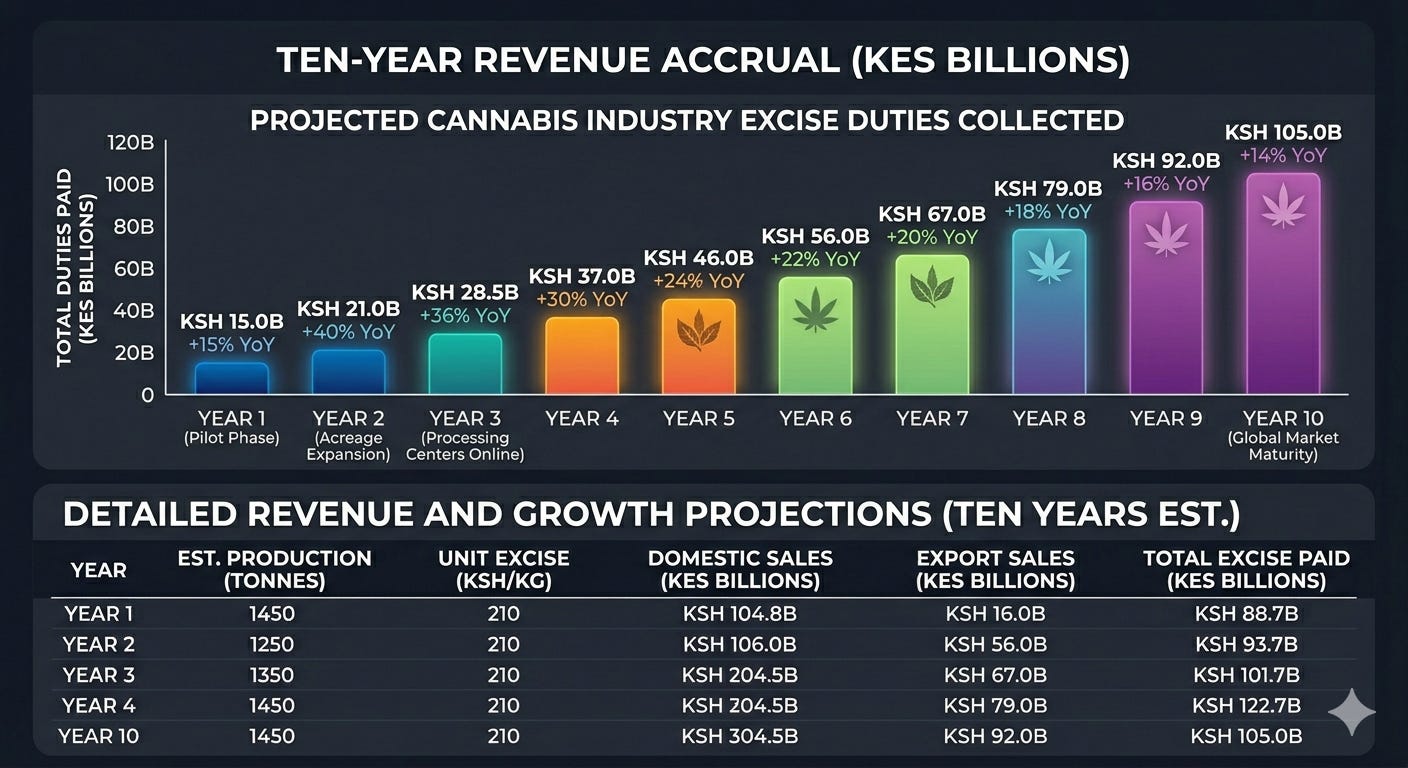
By benchmarking the "Green Gold" proposal against the historical performance of the tobacco sector, we can demonstrate that a disciplined excise-based framework—as visualized—has the potential to generate over KES 100 billion in annual tax revenue by year ten, providing a fiscal incentive for the government to transition from prohibition to a regulated, high-value industrial model.
IV. Governance & Integrity: Ensuring Institutional Longevity
To avoid the institutional instability and political patronage often seen in Kenyan parastatals, the Cannabis Industry Board (CIB) must be architected as a technocratic, performance-driven entity. Its success hinges on insulation from the volatile cycles of political influence, ensuring that it remains a facilitator of trade rather than a platform for rent-seeking.
Public-Private Partnership (PPP) Governance: We propose a governance model where the state acts strictly as the regulator—setting standards, issuing licenses, and enforcing compliance—while the private sector acts as the operator. This PPP structure ensures that investors provide the essential technology, risk capital, and global market linkages, while the government retains oversight without interfering in daily operational logistics.
Insulation from Patronage: The CIB board composition should be mandated by statute to include experts in pharmacology, agricultural economics, and supply chain management, rather than political appointees. By tying board mandates to technical milestones and fiscal transparency KPIs, we ensure the board’s primary accountability is to the national treasury and the farmers it serves, rather than political actors.
Radical Transparency: Every license issued, permit granted, and excise stamp accounted for by the CIB must be available on a public, digital dashboard. This real-time reporting environment acts as an additional layer of protection against corruption, fostering confidence among both local farmers and international investors.
V. Conclusion: From Contention to Commodity
The legislative debates unfolding in Parliament this week signal that the policy environment surrounding Cannabis sativa is finally maturing. It is time to move beyond the moralistic and political framing that has stalled progress for decades and treat this as a clear-cut, commodity-driven industrial policy.
By adopting the proven “Anchor-Outgrower” model—the same architecture that underpins the success of our tobacco and botanical exports—Kenya has a unique opportunity to convert a contentious, illicit crop into a legitimate, tax-generating powerhouse. This transition does not require a “leap of faith”; it requires an institutional commitment to formalization, traceability, and high-value processing.
VI. Global Benchmarks: Successful Economic Formalization
The following nations serve as primary case studies for how the transition from illicit to regulated markets can generate significant national wealth, job creation, and tax revenue.
Canada: Following its 2018 federal legalization, Canada established a highly regulated, infrastructure-heavy market. It has successfully integrated cultivation, processing, and retail into a multibillion-dollar industry that ranks among the top global producers for both medical and recreational purposes.
The United States: While utilizing a state-by-state model, legal sales exceeded $30 billion in 2023. States like Colorado and Washington have documented measurable increases in GDP, job creation, and tax revenues redirected into public infrastructure and social services.
The United Kingdom: While maintaining a more restricted domestic recreational market, the U.K. is a dominant global leader in the production and export of medical cannabis. It consistently ranks as one of the world’s top exporters of cannabis for medical and scientific use, generating substantial value through large-scale, licensed operations.
Uruguay: As the first country to legalize recreational cannabis nationally in 2013, Uruguay offers a model for a government-managed supply chain. This framework integrates pharmacy sales and government-monitored production, successfully shifting activity from the illicit market into a regulated system.
Israel: Israel is a global leader in medical cannabis research and development. Its robust legal framework has fostered an ecosystem of high-tech extraction businesses and clinical research, which contribute significantly to the country’s broader biotech sector.
Economic Drivers of These Models
The wealth generated in these jurisdictions is derived from three strategic pillars:
Tax Revenue: Governments replace illicit market activity with regulated sales, capturing tax revenue that is then reinvested into public services.
Job Creation: The industry provides a vast range of employment, from agricultural workers and greenhouse technicians to lab scientists, compliance officers, and retail staff.
Export Markets: Nations with established regulatory frameworks—such as Canada, the U.K., and Portugal—leverage high-quality production standards to export medical-grade cannabis to emerging markets, further bolstering their national balance of trade.