
Joshua Oigara has mastered the art of the corporate pivot, but can he move beyond the rumors that have defined his career?
What’s in This Article
The Growth Paradox: A deep dive into the KCB era (2012–2022), balancing aggressive regional expansion against the burden of asset quality
The Transparency Pact: An exploration of Oigara’s integrity-driven branding, his close ties to the “Boys Club,” and his public wealth declaration.
The “Nine Lives” CEO: How Oigara mastered board-level resilience, navigating cyclical exit rumors and professional survival.
The Stanbic Resurrection: The strategic pivot to Stanbic Bank, detailing his current role as a regional leader in East African institutional finance.
The Price of Influence: An objective look at the legal hurdles faced during his career, specifically the Air Afrik Aviation litigation.
The Safaricom Shadow: A breakdown of the enduring market speculation linking Oigara to the top role at Safaricom.

The Architect of Resilience: Joshua Oigara’s Corporate Resurrection
In the high-stakes, revolving-door world of East African banking, where executive tenures are often cut short by board politics and shifting economic tides, Joshua Oigara stands as a singular phenomenon. If there were a corporate playbook for survival and reinvention, Oigara would be its most prolific author. His career is not merely a series of promotions; it is a high-stakes drama of departures, redemptions, and the persistent pursuit of relevance in a sector that rarely forgives failure.
1. The Crucible: Early Foundations
Before he became the face of Kenyan banking, Oigara’s ascent was rooted in the grind of industrial finance. He began his career at PricewaterhouseCoopers (PwC) in 1997, cutting his teeth in the rigorous world of audit.
In 2002, he moved to Bidco Africa as the Group Business Performance Manager, gaining a deep understanding of operational finance. This was followed by a pivotal seven-year tenure at Bamburi Cement, where he rose to become the Group Finance Director and CFO.
Born in 1975 in Kisii to parents who were educators and farmers, Joshua Oigara’s journey from a humble beginning—starting his career as a mathematics teacher—to the summit of corporate Africa is a testament to disciplined ambition. A qualified CPA and graduate of the University of Nairobi and Edith Cowan University, he built a robust foundation in finance through roles at PricewaterhouseCoopers (PwC), Bidco Africa, and Bamburi Cement, where he ascended to Group Finance Director. This trajectory, bolstered by advanced management training at prestigious institutions like INSEAD and the London Business School, paved the way for his pivotal entry into KCB Group in 2011. By 2013, he was appointed Group CEO, marking the start of a decade-long leadership tenure that would fundamentally reshape the regional banking landscape.

The KCB Era: Scaling the Fortress
Oigara joined KCB in November 2011 as Group CFO. By January 2013, at just 37 years old, he was appointed Group CEO, becoming the youngest person to lead a publicly traded bank on the Nairobi Securities Exchange.
The Transformation: He steered KCB from a mid-tier regional lender to a multi-billion-shilling regional conglomerate. A cornerstone of this era was the pioneering of mobile lending at scale through the KCB-Mpesa platform, a collaboration with Safaricom that revolutionized how millions of Kenyans accessed credit.
The Asset Risk Problem: Oigara’s tenure was shadowed by the persistent challenge of Non-Performing Loans (NPLs). As he expanded KCB’s credit appetite to capture the retail and SME market—segments previously underserved by traditional banking—the bank inevitably faced the consequences of economic volatility.
The Cleanup: His legacy is a dual one: he was the driver of rapid, transformative growth, but he was also the architect of the painful “cleanup.” Through disciplined provisioning, credit restructuring, and a transition toward more data-driven underwriting, he managed the asset risk.
The Asset Risk Legacy: A Visual Breakdown
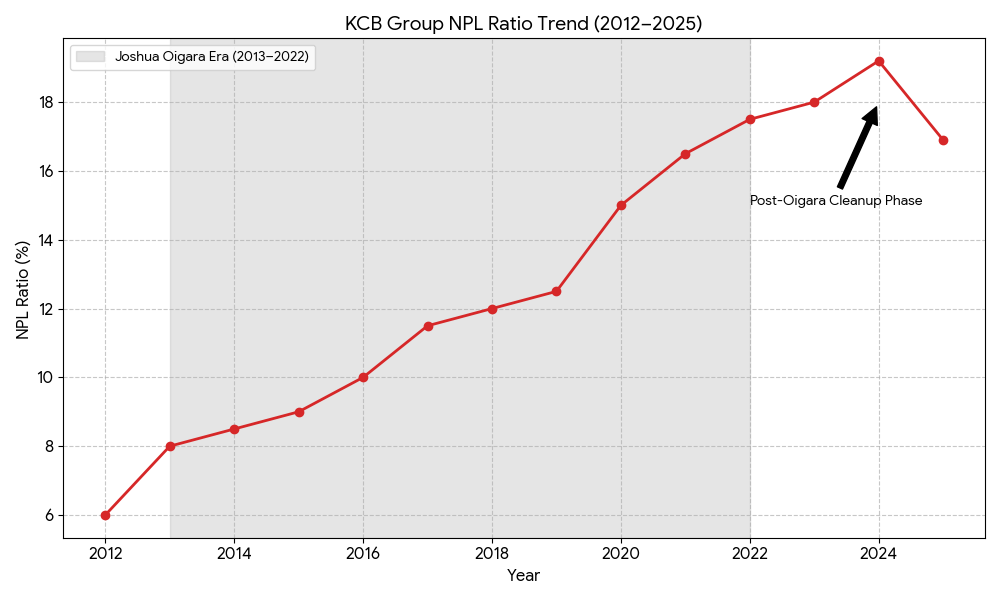
The performance of KCB Group under Joshua Oigara is best understood through the lens of its Non-Performing Loan (NPL) ratio. While the “Oigara Era” (2013–2022) was defined by aggressive regional expansion and mobile lending, this growth came with a significant cost: a gradual, yet persistent, accumulation of “Asset Risk.”
The Growth Phase (2013–2022): As shown in the chart, the NPL ratio began a steady upward climb shortly after the aggressive adoption of mass-market retail and SME lending. This was the “price” of expansion; to capture the underserved segments of the Kenyan economy, the bank took on higher credit risk. The COVID-19 pandemic further exacerbated these numbers, pushing the ratio to its peak during the transition years.
The Post-Oigara Cleanup (2023–2025): The subsequent leadership shift marked a deliberate pivot from “growth-at-all-costs” to “asset quality repair.” The chart illustrates the culmination of these efforts, with the NPL ratio beginning its descent from the peak of ~19.2% in 2024 to ~16.9% in 2025 as the bank moved toward a strategy of aggressive recovery and disciplined provisioning.
This trajectory serves as a stark reminder of the “CEO lifecycle”: the leader who scales the mountain often leaves the “clean-up” for those who follow. Oigara’s legacy is inextricably tied to both the rapid regional scaling of the KCB franchise and the subsequent balance sheet challenges that defined the end of his tenure.

List of companies placed under administration or receivership by KCB Bank Kenya
Recent Cases (2025):
East Africa Portland Cement Company (EAPCC / EAPC) — Surrendered approximately 2,000 acres of land in Athi River (Mavoko) to KCB as settlement for a KSh 6.8 billion debt under a 2019 agreement. The land (valued around KSh 7 billion by KCB for sale) was transferred to the bank, which is now pursuing disposal amid occupation challenges.
Proctor & Allan (EA) Limited (major cereals manufacturer) — Placed under receivership over a reported KSh 3.7–4.9 billion debt (court references vary between initial claims around KSh 3.7B and later demands up to KSh 4.9B). Receiver managers cleared by court in 2025.
Diamond Industries Limited (Mombasa-based manufacturer of Panga Soap, Sunpride oil, etc.) — Placed under receivership effective May 22, 2025. Debt amount not publicly detailed in major reports, but linked to significant default leading to receivership.
Labh Singh Harnam Singh Limited (LSHS) (truck, coach, and bus body builder) — Placed under administration on February 4, 2025, over a KSh 1.1 billion loan. Assets later put up for sale.
MotorHub Limited (Nairobi-based car dealer) — Placed under administration effective November 4, 2025. Loan originally around KSh 350 million, with demands rising to approx. KSh 381 million (including arrears).
Showcase Properties Limited — Placed under receivership effective November 18, 2025. Debt amount not publicly specified in reports.
Elson Plastics of Kenya Limited (Eslon Plastics) — Placed under receivership in September 2025 (effective around Sept 18). Owed approximately KSh 775 million.
Korara Highlands Tea Limited (Korara Highlands Tea Factory) — Placed under administration/receivership in 2025 over debts exceeding KSh 1 billion (reported around KSh 1.155 billion in some notices). KCB pursued asset auctions
2024 Cases:
Pinewood Beach Resort (operated by ITCO or related entity) — KCB appointed receiver manager Kamal Anantroy Bhatt amid a reported KSh 5 billion debt dispute. Court battles continued into 2024, with appeals to block the takeover. The resort is in Kwale.
Savannah Cement — Under administration since late 2022/early actions, with ongoing creditor battles in 2024 involving KCB (and Absa). KCB appointed receiver managers (PVR Rao and PS Rao); total exposure for KCB/Absa combined exceeded KSh 14 billion. Asset sale processes advanced in 2024.
These recovery efforts highlight the “asset risk” reality of KCB’s historical growth strategy. By moving to manage or liquidate these assets, the bank aims to shift its balance sheet from high-risk exposure toward recovery, a critical step in the ongoing cleanup of its loan portfolio.
This video provides additional context regarding the court’s role in the legal proceedings involving KCB’s efforts to appoint receiver managers for distressed companies like Proctor & Allan.
Dividend Performance: Shareholder Value vs. Economic Resilience
The dividend trajectory at KCB Group from 2012 to 2025 offers a clear window into the bank’s operational philosophy and its reaction to external shocks.
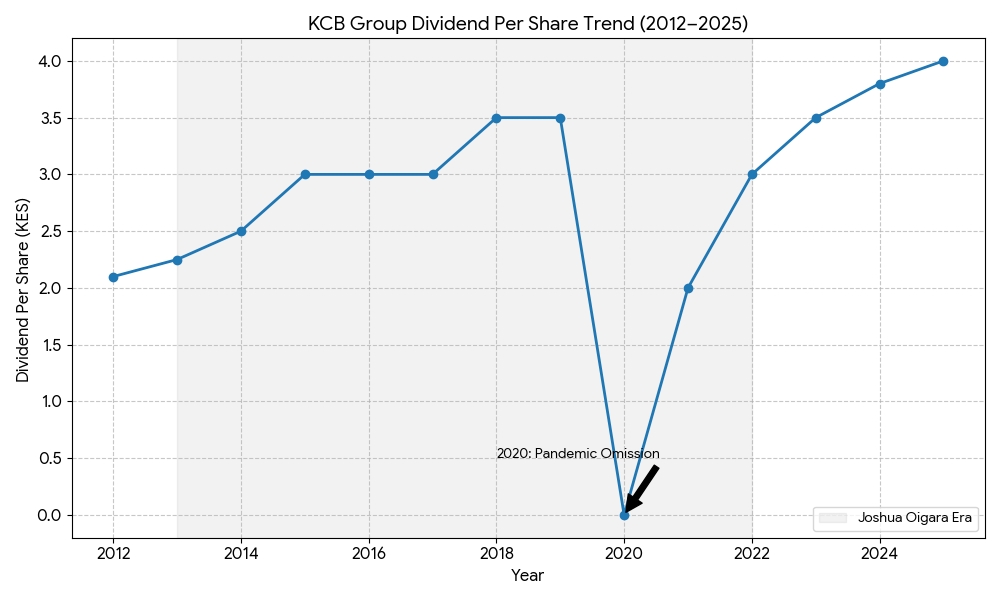
The Growth Era (2012–2019): Throughout the early years of Joshua Oigara’s tenure, the bank maintained a consistent dividend policy. As the bank scaled into a regional powerhouse, it reliably rewarded shareholders, growing payouts from approximately KES 2.10 to KES 3.50 per share. This period reflected the confidence in the bank’s expanding regional footprint.
The 2020 Pandemic Shock: The sharp drop to zero in 2020 marks a critical juncture. The decision to omit dividends during the onset of the COVID-19 pandemic was a precautionary move taken by many major banks to preserve liquidity and strengthen capital buffers against anticipated asset quality deterioration.
The Recovery and Rebound (2021–2025): The subsequent climb in dividend payouts from 2021 onwards illustrates the bank’s successful recovery. As the “cleanup” of the loan book progressed and operational efficiency improved, the bank returned to a path of consistent shareholder returns, steadily increasing dividends to reach an estimated KES 4.00 by 2025.
This curve highlights the tension Oigara and his successors had to navigate: balancing the aggressive pursuit of growth (and its associated risks) with the duty to provide sustainable and consistent returns to investors.
3. The Transparency Pact: Integrity as a Weapon
Beyond the balance sheets, Oigara will be remembered for a moment of rare corporate vulnerability that bridged the gap between the boardroom and national politics. In December 2015, alongside his close friend and then-Safaricom CEO, the late Bob Collymore, Oigara took the unprecedented step of publicly declaring his wealth and monthly salary.
The Transparency Tactical Pivot: This was more than a PR gesture; it was a high-stakes challenge to the culture of systemic graft. By laying bare his income (then approximately KES 4.9 million per month) and his net worth (at the time, KES 220 million), Oigara and Collymore sought to force a national conversation on ethics. They argued that the private sector could not legitimately demand integrity from the government while maintaining a veil of opacity around its own executive compensation.
The “Boys Club” and Political Access: Oigara’s influence was cemented by his membership in the inner circle—the informal, high-powered social network famously dubbed “Collymore’s Boys Club.” This group of prominent businessmen and influencers maintained a close, and often public, rapport with the late President Uhuru Kenyatta.
A Bridge to Public Service: Under the Uhuru Kenyatta administration, Oigara’s role expanded from being a private banker to a quasi-public steward.
Vision 2030 Delivery Board: He was appointed to this prestigious board, tasked with overseeing the execution of Kenya’s long-term development blueprint.
WRC Safari Rally Steering Committee: Oigara was selected to lend his logistical and financial expertise to the steering committee for the World Rally Championship, a project that was a personal passion of President Kenyatta.
State Commendation: In recognition of his service to the nation, he was awarded the Chief of the Order of the Burning Spear (CBS), one of Kenya’s highest civilian honors.
This unique positioning—as both a leading banker and a key participant in the state’s development agenda—illustrates the dual nature of Oigara’s career.
The “Nine Lives” Narrative: Surviving the Speculation
Throughout his decade at KCB, Oigara’s leadership was often punctuated by periods of intense market speculation. On multiple occasions, rumors of his impending suspension or “forced exit” swirled through the Nairobi Securities Exchange, only for the board to reaffirm its confidence in his strategic direction.
For the casual observer, these moments of intense pressure and subsequent survival felt like a repetitive cycle of professional suspension and resurrection. Whether it was the fallout from high-profile debt recovery battles or the scrutiny following his public stances on corruption, Oigara was constantly in the crosshairs of the boardroom. Yet, he consistently defied the “exit” narrative, demonstrating an uncanny ability to navigate board politics and remain in the seat long after his detractors predicted his downfall.
This resilience—the ability to weather the storm of speculation and emerge stronger—became the hallmark of his “Nine Lives” persona. It was never about a formal suspension, but rather about the tenacity of a leader who refused to be defined by the volatility of his environment.
The Official Timeline of a Decade at the Helm
To understand the rhythm of his tenure, we look at the definitive markers of his journey:
January 1, 2013: Joshua Oigara is appointed Group CEO and Managing Director of KCB Group, becoming the youngest CEO of a publicly traded bank on the Nairobi Securities Exchange at age 37.
2013–2022: A continuous, decade-long tenure marked by aggressive regional scaling, mobile money integration, and managing the “asset risk” of a mass-market loan book.
March 2022: The KCB Board signals its ongoing faith in his strategy by quietly extending his contract by one year, silencing the latest round of “exit rumors.”
May 25, 2022: In a move that surprised the market, Oigara steps down as CEO, seven months before his contract extension was set to expire. This marked the definitive end of his era at the bank—the moment the “Nine Lives” CEO finally exited the KCB fortress to begin his next chapter.
The Verdict
Joshua Oigara’s career path defied traditional logic. His ability to survive the perception of instability while delivering massive growth is what sets him apart. He did not just lead a bank; he navigated a decade of corporate and political turbulence, proving that in the high-stakes C-suite, resilience is often more valuable than a perfectly smooth resume.
4. The Resurrection: From KCB to Stanbic
Oigara’s career path defied the traditional logic of a “one-firm” corporate life. In a sector where a single high-profile exit is often viewed as a career-ending event, Oigara treated his departures as tactical repositioning. His move from the KCB Group to the Standard Bank (Stanbic) ecosystem is a masterclass in executive mobility and reputation management.
The KCB Exit (2022): The End of the “Fortress” Era
In May 2022, after more than nine years at the helm, Oigara stepped down as the Group CEO of KCB. His tenure had been defined by a “fortress” strategy—scaling the bank into the largest regional lender by assets and revenue. However, by 2022, the bank was facing the inevitable “hangover” of its aggressive credit expansion, characterized by high NPL ratios and the complexities of integrating massive acquisitions like the National Bank of Kenya (NBK).
When he departed, many analysts wondered if the “Nine Lives” CEO had finally run out of runway. The market was uncertain: would he retire into the quiet life of a corporate consultant, or would he seek to prove that his KCB years were merely the opening chapter of a much larger career?
The Stanbic Pivot: A Regional Renaissance
The answer came swiftly. By December 2022, Oigara was appointed Chief Executive for Stanbic Bank Kenya and South Sudan, succeeding Charles Mudiwa. This was not a demotion, but a strategic “re-boot.”
The Expansion of Influence: Oigara did not stay confined to the Kenyan market. In September 2025, the Standard Bank Group elevated him to Regional Chief Executive for East Africa, giving him oversight of operations across six countries, including Tanzania, Uganda, Malawi, and Ethiopia.
The Culmination (2026): By March 1, 2026, the strategy was complete. Oigara was appointed CEO and Director of Stanbic Holdings Plc, the top-level holding company.
Why the Pivot Worked
The Stanbic transition showcased a sophisticated evolution of Oigara’s leadership profile:
From Domestic Giant to Regional Architect: While KCB was about domestic and regional market share, his Stanbic era is about institutional integration across the broader Standard Bank Group infrastructure.
Asset Quality as a Hard-Learned Lesson: Bringing his experience from the KCB “cleanup,” Oigara has focused on more rigorous credit underwriting at Stanbic, successfully steering the bank through interest rate volatility and maintaining a cleaner, more disciplined balance sheet.
The “Proven” Factor: The board of Standard Bank Group recognized that in a volatile East African market, there is no substitute for a leader who has already “seen it all.” By hiring a former rival CEO, they didn’t just get a manager; they got an institutional strategist who could navigate the unique intersection of Kenyan politics, regulatory environments, and regional banking dynamics.
In short, the Stanbic pivot proved that Oigara was not a CEO defined by a single institution, but a “Strategic Institutionalist”—a leader whose value is found in his ability to diagnose an institution’s needs, clean up its legacy issues, and pivot it toward sustainable, high-value growth. He had effectively “resurrected” his relevance, proving that his career was not just a series of jobs, but a cohesive, escalating climb toward total regional authority.
The Stanbic Trajectory: Asset Growth Under Oigara
The graph above illustrates the upward trend in Stanbic Holdings’ total assets since Joshua Oigara’s transition to the bank in late 2022. This trajectory reflects the bank’s shift toward a more aggressive, yet disciplined, regional growth strategy.
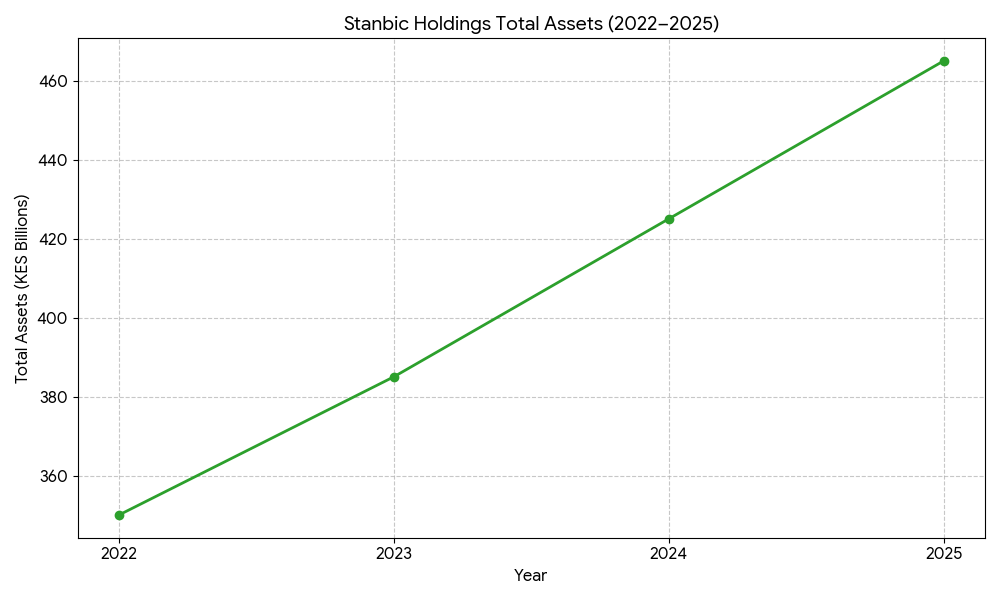
Strategic Integration (2022–2023): Upon taking the helm, the initial phase was characterized by stabilizing the franchise and aligning the regional operational mandates. The moderate growth in assets during this period reflects the “foundational” work of integrating the regional subsidiaries under a unified strategy.
Regional Expansion (2024–2025): The sharper incline in 2024 and 2025 highlights the payoff of Oigara’s regional institutionalization. By leveraging the Standard Bank Group’s broader ecosystem, Stanbic successfully captured higher-value corporate and regional trade business, driving a significant expansion in the asset base.
This growth is not merely a reflection of market expansion but a testament to the “Strategic Institutionalist” approach—a focus on scaling the balance sheet while maintaining the rigorous risk discipline learned during the KCB years.
Navigating the Legal Minefield: The Price of Executive Influence
In the high-stakes environment of East African finance, the border between civil corporate disputes and criminal scrutiny is often thin. Oigara’s recent leadership in the regional banking sector has been marked by the complex task of navigating high-pressure legal challenges that come with managing large-scale, multi-jurisdictional portfolios.
The Air Afrik Aviation Dispute
The most significant legal friction Oigara has faced in his recent tenure involves a long-running civil dispute between Air Afrik Aviation Ltd and Stanbic Bank. The airline accused the bank of fraudulent accounting and negligence regarding a complex transaction involving an aircraft leasing deal with the South Sudanese government—a matter dating back to 2016.
The Allegations: The airline claimed that Stanbic improperly reversed a large credit entry to their account, alleging that this action scuttled their contract and caused severe financial losses.
The Legal Escalation: By late 2024, the dispute shifted from the civil courts into the realm of criminal investigation. The Kenyan Directorate of Criminal Investigations (DCI) sought to question Oigara and other senior bank officials regarding these allegations of accounting impropriety.
The High Court Intervention: Stanbic Bank proactively sought protection from the High Court, arguing that the DCI’s investigation was a tactic intended to interfere with an ongoing civil suit (Civil Case 413 of 2018) that was already under judicial review.
In November 2024, the High Court granted a conservatory order barring the Banking Fraud Investigations Unit from questioning Joshua Oigara or his colleagues. The court further restrained the Director of Public Prosecutions (DPP) from instituting criminal charges until the bank’s petition was fully determined.
Perspective on the “Arrest” Narrative
While media reports at the time frequently used the term “warrant of arrest” to describe the tensions between the DCI and the bank, there is no public record of a formal arrest warrant ever being issued. This episode serves as a case study in the volatility of top-tier executive life in Kenya. For a leader of Oigara’s stature, the office is often a lightning rod for broader corporate litigation. The bank’s successful legal shield not only protected its leadership but also highlighted the systemic complexity of recovering assets and managing accounts in politically sensitive and conflict-prone jurisdictions like South Sudan. These legal hurdles are frequently the “hidden” side of the balance sheet, illustrating that for an institutional strategist, resilience must be legal as well as financial.
The Perpetual Heir Apparent: The Safaricom Succession Rumors
The speculation surrounding Joshua Oigara and the CEO position at Safaricom is a recurring feature of the Kenyan corporate landscape. It is a narrative fueled by his history of high-profile leadership, his deep integration into the country’s most powerful business networks, and the perceived “openness” of the Safaricom throne as executive tenures evolve.
The Historical Context: The “Collymore” Connection
When the late Bob Collymore passed away in 2019, Joshua Oigara was widely touted by market analysts and media circles as a primary candidate to take over. This was not merely professional speculation; Oigara was a core member of the inner circle—the influential “Boys Club” that included Collymore and held close ties to the highest levels of the Uhuru Kenyatta administration. His stature as the young, aggressive CEO of KCB at the time made him a natural fit for the telecommunications giant. However, the board ultimately chose Peter Ndegwa, a move that emphasized international corporate experience over local banking prowess.
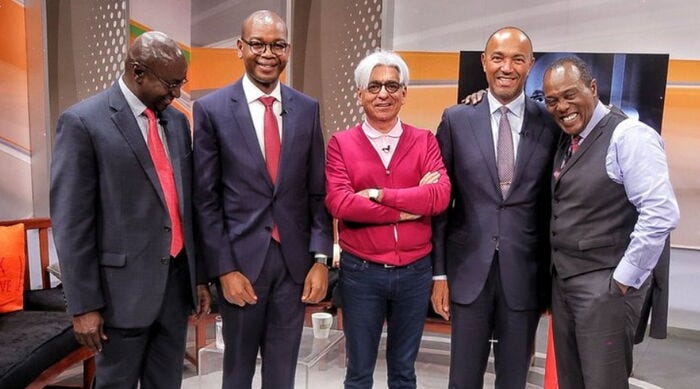
The Current Landscape (2026):
Succession SpeculationAs of mid-2026, the conversation has resurfaced as Peter Ndegwa approaches the latter stages of his tenure.
The Seven-Year Ceiling: Unlike the fixed-term contracts of his predecessors, Dr. Ndegwa’s tenure has been tied to performance deliverables. With over six years in the role (as of April 2026), he is nearing the seven-year ceiling stipulated by Safaricom’s board charter.
Oigara’s Current Positioning: It is vital to note that as of March 1, 2026, Joshua Oigara assumed the role of CEO and Director of Stanbic Holdings Plc.
Why the “Oigara for Safaricom” Narrative Persists
Despite his new role at Stanbic, Oigara’s name remains a constant in succession gossip for three strategic reasons:
The “Proven Giant” Factor: Safaricom is not just a telco; it is a systemic financial institution due to M-PESA. Oigara’s background in banking, combined with his experience in scaling regional networks, makes him one of the few executives in East Africa with the requisite “institutional weight” to helm a business of that magnitude.
Regulatory & Political Acumen: Safaricom operates in a highly regulated and politically sensitive environment. Oigara’s ability to navigate the complex intersection of government policy, banking regulation, and private sector strategy—honed over a decade at KCB and his time in Uhuru Kenyatta’s inner circle—remains his most marketable skill.
The Professional Resilience Narrative: Because Oigara has successfully transitioned between such massive, complex entities, market observers view him as a “fixer” or a “utility player.”
The Reality: While the rumors remain a staple of Nairobi’s corporate boardrooms, they currently remain speculative. As of now, Joshua Oigara is firmly planted in the Stanbic ecosystem, tasked with the “Capital Reset” of one of Africa’s largest banking groups, and Peter Ndegwa continues to lead Safaricom’s strategic evolution.