
Every time African policymakers gather at regional trade summits, the keynotes follow a well-rehearsed script: the African Continental Free Trade Area (AfCFTA) will unlock borderless commerce, unified settlement rails will facilitate seamless cross-border capital flows, and African retail investors will finally fund African mega-infrastructure. Yet when a generational equity event like the $1.6 Billion Dangote Petroleum Refinery IPO arrives, the rhetoric vanishes. What remains is the stark reality of fragmented infrastructure, rigid national banking siloes, and extreme friction for everyday investors across the continent.
The Asymmetry of Scale
The underlying economics of the issuance are staggering. Priced at ₦525 (KES 51 / $0.40) per share across 4.1 billion shares, the transaction implies a total market valuation of $40 Billion to $47 Billion.
“A single industrial asset in Lagos enters the public domain carrying a higher valuation than the entire equity market capitalizations of the Nairobi Securities Exchange (NSE) or Nigerian Exchange (NGX) combined.”
To appreciate the institutional gravity of these numbers:
Dangote Refinery Implied IPO Equity Valuation: $40.0B – $47.0B
Entire Nigerian Exchange (NGX) Total Market Cap: $35.0B
Entire Nairobi Securities Exchange (NSE) Total Market Cap: $32.2B
Despite the global significance of this asset, an investor operating out of Nairobi attempting to allocate KES 10,000 to this paper is immediately halted by institutional walls.
The Onboarding Audit: Friction on the Ground
Despite early signaling of potential cross-listings across regional bourses, the prospectus confirms a primary listing strictly on the NGX, with foreign cross-listings deferred for a minimum of three years. An operational audit conducted directly via regional fintech access points like Hisa App reveals why cross-border retail participation remains effectively non-existent:
Absence of Local Clearing Infrastructure: With zero primary cross-listing on the NSE, local brokers cannot route orders through domestic central securities depositories (CSDs).
The Biometric Credential Trap: Trading directly on the NGX mandates a Nigerian Bank Verification Number (BVN)—a local banking credential inaccessible to foreign retail investors without a physical footprint in Nigeria.
Jurisdictional Proof-of-Address Constraints: Secondary onboarding channels via regional intermediaries routinely demand a resident Nigerian guarantor or local utility documentation.
Requiring a Kenyan investor to produce a Lagos utility bill to execute a trade illustrates the profound operational disconnect in African market integration.
Capital Structure & Valuation Mechanics
For institutional readers analyzing the balance sheet, the equity offering presents structural nuances that merit scrutiny:
The 3.3% Free-Float Concentration: Selling 4.1 billion shares out of 120.13 billion registered shares leaves 96.7% tightly held by Aliko Dangote and core insiders. Minority public shareholders will possess limited governance leverage and face tight secondary market liquidity.
The Retail Spread: At $0.40 per share, retail buyers are subscribing at a 14% premium over the $0.35 per share pricing cleared by institutional anchors during the $2.5 Billion private placement in July 2026.
Refining Cycle Dynamics & Balance Sheet Leverage: The transaction hits the market amid elevated crude prices, masking the reality that refining operates on narrow crack spreads. Furthermore, substantial initial cash generation must service a $3.65 Billion to $5.67 Billion debt stack prior to meaningful equity distribution.
“Capital markets do not suffer from a deficit of African liquidity; they suffer from an absence of operational bridges.”
The Institutional Takeaway: The Dangote Refinery IPO underscores a clear market truth: high-quality engineering assets do not automatically translate into accessible public securities. While sovereign funds and strategic institutional investors navigate cross-border restrictions via dedicated Special Purpose Vehicles (SPVs), retail capital across East Africa remains trapped in domestic silos. Until regional regulators, central banks, and market clearing institutions move beyond symbolic frameworks and execute functional cross-border integration, “Pan-African investing” will remain a corporate talking point while everyday capital watches from the sidelines.
Part II: The Structural Breakdown — Valuation, Margins, and Insider Mechanics
While the operational barriers at the border effectively lock out regional retail participation, an institutional examination of the Dangote Petroleum Refinery & Petrochemicals FZE prospectus reveals that even for those with direct market access, the underlying security presents substantial structural and valuation risks.
A disciplined analysis of the corporate disclosures indicates that the offering is priced for absolute perfection—leaving public minority shareholders to absorb considerable downside risk while providing Aliko Dangote and early insiders with an exceptional exit valuation.
1. The Valuation Surge: Pricing Ahead of Execution
The most glaring anomaly in the prospectus is the rapid escalation in the refinery’s baseline valuation over a remarkably compressed timeframe.
Late-2025 Market Benchmarks: Informal private market appraisals and equity capital estimates pegged the asset’s enterprise valuation between $20 Billion and $25 Billion during its initial commissioning phase.
The Public Offer Baseline: The primary offering price of ₦525 ($0.40) per share across 120.13 billion total registered shares establishes an implied equity valuation of $40 Billion to $47 Billion.
An asset does not double its fundamental valuation in under nine months without undergoing a dramatic, multi-year shift in operational footprint. While the refinery transitioned to its 650,000 barrels per day (bpd) nameplate capacity in early 2026, forcing a $40B+ top-of-the-market valuation onto public buyers eliminates any traditional margin of safety. Investors subscribing to this public tranche are effectively paying for 2029 operational expansion targets today.
2. The 3.3% Free-Float Trap and Corporate Governance Risk
The issuance structure raises severe red flags regarding secondary market liquidity and minority shareholder protection:
Total Registered Capital: 120,130,000,000 Ordinary Shares
Public Offer Tranche: 4,100,000,000 Ordinary Shares
Resulting Public Free Float: 3.3%
A public free float of 3.3% is exceptionally tight for a mega-cap asset. Aliko Dangote and the parent conglomerate retain 96.7% controlling equity.
For minority investors, this creates two structural hazards:
Zero Governance Leverage: Public shareholders possess no meaningful voting weight to influence board composition, capital allocation decisions, or dividend distribution policies.
Trading Illiquidity & Price Volatility: With so few shares floating on the secondary order book of the Nigerian Exchange (NGX), institutional price discovery will be distorted. Small retail order flows could trigger wild price swings, while large funds will find it virtually impossible to exit sizeable positions without crashing the market price.
3. The Institutional Spread: Retail Paying the Mark-Up
A comparative look at the transaction history reveals a clear pricing hierarchy between smart money anchors and retail buyers:
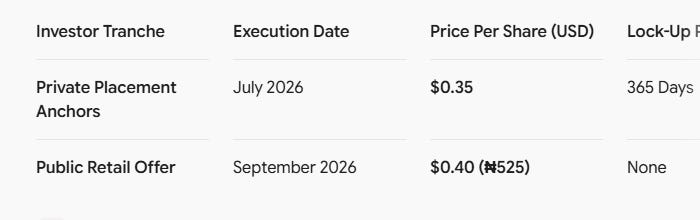
Institutional investors who committed $2.5 Billion in private capital just weeks prior secured a 14.3% discount compared to the public offer price. Retail buyers across Sub-Saharan Africa are effectively being asked to provide liquidity to validate the higher institutional benchmark.
4. Margin Volatility: Operating at the Top of the Refining Cycle
Refining is historically a cyclical, capital-intensive, low-margin industry. A refinery’s profitability is dictated by the “crack spread”—the differential between the cost of crude oil inputs and the market price of refined output products (PMS, AGO, Jet A-1).
Listing at Peak Crude Pricing: The IPO arrives at a moment when global crude prices are elevated ($85–$95/barrel range). Elevated crude prices inflate top-line revenue metrics but compress refining margins if end-consumer pump prices cannot rise proportionately.
Feedstock Sourcing Friction: The prospectus discloses ongoing operational friction with state-owned suppliers (NNPC) regarding domestic crude supply obligations. To maintain full capacity, the facility has been forced to import foreign crude (such as US West WTI) priced in hard USD, directly eating into gross refining margins (GRMs)
The H1 2026 Anomaly: While the prospectus highlights a swing from a $476 Million net loss in FY2025 to a $1.82 Billion after-tax profit in H1 2026, analysts must treat H1 2026 as a post-commissioning run-rate spike rather than a guaranteed perpetual yield.
5. The Balance Sheet: Debt Service Over Dividend Yield
Building a world-class, single-train refinery required over $20 Billion in total CAPEX, financed through heavy syndicate bank debt.
Total Balance Sheet Debt: Disclosed at approximately $5.67 Billion (KES 734B) as of mid-2026.
Cash Flow Allocation: Although the company projects $14.3 Billion in Phase II expansion CAPEX by 2029, primary operational cash flows over the next 24 to 36 months must first satisfy bank debt-service covenants and principal repayments.
Retail investors expecting high immediate dividend distributions will likely be disappointed as cash flows are prioritized toward de-leveraging the balance sheet and funding expansion.
Summary Verdict for East African Portfolios: The Dangote Refinery is unquestionably an engineering triumph and a vital strategic asset for Sub-Saharan Africa’s energy independence. However, an exceptional physical asset does not automatically constitute an attractive public stock. With a 3.3% float, an inflated $40B+ valuation, a 14% retail markup, and significant foreign exchange repatriation friction, this offering favors the issuer far more than the public investor. For Kenyan investors, keeping capital deployed in transparent domestic blue-chips or holding out for direct regional cross-border access remains the superior strategic move.
About Boardlot Africa Research
Boardlot Africa is a premier financial intelligence and corporate governance publication dedicated to unpacking the mechanics of capital, market strategies, and structural shifts across East Africa’s corporate landscape. By bridging the gap between raw economic data and actionable market intelligence, we deliver deep-dive research, independent corporate analysis, and policy insights designed for institutional investors, boardrooms, and sharp market observers.
Get in Touch
Email: boardlot.research@gmail.com
Phone: +254 753 133 901
Substack: Subscribe to Boardlot Africa
X (Twitter): BoardLotSultan
Well written 👏 hi it's motivated me to do some research… Im surprised there's no prospects how do they plan to launch them on Sep 14th?