
Stella Kilonzo: The Regulatory Architect
In This Writeup
1.0 Introduction: The Institutional Firefighter
1.1 The July 2008 Baptism of Fire: Retail Panic and Systemic Collapse
1.2 The Global Template: From FINRA to Frontier Compliance
1.3 The Thesis: Why Market Maturity Requires Absolute Integrity
2.0 Purging the Pipes: Cracking Down on Broker Misconduct
2.1 The Retail Protection Mandate: Segregating Client Capital
2.2 Raising the Cost of Entry: Squeezing Out High-Risk Intermediaries
2.3 The Introduction of Forensic Auditing: Transitioning to Active Surveillance
3.0 Structural Remodeling: Demutualization and Automation
3.1 Breaking the Broker Cartel: Uncoupling Trading Rights from Ownership
3.2 The Infrastructure Evolution: Eliminating Physical Certificate Vulnerabilities
3.3 The Birth of Bond Market Depth: The Launch of Automated Fixed-Income Trading
4.0 Managing the Boardroom: The Chairmen and the Power Dynamics
4.1 The Legacy Handover: Navigating the Transition from Prof. Chege Waruingi
4.2 The Strategic Alignment: The Kilonzo-Micah Cheserem Reform Tandem
4.3 The Conflict of Interest Battleground: Insulating Regulatory Policy from Industry Self-Interest
5.0 The Corporate Governance Shockwave
5.1 The Code of Corporate Governance: Board Independence and Pay Transparency
5.2 Sidelining Insider Trading: High-Stakes Prosecutions and Leveling the Playing Field
6.0 The Voluntary Exit and Pan-African Horizon
6.1 The Rarity of the Four-Year Exit: Preserving Absolute Professional Integrity
6.2 Scaling to the AfDB: Financial Engineering on a Continental Platform
7.0 Conclusion: The Gatekeeper’s Blueprint
7.1 The Legacy of Trust: Guardrails for Long-Term Value Compounding
7.2 The Uncompromising Standard: The Foundational Prerequisite for Capital Markets
8.0 Chronology of the Regulatory Overhaul (2008–2012)
8.1 Phase I: Intervention and Containment (2008)
8.2 Phase II: Capital Requirements and Institutional Purge (2009–2010)
8.3 Phase III: Systemic Infrastructure Upgrades and Demutualization Law (2011)
8.4 Phase IV: Governance Code Enforcement and Transition (2012)
1.0 Introduction: The Institutional Firefighter
1.1 The July 2008 Baptism of Fire
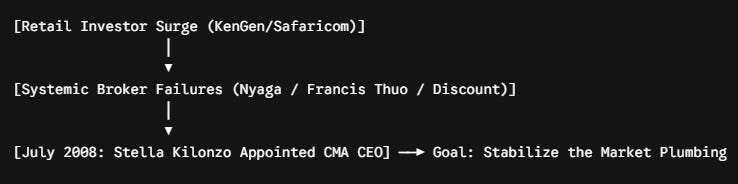
On July 15, 2008, Stella Kilonzo stepped into the office of the Chief Executive at the Capital Markets Authority (CMA) and walked directly into an institutional inferno. The Nairobi Stock Exchange (NSE) was caught in the throes of an unprecedented crisis of faith. For two years, the Safaricom and KenGen Initial Public Offerings (IPOs) had minted millions of first-time retail investors, drawing everyday Kenyans into the capital markets with promises of effortless wealth compounding.
Instead, they met a systemic collapse of the market’s underlying plumbing.
Legacy institutions like Nyaga Stockbrokers and Francis Thuo & Partners had collapsed, liquidating billions of shillings in retail savings through unauthorized sales of client shares and rampant internal fraud. Discount Securities was on life support, teetering on the edge of statutory management. The regulatory body Kilonzo inherited was widely viewed by the public as toothless, reactive, and hopelessly compromised by the very market intermediaries it was tasked to oversee.
Retail panic was absolute. Safaricom shares, which had listed amid national euphoria, were tanking below their IPO offer price, and local investors were scrambling to yank their capital out of the exchange entirely. Kilonzo did not have the luxury of a standard executive transition; her first day on the job was a trial by fire to save the systemic credibility of Kenya’s capital markets.
1.2 The Global Template
What the market operators did not realize was that Kilonzo was bringing a completely foreign, clinical, and uncompromising playbook to Nairobi. She arrived directly from Chicago, where she had spent years as a Senior Compliance Examiner at the Financial Industry Regulatory Authority (FINRA)—the largest independent regulator for all securities firms doing business in the United States.
At FINRA, Kilonzo had operated within an environment defined by algorithmic surveillance, strict segregation of client capital, and unyielding forensic account auditing. When she looked at the Nairobi Securities Exchange of 2008, she did not see a prestigious gentleman’s club; she saw a frontier exchange running on an obsolete, relationship-driven infrastructure where handshake agreements routinely overrode regulatory compliance.
Her mission was to forcefully transplant Western-style compliance methodologies into the Kenyan market. This meant replacing the standard, polite regulatory letters with unannounced forensic audits, instituting automated market surveillance, and forcing local brokerages to operate with the same transparency and risk-management protocols required of Wall Street firms.
1.3 The Thesis
Kilonzo’s entire regulatory philosophy was anchored on a singular, disruptive thesis that flew in the face of the exchange’s traditional leadership:
True market liquidity and institutional depth cannot exist without unyielding forensic oversight, absolute investor protection, and the systematic elimination of insider vulnerabilities.
For decades, the dominant school of thought among NSE insiders was that excessive regulation stifled market growth. Prominent market participants routinely argued that a frontier market needed a “soft touch” from regulators to encourage new listings and maintain high trading velocities.
Kilonzo completely rejected this premise. She countered that market volume built on a foundation of structural fraud is an optical illusion. For sustainable, long-term capital allocation to occur, the local retail saver buying a minimum boardlot must have the exact same level of systemic protection as a multi-billion-shilling institutional fund manager.
She asserted that market integrity was not a luxury to be deferred until the exchange matured; it was the foundational prerequisite for maturity. To attract serious global capital and protect domestic savings, the CMA had to transform from a passive licensing board into an aggressive, data-driven gatekeeper capable of breaking entrenched market cartels.
2.0 Purging the Pipes: Cracking Down on Broker Misconduct
2.1 The Retail Protection Mandate
When Stella Kilonzo took command, her immediate operational priority was to plug the massive capital leaks threatening to completely sink retail investor confidence. The spectacular collapses of Nyaga Stockbrokers and Discount Securities had exposed a fatal flaw in the market’s operational plumbing: stockbrokers were routinely treating client funds and shares as their own private liquidity pools. Intermediaries were illegally selling off retail investors’ shares without their consent and mixing client investment capital directly with the brokers’ daily operational accounts to fund lifestyle expenses or cover bad proprietary trading bets.
Kilonzo executed a swift, zero-tolerance regulatory intervention. She instituted a strict, legally mandated segregation of client funds. From that point forward, stockbrokers and investment banks were legally required to maintain entirely separate, ring-fenced bank accounts exclusively for client capital, completely insulated from the firm’s operational balance sheets.
To enforce this, the CMA clamped down on Discount Securities, placing it under statutory management to preserve remaining assets and protect what was left of retail wealth. By forcing this structural firewall into the back-office plumbing of market intermediaries, Kilonzo ensured that even if a brokerage house faced operational insolvency, the underlying retail boardlots remained legally protected and entirely untouchable.
2.2 Raising the Cost of Entry
For decades, running a stockbrokerage on the Nairobi Stock Exchange was a highly lucrative, low-overhead endeavor. Many legacy brokerages operated on razor-thin capital buffers, leaving them highly vulnerable to market volatility and tempted to dip into client funds during market downturns. Kilonzo recognized that to permanently clean up the ecosystem, she had to fundamentally raise the financial cost of operating in the capital markets.
She rolled out aggressive, non-negotiable capital adequacy frameworks that completely transformed the industry’s barrier to entry:
Stockbrokers: Required to dramatically increase their minimum liquid capital requirements to ensure a robust operational cushion against market shocks.
Investment Banks: Faced even steeper, multi-million-shilling capital thresholds to reflect their broader systemic risk profile.
This was a calculated, strategic squeeze. By making capital requirements strictly non-negotiable and tying licensing directly to a firm’s liquid capital ratios, Kilonzo effectively squeezed under-capitalized, high-risk, and poorly managed family-run operations out of the market ecosystem. The message to the street was unyielding: If you do not have the balance sheet to protect investor capital, you do not deserve a seat at the exchange. This regulatory filtering forced a wave of consolidation, paving the way for well-capitalized, institutionally backed investment banks to dominate the market plumbing.
2.3 The Introduction of Forensic Auditing
Before Kilonzo’s arrival, the Capital Markets Authority operated primarily as a passive, bureaucratic post-box. It relied heavily on self-reported, historical financial statements submitted by brokers at the end of the financial year. By the time the CMA noticed an irregularity, the broker had already collapsed, the money was gone, and the public was left holding the bag. Kilonzo completely dismantled this obsolete, post-event licensing model.
Drawing directly from her Western compliance template, she transformed the CMA into an active, data-driven supervisory body. She introduced forensic auditing and real-time market surveillance frameworks. Instead of waiting for annual reports, the CMA began executing unannounced, spot forensic audits on brokerage houses, sending teams of sharp, data-driven investigators directly into brokers’ offices to inspect back-office ledgers and audit trail logs.
Simultaneously, she championed the integration of automated surveillance systems that allowed the regulator to monitor trading patterns in real time, looking for immediate red flags like unusual trade volumes, unauthorized share movements, or suspicious price manipulation. This shifted the CMA from a coroner performing a post-mortem on collapsed firms into an aggressive, active gatekeeper capable of detecting corporate rot before it could trigger an institutional crisis.
3.0 Structural Remodeling: Demutualization and Automation
3.1 Breaking the Broker Cartel
Prior to Stella Kilonzo’s structural intervention, the Nairobi Stock Exchange operated essentially as a highly insulated private club. It was owned and controlled exclusively by its seat-holding stockbrokers. This legacy mutual structure created a severe, systemic conflict of interest: the very brokers who executed trades on the floor also owned the exchange, set its internal rules, and controlled access for new competitors. This closed loop effectively created a powerful broker cartel that resisted aggressive regulatory oversight and kept the market’s inner workings opaque.
Kilonzo set out to permanently dismantle this cartel by laying the critical legislative and structural groundwork for the demutualization of the exchange.
Her strategy was to legally separate trading rights from exchange ownership. By championing the necessary amendments to the Capital Markets Act, she initiated the process of converting the exchange from a broker-owned mutual company into a public, profit-driven corporate entity with a diversified shareholder base. This structural uncoupling stripped the legacy brokers of their monopolistic governance veto. It opened up the exchange’s board to independent directors, ensured that market infrastructure was run for the benefit of all investors rather than a handful of intermediaries, and paved the definitive path for the exchange itself to eventually list on its own main board.

3.2 The Infrastructure Evolution
When Kilonzo took office, a significant portion of the market’s back-office infrastructure was still bogged down by archaic, paper-based legacy systems. While the Central Depository and Settlement Corporation (CDSC) had introduced electronic accounts in 2004, a massive volume of older share certificates still sat in physical vaults across the country. These physical paper trails were a massive operational hazard—frequently stolen, forged, or used by unscrupulous brokers to execute the unauthorized share liquidations that sparked the 2008 retail panic.
Kilonzo drove a relentless campaign to finalize the immobilization and dematerialization of physical share certificates.
Under her supervision, the CMA forced listed entities and registrars to aggressively migrate remaining paper holdings into digital CDSC accounts. Simultaneously, she oversaw deep systemic upgrades to the CDSC platform to vastly improve transaction processing speeds and security protocols. By eliminating physical certificate vulnerabilities, she significantly reduced operational settlement risks. This electronic consolidation allowed the market to safely compress settlement cycles, moving the exchange closer to global delivery-versus-payment standards and giving long-term investors immediate, transparent confirmation of their boardlot ownership.
4.0 Managing the Boardroom: The Chairmen and the Power Dynamics
4.1 The Legacy Handover – Prof. Chege Waruingi
When Stella Kilonzo assumed executive leadership, the Capital Markets Authority board was presided over by its long-serving Chairman, Prof. Chege Waruingi. This initial era was defined by a traditional, academic, and highly deliberate corporate framework. Under this legacy setup, the regulator historically operated in a largely reactive posture—responding to market failures after the damage had already rippled through the exchange rather than preemptively shifting the goalposts on market operators.
Kilonzo realized early on that to successfully execute a radical, data-driven compliance overhaul, she had to establish absolute operational independence. Navigating the final stretch of the Waruingi regime, she systematically pushed the executive office out of its bureaucratic shell. By establishing rigid boundaries between daily executive enforcement and board oversight, she began steering the CMA away from polite institutional diplomacy and toward a culture of uncompromising statutory execution. This subtle but firm assertion of regulatory autonomy laid the groundwork for the aggressive structural interventions that were to follow.
4.2 The Strategic Alignment – Micah Cheserem (2009–2012)
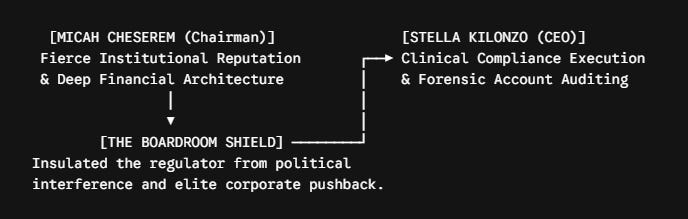
The true turning point in the CMA’s regulatory assertiveness arrived in early 2009 with the appointment of Micah Cheserem as Chairman. Cheserem was an institutional heavyweight—a fierce, no-nonsense former Governor of the Central Bank of Kenya (CBK) who possessed a legendary reputation for financial discipline and structural reform. The pairing of Kilonzo as Chief Executive and Cheserem as Chairman created a high-velocity, reform-minded dual engine at the apex of the regulator.
The Enforcement Shield
For an aggressive CEO, the biggest threat to enforcement is often political interference or pushback from well-connected corporate elites. Cheserem provided Kilonzo with an impenetrable boardroom shield. His deep understanding of macro-financial architecture and unyielding public stature meant that when Kilonzo moved to aggressively prosecute high-stakes insider trading or shut down fraudulent stockbrokerages, Cheserem absorbed the political heat. This powerful top-cover gave the executive team the rare, unfettered freedom to enforce statutory mandates without fear of elite capture or institutional paralysis.
The Shared Mandate
This unique alignment accelerated the capital markets reform agenda at an unprecedented pace. United by a shared mandate to protect the integrity of the market plumbing, the Kilonzo-Cheserem tandem systematically broke the traditional “Old Boys’ Club” grip on the exchange’s governing structures. Together, they aggressively pushed through the demutualization agenda, utilizing their combined institutional leverage to force seat-holding brokers to yield to public and independent capital governance frameworks.
4.3 The Conflict of Interest Battleground
Beyond managing the top-tier leadership transitions, Kilonzo’s daily boardroom battle was systemic. Historically, the CMA board was legally and structurally populated by active marketplace participants—including stockbrokers, investment bankers, and listed corporate executives. While this composition ensured the board possessed technical market expertise, it simultaneously turned the boardroom into a highly sensitive minefield of deep conflicts of interest. Regulated entities frequently sat on the very board tasked with disciplining them.
Kilonzo managed this battleground by drawing exceptionally hard operational lines. She institutionalized strict, non-negotiable conflict disclosure and recusal protocols during board deliberations. Whenever disciplinary actions, licensing adjustments, or forensic surveillance reports regarding specific market players were brought to the table, Kilonzo insisted on the absolute isolation of compromised board members from the decision-making loop. By firmly insulating regulatory policy from industry self-interest, she successfully transformed the CMA board from an extension of the exchange’s elite circles into an independent, fiercely objective organ of public trust.
5.0 The Corporate Governance Shockwave
5.1 The Code of Corporate Governance
Stella Kilonzo’s regulatory vision extended far beyond cleaning up the stockbrokerages; she recognized that the ultimate protection for a minority investor’s boardlot depended on the behavior of listed company executives inside corporate boardrooms. Before her tenure, corporate governance on the Nairobi Stock Exchange was largely treated as a series of polite, voluntary guidelines. Listed entities frequently populated their boards through insular networks, leaving audit committees weak and executive compensation completely hidden from public view.
Kilonzo initiated a profound corporate governance shockwave by introducing and aggressively enforcing strict compliance standards for listed equities. She championed a revamped framework that mandated:
Independent Board Composition: Requiring listed entities to appoint a significant proportion of independent, non-executive directors to break up cozy, insider-dominated boards.
Insulated Audit Committees: Demanding that audit committees be chaired by and composed of independent financial experts, completely free from the influence of managing directors.
Executive Compensation Disclosure: Forcing listed companies to publicly disclose exact director remuneration packages in their annual reports, introducing a level of fiscal transparency that shocked traditional corporate elites.
By transforming governance from a toothless checklist into a hard regulatory condition for listing, Kilonzo ensured that the leadership of public firms answered directly to their shareholders rather than their own self-interests.
5.2 Sidelining Insider Trading
In the old-school Nairobi market, access to non-public, price-sensitive information was long considered an unofficial perk of corporate leadership. Board members, major shareholders, and transactional advisors routinely used their proximity to upcoming earnings reports or major merger announcements to trade ahead of the general public, pocketing effortless capital gains at the expense of retail investors.
Kilonzo set out to permanently sideline this practice. Equipped with automated market surveillance tools, the CMA began monitoring anomalous price movements and trading spikes ahead of material corporate disclosures.
Her administration made history by aggressively investigating and prosecuting high-stakes insider trading cases—most notably launching forensic probes into the trading patterns of prominent corporate figures during major transactions like the Access Kenya share movements and the KenolKobil acquisitions. By hauling corporate elites before regulatory tribunals and imposing stiff financial penalties, Kilonzo sent a clear, chilling message to the entire market: proximity to private corporate data was no longer an insulated shield for illicit wealth. This aggressive enforcement posture leveled the playing field, assuring long-term savers that the market’s pricing mechanisms were no longer systematically rigged against them.
6.0 The Voluntary Exit and Pan-African Horizon
6.1 The Rarity of the Four-Year Exit
In the landscape of Kenyan state agencies and regulatory bodies, executive power is a highly coveted commodity. Chief executives routinely wage intense boardroom and political campaigns to secure a second term, often compromising their regulatory independence to appease the political and corporate masters who hold the keys to their contract renewals.
Stella Kilonzo completely broke this mold. In June 2012, at the exact conclusion of her initial four-year term, she announced her voluntary decision to step down as CEO of the Capital Markets Authority.

This exit was an absolute rarity in local corporate history. Kilonzo was departing at the absolute peak of her institutional power, having earned immense backing from institutional fund managers, international development partners, and her own reformist Chairman, Micah Cheserem. By refusing to seek a second term, she preserved her absolute professional integrity. She demonstrated a profound, clinical understanding of institutional leadership: her mandate was to build an unyielding structural foundation, secure the plumbing of the exchange, and exit before the messy compromises of long-term bureaucratic survival could dilute her legacy.
6.2 Scaling to the AfDB
Kilonzo did not exit the CMA to slide into a quiet retirement; instead, she immediately scaled her structural execution capabilities to a continental platform. Her track record of successfully reforming a frontier financial market caught the attention of multilateral institutions, landing her a senior appointment at the African Development Bank (AfDB) as the Division Manager for Financial Sector Development.
At the AfDB, Kilonzo took her Nairobi blueprint and applied it to multiple emerging capital markets across the continent. Her portfolio shifted from local enforcement to high-level, macro-financial engineering:
Sovereign Credit Guarantees: Designing innovative local-currency bond frameworks and credit guarantees to help African governments and infrastructure projects crowd in long-term domestic institutional capital.
The African Exchanges Linkage Project (AELP): Championing and structuring the framework to electronically connect Africa’s leading securities exchanges—including the NSE, the Johannesburg Stock Exchange (JSE), and the Casablanca Stock Exchange—enabling seamless, cross-border capital flows across the continent.
By transitioning from a localized marketplace referee into a continental financial architect, Stella Kilonzo proved that robust, transparent market plumbing was not just a Kenyan necessity, but the ultimate prerequisite for unlocking sustainable wealth compounding across the entire African continent.
7.0 Conclusion: The Gatekeeper’s Blueprint
7.1 The Legacy of Trust
The ultimate measure of a regulator’s success is not found in the headlines generated during their tenure, but in the quiet confidence of the marketplace long after they have departed. For the modern value investor on the Nairobi Securities Exchange, the ability to comfortably maintain a long-term, buy-and-hold philosophy is a direct dividend of the structural guardrails anchored by Stella Kilonzo.
Before her arrival, the systemic risk of intermediary default or unauthorized share liquidations hung like a shadow over every portfolio. By forcefully separating client capital, raising capital adequacy baselines, and shifting the exchange away from paper vulnerabilities, she injected a foundational layer of trust into the market’s plumbing. When a retail or institutional investor buys a boardlot today, they can focus entirely on the underlying business fundamentals, dividend yields, and corporate earnings power, safe in the knowledge that their custody architecture is secure, transparent, and legally insulated from the operational failures of intermediaries.
7.2 The Uncompromising Standard
Stella Kilonzo stands as the definitive institutional pioneer who shattered the myth that frontier markets require a “soft touch” to survive. Her tenure proved that a well-regulated capital market is not an impediment to capital accumulation, but its absolute prerequisite. By refusing to compromise with entrenched broker cartels or corporate insiders, she established a new psychological baseline for the Kenyan financial ecosystem: compliance is non-negotiable.
She demonstrated that market depth and sustainable wealth compounding cannot exist on a foundation of opaque, relationship-driven governance. Her clinical, data-driven framework elevated the CMA into an active gatekeeper of public trust. It provided a powerful, permanent blueprint showing that a clean, highly transparent exchange is the only vehicle capable of consistently attracting global institutional capital and protecting domestic savings over generations.
8.0 Chronology of the Regulatory Overhaul (2008–2012)
8.1 Phase I: Intervention and Containment (July 2008 – December 2008)
July 2008: Stella Kilonzo officially takes office as CMA Chief Executive amidst a severe crisis of investor confidence triggered by high-profile stockbrokerage collapses.
August–October 2008: The CMA executes immediate intervention strategies, placing Discount Securities under statutory management to freeze remaining retail assets and stem systemic contagion.
November 2008: Introduction of emergency back-office directives mandating the immediate, strict segregation of client investment funds from the daily operational bank accounts of all market intermediaries.
8.2 Phase II: Capital Requirements and Institutional Purge (2009–2010)
Early 2009: Strategic boardroom alignment is achieved with the appointment of former Central Bank Governor Micah Cheserem as CMA Chairman, establishing an aggressive enforcement dual-engine.
Late 2009: The CMA rolls out and enforces a steep, non-negotiable upward revision of minimum liquid capital adequacy requirements for all licensed stockbrokers and investment banks.
December 2009: Historic launch of the Automated Trading System (ATS) for bonds, migrating corporate and sovereign fixed-income instruments onto transparent electronic screens.
Mid-2010: Under-capitalized and non-compliant legacy brokerage houses are systematically denied license renewals, forcing a wave of healthy institutional consolidation across the street.
8.3 Phase III: Systemic Infrastructure Upgrades and Demutualization Law (2011)
January–April 2011: Relentless enforcement of the absolute immobilization and dematerialization of historical paper share certificates into secure electronic CDSC registry accounts.
July 2011: The passing of critical legislative amendments to the Capital Markets Act, laying the non-negotiable legal groundwork to split trading rights from exchange ownership.
Late 2011: Modernization of real-time automated market surveillance tools at the CMA, transitioning the regulator into active, data-driven forensic auditing and spot checks.
8.4 Phase IV: The Governance Code Enforcement and Transition (Early 2012 – June 2012)
Early 2012: Enforcement of the modernized Code of Corporate Governance, requiring mandatory independent board seats, independent audit chairs, and public executive pay disclosures for listed entities.
First Quarter 2012: Active prosecution and heavy financial penalties levied against corporate insiders for anomalous trading patterns, effectively sidelining insider trading.
June 2012: At the exact conclusion of her highly successful four-year term, Stella Kilonzo makes the rare decision to voluntarily step down as CEO, preserved in absolute professional integrity before transitioning her blueprint to the African Development Bank.