
Welcome to Boardlot Africa, where we pull back the curtain to reveal the untold stories, power dynamics, and strategic maneuvers shaping the boardrooms of Corporate Africa—subscribe for free to join the conversation. join 1000 other subscribers
We publish:
Sultans weekly NSE Stock Picks, every Friday at 5pm
Kenya’s Most Consequential Legal, Governance & Labor Disputes
A Series on the 100 Most Influential Kenyan Captains of Industry
The Queens of East Africa Boardrooms
The Silicon Savana Chronicles, every Wednesday at 5.00pm
Sultan’s Farming Diary, every Monday at 5.00pm
As Kenya’s financial regulatory landscape enters a phase of forced maturation, investors must navigate a “brittle yet reforming” ecosystem where systemic governance gaps, redundant regulatory friction costs, and performative enforcement are rapidly rewriting the rules of capital preservation and growth.
Table of Contents: The State of the Watchdog
I. Executive Summary: The State of the Watchdog – Brittle yet Reforming
II. The Kenyan Regulatory Perimeter: Mapping the Unified Oversight Ecosystem
III. The Resilience Matrix: Mandate Clarity vs. Market Reality
IV. The BoardLot Regulatory Scorecard: Institutional Integrity & Performance
V. The Friction Cost: Regulatory Overlap & The Burden on Capital
VI. The Investor’s Roadmap to 2027: Tactical Strategies for a High-Friction Landscape
I. Executive Summary: The State of the Watchdog
The BoardLot Diagnosis: A System Brittle yet Reforming
As we navigate the second half of 2026, Kenya’s financial regulatory landscape has reached a critical inflection point. The era of “permissive innovation”—which allowed Kenya to leapfrog global banking benchmarks via mobile-first ecosystems—has yielded to a more disciplined, albeit strained, oversight regime. At BoardLot Africa Research, our diagnostic appraisal characterizes the current framework as “brittle yet reforming.”
The system is currently oscillating between two extremes: the aggressive, reactive enforcement of new fiscal mandates and the lingering instability of unresolved legacy insolvencies. This friction suggests a market in the throes of a painful maturation process.
The Rear-View Mirror: Cycles of Systemic Stress To understand the current regulatory volatility, one must acknowledge the “scar tissue” of the past two decades. Kenya’s market history is a recurring cycle of rapid capital mobilization followed by systemic shocks. From the collapse of major stockbrokers in the 2000s, collapse of major banks—which fundamentally eroded retail investor trust—to the periodic tremors in the banking and SACCO sectors, these events were not merely isolated anomalies. They were structural failures of transparency, oversight, and timely enforcement. The market has learned that when regulators act only after the “music stops,” the cost—measured in evaporated life savings and stagnant capital—is borne by the public.
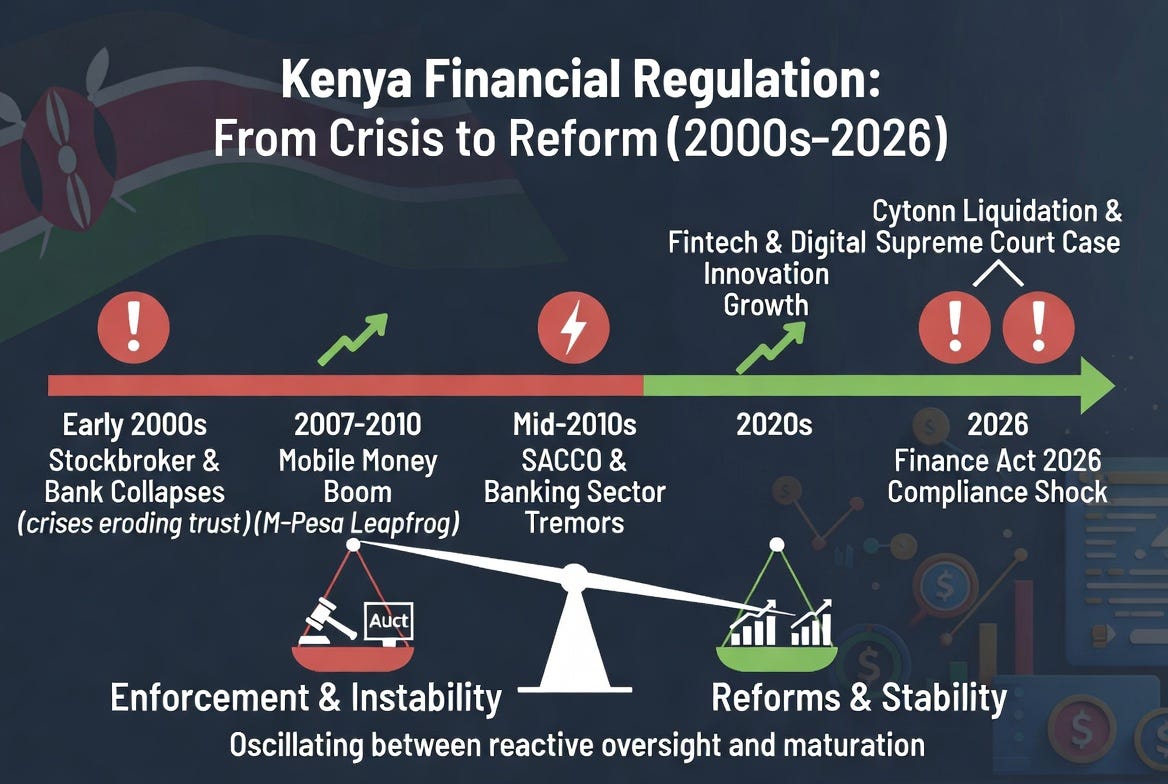
Current Flashpoints: The Mid-2026 Stress Tests The resilience of the current regulatory architecture is being stress-tested by three defining events that have dominated the first half of 2026:
The Cytonn Liquidation & The Cytonn Supreme Court Gambit: The July 2026 Supreme Court intervention in the Cytonn liquidation saga has created a significant legal crossroads. By restraining the Official Receiver from enforcing vesting orders over key real estate assets, the court has forced a collision between constitutional property rights and the practical necessity of insolvency resolution. This case is no longer just about one entity; it is a landmark test of whether the state’s insolvency machinery can effectively navigate the complexities of modern, asset-heavy investment structures.
The Erosion of “Public Interest” Exemptions: The judicial trajectory regarding tax waivers—most notably the invalidation of the CBA-NIC merger stamp duty exemption—signals a paradigm shift. The courts are actively redefining the “public interest” test, signaling that regulatory concessions can no longer serve as a “beautiful veil” for private interests. This judicial assertiveness is creating a new, higher standard for regulatory transparency and accountability.
The Finance Act 2026 Compliance Shock: The implementation of the Finance Act 2026 has triggered a sector-wide “survival-audit” mindset. By broadening the tax net across digital payment networks and payment processing fees, the state has fundamentally altered the economics of financial innovation. Institutions are currently struggling to bridge the gap between aggressive regulatory revenue mandates and the need to preserve the low-cost digital infrastructure that remains the bedrock of Kenyan financial inclusion.
In summary, the Kenyan financial regulator is no longer a passive observer; it is an active, and often disruptive, participant in the market’s re-engineering. For market participants, the margin for error has vanished. For the regulators, the challenge of the coming months will be to prove that this new, tighter architecture fosters genuine institutional maturity rather than mere administrative fragmentation.

II. The Kenyan Regulatory Perimeter: Mapping the Watchdogs
To evaluate the structural integrity of Kenya’s financial system, one must first identify the primary actors responsible for its stability. At BoardLot Africa Research, we monitor these entities not as isolated silos, but as a unified oversight ecosystem.
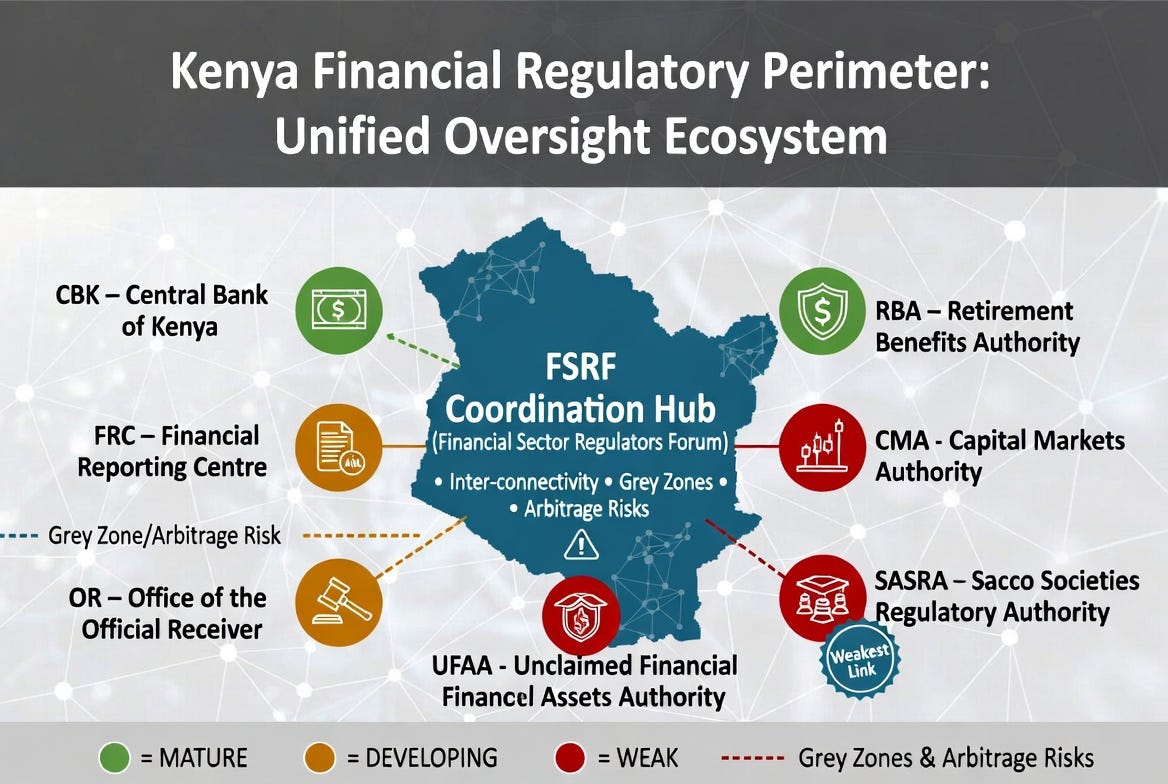
The effectiveness of our market relies on how these institutions coordinate their mandates to bridge the “grey zones”—those structural gaps where complex holding structures, shadow banking, and innovative fintech products often operate outside traditional oversight.
Central Bank of Kenya (CBK)Monetary Policy & Banking Supervision: Systemic liquidity, settlement stability, and credit risk.
Capital Markets Authority (CMA)Securities & Investment Regulation: Market conduct, disclosure transparency, and investor protection.
Insurance Regulatory Authority (IRA)Insurance & Reinsurance Supervision: Solvency standards, premium safety, and claims integrity.
Retirement Benefits Authority (RBA)Pension & Retirement Fund Oversight: Long-term asset safety and fiduciary compliance.
Sacco Societies Regulatory Authority (SASRA)Deposit-taking SACCO Supervision: Member deposit protection and capital adequacy.
Competition Authority of Kenya (CAK)Market Competition: Abuse of dominance, predatory pricing, and merger control.
Financial Reporting Centre (FRC)Financial Intelligence (FIU)Anti-Money Laundering (AML) & Countering Terrorism Financing (CFT).
Office of the Official Receiver (OR)Insolvency & Liquidation: Distressed asset management and corporate exit processes.
Unclaimed Financial Assets Authority (UFAA)Asset Safeguarding & Reunification: Safekeeping of dormant/abandoned assets and trust management.
The BoardLot Insight: The Inter-Connectivity Mandate
While these institutions operate with distinct legal mandates, their functional success is predicated on the Financial Sector Regulators Forum (FSRF). In our diagnostic assessment, the “regulatory gap” that historically allowed for systemic failures often hides in the shadows between these mandates.
When a conglomerate spans banking, real estate, and asset management—as we have seen in recent high-profile liquidations—the risk of regulatory arbitrage rises exponentially. Institutions can exploit minor inconsistencies in rules across sectors to shield risky assets from scrutiny. Therefore, we do not view these regulators as separate entities; we view them as a singular supervisory architecture. Their inability to share real-time intelligence and coordinate enforcement is not just an administrative inconvenience—it is a material risk to every participant in the Kenyan market.
III. The BoardLot Regulatory Resilience Matrix: Mandate vs. Reality
In this diagnostic section, we stress-test the current regulatory framework against the high-velocity realities of mid-2026. The core tension we observe at BoardLot Africa Research is the “Mandate-Reality Gap”: a situation where traditional statutory mandates are being outpaced by the structural evolution of the market.
The Resilience Matrix
We categorize the current performance of our oversight ecosystem across three dimensions: Clarity, Enforcement Power, and Adaptability.
Mandate Clarity: High (Formal) / Low (Functional)
Overlap between the Finance Act 2026 tax-recovery mandates and traditional sectoral oversight (CBK/CMA) creates confusion on whether the primary goal is financial stability or revenue generation
Enforcement Power: Escalating (Aggressive) The Kenya Revenue Authority (KRA) now operates with “expanded enforcement powers” that can effectively freeze non-tax levies, forcing institutions into a perpetual “survival-audit” posture.
Adaptability Strained: The shift from “permissive innovation” to “structured oversight” is lagging, particularly in regulating digital assets and cross-border payment platforms.
The “Structural Friction” Analysis
The BoardLot diagnostic identifies three areas where the regulatory perimeter is failing to contain the market reality:
1. The Revenue-Stability Paradox
The Finance Act 2026 has effectively deputized revenue collection as a component of financial regulation. When an institution’s primary regulator (e.g., CBK) pushes for stability, while the tax authority (KRA) pushes for liquidity extraction through aggressive levy recovery, the institution is caught in a dual-mandate trap. This reduces the functional clarity of the mandate: are we building a resilient sector, or are we maximizing the extraction of fees?
2. The “Grey Zone” of Digital Liquidity
As noted in the 2026 Virtual Asset Service Providers (VASP) legislative rollout, the legal framework is catching up to the technology. However, there remains a disconnect between Financial Reporting Centre (FRC) intelligence and real-time market activity. “Deep fakes” and AI-driven fraud are now systemic threats that current ex-post (reactive) reporting models are ill-equipped to handle. The reality is that the “perimeter” is porous; capital can exit the regulated system via digital assets far faster than the FRC can flag the underlying transaction.
3. The Liquidation Bottleneck
The interaction between the Office of the Official Receiver (OR) and the Unclaimed Financial Assets Authority (UFAA) remains one of the most significant “blind spots.” In the event of a firm’s collapse, the process of separating client assets from corporate liabilities is often delayed by archaic court processes. When the Official Receiver is forced to manage complex, asset-heavy estates (like the Cytonn case), the transition of these assets into the UFAA for eventual reunification with the public is glacial, essentially locking up billions in capital during a period of acute market need.

Strategic Outlook
The current regulatory environment is characterized by “Regulatory Overreach as a Substitute for Institutional Maturity.” By focusing heavily on tax compliance and revenue extraction, the state is arguably neglecting the deeper work of market integrity—transparency, corporate governance, and executive accountability.
Moving forward:
The question is not whether the regulators have enough laws; it is whether they have the intelligence-led enforcement to use them.
IV. The BoardLot Regulatory Scorecard: Institutional Integrity & Performance
In this diagnostic phase, we evaluate the key pillars of the Kenyan financial regulatory landscape. This scorecard reflects the “on-the-ground” reality of institutional efficacy, shifting focus from stated statutory goals to tangible outcomes.
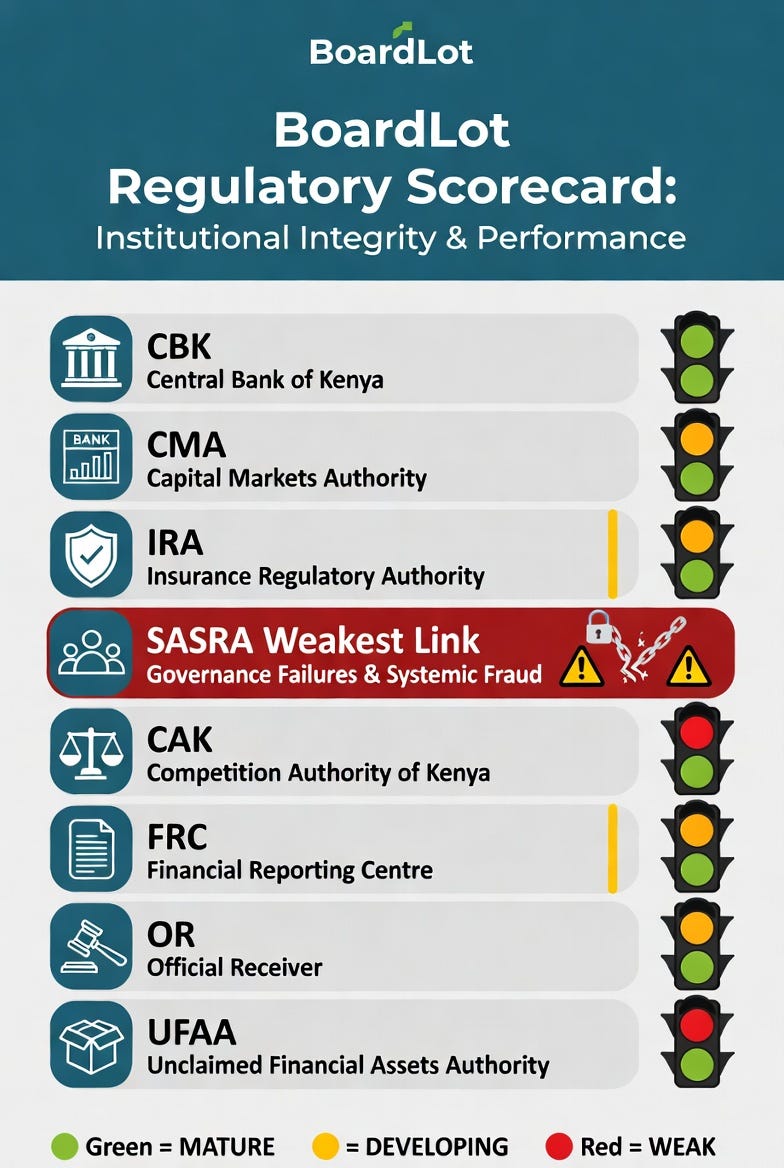
Central Bank of Kenya (CBK) MATURE
From the days of Micah Chesrem’s Goldenberg cleanup, CBK Successfully defended institutional independence and anchored the authority of CBK Governors in law. It has strengthened its mandate and risk-sensing capabilities, complemented by robust research and technical publications. Capital adequacy rules ushed by Governor
Capital Markets Authority (CMA) WEAK
Struggles with market supervision, particularly regarding special funds. Its publications and market intelligence lack depth; it remains largely disconnected from the retail investor pulse and lags in regulating emerging financial products. We have written about successful CMA CEOS such as Paul Muthaura & Stella Kilonzo, and now we have CMA Leadership that cannot be referred as successful or innovative.
Insurance Regulatory Authority (IRA) WEAK
Consistently reactive rather than proactive. The collapse of major insurance companies caught the regulator by surprise, and the protracted, unresolved litigation surrounding major industry players underscores a lack of decisive intervention.
Retirement Benefits Authority (RBA) MATURE
A high-performing regulator characterized by consistent, high-quality research. The sector shows stability, with NSSF funds now managed under significantly safer frameworks than in historical cycles. The seamless transition of founder CEO Edward Odundo is reassuring.
Sacco Societies Regulatory Authority (SASRA) WEAK
The “weakest link.” The sector is plagued by systemic issues, including the Mwalimu/Spire Bank fraud debacle and the chronic instability of major institutions, where leadership battles and governance failures have become the norm.
Competition Authority of Kenya (CAK) WEAK
A functional oxymoron. Its mandate overlaps with nearly all other regulators, leading to inefficient bureaucracy. Its recent aggressive, performative interventions into retail and manufacturing suggest a “charlatan” approach rather than sophisticated market policing.
Financial Reporting Centre (FRC) DEVELOPING
Currently lacks the visibility and public impact expected of its critical AML/CFT mandate. Its operational output remains opaque, with little demonstrable influence on market integrity for the average participant.
Unclaimed Financial Assets Authority (UFAA) DEVELOPING
While managing a massive, growing pool of public assets, the authority has institutionalized a process so procedural and complex that it has become effectively impossible for the average claimant to recover their assets.
The BoardLot Diagnostic Conclusion
The disparity in these ratings reveals a dangerous fragmentation of standards. While the CBK and RBA provide islands of stability and intellectual rigor, the peripheral regulators are struggling with institutional competence and “mandate creep.” This imbalance creates the very “grey zones” where systemic risk thrives.
SASRA: The Weakest Link
The cooperative sector, intended to be a pillar of grassroots financial inclusion, has increasingly become a theater for systemic governance failure. At BoardLot Africa Research, our diagnostic assessment identifies SASRA as the “weakest link” in the regulatory chain, struggling to contain an epidemic of fraud that transcends individual institutions. The following cases serve as the “stress fractures” in this oversight framework:
Mwalimu National Sacco & The Spire Bank Misadventure: A decade-long saga that saw the Sacco sink billions into the struggling Equatorial Commercial Bank (later rebranded Spire Bank). The 2026 audit confirming a Sh960 million write-off—following years of capital erosion—highlights a catastrophic failure in due diligence and a reckless gamble with member savings that effectively hollowed out the institution’s balance sheet. This is notwithstanding Coop Bank CEO Gideon Muriukis efforts to organize the sector
The Metropolitan National Sacco KSh14.4 Billion Scandal: As of May 2026, 19 current and former officials are facing charges over a staggering KSh14.4 billion fraud scheme. The plot involved years of manipulating financial records to create “fictitious loans,” alongside a secondary “investment” vehicle used to divert over KSh750 million into land schemes in Kitengela. This represents the ultimate failure of internal controls and regulatory detection.
KUSCCO Forensic Crisis: A 2025 PwC forensic audit exposed a “phantom” financial world at the apex organization, KUSCCO. With KSh12.5 billion in misappropriated funds, the fraud included the “cooking of books,” overstated assets, and the payment of dividends from member savings rather than genuine profit. The crisis reached a surreal low when it was discovered that financial statements were finalized using the signature of a deceased official.
Njiwa Sacco (NIS Staff): In September 2023, nine employees—including senior internal auditors, loan managers, and system analysts—were arrested for siphoning KSh160 million. This case exemplifies the “insider threat,” where those entrusted with the Sacco’s digital and forensic security used their positions to orchestrate systemic theft, suggesting that even the most “secure” Saccos are vulnerable to internal rot.
Safaricom Sacco System Manipulation: In June 2026, ICT officials were apprehended for siphoning over KSh22.4 million through back-end system manipulation. By creating conduits through third-party accounts, these officials bypassed standard security protocols, further eroding member trust in the digital architecture of their savings vehicles.
The “Charlatan” Critique: Analyzing the CAK’s Operative Model
At BoardLot Africa Research, our classification of the Competition Authority of Kenya (CAK) as WEAK is not merely a critique of its efficacy, but a diagnostic observation of its methodology. A sophisticated regulatory body operates through data-driven oversight and long-term market intelligence; conversely, the CAK’s current pattern of intervention exhibits the hallmarks of a “charlatan” regulatory approach, characterized by the following:

Publicity-Seeking over Systemic Oversight: The Authority’s strategy appears heavily weighted toward performative, high-visibility actions designed for the news cycle rather than sustained market monitoring. By prioritizing “dawn raids” on specific sectors—such as the recent simultaneous searches of six mattress manufacturers—the Authority generates headlines that suggest decisive action while leaving the actual regulatory environment opaque and unpredictable.
Reliance on Anecdotal Whistle-blowing: The Authority frequently relies on unverified public reports and opportunistic whistle-blowing to launch investigations, rather than initiating them through deep, proactive forensic surveillance of market structures. Relying on the public to “report the matter” is a confession of a lack of sophisticated internal market-tracking infrastructure.
The “Raids-as-Regulation” Fallacy: The CAK consistently utilizes unannounced entry and search operations—commonly called “dawn raids”—to secure evidence that is ostensibly at risk of destruction. This reactive, “raid-first” approach treats business premises like crime scenes before any systemic breach of competition law has been properly established.
Inconsistent, Reactive Policing: The Authority’s history shows a preference for targeting low-hanging fruit in the retail space—such as the 2020 order for a supermarket to refund sanitizer prices—rather than addressing the structural dominance of large-scale cartels that actually move the needle on Kenyan consumer costs. These interventions often appear to be “knee-jerk” responses to public pressure rather than part of a coherent, long-term antitrust strategy.
BoardLot Insight: A regulator that needs the public to provide the intelligence to do its job is not a regulator; it is an enforcement platform for whistleblowers. True market integrity requires a body that understands industry supply chains and pricing mechanics so intimately that it does not need to resort to “raid-and-seize” tactics to confirm what it should have already discovered through forensic analysis.
The BoardLot Diagnostic: These are not isolated incidents of “bad apples”; they are symptoms of a structural governance deficit. Whether it is the failure to oversee high-risk bank acquisitions or the inability to detect long-term digital system manipulation, the recurring theme is an oversight regime that remains two steps behind the perpetrators. For the average investor, this indicates that the Sacco sector—despite its size—requires a level of personal due diligence that exceeds what one would expect from a properly regulated financial institution.
19 senior Metropolitan Sacco officials charged with fraud
This video report provides direct insight into the judicial proceedings and the scale of the KSh14.4 billion fraud scheme involving Metropolitan Sacco, illustrating the extreme governance failures currently plaguing the sector.
V. The Friction Cost: Regulatory Overlap & The Burden on Capital
A defining characteristic of the Kenyan financial system in 2026 is the “Regulatory Tollbooth Effect.” For institutions attempting to navigate growth—particularly through mergers, acquisitions, or product innovation—the landscape is less of a cohesive roadmap and more of a series of redundant, fee-generating checkpoints.
1. The Multi-Mandate Paradox & The “Three-Way” Squeeze
We observe an increasing and costly overlap between regulators that serves to inflate transaction costs without enhancing market integrity. The most acute friction occurs at the intersection of insurance, pensions, and capital markets:
Insurance vs. Pensions (IRA & RBA): While the Insurance Regulatory Authority (IRA) licenses life insurance companies, many of these entities also manage pension business. This creates a dual-regulatory environment where insurers must satisfy both the Insurance Act (under IRA) and the Retirement Benefits Act (under RBA). An insurer managing an occupational pension scheme is essentially reporting the same financial health to two different masters, often with conflicting compliance requirements for capital adequacy and asset segregation.
Collective Investment Schemes (CMA vs. Others): The Capital Markets Authority (CMA) licenses Collective Investment Schemes (CIS). However, when these schemes (such as Money Market Funds) are marketed as retirement or insurance-linked products, they trigger oversight from the RBA or IRA. This “regulatory layering” means that a single financial product—like an umbrella pension scheme—can be subjected to the overlapping scrutiny of the CMA (for the underlying securities), the RBA (for the scheme structure), and potentially the IRA (if the product is underwritten by an insurer).
2. The Hidden Tax: Compliance as a Barrier to Entry
Beyond the direct fees, the indirect compliance burden is a silent killer of innovation. The current regulatory environment imposes a heavy “reporting tax” that filters down to the end investor:
Data Redundancy: Firms are frequently required to submit near-identical data sets to the CBK, FRC, and CMA in non-interoperable formats. This forces firms to maintain expansive, high-cost compliance departments whose primary function is redundant data entry rather than genuine risk management.
The “Survival-Audit” Posture: As seen with the recent Finance Act 2026 compliance requirements, the shift toward aggressive revenue-collection mandates has forced firms to prioritize “tax-readiness” over “product-development.” The cost of maintaining specialized teams to navigate these overlapping fiscal and regulatory mandates is eventually passed directly to the consumer in the form of higher transaction fees and wider interest rate spreads.
3. The “Institutional Tollbooth” Assessment
The following table illustrates how this fragmentation forces redundant costs onto the market:
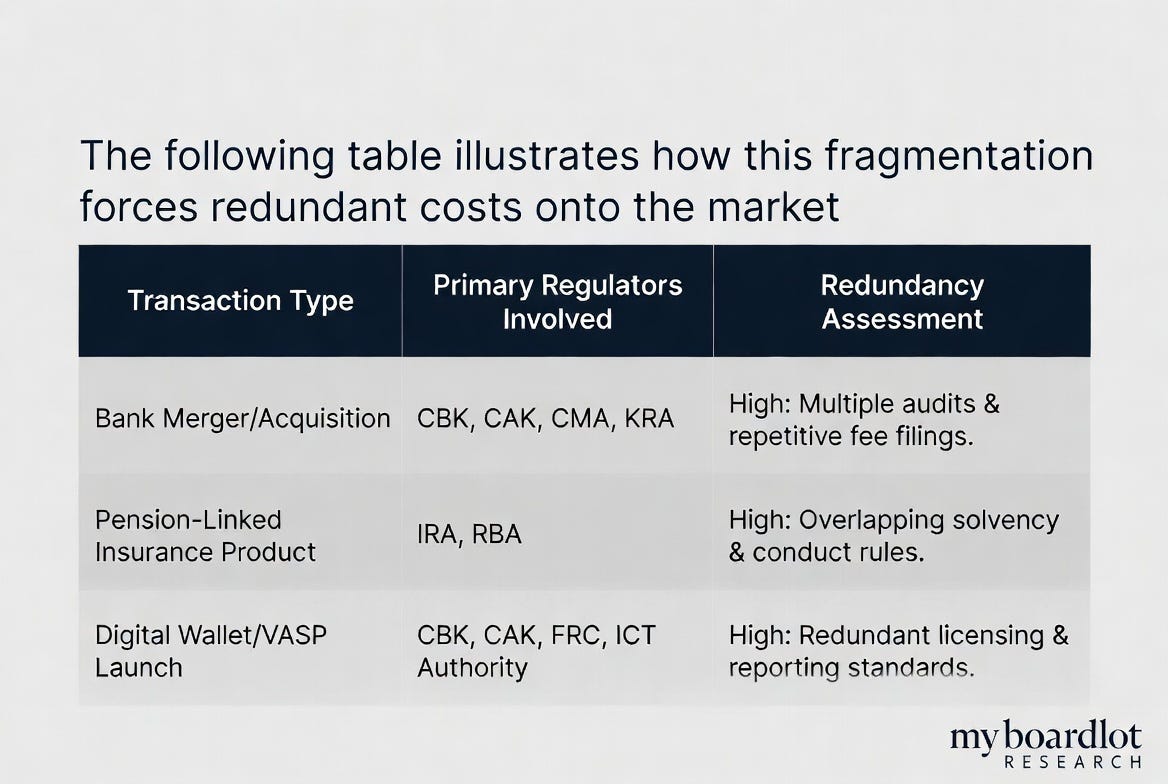
BoardLot Insight: The “Regulatory Tollbooth” is a Systemic Leak
When a regulator—such as the CAK—intervenes in a merger already scrutinized by the sector-specific supervisor (CBK or CMA), it adds time and legal costs that act as a barrier to entry. We are essentially taxing market efficiency.
In our view, this “tollbooth” approach encourages larger, legacy players to absorb these costs while pricing out smaller, more agile competitors—ironically leading to the very market concentration that the Competition Authority claims to be fighting. Until the Financial Sector Regulators Forum (FSRF) mandates a “single-window” filing system where one submission satisfies the data requirements of all relevant bodies, the cost of compliance will remain a significant, avoidable drag on the Kenyan economy.
VI. The Investor’s Roadmap to 2027: Navigating the Brittle Perimeter
As we move toward 2027, the Kenyan financial landscape demands a departure from passive investment strategies. For the sophisticated investor, the “brittle yet reforming” environment we have mapped—characterized by aggressive fiscal extraction, fragmented regulatory oversight, and judicial volatility—is not a deterrent, but a filter.
At BoardLot Africa Research, we believe the following strategies are essential for maintaining capital integrity in this high-friction ecosystem.
1. The “Regulatory Arbitrage” Hedge
The current fragmentation between the CBK, CMA, IRA, and RBA creates significant inefficiencies, but also opportunities.
Concentrate on “Island of Stability” Assets: Align your portfolio with sectors supervised by the more MATURE regulators (e.g., Tier-1 banking entities under CBK supervision and Tier-1 pension funds under RBA oversight). These institutions have better institutional defensive moats against the current wave of “survival-audit” fiscal pressures.
Avoid “Over-Regulated Grey Zones”: Be highly cautious of firms heavily exposed to the SASRA-supervised cooperative sector or those reliant on the CAK’s performative oversight. The systemic governance failures in these sectors are not cyclical; they are structural, and recovery timelines remain unpredictable.
2. Liquidity & Exit-Planning as a Primary Metric
In a market where the Official Receiver and UFAA are increasingly active in processing corporate exits, liquidity is your only true risk-management tool.
The “Exit-Ready” Audit: Before entering a medium-to-long-term investment, analyze the entity’s liquidation pathway. If the firm’s asset structure is convoluted—involving complex inter-company lending, real estate holdings in volatile counties, or unproven digital asset conduits—consider the cost of capital effectively “locked.”
Monitor the UFAA Gap: Avoid assets that might drift into the “unclaimed” category. The procedural difficulty of recovering assets from the UFAA makes it a “black hole” for capital.
3. The “Institutional Tollbooth” Discount
Factor the “Regulatory Friction Cost” into your valuation models.
Account for the “Toll”: If a company you are monitoring is planning a merger or a significant corporate restructuring, apply a “regulatory haircut” to your projected returns. The redundancy of fees across CBK, CMA, and CAK—combined with potential litigation delays—can easily erode 15–20% of your projected IRR in a restructuring scenario.
Prioritize “Clean-Slate” Competitors: Look for agile, smaller-cap firms that are avoiding the high-cost “tollbooth” of multi-regulatory compliance by staying within lean, singular-mandate business models.
4. The BoardLot Strategic Outlook
The next 18 months will be defined by enforced institutional maturation. We expect:
Increased Judicial Intervention: As seen in the Cytonn and CBA-NIC rulings, the judiciary will continue to be the primary check against regulatory and executive overreach. Watch high-court dockets as closely as you watch quarterly earnings.
Consolidation of the “Weak”: The ongoing failures in the SACCO and insurance sectors will eventually force a state-led consolidation. Expect larger, more stable entities to absorb these “failed” assets at distressed prices—this will be the primary source of alpha for capital-rich investors in 2027.
Final Investor Summary: The Kenyan market is not currently rewarding the “innovators” who thrive in regulatory grey zones; it is rewarding the “operators” who can navigate the clear, stable channels provided by the more MATURE institutions.
About Boardlot Africa Research
Boardlot Africa is a premier financial intelligence and corporate governance publication dedicated to unpacking the mechanics of capital, market strategies, and structural shifts across East Africa’s corporate landscape. By bridging the gap between raw economic data and actionable market intelligence, we deliver deep-dive research, independent corporate analysis, and policy insights designed for institutional investors, boardrooms, and sharp market observers.
Get in Touch
Email: boardlot.research@gmail.com
Phone: +254 753 133 901
Substack: Subscribe to Boardlot Africa
X (Twitter): BoardLotSultan