
In This Article
Introduction: The Anatomy of a Collapse
Moving beyond abstract regulatory metrics to name the boardroom failures and patronage that reshaped Kenya’s financial rules.
Era-by-Era Analysis: Crisis and the Regulatory “Cure”
1. The 1980s: Unregulated Expansion and the Rise of Indigenous NBFIs
2. The 1990s: Political Patronage, Insider Lending, and the Goldenberg Shock
3. The 2015–2016 Shocks: Operational Fraud, Corporate Governance, and the Shift to Risk-Based Supervision
The Registry of Failures: Timeline of Statutory Management (1984–2016)
A definitive breakdown of over 30 collapsed institutions, identifying the founders, managing directors, and core vulnerabilities.
The Gubernatorial Eras: Leadership Under Fire
Profiles in supervision: From the political turbulence of the Kotut and Nyagah eras to the institutional cleanups of Cheserem and Njoroge.
The Legal Architecture: Key Instruments of the Financial Fortress
From Cap 491 to the Draft VASP Regulations (2026): Mapping the statutory mechanisms that anchored each era’s stabilization.
The Modern Squeeze: How Compliance Accelerates the Demise of Mid-Tier Deposits
The looming liquidation: Analyzing the Ksh. 19.8 Billion Tier III capital gap and the structural “flight to quality” through 2029.
Data & Structural Shifts (2017–2024): The “Winner-Takes-Most” Model
Market Share Dynamics: The rise of Tier 1 “Fortress” balance sheets and the competitive squeeze on Tier 2.
Primary legislative archives, supervisory frameworks, and historical records.History is often sanitized, but the collapse of a financial institution is never an abstract event—it is the result of specific decisions made by specific people. In this article, I am not just chronicling the regulatory changes that emerged from Kenya’s banking crises; I am identifying the leaders who presided over them. This is the story of the boardroom failures, the patronage, and the systemic risks that forced the Central Bank to fundamentally rewrite our financial rules.
The story of bank failures in Kenya is a narrative of transition: from the fragile, post-colonial “boom-and-bust” cycles of the 1980s to the tech-driven, risk-sensitive era of the 2020s. Over the last four decades, the collapse of over 30 financial institutions has served as the painful “stress test” that forced the Central Bank of Kenya (CBK) to build the robust regulatory framework it maintains today.Era-by-Era Analysis: What Was “Cured”?
1. The 1980s: The Era of Unregulated Expansion
1980s: Rural Urban, Continental Bank, Union Bank. Under-capitalization, insider lending, and lack of “Lender of Last Resort” facilities.
Following the birth of the indigenous banking sector, many new banks were launched with minimal capital. They functioned as “fringe” institutions, lacking the sophistication to manage risks.
The Problem: Inadequate capital and aggressive, often reckless, scrambles for deposits.
The “Cure”: This era directly led to the Banking Act revisions and the establishment of the Deposit Protection Fund (DPF) in 1985. It signaled to the market that the CBK would no longer tolerate “backyard” banking.
2. The 1990s: Political Patronage and the Goldenberg Crisis
1990s: Trade Bank, Postbank Credit, Exchange Bank, Trust Bank Political patronage, Goldenberg scandal, and extreme macroeconomic instability.
2000s: Bullion Bank, Euro Bank, Prudential Building Society. Governance failures and inadequate credit risk management.
This period witnessed the most systemic shocks in Kenya’s history. The collapse of banks like Trade Bank and Exchange Bank became synonymous with the Goldenberg scandal, where political influence allowed entities to bypass prudential requirements.
The Problem: “Insider lending” where directors treated bank funds as personal wealth, and lack of CBK autonomy to intervene.
The “Cure”: The 1997 Amendment to the CBK Act was the turning point. It finally granted the Central Bank the legislative independence to act without political interference, setting the stage for the professionalization of bank supervision.
3. The 2015–2016 Shocks: Fraud and Modern Governance
2015–2016: Dubai Bank, Imperial Bank, Chase Bank Large-scale internal fraud and liquidity mismatches.
After years of relative stability, the failures of Imperial Bank and Chase Bank stunned the market. Unlike the 1990s, these were not “politically connected” failures in the traditional sense; they were sophisticated cases of internal operational fraud and governance breakdown.
The Problem: Senior management collusion and weaknesses in IT-based accounting systems.
The “Cure”: This sparked the move to Risk-Based Supervision (RBS). The CBK transitioned from checking paper ledgers to auditing the entire risk culture and corporate governance structure of banks. This also ushered in the era of mandatory disclosure and stricter enforcement of AML (Anti-Money Laundering) protocols.
Timeline of Bank Failures and Statutory Management (1984–2016)
1984: Rural Urban Credit Finance: Andrew Ngumba (Founder/Chairman) Signaling the instability of early indigenous NBFIs.
1986: Continental Bank: Philip Wahome (Founder)Placed under receivership; part of the first wave of indigenous bank failures.
1989: Union Bank: Jimnah Mbaru (Chairman) Collapsed following liquidity crises and poor management.
1992: Trade Bank: Alastair Lucock (MD), Ian Rayner Collapsed amid the height of the Goldenberg scandal and political patronage.
1993: Postbank Credit: Senior Management. Failed during the mid-90s economic turbulence.
1994: Exchange Bank: Kamlesh Pattni (Owner)Directly linked to the Goldenberg fraud; shuttered by the CBK.
1998: Reliance Bank: Ajay Shah (Director)Placed under management; later liquidated.:
1999: Trust Bank: Ajay Shah (Director) One of the largest failures of the 90s; caused significant market panic.
2000: Bullion Bank: Sanjay Aggarwal (Director)Failed due to gross mismanagement and poor corporate governance.
2001: Euro Bank: Zachary Kamondo/Solomon Muthamia (Owner)Collapsed in 2003, leading to the resignation of CBK Governor Nahashon Nyagah.
2004: Prudential Building Society: Board of Directors. Failed after the CBK tightened capital adequacy requirements.
2015: Dubai Bank Kenya: Hassan Zubeidi (Chairman) Placed under statutory management for liquidity/capital deficiencies.
2015Imperial Bank: Abdulmalek Janmohamed (Late MD) Massive internal fraud exposed; placed under receivership.
2016: Chase Bank Kenya: Zafrullah Khan (Chairman), Duncan Kabui (MD)Experienced a run on deposits; placed under receivership, later acquired.
Contextual Notes on Gubernatorial Eras:
Philip Ndegwa (1982–1988): Oversaw the initial period of indigenous banking expansion and the first systemic cracks in the NBFI sector.
Eric Kotut (1988–1993): His tenure coincided with the height of political patronage in the banking sector, particularly the Goldenberg-era bank failures.
Micah Cheserem (1993–2001): Widely credited with “cleaning up” the sector. He implemented the 1997 reforms and aggressively shuttered insolvent “political banks,” setting the standard for CBK autonomy.
Nahashon Nyagah (2001–2003): His tenure was marked by the Euro Bank scandal, which ultimately led to his resignation due to the loss of public funds deposited in the bank.
Dr. Andrew Mullei (2003–2007): Focused on stabilizing the sector following the 2003 political transition and enforced stricter capital adequacy standards.
Prof. Njuguna Ndung’u (2007–2015): Oversaw the massive growth of mobile money (M-Pesa) and the later stages of the sector’s consolidation.
Dr. Patrick Njoroge (2015–2023): Inherited the 2015 crisis (Imperial and Chase Bank) and shifted the CBK toward an intense, proactive focus on Risk-Based Supervision (RBS) and ethical governance.
The Legacy: From Crisis to Resilience
Since 2016, the Kenyan banking sector has undergone a “flight to quality.” Customers have shifted deposits toward Tier-1 banks, and the CBK has used its constitutional mandate (Article 231) to enforce rigorous capital adequacy requirements.
Today, the regulatory focus has shifted from “preventing bank collapses” to “securing the digital ecosystem.” With the emergence of Digital Credit Providers (2021) and now Virtual Asset Service Providers (2026), the CBK is applying the hard-won lessons of the last 40 years to ensure that even as the financial system moves to the cloud, the core principles—transparency, capital buffers, and accountability—remain non-negotiable.
From Post-Colonial Currency Boards to the Digital Frontier: How Six Decades of Regulatory Evolution Built a Financial Fortress
The Regulatory Foundation: Key Legal Instruments
The strength of Kenya’s financial system is built on a specific suite of laws and frameworks that have evolved to meet the challenges of each era. Throughout this history, these regulations have acted as the primary mechanisms to “cure” systemic instability:
Central Bank of Kenya Act (Cap 491) of 1966: The bedrock legislation that established the CBK, granting it the power to manage national currency and serve as the lender of last resort.
Banking Act (1968, as amended): The fundamental law governing the conduct of commercial banks, later bolstered by the 1985 revision to create the Deposit Protection Fund (DPF) following the first wave of indigenous bank failures.
1997 Amendment to the CBK Act: The watershed moment for institutional autonomy, which legally decoupled the Central Bank from the Treasury to prevent the hyperinflationary fiscal cycles of the 1990s.
National Payment System (NPS) Act (2011): The crucial framework that brought mobile money—such as M-Pesa—into the formal regulatory perimeter, ensuring that consumer “floats” are held in secure, ring-fenced trust accounts.
CBK (Amendment) Act (2021) & Digital Credit Providers (DCP) Regulations (2022): The legislative response to the “Wild West” of digital lending, mandating licensing, ethical collection practices, and credit reference bureau (CRB) compliance to curb predatory behavior.
Financial Consumer Protection Framework (March 2026): The latest mandate requiring “affordability and means-testing” for all credit facilities, ensuring that lenders document income-and-expense analysis before any approval.
Virtual Asset Service Providers (VASP) Regulations (Draft 2026): The current regulatory frontier, operationalizing the VASP Act of 2025 to enforce KYC/AML standards, mandate asset segregation in digital wallets, and mitigate fraud in the decentralized finance (DeFi) sector.
Era-by-Era Analysis: What Was “Cured”? from Each Banking Collapse Cycle
1. The 1980s: The Era of Unregulated Expansion
Following the birth of the indigenous banking sector, many new banks were launched with minimal capital. They functioned as “fringe” institutions, lacking the sophistication to manage risks.
The Problem: Inadequate capital and aggressive, often reckless, scrambles for deposits.
The “Cure”: This era directly led to the Banking Act revisions and the establishment of the Deposit Protection Fund (DPF) in 1985. It signaled to the market that the CBK would no longer tolerate “backyard” banking.
2. The 1990s: Political Patronage and the Goldenberg Crisis
This period witnessed the most systemic shocks in Kenya’s history. The collapse of banks like Trade Bank and Exchange Bank became synonymous with the Goldenberg scandal, where political influence allowed entities to bypass prudential requirements.
The Problem: “Insider lending” where directors treated bank funds as personal wealth, and lack of CBK autonomy to intervene.
The “Cure”: The 1997 Amendment to the CBK Act was the turning point. It finally granted the Central Bank the legislative independence to act without political interference, setting the stage for the professionalization of bank supervision.
3. The 2015–2016 Shocks: Fraud and Modern Governance
After years of relative stability, the failures of Imperial Bank and Chase Bank stunned the market. Unlike the 1990s, these were not “politically connected” failures in the traditional sense; they were sophisticated cases of internal operational fraud and governance breakdown.
The Problem: Senior management collusion and weaknesses in IT-based accounting systems.
The “Cure”: This sparked the move to Risk-Based Supervision (RBS). The CBK transitioned from checking paper ledgers to auditing the entire risk culture and corporate governance structure of banks. This also ushered in the era of mandatory disclosure and stricter enforcement of AML (Anti-Money Laundering) protocols.
The Legacy: From Crisis to Resilience
Since 2016, the Kenyan banking sector has undergone a “flight to quality.” Customers have shifted deposits toward Tier-1 banks, and the CBK has used its constitutional mandate (Article 231) to enforce rigorous capital adequacy requirements.
Today, the regulatory focus has shifted from “preventing bank collapses” to “securing the digital ecosystem.” With the emergence of Digital Credit Providers (2021) and now Virtual Asset Service Providers (2026), the CBK is applying the hard-won lessons of the last 40 years to ensure that even as the financial system moves to the cloud, the core principles—transparency, capital buffers, and accountability—remain non-negotiable.
The Looming Liquidation: How Regulatory Compliance is Accelerating the Demise of Mid-Tier Deposits
The Kenyan banking sector is currently at a critical juncture where the long-term trend of deposit concentration is poised to accelerate further between 2026 and 2029. This "flight to quality," which has already seen Tier 1 banks command over 75% of total deposits, is being reinforced by new structural pressures. Specifically, as of August 2025, 12 banks in Tier III are facing significant capital adequacy challenges, requiring them to raise a total of Ksh. 19.8 billion in additional capital under a severe stress scenario to remain compliant.
As these smaller institutions struggle to bridge this capital gap through retained earnings or external investment, they face a heightened risk of acquisition or consolidation by larger, more stable entities. This dual squeeze—where depositors continue to migrate toward "fortress" balance sheets while smaller banks face acute regulatory capital requirements—suggests that the industry is likely to undergo another major wave of consolidation, further reducing the number of active players in the Tier III segment through 2029.
From 2017 to 2024: The Structural Shifts Reshaping the Competitive Landscape of Kenyan Banking
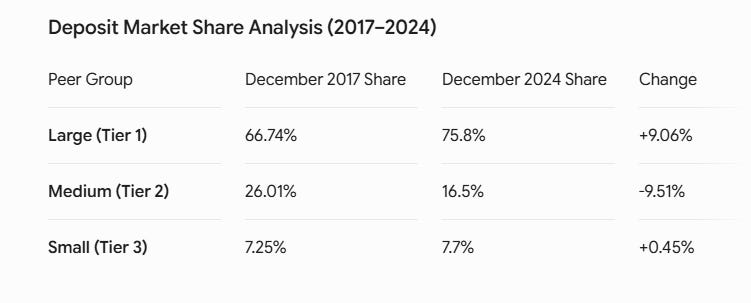
The shift in deposit market share between 2017 and 2024 reveals a significant structural transformation within the Kenyan banking sector, driven by a persistent "flight to quality" and increasing regulatory pressures.
Implications for Sector Consolidation
Dominance of Tier 1 “Fortress” Balance Sheets: The increase of Tier 1 banks’ market share to 75.8% demonstrates that the largest institutions have become the primary beneficiaries of deposit mobilization. This consolidation is fueled by depositors seeking the perceived safety of larger banks, a trend that intensified following systemic shocks in the sector.
The Pressure on Mid-Tier Banks: The sharp decline of Medium (Tier 2) banks from 26.01% to 16.5% indicates that this group has been caught in a competitive “squeeze,” losing significant market share to larger institutions while struggling to maintain profitability and scale.
Regulatory-Induced Consolidation: The structural shift is not merely driven by depositor behavior; it is also accelerated by regulatory requirements. Small and medium banks face increasing pressures—such as meeting higher capital adequacy standards—which often force them to seek strategic partners, undergo acquisitions, or merge to survive. As seen in the 2017 to 2024 period, shifts in market share are frequently tied to institutional reclassifications or acquisitions, such as the movement of banks between peer groups.
Ultimately, this data suggests that the Kenyan banking landscape is evolving toward a “winner-takes-most” model, where regulatory capital demands and the ongoing flight to safety act as powerful catalysts for further industry consolidation.
This research draws upon a combination of foundational legislative documents, regulatory frameworks, and historical analyses of the Kenyan financial sector. Below are the primary sources used to construct the timeline and regulatory analysis.
1. Primary Legislative & Regulatory Sources
Central Bank of Kenya Act (Cap 491): The foundational 1966 Act and its subsequent landmark amendments, specifically the 1997 Act that established institutional autonomy and price stability as the primary mandate.
The Constitution of Kenya (2010): Article 231, which provides the supreme legal anchor for the Central Bank’s existence, independence, and functions.
The Banking Act (Cap 488): Including the original 1968 Act and the critical 1985/1989 revisions that introduced the Deposit Protection Fund (DPF) and modern licensing standards.
National Payment System Act (No. 39 of 2011): The pivotal legislation that formalized the oversight of mobile money and non-bank payment service providers.
Digital Credit Providers (DCP) Regulations (2022): The regulatory framework operationalizing the 2021 amendment to bring digital lenders under CBK supervision.
Draft Virtual Asset Service Providers (VASP) Regulations (2026): The current proposed framework from the National Treasury and CBK for overseeing crypto-assets and digital service providers.
2. Supervisory & Policy Frameworks
CBK Risk-Based Supervision (RBS) Framework (2013): The policy document detailing the shift from “transaction-testing” to a risk-centric, forward-looking supervisory methodology initiated in 2004.
Financial Consumer Protection Framework (2026): Guidelines issued by the CBK to institutionalize affordability and means-testing within the credit sector.
3. Historical & Analytical References
Kenya Bankers Association (KBA) - “Turbulent Growth” Series: Historical accounts of the evolution of the Kenyan banking sector, detailing the rise of indigenous banks in the 1980s and the subsequent systemic challenges.
Retirement Benefits Authority (RBA) / Key Regulatory Bodies Archives: Data on the harmonization of Kenyan financial sector regulators and historical records of legislative milestones.
Reports on Systemic Failures: Analysis of bank closures from the 1980s through the 2016 consolidations (Imperial Bank, Chase Bank, etc.), utilized to map the “cause and effect” relationship between crises and regulatory “cures.”
Note: For further reading or verification, these documents are publicly available via the Central Bank of Kenya (CBK) Official Website and the Kenya Law Reform Commission archives.