
Executive Summary
The Official Narrative: SASRA claims 1.9 million dormant Sacco accounts are purely the result of shrinking take-home pay and statutory deductions.
The Reality: While wallet pressure is real, capital is actually fleeing Saccos due to severe yield lag, regulatory overreach, direct market access, and archaic membership rules.
The Yield Gap: Money Market Funds (12%–16.5%) and Special Funds (14%–18%) are destroying Sacco net dividends (6%–9%), driving a 28.5% surge in CIS assets while Sacco growth stalls.
The Bill’s Hidden Trap: The Sacco Societies (Amendment) Bill, 2025 sets up the Central Liquidity Facility (Section 28B), effectively turning member reserves into a captive pipeline for government securities.
Demographic Shift: Younger savers reject 60-day withdrawal locks and the intrusive “guarantor trap,” opting instead for frictionless mobile-first wealth platforms.
Beyond “Reduced Disposable Income”: The Real Reasons Sacco Savings Are Bleeding
When the Sacco Societies Regulatory Authority (SASRA) released its latest sector data, the headline numbers were painted as a simple product of macroeconomic hardship. Chief Executive David Sandagi quickly pointed to squeezed worker paychecks and statutory deductions to explain why 1.9 million accounts—over 24% of the industry’s membership—have fallen dormant.
While reduced take-home pay is real, blaming “shrinking wallets” alone is a convenient narrative. It shields policy failures, masks regulatory capture, and ignores a massive structural shift in how Kenyans allocate capital. The real exodus from Saccos is driven by regulatory overreach, lost yield competitiveness, market disintermediation, and generational friction.
1. Capital Flight: Sacco Deposit Growth vs. Competing Yield Instruments
To understand why 1.9 million Sacco members have gone dormant, one needs only to look at where money in Kenya is actually flowing. SASRA’s claim that members simply have “no money to save” crumbles when benchmarked against competing retail capital pools over the FY 2024–FY 2025 period.
While Sacco deposit growth has stagnated into single-digit inflation-adjusted terms and active membership growth has crawled at just 4.4%, alternative retail asset classes have surged:
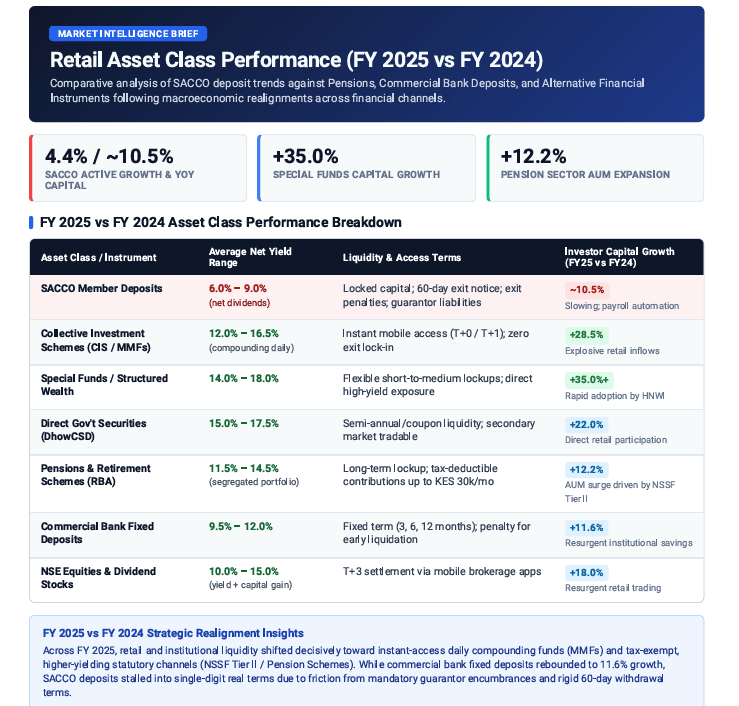
The math is brutal. When a retail saver can deposit funds into a Money Market Fund or Special Fund earning a 13% to 17% compounding net yield with instant mobile withdrawal and zero co-guarantee risk, leaving money locked in a Sacco earning single-digit dividends subject to 60-day withdrawal delays is an irrational financial decision. Capital isn’t disappearing—it is fleeing Saccos for vastly superior risk-adjusted returns.
2. The Sacco Amendment Bill 2025: Regulatory Capture and Debt Rerouting
The government’s legislative response to this shifting landscape makes the situation worse. Under the Sacco Societies (Amendment) Bill, 2025, the state lays the groundwork to direct cooperative capital into fiscal debt pipelines rather than protecting saver returns.
Mandatory Reserves to State Paper: Section 28B(b) and (c) of the Bill mandates that secondary societies holding the Central Liquidity Facility receive prescribed minimum liquidity amounts from member Saccos. Crucially, Section 28B(d) explicitly authorizes these entities to “take deposits from member Saccos and invest in Government securities.”
The Structural Trap: By institutionalizing a central pool forced to backstop government borrowing, the state is effectively converting cooperative savings into an off-balance-sheet treasury funding vehicle. Instead of member funds recirculating locally as affordable micro-loans for housing or business, they are systematically rerouted into government debt and infrastructure papers to offset fiscal deficits. Savers are taking notice: why leave money in a Sacco if the state treats it as a captive liquidity pool?
3. Retail Disintermediation: Direct Access to Capital Markets
The retail investor of 2026 is far more financially literate and tech-enabled than the traditional Sacco member of a decade ago.
Digital platforms, mobile broker apps, and direct government issuance infrastructure (such as the CBK’s DhowCSD platform) have democratized access to high-yielding Treasury Bills, infrastructure bonds, and equities on the Nairobi Securities Exchange (NSE). Savers no longer require a Sacco committee to act as an intermediary for wealth creation. Retail investors are bypassing the middleman entirely to capture whole yields without institutional haircuts.
4. Generational Friction: The Death of the Co-Guarantee Model
The sharpest structural headwind facing Saccos is demographic. Kenya’s younger workforce—Gen Z and Millennials—fundamentally rejects the operational friction built into the traditional Sacco model.
The Guarantor Trap: The traditional model relies on members begging three to five peers to sign off as guarantors, putting their own hard-earned savings at risk. Young professionals, freelancers, and gig-economy workers find this social liability outdated, intrusive, and structurally flawed.
Illiquid Offboarding: Under standard Sacco rules, withdrawing your own money requires finding replacement guarantors for lingering loans or waiting up to 60 days while paying reactivation or exit penalties.
Digital-native savers demand frictionless mobility. If an asset class does not permit immediate allocation, rapid scaling, and instant liquidation, younger demographics simply move their capital elsewhere.
Policy Accountability: SASRA Must Be Forthright
By framing 1.9 million dormant accounts strictly as a function of “paycheck pressure,” SASRA and policy makers are avoiding a necessary reckoning.
Rather than weaponizing regulatory frameworks through the 2025 Bill to funnel member liquidity toward fiscal deficits, regulators should focus on modernizing exit rules, reforming guarantor mechanics, and removing structural barriers to liquidity. Capital moves to where it is respected, yielded, and easily accessed. Until policy makers realize that Saccos are losing a competitive market war—not just suffering from “poor members”—dormancy numbers will continue to rise.
Boardlot Africa is a premier financial intelligence and corporate governance publication dedicated to unpacking the mechanics of capital, market strategies, and structural shifts across East Africa’s corporate landscape. By bridging the gap between raw economic data and actionable market intelligence, we deliver deep-dive research, independent corporate analysis, and policy insights designed for institutional investors, boardrooms, and sharp market observers.
Get in Touch
Email: sultan@boardlot.africa
Phone: +254 753 133 901/254181683210
Substack: Subscribe to Boardlot Africa
X (Twitter): BoardLotSultan
Linkedn:): BoardLot Sultan