
857,000 Refugees and a Fragile Peace: The Dangerous Cost of Economic Nationalism in Kenya
Beyond the Burundian Exodus: How Kenya Risks Becoming the South Africa of East Africa
A hard look at the intersection of immigration enforcement, informal survival work, and why ordinary Kenyans refuse to follow South Africa down a dark path.
The current refugee and immigration crisis in Kenya was ignited directly by the executive branch, tracing back to comments and directives from President William Ruto ordering authorities to shut down small businesses operated by foreign traders. While framed by the government as a measure to protect local Kenyan vendors from unfair competition, the sudden policy shift immediately triggered widespread panic, public profiling, and a panicked exodus of foreign nationals seeking emergency travel documents outside their embassies. Rather than solving deep-seated economic anxieties, this rhetoric crossed a dangerous threshold, transforming routine regulatory enforcement into a volatile social flashpoint.
Kenya stands at a dangerous historical crossroads. Official figures compiled from the United Nations High Commissioner for Refugees (UNHCR) reveal that the country’s cumulative refugee and asylum-seeker population reached an unprecedented 857,065 by June 2026, marking a 73.2 percent surge from 494,863 in 2016 as the nation increasingly serves as a destination for those fleeing conflict, political instability, and economic hardship. Yet, this numerical milestone tells only half the story. Behind these aggregate macro-statistics lies a volatile domestic reality: a boiling point of economic anxiety, systemic livelihood exclusion, and state-sanctioned crackdowns that threaten to ignite widespread social violence.
The refugees and asylum numbers map a shifting regional tragedy. Somalis remain by far the largest group at 472,470 in June 2026 (accounting for 55.1 percent of the total), followed by South Sudanese at 208,978, and refugees from the Democratic Republic of Congo at 66,654. But the fastest growth rates belong to smaller communities: Eritreans surged by 395.6 percent from 1,590 in 2016 to 7,880, while Burundians saw a 314.2 percent increase, rising from 8,461 to 35,048 over the decade.
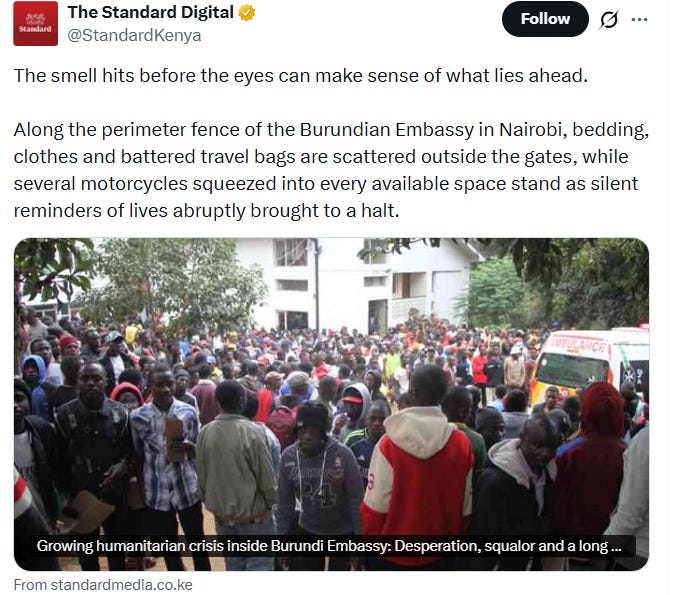
It is the Burundian population in Kenya that has been thrust violently into the eye of a brewing political storm. Following presidential directives ordering authorities to shut down small businesses operated by foreign traders, hundreds of Burundians gathered outside their embassy in Nairobi seeking travel documents to return home. Many reported receiving threats and fearing they were no longer safe after President William Ruto ordered a crackdown on foreigners operating businesses without required permits.
This spectacle exposes a profound systemic failure. As prominent lawyer and publisher Gitobu Imanyara observes, President Ruto’s rhetoric framing the crackdown as a defense of local workers is a dangerous distraction. Imanyara notes that “A Burundian doing mjengo in Nairobi is not responsible for Kenya’s unemployment crisis. A Rwandan shopkeeper did not design our taxation system. A Congolese waiter did not accumulate Kenya’s public debt... These people are convenient targets because they possess little power.” A citizen exhausted by local inflation, public debt, and crushing taxation will not suddenly forget their grievances just because a migrant worker has been expelled.
Worse still, this policy ignores the deep mirror effect on Kenya’s own diaspora. Thousands of Kenyans have built livelihoods across Uganda, Rwanda, Burundi, Tanzania, South Sudan, and beyond as bankers, teachers, engineers, traders, and entrepreneurs. By turning on regional neighbors, Kenya invites devastating retaliatory isolation. As Imanyara warns, regional integration works through reciprocity: “If Burundi concludes that its citizens are unwelcome in Kenya, what prevents restrictions against Kenyans in Bujumbura? If Rwanda responds similarly, Kenyan professionals and businesses could suffer.”
This dynamic is a ticking time bomb. When a state criminalizes survival work without offering legal pathways for economic integration, it manufactures an underground class vulnerable to extortion and sudden mass expulsion. When popular frustration is redirected toward vulnerable foreign vendors, it licenses street-level mob hostility. As Imanyara concludes, “When a government lights the fire of economic nationalism in an interconnected region, it cannot choose where that fire burns. The people ultimately burnt may be our own.”
The Shadow of South Africa: Rejecting the Path of State-Sanctioned Hatred
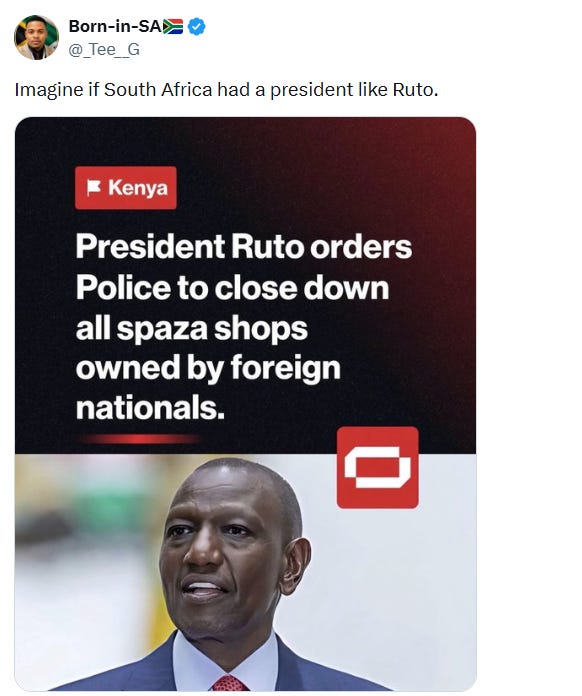
The danger of this trajectory is made chillingly clear when mirrored against South Africa’s deep-seated, institutionalized xenophobia, where systemic anti-immigrant sentiment has long exploded into deadly violence and looting. When the recent crackdown unfolded in Nairobi, the reaction across digital borders was telling: social media spaces in South Africa lit up with gloating celebrations, with commentators openly cheering and hoping that Kenya would sink into the same mire of lawless brutality that has stained South Africa’s global reputation. Yet, that toxic schadenfreude fundamentally misreads the Kenyan spirit. As captured by social media reactions rejecting this descent—such as user @_Tee__G noting the disheartening reality of regional neighbors celebrating Kenya’s lowest impulses—Kenyans fiercely refuse to become like South Africa. The overwhelming domestic pushback against state-stoked hostility proves that ordinary citizens recognize mob chauvinism for what it is: a moral failure and a governance shortcut that solves nothing.
What Must Kenya Do to Defuse This Ticking Bomb?
Retire Blanket Administrative Directives: Nairobi must replace abrupt executive statements with transparent, statutory regulation through the Ministry of Interior and local trade bodies, ensuring enforcement targets legal compliance rather than stoking blanket hostility.
Operationalize the Shirika Plan: The government must shift away from punitive encampment toward structured economic integration in host counties, allowing refugees and long-term migrants to contribute legally to host economies through tax compliance and clear work authorization.
Streamline Permitting and Status Transition: Authorities must lower prohibitive work permit fees and clear registration backlogs so long-term residents and refugees can easily transition from informal street vending to compliant, licensed micro-enterprises.
Counter Xenophobia with Community Engagement: Law enforcement must strictly penalize the harassment, profiling, and extortion of foreign nationals, pairing these measures with joint local-refugee trader committees to address market competition constructively.
If Kenya continues down this populist path of economic scapegoating, the collateral damage will erode its diplomatic standing, shatter regional trade ties, and normalize a culture of lawless xenophobia that threatens the security of everyone within its borders.
About Boardlot Africa Research
Boardlot Africa is a premier financial intelligence and corporate governance publication dedicated to unpacking the mechanics of capital, market strategies, and structural shifts across East Africa’s corporate landscape. By bridging the gap between raw economic data and actionable market intelligence, we deliver deep-dive research, independent corporate analysis, and policy insights designed for institutional investors, boardrooms, and sharp market observers.
Get in Touch
Email: boardlot.research@gmail.com
Phone: +254 753 133 901
Substack: Subscribe to Boardlot Africa
X (Twitter): BoardLotSultan