
Welcome to Boardlot Africa, where we pull back the curtain to reveal the untold stories, power dynamics, and strategic maneuvers shaping the boardrooms of Corporate Africa—subscribe for free to join the conversation. join 1000 other subscribers
We publish:
Sultans weekly NSE Stock Picks, every Friday at 5pm
Kenya’s Most Consequential Legal, Governance & Labor Disputes
A Series on the 100 Most Influential Kenyan Captains of Industry
The Queens of East Africa Boardrooms
The Silicon Savana Chronicles, every Wednesday at 5.00pm
Sultan’s Farming Diary, every Monday at 5.00pm
Titus Naikuni’s career is a compelling study in the paradox of the “turnaround artist,” chronicling the journey of an engineer who possessed the precision to lift Kenya Airways to unprecedented heights, only to later preside over the complex structural turbulence that challenged its survival.
Table of Contents
I. The Engineer Who Flew: An Introduction to the Technocratic Archetype
II. The “Dream Team” Baptism: Trials in the Civil Service
III. The KQ Rescue: Building the “Pride of Africa”
IV. The Architect’s Temperament: The Cost of Absolute Control
V. Project Mawingu: The Hubris of the High-Altitude Gamble
VI. The Debt Trap: The Unraveling of the Mawingu Legacy
VII. Beyond the Runway: The Portfolio of a Seasoned Industrialist
VIII. Conclusion: The Engineer’s Lasting Impact on Our Markets
I. Introduction: The Engineer Who Flew
Few figures in the history of Kenya’s capital markets have embodied the promise and the peril of the “technocrat” quite like Titus Naikuni. A trained engineer who rose from the salt-crusted technical halls of Magadi Soda to the high-stakes, pressure-cooked corridors of State House, Naikuni was the quintessential face of the early 2000s’ “Dream Team.” He emerged at a moment when Kenya was desperate for a new brand of leadership—one that traded the old-guard politics of patronage for the sterile, calculated precision of the engineer’s drafting board.
Naikuni’s legacy is a complex, cautionary masterclass in corporate “Hero-to-Zero” dynamics. At his peak, he was hailed as the master architect of the “Pride of Africa,” possessing the mechanical precision required to rescue Kenya Airways from the brink of bankruptcy and steer it into a golden era of continental dominance. Yet, his tenure eventually became a study in the limitations of individual brilliance; the same fiercely centralized, engineering-driven management style that allowed him to build the airline into a global contender ultimately sowed the seeds of its turbulence. As we analyze his trajectory, we are forced to confront a difficult question: does the very drive that allows a leader to save an institution inevitably blind them to the necessity of its evolution?

II. The “Dream Team” Baptism: A Trial by Fire
By 1999, Kenya was gasping for air. Decades of economic mismanagement had left the country in a state of stagnation, prompting the IMF and World Bank to tighten the purse strings until the government committed to radical reform. In a move that surprised both his base and his critics, President Daniel arap Moi reached into the private sector to recruit a “Dream Team”—a cohort of high-flying technocrats tasked with injecting corporate discipline into a sclerotic civil service.
Titus Naikuni, fresh from his success at Magadi Soda, was thrust into the center of this experiment alongside luminaries like Dr. Richard Leakey. As a Permanent Secretary for Transport and Communications, Naikuni was part of a bold, if fragile, attempt to pivot the nation toward professionalism. It was a baptism of fire. For a man who had spent his career optimizing industrial output, the civil service was a labyrinth of inertia, political patronage, and bureaucratic sabotage.
This period served as the ultimate crucible for Naikuni. He learned the brutal reality of managing state-owned entities (SOEs) that were less about efficiency and more about sustaining political networks. He saw firsthand how institutional “bloat” wasn’t just accidental—it was often a feature of the system.
However, the “Dream Team” was more drama than miracle. Despite their technical pedigree, the team operated in a hostile ecosystem. The inherent friction between corporate logic and political survival meant that their influence was always precarious. Faced with insurmountable internal resistance, the team members eventually departed, exiting the public stage quietly and one by one. Naikuni, however, walked away with a lethal lesson that would define his future: he understood that to reform a gargantuan, politicized entity like Kenya Airways, he couldn’t just be an advisor—he had to be the undisputed master of the cockpit. He left the civil service not as a failure, but as a graduate of the most difficult leadership school in the country.

III. The KQ Rescue: Building the “Pride of Africa”
If his time in the civil service was an exercise in frustration, his transition to the helm of Kenya Airways (KQ) in 2003 was a masterclass in execution. Naikuni inherited an airline that was still recovering from the seismic shifts of the late 90s, but he quickly signaled that the era of “business as usual” was over.
Naikuni treated the airline not just as a national carrier, but as an engineering project. He focused on three pillars: fleet modernization, route network density, and operational ruthlessness. He understood that in the high-stakes game of global aviation, you are either a hub or a spoke; he was determined that Nairobi would be the center of the African map.
Under his leadership, the “Pride of Africa” began to mean something tangible. He spearheaded aggressive expansions into West and Central Africa, effectively capturing the transit market that had been neglected by legacy carriers. He fostered a culture of performance where technical uptime and flight reliability became the brand’s core product.

However, the real test of his mettle came with the Douala Crash in 2007. When tragedy struck, Naikuni’s response was a defining moment for the company. He handled the crisis with a clinical, detached calm that served to stabilize the organization’s reputation when it was most vulnerable. He bypassed the usual bureaucratic panic, stepping in as the face of accountability and ensuring that the airline’s operational integrity remained intact despite the immense human and PR toll.
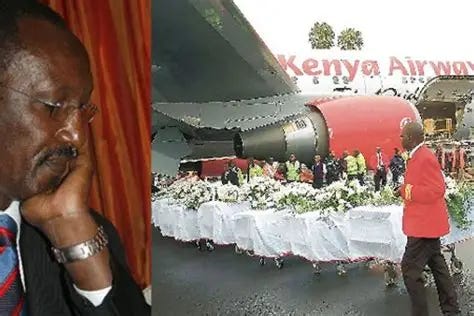
For many, this was Naikuni at his best: the engineer-turned-CEO who could calibrate a company as easily as he could a machine. During this “Golden Age,” the airline’s profitability soared, the brand became a symbol of Kenyan regional soft power, and the stock price on the Nairobi Securities Exchange reflected the market’s absolute faith in his vision. He had succeeded where others had stalled—he had turned a state-linked enterprise into a global, competitive success story. But as the airline grew, so did the complexity of the machine he was building, setting the stage for the turbulence that would follow.
IV. The Architect’s Temperament: The Cost of Absolute Control
As the “Pride of Africa” ascended, so did the persona of its CEO. Titus Naikuni’s leadership style was famously uncompromising, characterized by a “my way or the runway” philosophy that left little room for dissent or deviation. While this iron-fisted approach was undeniably effective in forcing a bloated bureaucracy to pivot, it created a culture of fear that slowly eroded the airline’s internal fabric.

Stories of his volatile temperament became the stuff of corporate legend, illustrating a leader who demanded total adherence to his personal standards of decorum and loyalty. One of the most cited instances involved a senior communications director who arrived at a staff party wearing an Emirates-branded t-shirt. To Naikuni, this was not merely a fashion error; it was an act of corporate treason. The director was publicly humiliated, summarily removed from the event, and subsequently fired. While the director eventually challenged the dismissal in court and won—a rare victory against the “Naikuni machinery”—the incident served as a chilling reminder to the entire organization: at Kenya Airways, loyalty was non-negotiable, and the line between personal authority and corporate policy had effectively vanished.

This intensity followed him beyond the office walls. Naikuni was a prominent figure at Whistling Thorns in Kiserian, a spot where the veneer of the corporate CEO often collided with the rawness of his off-duty persona. Reports of his involvement in altercations and bar brawls became whispers in the city’s social circuits, painting a picture of a man who carried the same pugnacious, confrontational energy into his private life.
For an institution like Kenya Airways, which relied on diplomacy, global partnerships, and delicate stakeholder management, these outbursts were more than just personal flaws—they were liabilities. They signaled a growing insularity, where the leader’s ego began to eclipse the institution’s interests. The same “toughness” that had once been his greatest asset in the early, gritty days of the turnaround was hardening into a rigidity that would, in time, make him deaf to the warnings of an encroaching storm. He had built a machine that could fly, but he had also built an environment where no one dared to tell the pilot that the fuel gauge was hitting empty.

VI. Project Mawingu: The Hubris of the High-Altitude Gamble
If the turnaround years were marked by Naikuni’s tactical brilliance, the final chapter of his tenure was defined by a strategic gamble of continental proportions: Project Mawingu.
By the early 2010s, Naikuni’s success had transitioned into a sense of corporate invincibility. He no longer saw Kenya Airways as a regional carrier; he viewed it as a global titan capable of challenging the world’s biggest legacy airlines. Project Mawingu—meaning “clouds” in Swahili—was his vision for this transformation. It was a rapid, aggressive expansion plan designed to drastically increase the fleet size, open dozens of new routes, and cement Nairobi as the primary gateway for African aviation.
On paper, the ambition was seductive. It promised to leverage the airline’s brand equity to capture the booming trade and tourism flows between Africa and Asia. But in reality, the expansion was built on a foundation of precarious assumptions. Naikuni, once the master of operational precision, began to favor hyper-growth over the fundamentals of cash flow and debt management.

The execution of Project Mawingu became a masterclass in over-extension. The airline committed to massive capital expenditure, loading its balance sheet with expensive, high-interest debt just as the global economic climate began to shift. The timing was disastrous:
External Shocks: The rise of regional insecurity, the 2013 Westgate attack, and the subsequent dip in tourism revenue hit the airline when it was most vulnerable.
Operational Strain: The rapid scaling outpaced the airline’s ability to train personnel, maintain quality, and manage the complexity of new, loss-making routes.
Competitive Pressure: As KQ expanded, it ran headlong into better-capitalized Middle Eastern giants like Emirates and Qatar Airways, which had the scale to absorb losses that KQ simply could not afford.
As the “Pride of Africa” began to bleed cash, the disconnect between Naikuni’s top-down vision and the reality on the tarmac became absolute. The same centralized, iron-fisted leadership that had once saved the airline now acted as a filter, preventing the board and shareholders from seeing the true depth of the crisis until it was too late. Project Mawingu didn’t just fail; it hollowed out the company’s financial reserves, leaving the airline in a state of turbulence from which it would take years, and billions in taxpayer bailouts, to even begin to recover. Naikuni had sought to reach the clouds, but in doing so, he lost sight of the ground beneath him.
Titus Naikuni’s Project Mawingu and KQ’s downfall
This video provides a critical look at how the ambitious expansion strategy of Project Mawingu contributed to the decline of Kenya Airways during Titus Naikuni’s tenure.
VI. The Debt Trap: The Unraveling of the Mawingu Legacy
Project Mawingu was intended to be the engine of Kenya Airways’ continental dominance, but in its collapse, it became the anchor that dragged the airline into a decade-long financial abyss. The project’s fundamental flaw lay in its aggressive, debt-fueled acquisition strategy. To scale from 31 aircraft to a fleet of over 100, the airline committed to massive, long-term lease obligations that assumed an uninterrupted trajectory of hyper-growth.
The Leasing Nightmare
As the project’s projections began to miss the mark due to regional shocks and the Jomo Kenyatta International Airport (JKIA) fire, the “fixed” nature of these aircraft lease debts became catastrophic.
The Mismatch: KQ was locked into high-cost, long-term lease agreements for wide-body aircraft (notably Boeing 777s acquired as substitutes for delayed 787 Dreamliners) at a time when passenger numbers and yields were plummeting.
Operational Inflexibility: Unlike operational costs that can be scaled down in a downturn, lease obligations remained inflexible. The airline was paying premium rates for “expensive” fleet assets that were often under-utilized or poorly matched to the routes they were meant to serve.
The Debt Spiral: To service these mounting lease costs, KQ was forced to borrow more, creating a cycle where new debt was used solely to keep the existing fleet in the air. This shifted the airline’s focus from providing a service to merely servicing its financiers.
A Decade of Turbulence
The fallout from this over-extension defined the next ten years, characterized by a state of permanent “financial ditch.”
Persistent Losses: Starting in 2013, the airline slipped into a pattern of record-breaking annual losses. In 2015 alone, the company posted a historic Ksh 26.2 billion loss, forcing a complete halt to the Mawingu expansion.
The “Turnaround” Trap: Subsequent initiatives—Operation Pride, Project Safari, and Project Kifaru—were launched in desperate succession to stabilize the company. These efforts involved debt-to-equity conversions, painful retrenchments, and the sub-leasing of aircraft to competitors at loss-making rates.
Public Burden: As KQ failed to meet its debt obligations, the Kenyan taxpayer was repeatedly called upon. The government has had to shoulder billions in guaranteed loans, convert bank debt into equity (ceding a 38% stake to lenders), and provide constant working capital lifelines just to keep the “Pride of Africa” operational.
By the time the COVID-19 pandemic hit, the airline was already in a weakened state, unable to navigate the global freeze. The legacy of Mawingu was not just the failure of a business plan; it was the institutionalization of a “management by crisis” model, where the burden of servicing high-interest debt repeatedly eclipsed the airline’s ability to invest in its own future.
Kenya Airways financial loss setbacks and recovery challenges
This video provides an overview of the ongoing financial instability at Kenya Airways, highlighting how persistent losses and mounting debt continue to undermine the airline’s efforts to return to sustained profitability.
VIII. Beyond the Runway: The Portfolio of a Technocrat
While Titus Naikuni’s tenure at Kenya Airways remains the most visible chapter of his career, his influence has spanned a vast array of sectors, from chemicals and telecommunications to higher education and infrastructure. His transition from the “Pride of Africa” to a post-retirement portfolio of board roles reflects a career built on the reputation of a seasoned industrial “turnaround artist.”
Industrial Roots: Magadi and Chemicals
Naikuni’s professional DNA is inextricably linked to the Magadi Soda Company (now Tata Chemicals Magadi). Joining as a trainee engineer in 1979, he rose through the ranks to become Managing Director, a role he returned to after his stint in the civil service. Even after his executive career evolved, he maintained a long-standing relationship with the organization, serving as its Vice Chairman and an advisor, cementing a legacy that has lasted over four decades.
Telecommunications and Infrastructure
Following his retirement from KQ in 2014, Naikuni leveraged his governance expertise to take on high-stakes chairmanships:
Airtel Kenya: Appointed Chairman in 2014, where he navigated the telecom giant through intense market competition.
Rift Valley Railways (RVR): He took over the chairmanship during a critical period of debt restructuring and operational overhaul for the Kenya-Uganda rail network, attempting to apply the same industrial logic that defined his earlier successes.
Boardroom Governance and Advisory
His boardroom experience is expansive, covering both private and publicly listed entities. Notable roles include:
Financial & Insurance: Chairman of Prudential Life Assurance Kenya and former board member of Housing Finance Company of Kenya (HFCK), CFC Bank, and Heritage Insurance.
Energy & Manufacturing: Former Chairman of Kenya Power and Lighting Company (KPLC) and board member of the East African Portland Cement Company.
International Advisory: He has sat on the Lafarge International Advisory Board and served as a director for Tata Chemicals South Africa.
Education and Conservation
Beyond corporate boardrooms, Naikuni has focused on institutional leadership and civic duty:
Chancellor of South Eastern Kenya University (SEKU): Since 2013, he has guided the institution’s rapid expansion.
Conservation: His dedication to local heritage is evidenced by his role as a trustee of the Maasai Wilderness Conservation Trust and his directorship at the Turkana Basin Institute.
These positions illustrate a man who—despite the controversies of his final years at Kenya Airways—remains a go-to figure for organizations seeking a leader with a deep understanding of the “mechanics” of running large-scale, complex African enterprises.
Titus Naikuni’s career and success
This video explores the professional journey and leadership style of Titus Naikuni, providing context on how his early successes shaped his reputation as a formidable business executive.
About Boardlot Africa Research
Boardlot Africa is a premier financial intelligence and corporate governance publication dedicated to unpacking the mechanics of capital, market strategies, and structural shifts across East Africa’s corporate landscape. By bridging the gap between raw economic data and actionable market intelligence, we deliver deep-dive research, independent corporate analysis, and policy insights designed for institutional investors, boardrooms, and sharp market observers.
Get in Touch
Email: boardlot.research@gmail.com
Phone: +254 753 133 901
Substack: Subscribe to Boardlot Africa
X (Twitter): BoardLotSultan