
Welcome to Boardlot Africa, where we pull back the curtain to reveal the untold stories, power dynamics, and strategic maneuvers shaping the boardrooms of Corporate Africa—subscribe for free to join the conversation.
We publish:
Sultans weekly NSE Stock Picks, every Friday at 5pm
Kenya’s Most Consequential Legal, Governance & Labor Disputes
A Series on the 100 Most Influential Kenyan Captains of Industry
The Queens of East Africa Boardrooms
The Silicon Savana Chronicles, every Wednesday at 5.00pm
Sultan’s Farming Diary, every Monday at 5.00pm
This article profiles the extraordinary career of Jacinta Mwatela, the Central Bank of Kenya official whose unwavering commitment to institutional integrity and meticulous documentation made her a legendary, singular force against the systemic corruption of the Goldenberg era.
What’s in this Article
1.0 Introduction: The Witness Who Knew Too Much
1.1 The Goldenberg Spotlight
1.2 The Anatomy of “Stubbornness”
1.3 The Core Thesis
2.0 The Exchange Control Gatekeeper: Drafting the Paper Trail
2.1 The Graduate Trainee to the Vault
2.2 The Monopoly Trap
2.3 Saying “No” in the Nyayo Era (Clashes with Eric Kotut, Prof. George Saitoti, and James Kanyotu)
3.0 The Goldenberg Testimonies: Exposing the Parallel Central Bank
3.1 Lifting the Corporate Veil
3.2 The Legal Siege
3.3 The Birth of Public Popularity
3.4 The Transcripts of Defiance: Verbatim Exchanges at the Inquiry
4.0 The Ceiling Shattered: First Female Deputy Governor
4.1 Historic Ascent (2005) and Acting Governor Tenure
4.2 The Currency Printing Cleanout (The De La Rue Confrontation)
4.3 The Deep Institutional Backlash (Friction with Amos Kimunya, Joseph Kinyua, and Prof. Njuguna Ndung’u)
5.0 The Ultimate Defiance: Choosing Exile Over Compromise
5.1 The Strategic Ouster (2008)
5.2 The Historic Rejection of the Presidential Appointment
5.3 The Legacy of the Maverick
6.0 Data/Historical Feature: The Multi-Billion-Shilling Cost of Paper Gold (Referencing the technical layout detailed in
goldenberg_macro_shock.pdf)7.0 Conclusion: The Maverick’s Dividend
7.1 Why Value Investors Owe Her a Debt
7.2 The Unyielding Standard

1.0 Introduction: The Witness Who Knew Too Much
1.1 The Goldenberg Spotlight
For years, the Goldenberg scandal had existed in the public imagination as a dense, untouchable web of multi-billion-shilling ghost exports, fake gold, and phantom diamonds that had crippled the country’s macroeconomic foundations in the 1990s. The architects of this scheme had built a formidable legal defense wall, shielded by the most expensive and aggressive corporate lawyers in East Africa.
Then walked in Jacinta Mwatela.

As she took the witness stand, the entire dynamic of the inquiry shifted. Armed with an impeccable memory and an exhaustive, ironclad paper trail that she had meticulously preserved from her days in the Exchange Control Department, Mwatela completely derailed the defense. She named names, exposed transaction codes, and unpacked the mechanics of state-sponsored looting with clinical precision, exposing the rot behind the closed doors of the reserve bank.
1.2 The Anatomy of “Stubbornness”
To the defense attorneys accustomed to intimidating witnesses into submission, Jacinta Mwatela was an absolute anomaly. They quickly discovered that she possessed a trait that political patronage networks found impossible to manage: a fierce, unyielding “stubbornness” rooted entirely in institutional truth.
Her stubbornness was not loud or performative; it was structural. When lawyers attempted to rewrite the history of the illegal 35% export compensation rates or paint the fictitious gold shipments as legitimate commercial trade, Mwatela countered with cold, hard operational realities.

1.3 The Core Thesis
For value investors, market analysts, and students of corporate governance, Jacinta Mwatela’s historic stand offers a profound systemic lesson. In a capital ecosystem built on political patronage, crony capitalism, and weak institutional checks, it is easy to assume that systemic corruption is a permanent, unbeatable force. Mwatela proved that this is an illusion.

Her legacy establishes the core thesis of this profile: a single, uncompromised public servant armed with an absolute audit trail can act as a systemic circuit-breaker. When the entire machinery of a state is aligned to bleed the sovereign ledger dry, one honest operator refusing to sign an illegal transfer can disrupt the entire operation. Mwatela’s defiance didn't just expose historical looting; it permanently altered the market plumbing of Kenya.

2.0 The Exchange Control Gatekeeper: Drafting the Paper Trail
2.1 The Graduate Trainee to the Vault
Long before she became a household name at the Kenyatta International Convention Centre (KICC) inquiry, Jacinta Mwatela JOINED the Central Bank in 1977 as a young graduate trainee.
By the turn of the 1990s, she had risen to head the Exchange Control Department. Every single dollar leaving or entering the country required regulatory approval, this department was the absolute vault of the nation.
2.2 The Monopoly Trap
In 1990, the quiet, rules-bound world of the Exchange Control Department was upended by a highly unusual, politically backed directive: a young, smooth-talking businessman named Kamlesh Pattni, operating under the corporate banner of Goldenberg International, had been granted a bizarre monopoly. His company was given the exclusive right to export Kenya’s gold and diamonds out of the country. Because Kenya had virtually no commercial gold mines or diamond deposits to speak of, the entire premise was built on quicksand.

Mwatela was tasked with drafting the initial operational guidelines and agreements governing this unprecedented arrangement. The scheme was engineered to exploit the “export compensation” law—a mechanism designed to encourage legitimate local manufacturers by giving them a 20% cash rebate on foreign currency earned from exports. Pattni, however, had negotiated an illegal, exclusive 35% compensation rate.
The shipping documents, customs declarations, and foreign exchange inflows simply did not add up. Instead of looking the other way or greenlighting the paperwork like many of her superiors, she did something that would ultimately break the scandal wide open: she filed, cross-referenced, and meticulously archived every single fraudulent claim, transaction slip, and internal memo.
2.3 Saying “No” in the Nyayo Era
To understand the sheer gravity of Mwatela’s defiance, one must understand the political architecture of the early 1990s Nyayo era. The Goldenberg pipeline was the financial lifeblood of the ruling political elite, meant to bankroll the multi-billion-shilling 1992 general election.

Yet, when the pressure mounted to clear billions in ghost export compensation, Jacinta Mwatela chose to say no.
The Target of Her Defiance: The CBK Hierarchy
Eric Kotut (Governor of the Central Bank of Kenya, 1988–1993): He was her direct ultimate boss during the height of the Goldenberg entries. In her explosive 6-day testimony at the inquiry, Mwatela directly placed the systemic blame on Kotut, famously delivering the knockout line: “The buck stops with the governor.” She testified that as early as May 7, 1991, she had formally flagged to Kotut that the massive foreign currency being sold to the CBK by Goldenberg’s bankers was of completely dubious origin and couldn’t be verified. Kotut ignored her warnings and allowed the transactions to be cleared anyway, later attempting to serve her with an adverse notice at the commission in retaliation.
The Bypassed Superiors (Chief Banking Managers): Mwatela revealed that when she stubbornly refused to approve the fraudulent 35% export compensation claims at her desk, senior treasury officials and compliant CBK executives intentionally created an internal shadow loop. They systematically bypassed the Exchange Control Department entirely to clear Kamlesh Pattni’s paperwork through higher, politically compromised offices within the bank.

3.0 The Goldenberg Testimonies: Exposing the Parallel Central Bank
3.1 Lifting the Corporate Veil
When Jacinta Mwatela took the witness stand at the Kenyatta International Convention Centre (KICC), her testimony shattered myths. The Central Bank of Kenya was practically running two parallel operations. On the surface sat the legitimate, rules-bound pipeline handling standard commercial banking for the nation. Beneath it ran a dark, hyper-efficient shadow pipeline engineered solely for political paper-gold processing.

Mwatela exposed how this shadow structure deliberately bypassed standard oversight. She testified that as early as May 7, 1991, she had formally flagged to her direct ultimate boss, CBK Governor Eric Kotut, that the astronomical sums of foreign currency being brought in by Kamlesh Pattni’s Goldenberg International. Kotut ignored her warnings.
When Mwatela refused to sign off on the fraudulent 35% export compensation claims at her desk, the architects of the scheme simply built an internal bypass. Compliant senior executives and Chief Banking Managers systematically routed the paperwork around the Exchange Control Department entirely. This shadow pipeline connected Pattni directly to the highest offices of state capture—fueled by Vice-President and Minister for Finance Prof. George Saitoti, and the dreaded intelligence chief James Kanyotu—effectively turning the reserve bank into a printing press for a political cartel.

3.2 The Legal Siege
The revelation of this parallel bank triggered an immediate, aggressive counter-offensive from the defense. Mwatela found herself under a grueling, multi-day legal siege led by some of the most formidable and high-priced legal minds in East Africa. Top-tier defense lawyers—including sharp corporate litigators representing Governor Eric Kotut and Kamlesh Pattni—converged on her with an explicit mandate: dismantle her credibility, frame her as a rogue, insubordinate mid-level manager, and break her composure under the glare of national television.
The courtroom exchanges were thick with friction. Legal teams attempted to serve her with adverse notices and trap her in technicalities regarding export documentation. Mwatela, however, met the onslaught with an unyielding wall of technical precision and unwavering calm. She didn’t rely on emotional rhetoric; she relied on the shadow archive of files she had saved.
When lawyers tried to shield the executive leadership from blame, Mwatela pinned the accountability exactly where the law dictated, famously delivering the knockout line: “The buck stops with the governor.”
The Political Masterminds Behind the Pressure
While she was fighting internal administrative battles inside Haile Selassie Avenue, the directives bypassing her department were fueled by the most feared titans of the Moi regime who protected the Goldenberg pipeline:
Prof. George Saitoti (The powerful Vice-President and Minister for Finance).
James Kanyotu (The dreaded Head of the Directorate of Security Intelligence/Special Branch, who was a secret founding partner in Goldenberg International itself).
3.3 The Birth of Public Popularity
Before the Bosire-led Commission, nobody in the public square knew who Jacinta Mwatela was. She was an invisible cog in a vast bureaucratic machine. But as her multi-day testimony went live on television and radio, she became an instant national sensation.
Overnight, she was transformed into a folk hero and a living symbol of institutional resistance. Her popularity stemmed from her raw authenticity; she gave a voice to the millions of depositors and taxpayers whose currency had been systematically devalued by the Goldenberg macro-shock.

3.4 The Transcripts of Defiance: Verbatim Exchanges at the Inquiry
These actual records from her six days on the witness stand perfectly illustrate her legendary “stubbornness” and how she completely dismantled the defenses of her superiors and the high-priced legal teams.
The “Guitar to a Goat” Metaphor
When the Commission’s assisting counsel, Mrs. Dorcas Oduor, pressed Mwatela on why she didn’t do more to stop Kamlesh Pattni’s illegal claims when she first noticed the red flags in May 1991, Mwatela vividly described the structural frustration of fighting her own bosses—specifically Chief Banking Manager Birech Kuruna, Deputy Governor Eliphaz Riungu, and Governor Eric Kotut:
Mrs. Oduor: “Mrs. Mwatela, what happened when you brought these fraudulent claims and the unverified sources of foreign currency to the attention of your immediate superiors?”
Mrs. Mwatela: “My lords, my attempts to bring these shady deals to the attention of my bosses amounted to ‘playing a guitar to a goat.” I felt like a complete loner in this battle. The governor [Eric Kotut] was a little devious. The four of us discussed the matter, and I discovered that the three of them had already taken a decision, which was being communicated to me indirectly. I told them plainly I was not happy with their decision, and upon returning to my office, I reduced their verbal instructions into writing to protect myself.”
The Legal Trap: Deflecting Blame to the Governor
During cross-examination, defense lawyers representing the former CBK leadership tried to corner Mwatela, arguing that a department head should have had the executive power to unilaterally freeze the transactions under the Exchange Control Act, attempting to make her the administrative scapegoat.
The exchange shut down the defense’s strategy instantly:
Defense Counsel: “Mrs. Mwatela, as the head of the exports division, you had the regulatory tools. If these Goldenberg transactions flouted the rules so flagrantly, why didn’t your specific department permanently halt the clearances?”
Mrs. Mwatela: “My lords, because the shadow pipeline completely bypassed my desk once I flagged it. But more importantly, under Section 30 of the Central Bank Act, who is the ultimate administrator of the Exchange Control Act? It is the Governor.”
Mrs. Oduor: “So, where does the final administrative responsibility lie for these multi-billion losses?”
Mrs. Mwatela: (Looking directly at the defense bench) “My lords, the buck stops with the governor.”
Dismantling the “Too Little, Too Late” Defense
When lawyer Okoth Oriema, representing former Governor Eric Kotut, attempted to present documents showing that Kotut eventually ordered an internal audit of the Goldenberg-linked banks and appointed a liquidator for Pattni’s Exchange Bank in late 1993, Mwatela delivered a devastating technical critique:
Mr. Okoth Oriema: “Look at these records, Mrs. Mwatela. The Governor did act. He suspended officers and liquidated Exchange Bank to stop the bleeding. Is that not regulatory action?”
Mrs. Mwatela: “My lords, I brought the clear documentary evidence of these suspicious, illegal transactions to the Governor’s desk on May 7, 1991. He allowed them to clear for over two more years anyway. This action in late 1993 was too little, done entirely too late. Billions of taxpayers’ funds had already left the vault.”
4.0 The Ceiling Shattered: First Female Deputy Governor
4.1 Historic Ascent (2005)
By the mid-2000s, the political and institutional landscape of Kenya was undergoing a profound shift under the (NARC) administration of President Mwai Kibaki. There was a growing national demand to institutionalize the transparency that whistleblowers like Jacinta Mwatela had championed. In May 2005, this culminated in a historic milestone: Mwatela was appointed as the first female Deputy Governor of the Central Bank of Kenya.
Her vertical ascent peak came much sooner than anyone anticipated. In March 2006, sitting CBK Governor Andrew Mullei was suspended from office over abuse-of-office allegations. Mwatela was thrust directly into the apex seat, taking over as Acting Governor of the Central Bank of Kenya from 2006 to 2007.
4.2 The Currency Printing Cleanout
For decades, De La Rue had held a virtual monopoly over the printing of Kenya’s banknotes. When Mwatela took over the acting governor’s seat, she found a controversial, single-sourced interim contract being pushed through the procurement pipeline by top-tier Treasury and CBK insiders. Mwatela did what she did best: she stopped the machine.
She aggressively raised red flags over the pricing anomalies, arguing that single-sourcing the multi-billion-shilling contract instead of putting it out to competitive international bidding was a flagrant violation of the Public Procurement and Disposal Act.
4.3 The Deep Institutional Backlash
Mwatela’s refusal to play ball with the new economic elite rapidly created severe administrative friction within the Kibaki-era government. She found herself isolated by a powerful triumvirate of state finance: Finance Minister Amos Kimunya, Treasury Permanent Secretary Joseph Kinyua, and the newly appointed CBK Governor, Prof. Njuguna Ndung’u, who took over the substantive governor post in 2007.
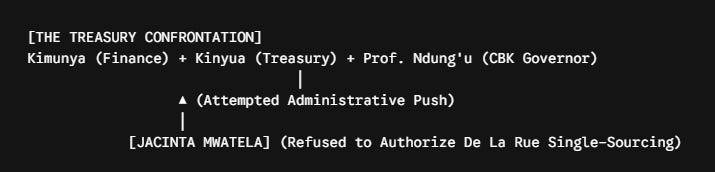
While Prof. Ndung’u and Minister Kimunya defended the extensions given to De La Rue as necessary to prevent a catastrophic banknote shortage in the country, Mwatela openly counter-argued before parliamentary committees that taxpayers were being ripped off. To the political establishment, she was no longer just an administrative headache; she was an unmanageable roadblock sitting right on top of the national vault.
Institutional Integrity vs. Political Muscle: Mwatela Pulls the Plug
When the moment of reckoning arrived on the morning of June 23, 2006, the final decision to dismantle Kenya’s most protected parallel economy fell squarely on the shoulders of Acting Governor Jacinta Mwatela.
Her predecessor, Dr. Andrew Mullei, had been unceremoniously engineered out of the very same chair just three months prior for pulling at this exact corporate thread. Mwatela chose to anchor her legacy on unyielding institutional integrity. Working in lockstep with Finance Minister Amos Kimunya’s ministerial directive, she single-handedly shattered the cartel’s armor of untouchability with the stroke of a pen.

5.0 The Ultimate Defiance: Choosing Exile Over Compromise
5.1 The Strategic Ouster (2008)
By September 2008, the state decided that Mwatela had to be removed from the Central Bank command chain at all costs. However, because the Deputy Governor’s position is a secure, tenure-protected constitutional appointment designed to shield regulators from political interference, they could not simply fire her without sparking a massive public outcry and legal crisis.
The government resorted to a classic, passive-aggressive political maneuver: a strategic “promotion.” In a swift evening cabinet reshuffle, President Mwai Kibaki appointed Mwatela as the Permanent Secretary (PS) for the newly created Ministry of Development of Northern Kenya and Other Arid Lands. In the calculus of the Office of the President, this was a masterful stroke.
5.2 The Historic Rejection
The political elite expected her to quietly packed her bags, accept the high-ranking PS title, and fade into the ministerial background. Instead, Jacinta Mwatela delivered an act of defiance never before seen in the history of Kenya’s public service.
She flatly and publicly rejected the President’s appointment.
In an explosive public declaration that sent shockwaves through State House, Mwatela made it clear that she would not be used as a political pawn.
5.3 The Legacy of the Maverick
Jacinta Mwatela’s dramatic exit from public service solidified her status as the ultimate institutional maverick. In Kenyan political culture, where public officials routinely compromise their integrity, cover up mega-scandals, or accept meaningless postings just to remain close to power and a state salary, her rejection of a presidential appointment was revolutionary.
For capital market analysts and value investors looking back at this history, her legacy is non-negotiable. If Sheila M’Mbijjewe was the institutional sentinel who later consolidated the modern banking architecture, Jacinta Mwatela was the raw, unyielding force that exposed the structural holes in the old plumbing.
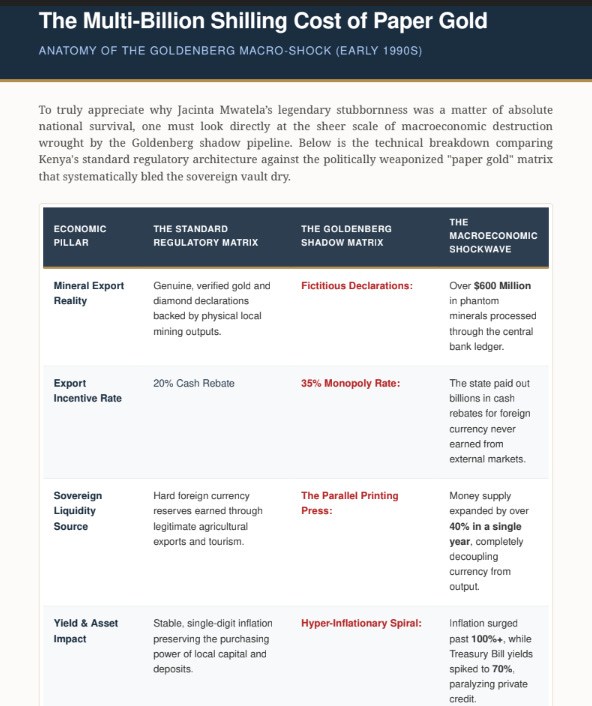
6.0 Data/Historical Feature: The Multi-Billion Shilling Cost of Paper Gold
To truly appreciate why Jacinta Mwatela’s stubbornness was a matter of national survival, one must look at the sheer macroeconomic destruction wrought by the Goldenberg shadow pipeline. Below is the anatomical breakdown of how fictitious “paper gold” systematically bled Kenya’s liquid reserves and triggered an unprecedented inflationary spiral in the early 1990s.
7.0 Conclusion: The Maverick’s Dividend
7.1 Why Value Investors Owe Her a Debt
For the modern value investor on the Nairobi Securities Exchange, long-term compounding is only possible when you can trust the underlying plumbing of the financial system. Wealth creation requires transparent corporate reporting, predictable central bank oversight, and an ironclad defense of the sovereign ledger.
Jacinta Mwatela’s career reminds us that these market safe-havens did not appear by accident. Without mavericks like her stepping onto the national stage to expose the parallel pipelines of state capture, the old Central Bank would have remained a highly vulnerable, politically weaponized vault. Every dividend check clipped today from resilient Tier-1 banks is a direct compound interest payment on the historical truth-telling she chose to provide when the stakes were highest.
7.2 The Unyielding Standard
In the final analysis, Jacinta Mwatela’s career establishes the ultimate benchmark for modern public financial governance. She proved that institutional resilience does not come from complex automated software or bloated regulatory committees—it comes from individual moral clarity.
By looking at the country’s most feared political elite and choosing to say no, by preserving the paper trail when her peers were destroying files, and by choosing self-exile over an unearned presidential promotion, she set an unyielding standard. Mwatela showed Kenya that a public servant’s true loyalty belongs exclusively to the sanctity of the public ledger, cementing her legacy as the ultimate circuit-breaker against financial tyranny.
About Boardlot Africa Research
Boardlot Africa is a premier financial intelligence and corporate governance publication dedicated to unpacking the mechanics of capital, market strategies, and structural shifts across East Africa’s corporate landscape. By bridging the gap between raw economic data and actionable market intelligence, we deliver deep-dive research, independent corporate analysis, and policy insights designed for institutional investors, boardrooms, and sharp market observers.
Get in Touch
Email: boardlot.research@gmail.com
Phone: +254 753 133 901
Substack: Subscribe to Boardlot Africa
X (Twitter): BoardLotSultan