
Welcome to Boardlot Africa, where we pull back the curtain to reveal the untold stories, power dynamics, and strategic maneuvers shaping the boardrooms of Corporate Africa—subscribe for free to join the conversation. join 1000 other subscribers
We publish Kenya’s Most Consequential Legal, Governance & Labor Disputes and
A Series on the 100 Most Influential Kenyan Captains of Industry
The Ziidi Trader Illusion: Why Volume Doesn’t Equal Value
Part 1: The Metrics of Participation – A Timeline
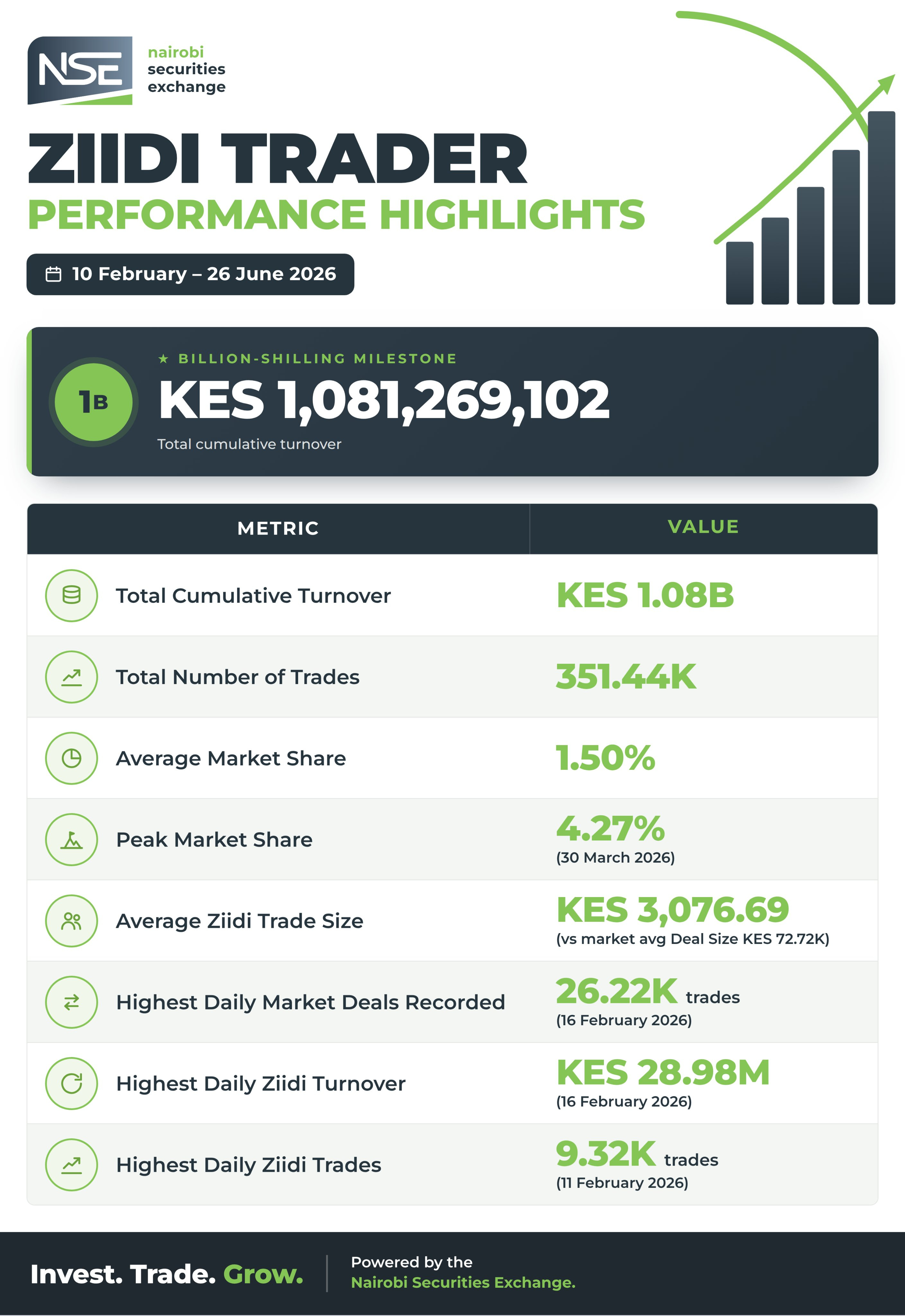
Between February 10 and June 26, 2026, the Nairobi Securities Exchange (NSE) oversaw a massive retail participation experiment via the Ziidi Trader platform. During this period, the platform facilitated 351,440 trades, driving a cumulative turnover of KES 1.08 billion.
The platform demonstrated high retail-level engagement, with an average market share of 1.50%, and a peak penetration of 4.27% on March 30, 2026. The profile of this activity was distinctly retail, characterized by an average trade size of KES 3,076.69, starkly contrasting with the broader market’s average deal size of KES 72.72K. While the sheer volume suggests a successful democratization of the market, the infrastructure powering these numbers has begun to show significant cracks.
Part 2: The Critical Case – Why I Advise an Exit
As a market analyst, I view the metrics above as a warning rather than a victory. High-volume retail participation is only beneficial if it is supported by institutional-grade reliability. My advisory to exit Ziidi Trader—as I voiced in my post seen in Screenshot 2026-07-02 203201.png—is grounded in six fundamental failures that jeopardize investor rights.
Operational Bottlenecks (Settlement Delays): Liquidity is a fundamental right of the trader. Users have frequently reported persistent delays in the settlement of trades, which suggests that the platform’s back-end infrastructure is unable to handle the throughput its growth demands.
Dividend Latency: In a fair market, all shareholders are equal. However, Ziidi users have reported receiving dividends weeks after they have been processed for investors using traditional, institutional-grade brokers, creating an unfair opportunity cost for the retail user.
Governance & AGM Exclusion: Despite Kestrel Capital being the designated broker responsible for backend management, dividend settlement, and attending AGMs on behalf of shareholders, users have faced a lack of access to these meetings and no real representation, stripping them of their voice as company owners.
The CDS Transparency Gap: Perhaps the most egregious flaw is the absence of direct Central Depository System (CDS) integration; without a personal CDS reference number, users are denied the ability to independently verify or track their shareholdings, creating a “black box” ecosystem.
Failed Brokerage Oversight: While Kestrel Capital serves as the designated broker, the execution has been severely lacking, leaving investors in the dark about their actual holdings and entitlements.
Unresponsive Customer Support: Perhaps the most immediate source of investor frustration is the total lack of dedicated support; Safaricom’s customer care for Ziidi is reportedly extremely unresponsive, with no designated phone number or WhatsApp channel specifically for resolving technical or trade-related issues.
The “Ziidi experiment” has achieved its goal of boosting transaction counts, but it has done so at the expense of investor agency and support. For anyone treating the stock market as a serious wealth-building vehicle, it is time to move your holdings to established, transparent platforms—such as AIB, Faida, NCBA, or Hisa—that respect the rights and liquidity needs of the shareholder.
What platforms are you using to trade? What are your experiences?

About Boardlot Africa Research
Boardlot Africa is a premier financial intelligence and corporate governance publication dedicated to unpacking the mechanics of capital, market strategies, and structural shifts across East Africa’s corporate landscape. By bridging the gap between raw economic data and actionable market intelligence, we deliver deep-dive research, independent corporate analysis, and policy insights designed for institutional investors, boardrooms, and sharp market observers.
Get in Touch
Email: boardlot.research@gmail.com
Phone: +254 753 133 901
Substack: Subscribe to Boardlot Africa
X (Twitter): BoardLotSultan
