
To the average shopper in early 2000s Nairobi, Charterhouse Bank was invisible. It commanded a measly 0.55% market share and just ten branches—eight of which were tucked inside the bustling aisles of Nakumatt supermarkets. It didn’t chase ordinary depositors or fund local mortgages.
But behind this engineered invisibility lay the blueprint for the most sophisticated parallel economy in Kenyan history.
Charterhouse was never a traditional bank; it was an exclusive financial laundromat. It existed to seamlessly blend legitimate retail cash flow with multi-billion-shilling tax evasion and the proceeds of international narcotics syndicates. For over two decades, it operated as an untouchable corporate fortress where elite tycoons could tell regulators their questions were “none of your business,” and where the board held enough political leverage to effectively fire the Governor of the Central Bank.
This is the story of how a microscopic lender outmaneuvered the state, triggered a high-stakes standoff with the White House, and became Kenya’s ultimate “zombie bank”—a financial corpse kept breathing on political life support for fifteen years
The Charterhouse Bank Files: Series Index
Act I: The Humble Beginnings and the “Nakumatt” Connection
The takeover of Middle East Kenya Finance Limited (1996–1998).
The retail footprint: Why eight out of ten branches lived inside supermarket aisles.
The creation of a captive treasury for an insular corporate cartel.
Act II: The KSh 2 Billion Shockwave and the AG’s High Court Standoff
Crucial Properties Limited: The $24.9 million international transfer (2001).
Humphrey Kariuki and the ultimate corporate retort: “None of your business.”
Attorney General Amos Wako’s aggressive intervention and the accusations of engineered incompetence.
The legal loophole sprint and the offshore evacuation.
Act III: The Whistleblower’s Dossier and the Laundromat
The mechanics of structural layering: Ghost accounts, smurfing, and stolen identities.
Bleeding the state: The KSh 18 billion tax blind spot that crippled competitors.
Peter Odhiambo’s forensic heist: Compiling the data that cracked the fortress.
The US DEA extraction: Smuggling witnesses into asylum.
Act IV: Enter “The Boss” and the Narcotics Connection
John Harun Mwau: The Olympian, politician, and “The Architect of Untouchability.”
Blending blood money with grocery cash: Shuffling cartel revenue into global tax havens.
Sacking the CBK Governor: How poking the hornets’ nest saw Dr. Andrew Mullei suspended and criminally charged.
Act V: The 2006 Collapse and the Spied-On Auditors
Billow Kerrow’s parliamentary bomb and Finance Minister Amos Kimunya’s cornered directive.
The iron-willed Deputy: Acting CBK Governor Jacinta Mwatela pulls the plug (June 23, 2006).
Corporate Espionage: How investigators found hidden mics and CCTV cameras inside the PwC audit boardroom.
Act VI: The 15-Year Zombie Bank & The Final Liquidation
Death by a thousand injunctions: How Charterhouse survived in suspended animation (2006–2021).
The audacity of 2010: The parliamentary push to resurrect a financial crime scene.
The US Kingpin Act and the threat of systemic SWIFT sanctions.
May 2021: Governor Patrick Njoroge and the KDIC sign the formal death certificate.
Part VII: The Jurisprudence—How Charterhouse Rewrote the Legal Playbook
The financial Wild West: Kenya’s structural vulnerability post-2006.
The evolution of POCAMLA and the dismantling of banking secrecy shields.
Targeting professionals: Moving the AML lens to lawyers, accountants, and auditors.
The shift in the burden of proof: From criminal convictions to swift civil asset forfeiture.
Act I: The Humble Beginnings and the “Nakumatt” Connection
Charterhouse Bank did not emerge from a grand vision of corporate expansion or financial inclusion. It was born out of a quiet, calculated takeover in 1996, absorbing the assets and operational license of Middle East Kenya Finance Limited. By 1998, it had officially converted into a fully fledged commercial bank, ready to open its doors to the public.
To the casual observer, Charterhouse appeared to be an inconsequential, lightweight player in Kenya’s financial sector. It didn’t boast towering skyscraper headquarters or massive marketing campaigns. Instead, it operated a microscopic network of just ten branches spread across Nairobi, Kisumu, and Mombasa.
However, a closer look at its geography revealed a highly deliberate and unprecedented corporate design: eight of those ten branches were located directly inside Nakumatt supermarkets.
The story of Charterhouse Bank is one of the most gripping, highly politicized, and prolonged financial scandals in East African history. Often referred to by financial analysts as one of Kenya’s smallest but “dirtiest” lenders, Charterhouse operated less like a traditional retail bank and more like a massive, sophisticated clearinghouse for tax evasion, money laundering, and the international narcotics trade.
Despite commanding a measly 0.55% market share at its peak, the sheer volume of wealth that secretly flowed through its halls nearly broke the Kenyan financial sector. It took a decades-long clash between courageous whistleblowers, determined central bankers, the American government, and deeply entrenched political interests to finally bring it down.
The Illusion of a Minor Player
To the average Kenyan walking past its branches in the late 1990s and early 2000s, Charterhouse Bank was practically invisible. In a financial ecosystem dominated by giants like Kenya Commercial Bank (KCB) and Barclays, Charterhouse was a financial drop in the ocean.
But this microscopic retail footprint was entirely by design.
It operated as an exclusive, high-volume financial conduit tailored for a select cartel of powerful tycoons, multi-billion-shilling retail empires, and shadowy political figures who required a completely compliant institution to move immense wealth without attracting regulatory scrutiny.
The Financial System’s Blindspot
Charterhouse became the ultimate blindspot. While major lenders spent massive resources adhering to international compliance and “Know Your Customer” (KYC) protocols, Charterhouse actively dismantled those barriers for its elite clientele. It wasn’t just a bank failing due to bad loans or poor management; it was an institution systematically weaponized from within to run a multi-billion-shilling parallel economy.
The sheer velocity of the capital moving through this tiny lender was enough to distort local foreign exchange markets, systematically rob the state of vital tax revenues, and provide safe passage for the proceeds of major transnational crime syndicates. It was a financial ticking time bomb, and when it finally ruptured, it sent shockwaves that reached all the way to Washington D.C.
Act II: The KSh 2 Billion Shockwave and the AG’s High Court Standoff (2001)
Long before the term “money laundering” was even formally codified into Kenyan law, Charterhouse Bank was already moving sums of wealth that staggered the local financial system. The definitive proof came in January 2001, through a single, eye-watering international transaction that served as the bank’s coming-out party for the criminal underworld.
A company named Crucial Properties Limited, which had sat completely dormant since its registration in 1996, suddenly woke up. Days prior, it had appointed a sharp, ambitious mid-30s businessman as its director and sole account signatory: Humphrey Kariuki. On January 16, 2001, electronic financial switches flipped in New York, routing an unbelievable $24.9 million (approx. KSh 2 billion at the time) straight into the tiny, unheralded vaults of Charterhouse Bank.
The Standoff
At a time when Kenya’s economy was gasping for air, foreign aid from international lenders was frozen, and local foreign exchange liquidity was tightly monitored, a KSh 2 billion deposit into the account of a local restaurant owner triggered absolute panic.
The Central Bank of Kenya (CBK) Fraud Unit slammed the brakes, freezing the account under suspicious transaction protocols. Regulators demanded a full, transparent breakdown of where this immense cash injection had originated, with police and investigators flatly alleging the funds were “proceeds of drug trafficking and money laundering.”
Kariuki didn’t flinch. Backed to the hilt by Charterhouse’s management—who aggressively stonewalled investigators behind the shield of “customer confidentiality”—he launched a ferocious legal counter-offensive in the High Court to unfreeze the money and block his arrest.
When cornered by senior central bankers to explain the source of his sudden fortune, Kariuki reportedly looked the regulators in the eye and coldly told them that the origin of the money was:
“None of your business.”
He maintained the multi-billion-shilling transfer was completely legitimate, claiming it was merely the first tranche of a massive $150 million international investment package from an entity called the “Temuco Foundation” to fund regional trade.
The Attorney General Steps In
Recognizing that a massive financial blind spot was being exploited, Attorney General Amos Wako personally moved to intervene. Representing the state’s interests, Wako’s office took the aggressive and unusual step of attempting to wrestle control of the case away from the Civil Registry. Wako filed a high-stakes application to have the entire matter referred directly to Chief Justice Bernard Chunga for criminal directions.
Wako’s prosecution team, led by Assistant Deputy Director of Public Prosecutions Momanyi Bwonwonga, argued fiercely that the High Court was being used to shield an active criminal enterprise. Confronting the defense’s attempts to use civil technicalities to protect the funds, Wako’s office made the state’s position crystal clear to the bench, stating that:
“The application filed by the tycoon is entirely criminal in nature and must be treated as such. The state cannot be restrained from investigating potential international drug trafficking and money laundering under the guise of civil liberties.”
However, a joint probe by the CBK, the Anti-Narcotics Unit, Interpol, and the FBI quickly pulled back the curtain. The Temuco Foundation did not exist at its stated US address. Instead, the paper trail led straight to Vaduz, Liechtenstein—a hyper-secretive European tax haven. The funds had been layered through major banks in New York before being dumped into Nairobi.
The Clean Escape and the Engineered Blame Game
Despite the high-profile courtroom fireworks, the state ran headfirst into a legal brick wall. In 2001, Kenya completely lacked a robust statutory framework to handle complex financial crimes; the Proceeds of Crime and Anti-Money Laundering Act was still years away from being drafted.
Exploiting these massive statutory gaps, Kariuki’s legal team successfully cornered the state. They convinced the High Court that neither the Central Bank nor the Police Commissioner possessed the legal authority to indefinitely freeze private funds or arrest directors without an active, substantive criminal conviction under existing Kenyan laws.
The High Court capitulated, ruling in favor of Crucial Properties and lifting the freeze. The cartel’s operational speed was blinding. The exact moment the legal restrictions were dropped, the KSh 2 billion was swiftly wired out of Charterhouse Bank via demand drafts, bypassing local clearing mechanisms, and evacuated from the country.
The money vanished into the offshore ether before Wako’s office could even gather the paperwork to draft an appeal. In the aftermath of the humiliation, public outrage boiled over. Contemporary reporting by The Standard exposed a deeper, more cynical rot inside the state machinery.
While Wako publicly lamented that his office lacked the strict statutory evidence to prosecute Charterhouse Bank, critics, civil society, and legal analysts loudly accused the Attorney General of deliberate incompetence. The prevailing sentiment was that Wako had intentionally presented a hollow, weaponless case to the courts—willfully omitting critical forensic trails and failing to secure international mutual legal assistance in time—precisely to let the KSh 2 billion off the hook.
The state was compromised, the money was gone, and the message to the global underworld was definitive: Charterhouse Bank was open for big business, and its walls were completely impenetrable to the Kenyan state.
Act III: The Whistleblower’s Dossier and the Laundromat (2004)
By 2004, the legal loopholes that allowed the Crucial Properties millions to vanish were tightening, but Charterhouse Bank’s internal machinery had evolved into something far more vast and systemic. The bank had transitioned from handling isolated multi-billion-shilling shocks to running a continuous, highly sophisticated parallel economy.
The operational genius of this mechanism relied completely on its structural marriage to Nakumatt Holdings. Under the cover of supermarket aisles, Charterhouse built a financial machine designed to execute two primary tasks: bleeding the Kenyan state of tax revenue and cleaning massive volumes of untraceable capital.
The Mechanism of the Laundromat
The structural setup operated on a multi-layered system that completely bypassed standard banking safeguards:
The Cash Generator: Every hour of the day, millions of shillings in untraceable, cold cash from everyday shoppers walked into Nakumatt supermarkets across the country. Supermarkets are inherently cash-intensive, making them the ultimate corporate front for mixing funds.
Structuring (Smurfing): Instead of depositing these massive corporate revenues into standard, audited commercial accounts, Charterhouse managers utilized structuring. They systematically broke giant corporate cash sums down into hundreds of smaller, unalarming tranches.
Layering via Ghost Accounts: These structured sums were then shuffled across roughly 85 internal accounts. These accounts were a graveyard of financial fiction: some were opened using stolen identities, others under the names of dead individuals, and dozens belonged to completely fictitious shell companies. Funds bounced between these internal accounts at lightning speed, creating a chaotic paper trail that completely blinded external oversight.
The Final Polish: Once the money was sufficiently scrambled, it was either diverted straight into the personal accounts of the bank’s directors or wired out of Kenya to offshore tax havens.
Through this internal plumbing, Nakumatt was able to hide its true revenues, declaring virtually zero profit while moving billions. Investigators later estimated that this single loop bled the Kenya Revenue Authority (KRA) of over KSh 18 billion in unpaid taxes over a six-year window.
The Inside Rupture
In 2004, a senior internal auditor within the bank named Peter Odhiambo began noticing staggering, irreconcilable deviations between the bank’s official regulatory reporting and its actual internal ledgers. Risking his life, Odhiambo quietly and systematically began duplicating the bank’s sensitive customer accounts, transaction histories, and director-approved transfer logs.
He compiled what would become known as The Charterhouse Dossier—a mountain of undeniable forensic evidence detailing a parallel banking universe operating right in the middle of Nairobi.
The Escape
Odhiambo initially tried to escalate his findings to authorities, quietly sharing the files with senior officials at the Kenya Revenue Authority and the Central Bank of Kenya. Instead of an immediate raid on the bank, Odhiambo found himself being monitored. Death threats followed.
Fearing that a critical witness to transnational financial crime was about to be eliminated, the US Drug Enforcement Administration (DEA) and the US Embassy in Nairobi organized a covert extraction.
In a high-stakes operation, Odhiambo and two vital IT consultants were quietly smuggled out of Kenya under heavy guard. They were flown to the United States and granted immediate political asylum. While Odhiambo disappeared into the US witness protection ecosystem, the explosive dossier he left behind remained in play, acting as a financial hand grenade with the pin already pulled.
Act IV: Enter “The Boss” and the Narcotics Connection
By 2004, the Central Bank of Kenya was no longer just dealing with a massive headache over tax evasion. International intelligence agencies were screaming about a much more lethal threat deeply embedded within the Kenyan economy: narcotics. Kenya had rapidly transitioned from a passive transit point for South American and Asian cartels into a full-blown global hub for high-grade cocaine and heroin trafficking.
The staggering amounts of untraceable cash generated from this deadly trade required a quiet, hyper-compliant home where it could be scrubbed clean.
When Peter Odhiambo’s leaked database was finally analyzed by forensic investigators, the looming, impenetrable political fortress behind the bank was unmasked. The trail led directly to one man: John Harun Mwau.
The Architect of Untouchability
Known universally across Kenya’s political and business elite simply as “The Boss,” Mwau was a larger-than-life figure. A former elite police marksman who represented Kenya in the 1968 and 1972 Olympics, he had transitioned into an enigmatic billionaire, a powerful Member of Parliament, and—ironically—had briefly served as the head of Kenya’s Anti-Corruption Authority.
The leaked Charterhouse ledgers exposed that Harun Mwau and his sprawling corporate network, including companies like Pepe Limited (an inland container depot based in Athi River), were deeply woven into the very DNA of Charterhouse Bank. His entities acted as major, high-volume depositors.
The operational beauty of the setup was flawless. By funneling vast, unexplained corporate deposits from Mwau’s logistics and import businesses into Charterhouse, and mixing them with the heavy, daily streams of legitimate supermarket cash flowing from Nakumatt’s registers, the bank made blood-stained drug money completely indistinguishable from everyday retail grocery sales. Once inside this self-contained financial loop, the funds were easily wired out to secure offshore havens under the guise of “import payments.”
Sacking the CBK Governor
Mwau’s true value to the Charterhouse cartel was not just his billions, but his absolute political untouchability. He held immense sway over the fractured post-2002 NARC coalition government.
When the Governor of the Central Bank of Kenya, Dr. Andrew Mullei, received the whistleblower’s dossier and aggressively pushed to invoke regulatory sanctions to revoke Charterhouse Bank’s license in 2005, he unknowingly signed his own professional death warrant.
Mullei had poked a hornets’ nest. The moment the cartel realized the Central Bank Governor was serious about shutting down their multi-billion-shilling pipeline, the empire struck back with terrifying institutional precision.
Overnight, deep political networks were activated. Fabricated, highly engineered “abuse of office” charges were slapped against Governor Mullei, alleging nepotism in the hiring of independent forensic consultants to audit the banking sector. In a shocking, unprecedented display of raw cartel power, the Central Bank Governor was suspended from his position and dragged to court as a criminal suspect.
The message sent across the entire East African financial sector was chilling, definitive, and clear: the bank did not answer to the regulator; the bank had the power to engineer the sacking of the CBK Governor. With Mullei successfully neutralized and tied up in a humiliating legal battle, the vaults of Charterhouse Bank remained wide open, completely unbothered, continuing to pump billions through the heart of Nairobi.
Act V: The 2006 Collapse and the Spied-On Auditors
By mid-2006, the political armor protecting Charterhouse Bank began to fracture under the sheer weight of public exposure. The flashpoint occurred inside the chambers of the National Assembly. Shadow Finance Minister Billow Kerrow stood up before parliament and defiantly tabled the leaked government task force report—the very same damning data Peter Odhiambo had smuggled out of the country.
With the explosive data officially out in the open, the newly appointed Minister for Finance, Amos Kimunya, found himself cornered.
In his place stood Jacinta Mwatela, the iron-willed Deputy Governor who had stepped up as Acting CBK Governor. Mwatela, renowned for her uncompromising stance on regulatory compliance, refused to be intimidated by the political heavyweights backing the lender. Working in tandem with Kimunya’s ministerial directive, Mwatela signed off on the fatal blow.
On June 23, 2006, the Central Bank of Kenya officially placed Charterhouse Bank under statutory management, abruptly freezing its operations, sealing its vaults, and locking out its elite clientele.
The Boardroom Bugs
What happened next reads less like a financial audit and more like a corporate espionage thriller. Following the shutdown, Acting Governor Mwatela dispatched a team of elite external forensic investigators from PriceWaterhouseCoopers (PwC) to dig through Charterhouse’s physical ledgers, servers, and transaction histories to map the full extent of the parallel economy.
The bank’s management, however, had no intention of letting their secrets be read quietly.
While working late nights inside a secure boardroom assigned to them at the bank’s headquarters, the PwC team noticed unusual wiring and physical anomalies in the room’s fixtures. A sweeping team was brought in, and the discovery shocked seasoned financial investigators: the bank had secretly installed hidden miniature microphones and CCTV cameras directly inside the boardroom assigned to the PwC audit team.
The cartel was actively spying on its own liquidators. Every private conversation, every strategy session, and every exclamation of discovery by the PwC auditors was being broadcast in real time to the bank’s executives. They wanted to know exactly which ghost accounts had been cracked, how much of the narcotics money trail had been mapped, and which political names were popping up in the digital ledgers.
Act VI: The 15-Year Zombie Bank & The Final Liquidation (2006–2021)
When Jacinta Mwatela and Amos Kimunya slammed the vaults shut in June 2006, standard financial logic dictated that Charterhouse Bank would be liquidated within months. Its balance sheet was an absolute graveyard of regulatory violations, tax evasion, and suspicious unmapped capital. Yet, what followed instead was a grueling, 15-year institutional war that exposed the terrifying depth of the cartel’s political resilience. Charterhouse refused to die, morphing into Kenya’s ultimate “zombie bank.”
The strategy deployed by the bank’s powerful shareholders was simple yet incredibly effective: death by a thousand legal injunctions. Every single time the Central Bank of Kenya moved to revoke Charterhouse’s license permanently, a fresh, highly engineered court order would drop from the High Court, tying the hands of the regulator.
The Parliamentary Shield
The cartel’s influence didn’t just stop at the judiciary; it comfortably penetrated the floor of the National Assembly. In 2010, a deeply compromised Parliamentary Committee on Finance, heavily lobbied by the bank’s political patrons, took the unprecedented step of recommending that Charterhouse Bank be handed back its license and allowed to reopen.
The committee argued that the continuous statutory freeze was hurting local businesses and depositors. It was an audacious attempt to sanitize a crime scene while the blood was still fresh on the floor.
However, the international community was watching, and they were not having it. The United States Government, having already blacklisted John Harun Mwau under the Kingpin Act for international narcotics trafficking, flatly threatened systemic sanctions against Kenya’s entire financial sector if Charterhouse Bank was allowed to plug back into the SWIFT international payment switches. Faced with the catastrophic prospect of Kenyan banks being cut off from the global financial system, the state quietly shelved the reopening plans.
The Quiet Burial
For the next decade, Charterhouse sat in a state of suspended animation—a ghost ship anchored in the middle of Nairobi’s financial district, consuming statutory management fees while its asset value steadily decayed alongside the slow, agonizing public collapse of its retail sibling, Nakumatt Holdings.
The definitive end of the saga did not arrive until May 2021. By then, the political patronage networks that had fiercely shielded the bank for over two decades had either aged out of power, shifted alliances, or succumbed to newer corporate realities.
The Central Bank of Kenya, under Governor Dr. Patrick Njoroge, finally found the clear regulatory window it had been waiting 15 years for.
The Autopsy of a Laundromat
On May 7, 2021, the CBK officially approved the liquidation of Charterhouse Bank, appointing the Kenya Deposit Insurance Corporation (KDIC) to dismantle the corporate entity once and for all.
The liquidation of Charterhouse Bank was not just the closure of a minor, rogue lender; it was the formal burial of an era. It marked the end of a wild, lawless chapter in Kenyan capitalism where a tiny financial institution could bug boardroom walls, engineer the sacking of a central bank governor, cold-shoulder the Attorney General, and comfortably process billions of shillings under the simple, defiant premise that its true business was none of your business
Part VII: The Jurisprudence—How Charterhouse Rewrote the Legal Playbook
The ultimate legacy of Charterhouse Bank is not found in its ruined vaults, the empty shelves of Nakumatt, or the millions that vanished into the offshore ether. Instead, it lives on in the dense, hard-fought pages of Kenya’s statute books.
When Charterhouse collapsed in 2006, it exposed a terrifying truth to the Kenyan public and the international community: Kenya was a financial Wild West. The country completely lacked the statutory teeth to define, investigate, or prosecute money laundering, leaving the state effectively defenseless against multi-billion-shilling cartels.
The structural shame of the Charterhouse saga—combined with intense, relentless pressure from the global Financial Action Task Force (FATF)—forced the Kenyan state into a furious, multi-decade legislative marathon to build a modern financial intelligence framework.
The evolution of Kenya’s anti-money laundering (AML) and combating the financing of terrorism (CFT) legal architecture unfolded across these critical milestones:
The Baseline: Proceeds of Crime and Anti-Money Laundering Act (POCAMLA): 2009
Three years after the Charterhouse closure, Parliament finally enacted POCAMLA (No. 9 of 2009). For the very first time in Kenyan history, money laundering was officially criminalized. The Act completely stripped away the “customer confidentiality” shield that Charterhouse managers had weaponized against the state, establishing a formal statutory framework to trace, freeze, and confiscate the proceeds of crime.
Birth of the Financial Intelligence Unit: The FRC and CBK Guidelines: 2012–2013
To operationalize POCAMLA, the state established the Financial Reporting Centre (FRC) in 2012 as an independent financial intelligence unit to monitor suspicious transactions. In 2013, the Central Bank of Kenya issued strict Prudential Guidelines on AML/CFT. This legally mandated the “Know Your Customer” (KYC) protocols that Charterhouse had systematically bypassed using ghost identities and dead men’s names.
The FATF Grey List Shock and Regulatory Tightening: 2014
Despite enacting POCAMLA, strategic deficiencies in enforcement caused the global watchdog, the Financial Action Task Force (FATF), to place Kenya on its “Grey List” of high-risk jurisdictions. The threat of international isolation and being cut off from the SWIFT network—the exact leverage used to block Charterhouse’s reopening in 2010—forced Kenya to pass urgent legislative amendments to align its asset recovery systems with global standards, successfully exiting the grey list later that year.
Targeting the Lawyers: The Battle for Professional Privilege: 2019–2021
Recognizing that cartels routinely used elite law firms to layer illicit wealth (as seen in the Crucial Properties escape in 2001), the state amended POCAMLA to designate lawyers, accountants, and auditors as “reporting institutions.” Legal professionals fiercely resisted, citing advocate-client privilege, but the amendment fundamentally closed the loophole that allowed legal professionals to act as unaccountable conduits for suspicious funds.
The Modern Standard: Digital Assets and AML Amendment Act: 2023
Parliament passed the Proceeds of Crime and Anti-Money Laundering (Amendment) Act, 2023. This massive upgrade drastically lowered the reporting thresholds for cash transactions, enhanced the punitive fines for non-compliant banks to astronomical levels, and formally brought digital assets, mobile money ecosystems, and virtual asset service providers under strict FRC surveillance.
The 2024 Grey List Relapse & Present-Day Enforcement: 2024–2026
In February 2024, the FATF returned Kenya to the Grey List, citing lingering gaps in monitoring fast-moving digital financial flows, non-profit organizations, and the speed of prosecuting high-profile laundering cases. Over the last two years, the state has entered an aggressive phase of enforcement—unifying the FRC, the Assets Recovery Agency (ARA), and the DCI Economic Crimes Unit to execute rapid asset forfeitures, ensuring that no modern bank can ever safely tell a regulator that their cash flows are “none of your business.”
The Structural Shift: A Comparative Autopsy
Today, the legislative environment is entirely unrecognizable from the 2001 era. The burden of proof has shifted significantly, giving the state sweeping powers to freeze accounts purely on reasonable suspicion, rather than waiting for a full criminal conviction.
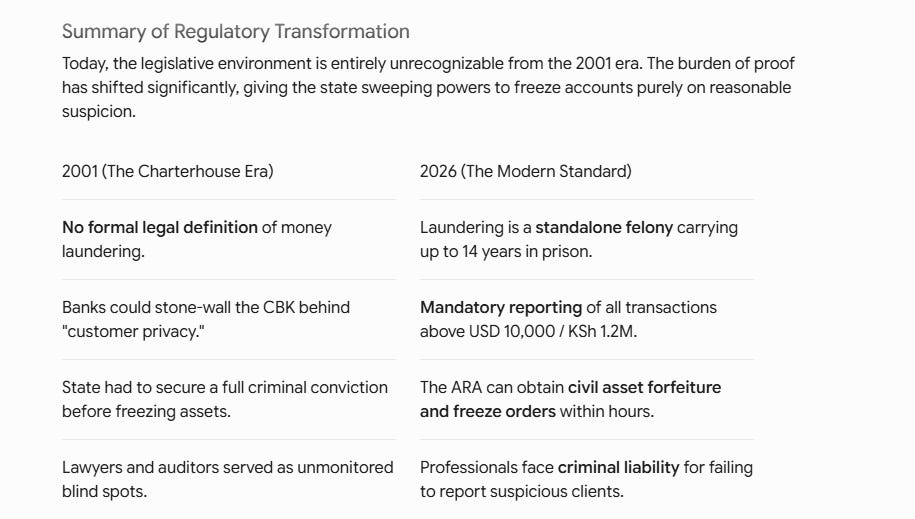
The Jurisprudential Legacy: Every single KYC questionnaire a Kenyan fills out today, every single compliance flag raised on a large cash transaction, and every asset forfeiture executed by the state trace their roots directly back to the vulnerabilities exposed by Charterhouse Bank. The state was humiliated into building a fortress.

