
Boardlot Africa | Silicon Savannah Chronicles
The $100M Fish Factory: Infrastructure Engine or CapEx Treadmill?
Part 1: The Great African Protein Deficit
Over the last decade, Sub-Saharan Africa’s venture landscape was obsessed with digital disintermediation. Billions of dollars flooded into asset-light software platforms, B2B e-commerce order books, and last-mile delivery algorithms designed to digitize informal trade.
Yet, while tech founders burnt capital optimizing the distribution of packaged consumer goods, a far more fundamental structural crisis went unaddressed: East Africa is running out of real food.
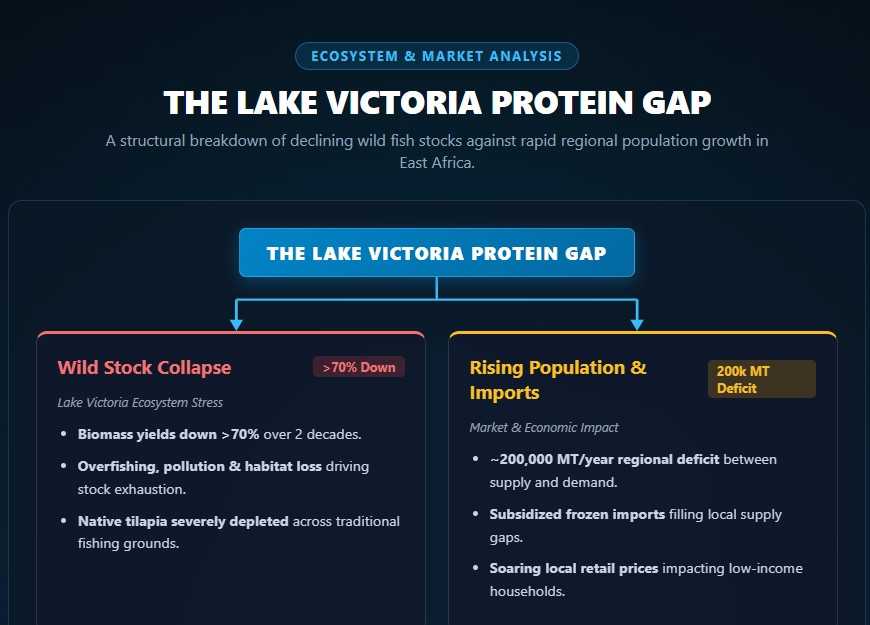
Nowhere is this gap more pronounced than in the basin of Lake Victoria. Historically the region’s primary source of native tilapia, the lake’s wild-catch yields have plummeted over 70% in two decades due to overfishing, environmental degradation, and invasive predators. This biological collapse created a staggering regional supply deficit—forcing East Africa to import hundreds of thousands of metric tons of frozen, heavily subsidized tilapia from China to meet basic urban demand.
Enter Victory Farms.
Founded in 2015, Victory Farms did not set out to build another app. Instead, it set out to construct an industrial-scale food utility—combining deep-water aquaculture cages in Lake Victoria, controlled hatcheries, proprietary feed technology, cold-chain logistics, and a direct-to-retail distribution network across Kenya and Rwanda.
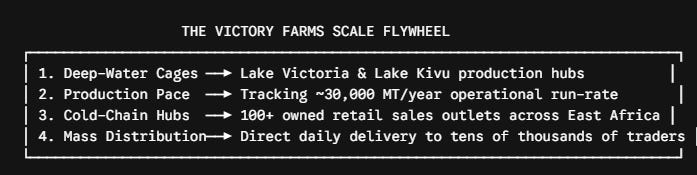
Today, as Victory Farms accelerates toward a production milestone of 30,000 metric tons per year across its Kenyan and Rwandan operations backed by over 100 owned retail outlets, it stands as sub-Saharan Africa’s most capitalized aquaculture platform.
Having raised over $100 million in cumulative equity, DFI debt, and mezzanine facilities, Victory Farms presents institutional allocators with a critical strategic question:
Part 2: The Founders & The West African Blueprint
Understanding Victory Farms requires stripping away the typical Silicon Valley founder trope.
Joseph Rehmann and Steve Moran did not come out of a Palo Alto incubator. They brought a lethal combination to East Africa: high-finance capital structuring and hard-nosed, boots-on-the-ground aquaculture operations.
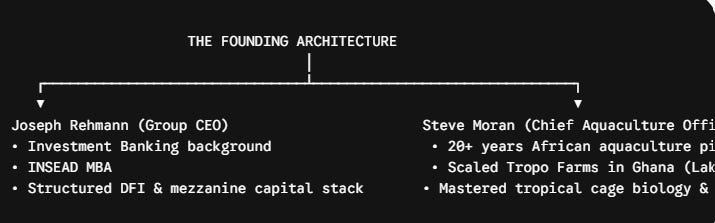
The Operational Architects
Joseph Rehmann (Co-Founder & Group CEO): A former investment banker with an MBA from INSEAD, Rehmann specialized in corporate finance and capital allocation before transitioning into African agri-infrastructure. His skill set was not writing code, but understanding how to bridge the gap between high-risk frontier assets and conservative international debt markets.
Steve Moran (Co-Founder & Chief Aquaculture Officer): A veteran operator in tropical aquaculture. Before Victory Farms, Moran spent seven years leading operations at Tropo Farms in Ghana—scaling it into one of the largest tilapia producers on Lake Volta. Moran brought deep, non-transferable domain knowledge in tropical cage design, feed conversion ratios (FCR), fingerling genetics, and mortality mitigation under African lake conditions.
The Tropo Farms Blueprint: Testing the Model in West Africa
Before placing a single cage into Lake Victoria, the founders had already witnessed both the potential and the structural pitfalls of African aquaculture through the West African experience.
At Tropo Farms on Lake Volta, Moran proved that commercial tilapia farming could achieve massive scale in Sub-Saharan waters. However, the Ghana experiment also exposed two structural vulnerabilities that would ultimately shape Victory Farms’ operational playbook in Kenya:
The External Cold-Chain Trap: Relying on third-party distributors and informal wholesalers meant farmers lost control over fish quality, pricing power, and cash collection cycles once the harvest left the farm gate.
The Feed Currency Mismatch: Sourcing expensive imported feed without controlling the local retail price created extreme vulnerability to local currency depreciations.
2015–2016: The Roo Landing
In late 2015, Rehmann and Moran took these lessons to Roo, a rural village in Homa Bay County on the shores of Lake Victoria.
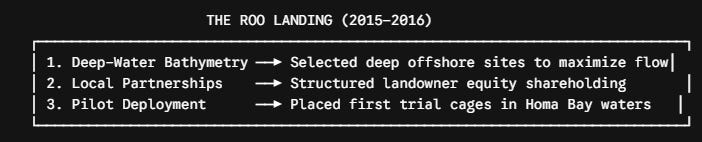
They did not start by leasing retail spaces in Nairobi. They spent months mapping bathymetric data—seeking deep, oxygen-rich waters in Lake Victoria that could support high-density industrial cages while mitigating environmental impact.To build local immunity against political and community friction, they structured a shareholder program giving surrounding landowners equity in the local operating entity. By 2016, with their first trial cages submerged in Roo, Rehmann and Moran set out to execute what would become the most capital-intensive, vertically integrated food experiment in East Africa.
Part 3: The Structural Shift — Owning Physical Assets vs. The Brokerage Trap
To understand why Victory Farms has survived while celebrated East African Agritech and B2B platforms imploded, one must look closely at the structural design of the supply chain.
Between 2017 and 2024, Silicon Valley venture funds poured over $300 million into Kenyan agritech and B2B ordering platforms—most notably Twiga Foods and iProcure. The pitch was seductive: use software to disintermediate chaotic, multi-layered informal markets, connect farmers directly to informal retailers (mama mboga or agro-dealers), and extract a digital transaction fee.
Yet, despite raising eye-watering sums ($185M+ for Twiga, $17M+ for iProcure), both companies succumbed to severe financial distress, entering formal administration as heavy burn rates and negative delivery margins caught up with them.
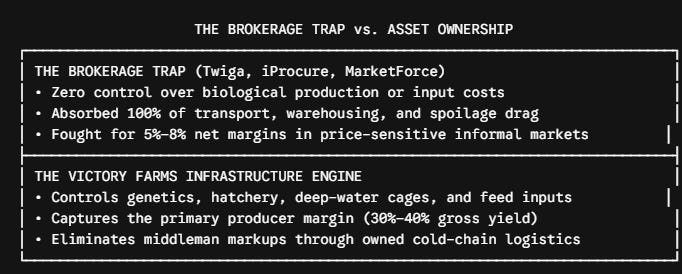
The Brokerage Trap: Why Agritech Middlemen Flame Out
The fundamental flaw of the “pure digital platform” approach in African food systems is simple: you absorb all the physical infrastructure drag without owning the high-margin supply.
Margin Squeeze at Both Ends: Middleman platforms like Twiga bought produce from independent, fragmented smallholder farmers who faced seasonal weather shocks, variable quality, and erratic pricing. They then tried to sell this produce to low-income informal vendors who had zero loyalty and bought strictly on the daily floor price.
Uncompensated Logistics CapEx: The platforms spent tens of millions of dollars leasing massive fulfillment centers (like Twiga’s Tatu City hub) and running fleets of trucks. They took on fixed, hard-currency-backed overheads to move highly perishable, low-yield items like bananas and tomatoes—taking on 100% of the spoilage, shrinkage, and fuel risk for a paper-thin net margin.
When global venture capital dried up, these platforms could no longer afford to subsidize logistics costs or fund inventory working capital out of equity. Without a high-margin anchor product, the unit economics collapsed.
The Victory Farms Counter-Model: Capturing the Primary Yield
Victory Farms approached the protein deficit from the exact opposite direction. They recognized that in frontier markets, the real margin is locked inside primary production and biological efficiency, not order-taking software.
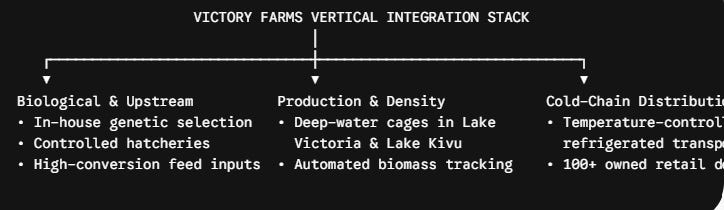
Upstream Margin Capture: By owning the hatchery, the genetic lines, and the deep-water cages, Victory Farms captures the primary agricultural producer margin (typically 30%–40% gross margin), rather than fighting for a 5% broker fee.
Price & Quality Lockout: Because they control the harvest schedule, Victory Farms guarantees uniform fish sizing, daily availability, and cold-chain integrity—giving them structural pricing power over frozen Chinese imports and unorganized wild catch.
Eliminating Warehouse Drag: VF built a lean distribution engine tailored specifically to local informal market dynamics. Rather than trying to deliver single boxes of fish to thousands of individual stalls, they established over 100 compact, owned retail depots directly inside high-density informal markets.
By refusing to be a middleman, Victory Farms turned vertical integration into its primary defense against the unit-economic trap that destroyed East Africa’s early tech darlings.
Part 4: The Capital Stack Audit — DFI Debt vs. Venture Capital Equity
Building a continent-scale protein infrastructure project on Lake Victoria requires immense capital. But more importantly, it requires the right kind of capital.
While venture darlings were burning through short-term equity checks to fund customer acquisition discounts, Victory Farms quietly engineered one of the most sophisticated, multi-layered capital structures in sub-Saharan African agriculture.
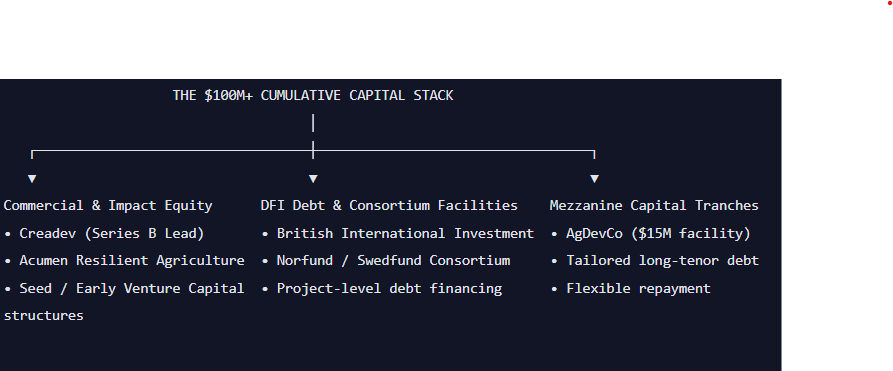
Tracing the Capital Velocity ($100M+)
To date, Victory Farms has raised over $100 million in cumulative equity, DFI debt, and mezzanine financing:
Early Venture & Growth Equity: After initial seed financing, Victory Farms raised a $35 million Series B round in 2023 led by French investment firm Creadev, with participation from Acumen Resilient Agriculture Fund (ARAF), Seedstars, and KATAPULT.
DFI Consortium Debt ($85M Lead Facilities): Victory Farms unlocked large-scale institutional debt facilities anchored by European Development Finance Institutions—including British International Investment (BII), Norfund, and Swedfund.
Mezzanine Facilities: Secured targeted long-term mezzanine capital, including AgDevCo’s $15 million debt facility, designed specifically to fund hatchery expansions, feed processing integration, and regional cold-chain infrastructure.
The Strategic Pivot: Why DFI Debt Beats Silicon Valley VC
The transition from venture capital equity to DFI debt was not an accident—it was a structural survival pivot.
Silicon Valley VC funds operate on short 7-to-10-year fund cycles. They demand rapid year-over-year revenue growth, high top-line multiples, and fast liquidity events. For physical infrastructure operating in frontier markets—where you must wait months for fingerlings to mature in deep-water cages—VC equity becomes toxic.
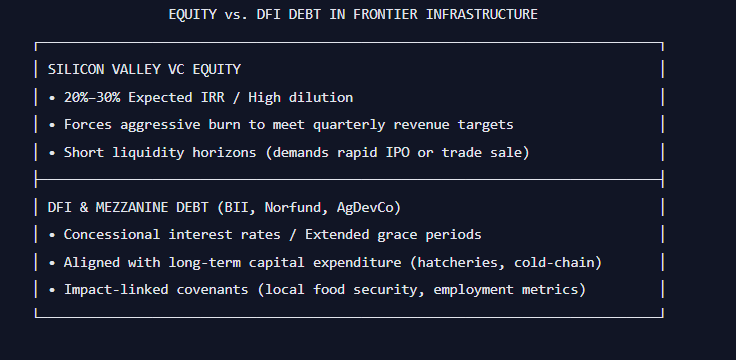
By tapping DFIs like BII, Norfund, and AgDevCo, Victory Farms secured long-tenor, patient capital. DFIs measure success not just in quarterly burn efficiency, but in regional food security, local employment, and carbon-offset metrics. This alignment allows Victory Farms to build out physical hatcheries and processing plants without the pressure of quarterly equity dilution.
The Balance Sheet Trap: Hard-Currency Debt vs. Local-Currency Revenue
However, this mega capital stack carries a inherent structural risk: The Currency Mismatch.
Victory Farms earns nearly 100% of its revenue in Kenyan Shillings (KES) and Rwandan Francs (RWF) from daily fish sales to local market vendors. Yet, a substantial portion of its DFI debt facilities and imported feed components are denominated in US Dollars (USD) or Euros (EUR).
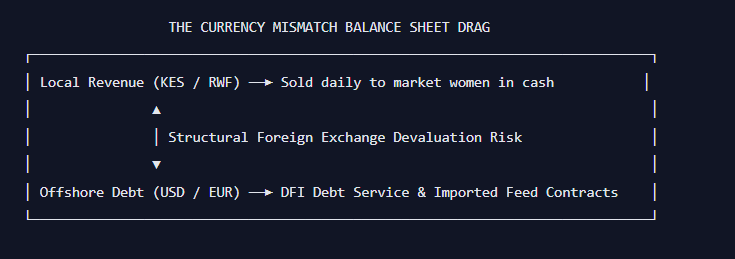
When regional currencies depreciate against the Dollar, the local cost of servicing hard-currency debt spikes overnight. For Victory Farms to maintain financial health, its gross operational margins must outrun both local currency inflation and the cost of servicing offshore DFI debt.
Part 5: Micro Unit Economics & Distribution — Why Victory Farms Succeeded Where Others Failed
The ultimate test for any African agricultural enterprise is not how much capital it can raise, but what happens to its unit economics at the micro level.
Why did Victory Farms succeed in building a profitable, cash-generative distribution engine while digital B2B darlings—like Twiga Foods, Copia, and MarketForce—burned through hundreds of millions in venture capital only to collapse?
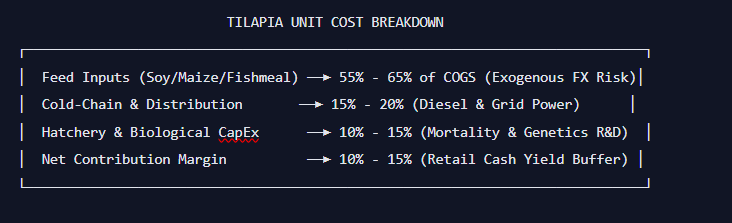
The answer lies in the fundamental unit economics of a single kilogram of fish.
1. The Feed Conversion Ratio (FCR) Arbitrage
The Cost Driver: Feed represents 55% to 65% of total Cost of Goods Sold (COGS) in commercial aquaculture.
Why Others Failed: Traditional livestock and smallholder aggregation models operated with poor, unstandardized Feed Conversion Ratios (FCR)—requiring 2.5kg to 3kg of expensive feed to produce 1kg of meat.
The Victory Farms Edge: By employing high-performance genetic selection and automated, acoustic feeding sensors in Lake Victoria’s deep waters, Victory Farms drives its FCR down toward ~1.2 to 1.4. Every fraction of a point saved on FCR translates directly into millions of dollars in gross margin expansion that no middleman broker can match.
2. Eliminating the Cold-Chain Storage Trap
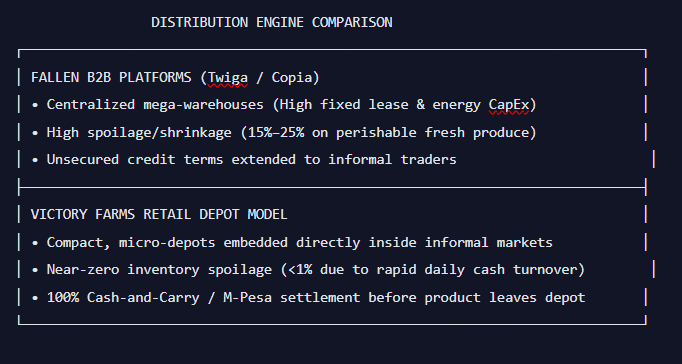
The Logistics Drag: Tech platforms built giant, central refrigerated warehouses and ran fleets of heavy diesel trucks to move low-value, highly perishable produce across urban traffic—taking on massive fixed overheads and high spoilage rates (up to 25%).
Why Victory Farms Succeeded: Instead of delivering individual boxes to thousands of scattered kiosks, Victory Farms built over 100 compact, company-owned retail depots embedded directly within informal market hubs (such as Gikomba, Kibera, Kisumu, and Kakamega).
Zero Spoilage via High Turnover: Fish are harvested at night, transported via insulated cold-chain trucks, and arrive at neighborhood depots by dawn. They are sold out in cash-and-carry daily batches within hours, completely eliminating multi-day warehousing costs and keeping spoilage rates below 1%.
3. Empowering the Mama Samaki (Zero Credit Risk)
The Credit Trap: B2B platforms attempted to buy market share by offering unsecured buy-now-pay-later (BNPL) credit to informal vendors, leading to catastrophic default rates as macroeconomic headwinds mounted.
Why Victory Farms Succeeded: Victory Farms tapped into the existing, highly resilient network of tens of thousands of mama samakis (female fish traders). Because fresh tilapia is a non-discretionary, high-velocity protein, traders purchase their daily stock from Victory Farms depots in cash or via M-Pesa every morning, turning it into fried or fresh retail sales by sunset.
100% Cash Collection: Victory Farms collects its working capital immediately at the depot counter—generating positive cash flow before its monthly feed or debt service bills come due.
4. Biological Moat vs. Software Illusions
Why Victory Farms Succeeded: Software can be copied overnight, and digital platforms face constant disintermediation when buyers and sellers trade off-platform to avoid fees. You cannot disintermediate a deep-water cage holding millions of live, genetically optimized fish. Victory Farms built a physical, biological moat that guarantees supply reliability 365 days a year—something no software startup could ever deliver.
Part 6: Risk Matrix & The Boardlot Verdict
For all its operational breakthroughs, Victory Farms is not immune to gravity. Scaling an industrial protein platform across Sub-Saharan Africa means operating at the intersection of biological fragility, foreign exchange exposure, and sovereign volatility.
To evaluate whether Victory Farms can evolve into a long-term dividend machine or remain tied to development capital, institutional investors must scrutinize three existential risk vectors:
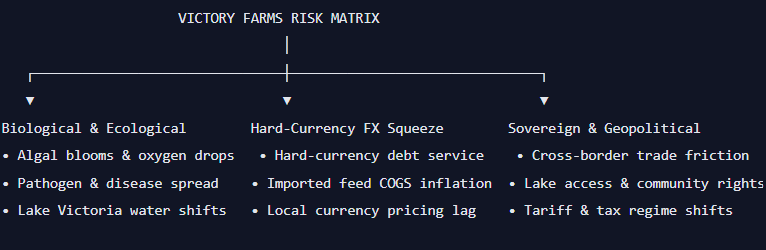
1. Biological & Ecological Vulnerabilities
The Environmental Hazard: Deep-water open-cage aquaculture relies on the natural ecosystem of Lake Victoria and Lake Kivu. Seasonal water turnover, sudden drop-offs in dissolved oxygen, and toxic algal blooms pose constant biological threats that can wipe out entire cage cycles overnight.
Pathogen Risk at Scale: High-density cage stocking amplifies the risk of infectious aquatic diseases—such as Tilapia Lake Virus (TiLV) or bacterial Streptococcus outbreaks. While Victory Farms deploys strict biosecurity and recirculating aquaculture system (RAS) hatcheries, a major disease outbreak would severely disrupt production.
2. Hard-Currency Debt vs. Local-Currency Revenue
The FX Squeeze: Victory Farms collects nearly 100% of its operating revenues in local fiat—Kenyan Shillings (KES) and Rwandan Francs (RWF). However, its capital structure includes large-scale hard-currency DFI facilities denominated in USD and EUR.
Feed COGS Exposure: Major raw feed ingredients (soy, maize, fishmeal) are priced against global dollar commodities. Currency devaluations instantly push up COGS, creating a margin squeeze if local retail fish prices cannot be raised at the same pace without denting demand among low-income consumers.
3. Sovereign & Community Friction
Cross-Border Regulatory Barriers: Expanding into Rwanda (via its sister brand Kivu Choice / Samaki Kivu) and targeting broader East African markets requires navigating fragmented trade policies, non-tariff barriers, and evolving veterinary import laws.
Riparian Access & Local Politics: Operating thousands of hectares of deep-water concessions requires continuous alignment with local beach management units (BMUs), traditional fishing communities in Homa Bay and Migori, and national environmental authorities (NEMA).
The Boardlot Verdict
Where venture-backed B2B startups—Twiga, MarketForce, Copia, Sendy, and iProcure—sold software promises and collapsed under logistics drag, Victory Farms built a physical infrastructure moat. Rather than burning capital attempting to disintermediate or “digitize” traditional retail, Victory Farms weaponized the existing, hyper-resilient mama samaki and mama mboga distribution networks. By capturing the primary producer margin, erecting a zero-spoilage depot network embedded directly within informal market centers, and enforcing a strict 100% cash-and-carry settlement model, Victory Farms has proved that vertical integration and localized trust can survive frontier execution.
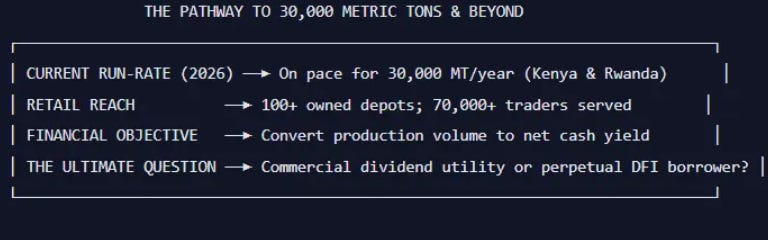
Victory Farms is on pace to produce 30,000 metric tons of fish per year across Kenya and Rwanda. The company has crossed the bridge from venture-funded experiment to regional food utility.
However, the final test remains: Can Victory Farms generate sufficient net free cash flow in local currency to comfortably service its $100M+ hard-currency DFI stack without requiring perpetual debt refinancing?
If it achieves this yield balance, Victory Farms will not only remain sub-Saharan Africa’s undisputed protein champion—it will provide the ultimate blueprint for building real, asset-heavy businesses in the African frontier.
Institutional Quote
“Victory Farms isn’t a tech startup selling a software dream; it is an industrial food utility operating in a continent starved of cheap protein. But when your revenue is collected in local currency and your capital stack is tied to global dollar debt, vertical integration is both your strongest operational moat and your heaviest financial burden.”
— Boardlot Sultan
A Note to DFI Capital Allocators
Institutional Note:
The systemic distress and collapse of Sub-Saharan Africa’s venture-backed distribution platforms—most notably Twiga Foods, MarketForce, Copia, Sendy, and iProcure—should serve as a permanent warning against funding abstract software layers that attempt to force artificial digital rails onto informal markets. Silicon Valley equity prioritized rapid, subsidized top-line GMV expansion over the physical realities of inventory drag, cold-chain spoilage, uncompensated logistics CapEx, and working capital defaults.
For DFIs, impact funds, and sovereign allocators seeking resilient food security and real infrastructure yields across frontier markets, the lesson is not to abandon African agriculture or logistics—it is to fund the right structural models.
High-yielding, defensible models do exist, but they look remarkably different from the failed digital B2B and B2C brokerage platforms of the last decade:
Primary Margin Ownership Beats Disintermediation: Sustainable impact capital must back primary production assets—hatcheries, deep-water biological cages, processing plants, and cold-chain hubs—that capture real 30%–40% gross yields rather than fighting for paper-thin 5% broker fees.
Embedding in Existing Informal Networks: The most capital-efficient distribution models do not attempt to “disrupt” or bypass informal traders. Success lies in embedding physical, high-velocity infrastructure directly into established, highly resilient traditional networks—such as the daily cash-and-carry mama samaki depot hubs that require zero debt financing or BNPL subsidies.
Local-Currency Debt Architecture: Funding physical infrastructure with hard-currency (USD/EUR) debt creates inherent balance sheet fragility. Capital allocators must innovate blended, local-currency-denominated credit instruments to prevent macro currency devaluations from destroying fundamentally sound operational models.
Capital deployment in frontier markets must prioritize biological efficiency, cash-yield conversion, and localized distribution moats over Silicon Valley growth narratives.
Boardlot Africa is a premier financial intelligence and corporate governance publication dedicated to unpacking the mechanics of capital, market strategies, and structural shifts across East Africa’s corporate landscape. By bridging the gap between raw economic data and actionable market intelligence, we deliver deep-dive research, independent corporate analysis, and policy insights designed for institutional investors, boardrooms, and sharp market observers.
Get in Touch
Email: sultan@boardlot.africa
Phone: +254 753 133 901/254181683210
Substack: Subscribe to Boardlot Africa
X (Twitter): BoardLotSultan
Linkedn:): BoardLot Sultan