
Who is Trying to Stop This Transaction?
Investigating the Legal Challenges to Diageo’s Sale of Its EABL Stake to Asahi Group Holdings:
On December 17, 2025, British drinks giant Diageo announced the sale of its 65% controlling stake in East African Breweries Plc (EABL) — held through Diageo Kenya Limited — along with its 53.68% interest in UDV Kenya, to Japan’s Asahi Group Holdings. The deal, valued at approximately $2.3 billion for the stake (with an implied enterprise value of around $4.8 billion for EABL), represents Diageo’s strategic exit from African brewing operations and Asahi’s major entry into the East African market.
Expected to close in the second half of 2026 (subject to regulatory approvals), the transaction has faced repeated court challenges in Kenya since announcement. These efforts have created uncertainty, raised questions about forum shopping, and tested the balance between private commercial disputes and large-scale cross-border investments with significant public interest implications (including potential Sh42 billion in capital gains tax revenue for Kenya).
This article examines the key players behind the legal attempts to halt or condition the deal, their backgrounds, stated motivations, and court outcomes.

The Challengers: Three Main Entities
Three primary actors have mounted challenges: two with longstanding commercial grievances and one focusing on minority shareholder and regulatory issues.
1. Bia Tosha Distributors Ltd – The Persistent Distributor:
Bia Tosha Distributors Ltd, a Kenyan beer distribution company, has a history of commercial disputes with EABL entities dating back to at least 2016. The company was involved in distributing EABL/Kenya Breweries Ltd (KBL) products and alleges unfair termination of distribution routes, anti-competitive practices, and related damages.
In early 2026 (starting around January), Bia Tosha filed urgent applications in the High Court seeking to block the Diageo-Asahi transaction. Their argument: completion of the sale could prejudice enforcement of any favorable judgment in their underlying dispute, as Diageo’s exit might complicate recovery of damages.
Court Outcome: Multiple bids were dismissed. In April 2026, Justice Bahati Mwamuye rejected the application to halt the deal, finding insufficient direct linkage between the historical distribution dispute and the share sale. The underlying 2016 matters could proceed independently. Further attempts, including in June, were also unsuccessful. EABL argued there was no factual or legal connection, and Asahi as the incoming owner would remain subject to Kenyan law.
Lawyer Kenneth Kiplagat represented Bia Tosha in these proceedings.

2. JILK Construction Company Ltd – The Contractor Claimant:
JILK Construction Company Ltd is a Kenyan firm that worked on EABL/KBL projects, notably the Kisumu brewery expansion in western Kenya. Their dispute stems from a terminated 2017 construction contract, involving claims for compensation (reportedly around Ksh 2.45 billion / ~$19 million) through arbitration and related proceedings.
In January 2026, JILK filed a separate High Court suit and urgent application to restrain the transaction, citing risks that Diageo’s exit would frustrate enforcement of any arbitral award. They named Diageo, EABL, KBL, and regulators as parties.
Court Outcome: On or around June 17, 2026, Justice Gregory Mutai dismissed JILK’s application. The court found no sufficient legal connection to the share transfer and emphasized the deal’s significant public interest and financial implications for Kenya.

3. Christine Irungu – The Minority Shareholder and Regulatory Petitioner:
The most recent and currently active challenge comes from Christine Irungu, a businesswoman who describes herself as a “spirited Kenyan” and public interest litigant. She appears to act in her capacity related to minority shareholding interests in EABL.
Irungu’s petition, filed around June 18, 2026, in the Machakos High Court, targets a different angle: constitutional and capital markets issues. Key claims include:
Minority shareholders allegedly lacked material information during Diageo’s 2022–2023 tender offer, which increased its stake from ~50% to 65%. Diageo had presented this as a long-term commitment.
The subsequent sale to Asahi (potentially at a control premium) disadvantaged those who sold or held shares.
Regulatory failures by the Capital Markets Authority (CMA) in protecting minorities and the Competition Authority of Kenya (CAK) in assessing impacts on competition, consumers, distributors, and public interest.
The petition names Diageo entities, EABL, Asahi, CMA, CAK, and others, seeking full disclosure of transaction documents, fresh regulatory reviews, and preservation of the status quo. Court Outcome: On the same day (June 18), Justice Josephine Mongare issued ex parte conservatory orders preserving EABL’s current ownership structure and restraining steps toward completing the deal pending an inter partes hearing. The matter is scheduled for mention on July 2, 2026. These orders remain in force as of late June 2026.
This filing came hours after a Nairobi court dismissed JILK’s bid, prompting EABL to petition Chief Justice Martha Koome for intervention over parallel proceedings, potential forum shopping (petitioner and most respondents Nairobi-based, yet filed in Machakos), and risks of conflicting orders.

Patterns and Broader Implications:
The first two challenges stemmed from pre-existing commercial/contractual disputes (distribution and construction) and sought to link them to the share sale for leverage. Courts largely rejected these, prioritizing the transaction’s independence and public benefits. Irungu’s petition shifts the focus to shareholder rights and regulatory diligence, potentially carrying more weight as a constitutional matter. EABL and Diageo maintain that these are separate disputes with no direct bearing on the validity of the Diageo-Asahi transfer. They stress the deal’s economic importance and regulatory progress (approvals secured in Uganda and Tanzania; CAK clearance pending).
Critics of the challenges point to timing, repeated filings, and use of ex parte orders as potential tactics for delay or settlement pressure. Supporters argue they highlight legitimate concerns about minority protection, enforcement of judgments, and transparent capital markets oversight in Kenya.Current Status and OutlookAs of June 24, 2026, the transaction is temporarily on hold due to the Machakos conservatory orders. The July 2 mention will be pivotal. Possible next steps include lifting of orders, appeals, further regulatory input, or negotiated resolutions.This saga underscores tensions in Kenya’s investment climate: robust access to justice versus the need for deal certainty in high-value M&A. For Diageo, it delays portfolio optimization; for Asahi, it postpones African expansion; for EABL and Kenya, it risks signaling instability to future investors.
The identities behind the challenges reveal a mix of longstanding litigants with direct commercial stakes and a newer voice raising systemic governance questions. Whether these efforts ultimately protect rights or merely prolong uncertainty remains to be seen in the coming weeks.

Who is Peter Burugu
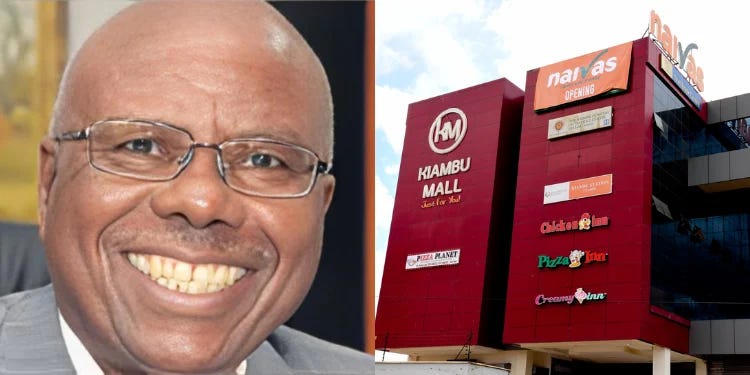
Peter Burugu GachuruPeter Burugu Gachuru (often referred to as Peter Burugu) is a prominent Kenyan businessman, founder and chairman of Bia Tosha Distributors Ltd, and owner/developer of Kiambu Mall through Mugaa Investments. He is a major player in the beer distribution sector and commercial real estate, with a reputation for being highly active in business and legal arenas rather than reclusive.
Personality and Lifestyle
Contrary to some media descriptions labeling him as “silent” or low-profile, Burugu is known to enjoy regular walks in Karura Forest, reflecting a grounded and accessible personal side amid his business success. He is widely recognized in Kenyan business circles as extremely litigious, with a long track record of court battles spanning distribution disputes, land and property claims, employment matters, and high-stakes corporate challenges.
His willingness to pursue legal remedies aggressively is evident in multiple ongoing and historical cases, including the protracted fight with EABL/Diageo entities.
Early Life and EABL Career:
Burugu spent about 27 years at East African Breweries Limited (EABL), starting as an accounts trainee and rising to head distribution and logistics. He left in the mid-1990s (around 1995) via a voluntary early retirement package during company restructuring.
Bia Tosha Distributors:
Post-EABL, he founded Bia Yetu as a retirement venture with a bank loan, a few trucks, and credit stock. He expanded aggressively, later creating Bia Tosha and merging the entities in 2008. The company became one of EABL’s largest distributors, covering key Nairobi and greater metropolitan routes (e.g., Nairobi West, Industrial Area, Upper Hill, Rongai, Kiserian, Kitengela, Athi River, and corridors toward Tanzania). At its height, it handled significant volumes of EABL products.
His daughter, Anne-Marie Burugu, serves as Managing Director, while he remains chairman. The business has generated substantial revenue and employed dozens directly while supporting broader logistics networks.
Ongoing Litigation:
Since 2016, Bia Tosha has been engaged in major disputes with EABL/Diageo over distribution territories, goodwill compensation, and related claims (reported demands in the range of Ksh 1 billion+ for alleged losses). This has extended to attempts to influence or halt the Diageo-Asahi transaction.
Real Estate:
Kiambu Mall and Beyond:
Through Mugaa Investments, Burugu developed Kiambu Mall, a Ksh 800 million+ five-storey commercial centre in Kiambu town. Key tenants include Naivas, Java, fast-food chains, banks, and a Nairobi Hospital branch. It serves as a local alternative to Nairobi shopping destinations.
He has also been involved in other high-value property matters, including disputes over prime land in areas like Runda (one reported ~16.7-acre site valued at around Ksh 3 billion).
Judicial Processes, Forum Shopping Allegations, and Public Commentary on the EABL-Asahi Transaction;
On 23 June 2026, lawyers representing East African Breweries Limited (EABL) — including Senior Counsel Kamau Karori of Iseme, Kamau & Maema Advocates (IKM Advocates) — wrote a detailed letter to Chief Justice Martha Koome seeking administrative intervention in the ongoing litigation surrounding the proposed $2.3 billion (approximately Sh340 billion) acquisition of Diageo’s 65% stake in EABL and related interests in UDV Kenya by Japan’s Asahi Group Holdings.
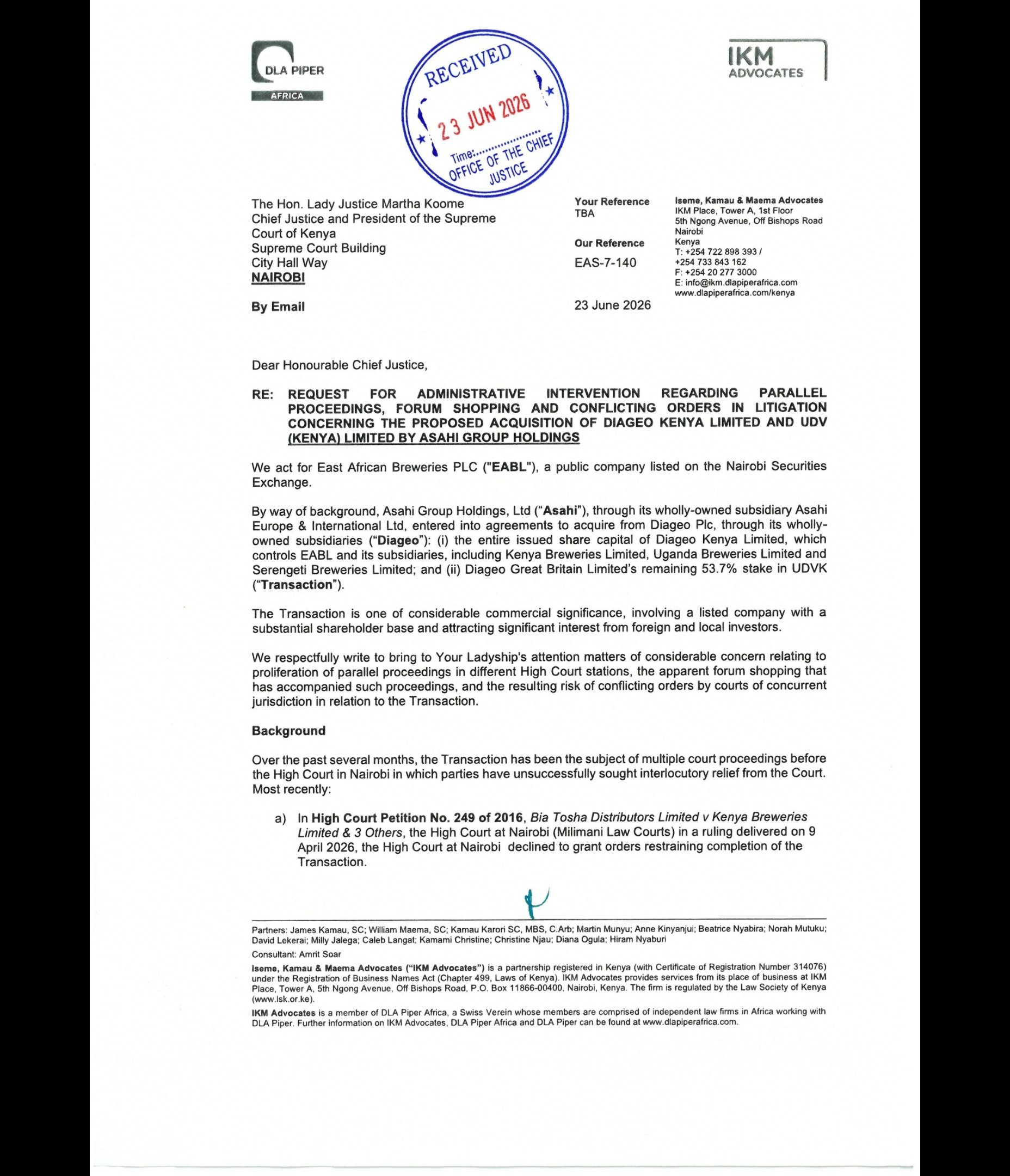
The letter highlighted what the advocates described as forum shopping and an abuse of court processes. It noted multiple parallel proceedings in different High Court stations. Applications for orders to restrain or halt the transaction had been declined in Nairobi, yet similar or related petitions were subsequently filed in other jurisdictions (including Machakos), where ex parte conservatory orders were then issued. The correspondence argued that this created a risk of conflicting orders, undermined judicial comity between courts of concurrent jurisdiction, and introduced unacceptable uncertainty into a major commercial transaction governed by strict contractual timelines.
The advocates requested that the Chief Justice exercise her administrative authority under the Constitution and the Judicial Service Act. Specific proposals included designating a single High Court judge in Nairobi to handle all related proceedings, expediting hearings, and engaging with the Judicial Service Commission to address the fragmentation and prevent further proliferation of cases.
Ahmednasir Intervention
In a widely circulated social media post on the same day, prominent constitutional lawyer and Senior Counsel Ahmednasir Abdullahi directly referenced the letter (which he attached as images) and addressed Kamau Karori SC. He wrote: “My friend Kamau Karori SC...CJ can’t help...tell your client to pay a BRIBE to those blocking your client...hapa ni Kenya bwana SC...” (tagging another lawyer, Nelson Havi). In an earlier post on the same matter, Abdullahi had similarly advised the parties involved in the EABL deal to “do the needful and BRIBE the right parties,” stating that the endless litigation and regulatory roadblocks meant “some people can’t let a deal worth Kshs 340b pass without their cut...this is Kenya bwana...lipa pesa.”
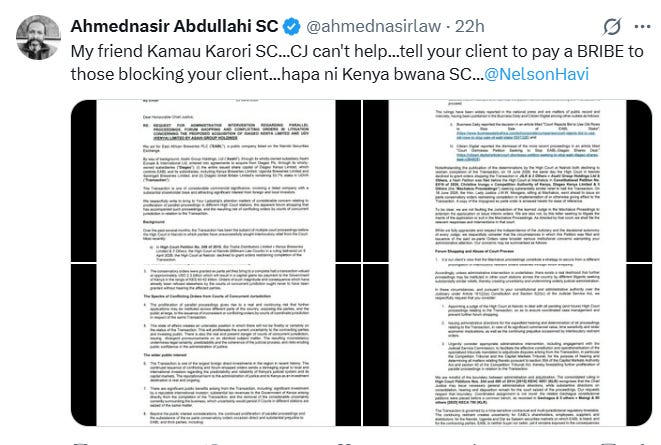
Abdullahi’s comments were interpreted by many observers as a blunt suggestion of judicial corruption or systemic graft influencing the handling of high-stakes commercial disputes. His remarks framed the reliance on court orders and administrative appeals as ineffective in the Kenyan context, implying that improper payments might be the practical route to overcoming obstacles posed by litigants and certain judicial decisions.These public interventions by two senior members of the Kenyan Bar have intensified debate about the administration of justice in major corporate transactions. They highlight longstanding concerns over the use of conservatory orders, forum shopping, and questions of judicial efficiency and integrity in cases involving significant foreign direct investment. The EABL-Asahi deal remains subject to ongoing regulatory approvals and the outcome of the various court challenges.
In the final analysis, Peter Burugu Gachuru, the influential founder of Bia Tosha Distributors and a long-time litigant against EABL over distribution rights and goodwill payments, appears to be the driving force behind both his company’s earlier legal challenges and the current minority shareholder petition by Christine Irungu, strategically using the courts to derail or extract concessions from the $2.3 billion Diageo–Asahi acquisition.