

Table of Contents
Executive Summary
Part 1: The Ruthless Accumulation of Wealth
Part 2: The Network of Titans & The Crucible of Power
Part 3: The Fortress of Last Resort — Pioneering the Living Trust
Part 4: The Outbreak of War & The Decay of the Crown Jewels
Part 5: The Landmark Judgment — How the High Court Rescued Njenga Karume’s Legacy
Part 6: Modern Lessons & The Horizon of Generational Wealth
Executive Summary
When self-made billionaire, former Cabinet Minister, and political kingmaker James Njenga Karume passed away from prostate cancer on February 24, 2012, he left behind an empire valued well over KES 120 billion. Built over five decades—from humble beginnings selling charcoal during the Mau Mau era—Karume’s portfolio encompassed prime real estate, commercial agriculture, beverage distribution, and flagship hospitality assets like the Jacaranda Hotel Group.
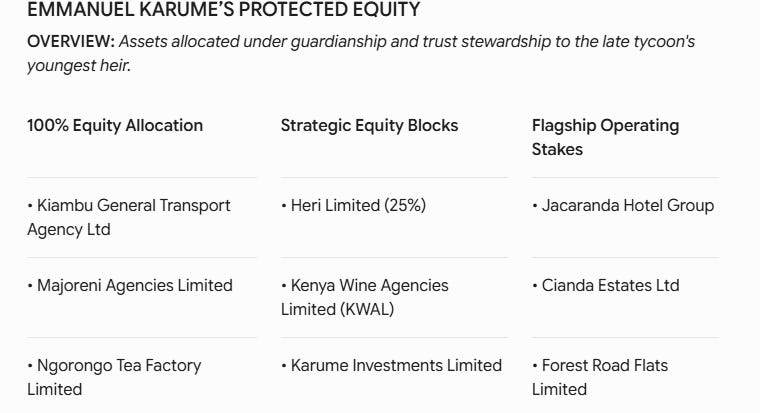
The revelation of his estate distribution in 2014 gripped the public imagination: among his primary heirs was his youngest son, Emmanuel Njenga Karume, who was just 4 years old at the time of his father’s passing. Emmanuel was bequeathed massive equity holdings across 10 major corporate entities, including:
100% control of Kiambu General Transport Agency Ltd, Majoreni Agencies Ltd, and Ngorongo Tea Factory Ltd.
Significant equity blocks in Heri Limited (25%) and Kenya Wine Agencies Limited (KWAL - 12.5%).
Direct stakes in Jacaranda Hotel, Cianda Estates Ltd, Karume Investments Ltd, Kabete Distributors Ltd, and Forest Road Flats Ltd.
Because Emmanuel was a minor, these assets were structured to be held under guardianship—managed via the Njenga Karume Trust and supervised by appointed guardians (including Dr. Dan Gikonyo and Bishop David Kamau) and executors—until he attained the age of 18. Beyond his immediate family, Karume’s generous bequest extended to loyal personal staff, granting KES 500,000 each to his longtime driver and cook.
However, what was designed as a fortress of generational wealth protection quickly degenerated into a classic, high-stakes court war. Hostility erupted between a faction of Karume’s older adult children and the trustees appointed to run the empire. Over a decade of litigation, tax liabilities, and debt default threats transformed one of East Africa’s most formidable fortunes into a case study on the vulnerabilities of estate planning and trust governance in Kenya.
Part 1: The Ruthless Accumulation of Wealth
The story of James Njenga Karume does not begin in plush boardrooms or high-ceilinged government offices. It begins in the dust and dense foliage of the Aberdare forest fringes in the late 1930s. Born into a landless family of squatter laborers on a European farm in Kiambu, young Karume understood early the brutal calculus of colonial Kenya: without land and capital, a man was merely a ghost in his own country.
He was not born into privilege; he forged it through a fierce, unyielding ambition. What separated Karume from his peers was not just hard work, but a cold, calculating foresight and a ruthless efficiency in capitalizing on every shift in Kenya’s political and economic tectonic plates.
1. The Charcoal Empire: The Mau Mau Era Opportunity
While the 1950s Emergency Period brought devastation to most, Karume recognized it as a market vacuum waiting to be exploited.
Exploiting Supply Lines: With movement strictly restricted for the Kikuyu population, trade in basic commodities collapsed. Karume secured coveted movement permits—navigating colonial bureaucracy with shrewd diplomacy—and built a monopoly moving charcoal and timber from the forests into the rapidly expanding townships of Kiambu and Nairobi.
Capitalizing on Chaos: While others focused purely on survival, Karume hoarded every shilling of profit, operating on paper-thin overheads and reinvesting immediately into physical assets. He realized that cash was temporary, but land and licenses were eternal.
2. The Conquest of Beverage Distribution
If charcoal was the foundation, beer was the catalyst that transformed Karume from a prosperous trader into a financial titan.
The Karia Ltd Masterstroke: Karume formed Karia Ltd, an entity that would become legendary in East African corporate history. Recognizing the explosive growth of urban drinking habits post-independence, he moved aggressively to corner the wholesale distribution of East African Breweries Limited (EABL) products.
Dominating the Central Circuit: Through a ruthless buyout of smaller regional distributors and strategic territorial expansion, Karia Ltd secured exclusive distribution rights across vast swathes of Central Kenya and Nairobi. Every bottle of beer consumed in these lucrative regions yielded a toll for Karume’s empire.
3. The Political Capitalist: GEMA and Land Aggregation
By the 1970s, Karume had mastered the ultimate Kenyan art form: synthesizing political patronage with massive land banking. As the founding chairman of the Gikuyu, Embu, and Meru Association (GEMA)—a socio-political powerhouse during President Jomo Kenyatta’s era—Karume sat at the absolute nexus of power.
Land Buying Companies: Through GEMA and personal land-buying syndicates, Karume orchestrated the acquisition of hundreds of thousands of acres of former European settler farms in the White Highlands (Kiambu, Nakuru, Laikipia).
The Prime Asset Accumulation: While organizing land for thousands of smallholder shareholders, Karume’s personal portfolio absorbed the crown jewels:
Cianda Estates: Thousands of acres of premium coffee and tea plantations in Kiambu.
Prime Urban Plots: Acquiring high-value commercial properties in Nairobi’s Central Business District (including Cianda House) and strategic parcels along major transport corridors.
Strategic Diversification: Karume did not restrict himself to agriculture. He poured capital into hospitality—establishing the iconic Jacaranda Hotel in Westlands, Nairobi, and expanding into coastal tourism with the Indian Ocean Beach Resort in Diani—alongside strategic minority equity stakes in commercial banks and manufacturing plants like Ngorongo Tea Factory.
4. The Billion-Shilling Titan
By the turn of the 21st century, Njenga Karume was no longer just a businessman; he was an economic nation-state. His personal fortune was conservatively estimated to exceed KES 120 billion.
He had constructed a empire that spanned hospitality, commercial real estate, agriculture, transportation, and retail distribution. Yet, the very trait that built this massive fortune—a ruthless, absolute, single-handed command over every shilling, deed, and enterprise—planted the seeds for the chaos that would unfold once the patriarch was no longer there to hold the empire together.

Part 2: The Network of Titans & The Crucible of Power
James Njenga Karume did not build his KES 120 billion fortune in a vacuum. His ascent was fueled by strategic alliances, high-stakes corporate syndicates, and fierce rivalries with the most powerful men in post-independence Kenya. To understand Karume’s wealth accumulation is to map out the elite network of the post-colonial aristocracy—where politics, land, and corporate equity merged seamlessly.
1. The Heri Limited Syndicate: Kibaki, Kiereini, and Njonjo
While Karume was building Karia Ltd to dominate beer distribution, he was simultaneously orchestrating syndicate investments with Kenya’s emerging political-bureaucratic elite.
The primary vehicle for this collective capital accumulation was Heri Limited—an elite investment company whose shareholder list read like a roster of Kenya’s ruling class.
Mwai Kibaki: A close personal friend, frequent golfing companion, and political partner. Kibaki and Karume pooled capital into Heri Limited, commercial real estate, and financial institution equity. Karume would later serve as a major financial engine behind Kibaki’s Democratic Party (DP) and eventually join his Cabinet.
Jeremiah Kiereini: As Permanent Secretary in the Ministry of Defence and later the formidable Chairman of East African Breweries Limited (EABL), Kiereini sat directly at the intersection of state power and corporate commerce. As a leading shareholder in Heri Limited alongside Karume, Kiereini was a crucial link in the corporate-bureaucratic nexus.
Charles Njonjo: Kenya’s first indigenous Attorney General held major shares in Heri Limited. This shared corporate interest created a web of mutual financial obligation between Karume, Njonjo, and the state’s top decision-makers.
2. The 1976 Clash: Karume vs. Njonjo & The Moi Succession
Despite their shared balance sheets in Heri Limited, political ambition shattered the alignment between Karume and Njonjo in 1976.
The GEMA Offensive: As Chairman of the Gikuyu, Embu, and Meru Association (GEMA), Karume spearheaded the high-stakes “Change the Constitution” movement. The goal was explicit: rewrite the succession laws to prevent Vice President Daniel arap Moi from automatically assuming the presidency upon Jomo Kenyatta’s death.
Njonjo’s Counter-Strike: Charles Njonjo, fiercely defending the constitutional process (and aligning himself with Moi), famously declared the discussion of the President’s death treasonous. Njonjo outmaneuvered Karume’s GEMA faction, securing Moi’s ascension in 1978.
The Aftermath with Moi: When Moi assumed power, Karume’s vast financial footprint was his greatest defense. Rather than expropriating Karume’s assets, Moi engaged in a pragmatic truce. Karume maintained his empire by insulating his holdings behind nominee accounts, strategic corporate trusts, and cross-shareholdings that quietly tied back into Nyayo-era power brokers.
3. Land Banking Rivals & Allies: John Njoroge Michuki
Parallel to Karume’s empire was that of John Njoroge Michuki—the ruthless Executive Chairman of Kenya Commercial Bank (KCB) and later Cabinet Minister.
The Land Rush: Both Karume and Michuki were aggressive orchestrators of post-independence land acquisition in Kiambu, Nairobi, and the Rift Valley. While Karume used GEMA and personal buying companies to corner agricultural coffee/tea estates (like Cianda), Michuki aggressively accumulated commercial real estate and large-scale agricultural holdings (like Windsor/Kangema estates).
Parallel Titans: The two operated as dual pillars of Kiambu’s financial elite for decades—frequent political allies in the struggle to protect Central Kenya’s economic hegemony, and personal friends until their deaths within days of each other in February 2012.
4. The Legacy of the Syndicate
Through these interactions, Karume ensured that his empire was deeply woven into the financial fortunes of Kenya’s founding fathers. When Karume accumulated shares in entities like Kenya Wine Agencies Limited (KWAL), Heri Limited, and Ngorongo Tea Factory, he was sharing balance sheets with the most powerful men in East Africa.
Yet, as the founding generation passed away—Michuki, Karume, Kibaki, Njonjo, and Moi—the personal trust and political handshakes that protected these corporate syndicates disintegrated, leaving heirs like 4-year-old Emmanuel Karume exposed to a new era of legal warfare.
Part 3: The Fortress of Last Resort — Pioneering the Trust in Kenyan Succession
By early 2011, James Njenga Karume was facing an enemy he could neither negotiate with nor buy off: stage-four prostate cancer. For decades, Karume had watched as the legendary fortunes of his peers, contemporaries, and political allies crumbled into public mudslinging the moment the patriarch was laid to rest. He was acutely aware of the cautionary tales surrounding Kenyan succession—endless probate litigation, frozen bank accounts, and asset decay driven by court injunctions. Karume was determined not to let his KES 120 billion empire suffer the same fate.
In a groundbreaking move for a high-net-worth African patriarch of his generation, Karume turned away from relying solely on a conventional Last Will and Testament. Instead, he became the first major Kenyan political and business titan to pioneer the use of a sophisticated, Irrevocable Living Trust as the primary legal fortress to ring-fence his corporate holdings and dictate succession across generations.

1. The Formation of the Njenga Karume Trust (May 2011).
In May 2011, operating under the advice of top-tier legal and financial strategists, Karume executed the deed establishing the Njenga Karume Trust. The core objective was structural separation: separating ownership of the underlying businesses from the beneficial enjoyment of the wealth. Karume recognized that if his vast corporate assets passed directly into his estate via probate, his heirs would battle over individual shares, paralyze company boards, and potentially force the liquidation of flagship assets. To prevent this, Karume transferred ownership of his primary holding companies into the Trust:
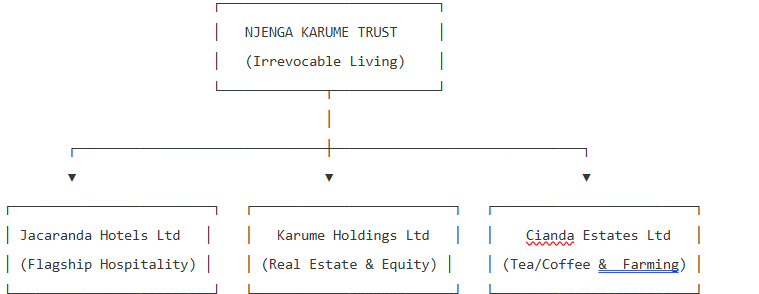
By vesting the equity of Jacaranda Hotels Ltd, Karume Holdings Ltd, and Cianda Estates Ltd into the Trust, Karume effectively removed his greatest income-generating assets from his personal estate. The empire would no longer belong to “Njenga Karume the individual,” but to a legal entity designed to outlive him.
2. The Dual-Instrument Strategy: Trust vs. Will
Karume’s succession architecture relied on two distinct, parallel legal instruments designed to handle two different categories of wealth:
Instrument A: The Declaration of Trust
Executed in August 2011, this document established the operational rules of the empire. It appointed a Board of Trustees—comprising trusted advisors, seasoned legal minds, and financial experts—to act as the stewards of the business holdings.
The Trust was mandated to manage the companies professionally, reinvest profits, service corporate debts, and distribute dividends or maintenance stipends to specified family beneficiaries according to strict guidelines.
Instrument B: The Last Will and Testament
While the Trust held the corporate engine, Karume used his Last Will to address personal real estate, liquid cash reserves, and direct share allocations outside the primary holding entities.
It was in this Will—details of which surfaced publicly in 2014—that Karume made some of his most dramatic personal bequests:
The 4-Year-Old Heir: Allocating a massive 10-company portfolio of direct shares (including Kiambu General Transport Agency, Ngorongo Tea Factory, Heri Ltd, and KWAL) to his youngest son, Emmanuel Njenga Karume.
Generous Staff Bequests: Demonstrating his characteristic loyalty to long-serving personal staff by leaving KES 500,000 each to his personal driver and cook.
Family Allocations: Providing specific property titles and monetary distributions to his widow, Grace Njoki, his older adult children, and his grandchildren.
3. Protective Shields: Guardianship & Execution Setup
Understanding that a 4-year-old child could not manage equity stakes in multi-billion-shilling corporate entities, Karume built a multi-layered guardianship and governance structure around his minor heirs.
Appointment of Guardians: Karume entrusted the personal care and estate guardianship of Emmanuel to respected public figures outside the immediate family battleground—notably Dr. Dan Gikonyo (founder of The Karen Hospital and Karume’s personal physician) and Bishop David Kamau. They were tasked with protecting the minor’s welfare and ensuring his inheritance remained intact until he attained the age of 18.
Executors of the Will: To administer the Will and oversee the probate transition, Karume named a mixed panel of family and trusted associates, including his daughter Dr. Francisca Wanjiku Kahiu, his cousin James Njenga, and his close friend Stephen Karau.
4. The Grand Experiment
With the signing of these documents in the final months of 2011, Karume believed he had solved the ancient problem of patriarch succession in Africa. He had pioneered a modern corporate fortress: professional trustees at the helm, guardians protecting minor heirs, and a living trust insulating the operating core from court injunctions.
Yet, Karume’s ground-breaking model contained an unintended flaw. By transferring power to an external Board of Trustees and placing vast wealth behind legal locks, he created a profound power imbalance between the trustees who held the keys and the older adult children who felt disenfranchised.
When Karume breathed his last on February 24, 2012, his trust framework did not prevent war—it became the primary battlefield.

Part 4: The Outbreak of War & The Collapse of the Fortress
When James Njenga Karume was laid to rest at his Cianda Estate in Kiambu in March 2012, the mourning period was brief. Behind the black-tie suits and solemn eulogies, a storm was gathering. The sophisticated legal machinery Karume had erected—the Irrevocable Living Trust, the Guardianships, the Board of Trustees—was meant to act as an unassailable shield. Instead, it became an engine of profound family division. Within two years of his passing, as the details of the Will and Trust structure became fully public in 2014, the estate exploded into one of the most vicious, high-stakes succession battles in East African judicial history.
1. The Spark: Disenfranchisement & The Capacity Challenge
The opening salvo came from a faction of Karume’s older adult children, led by Albert Kigera Karume, Samuel Wanjema Karume, and Lucy Karume. Having grown up watching their father run his empire with absolute authority, they suddenly found themselves subservient to an external Board of Trustees for every shilling of maintenance, medical allowances, and school fees.
To dismantle the fortress, the adult children launched a direct assault on the validity of the Trust itself:
The Mental Capacity Argument: The disaffected heirs filed suit in the High Court, alleging that by August 2011—when the critical Declaration of Trust amendments were executed—their father was severely debilitated by terminal cancer and heavy pain medication. They argued he was subjected to undue influence by his trusted advisors, who had written themselves into positions of unchecked corporate power.
The Allegation of Trustee Tyranny: The children claimed the trustees (including George Waireri, Kung’u Gatabaki, and Henry Waireri Karume) were acting as “lords of the estate,” withholding monthly living stipends, refusing to pay medical bills for family members, and making opaque capital allocation decisions without consulting the beneficiaries.
2. The Defense: Professional Duty vs. Financial Reality
The Trustees hit back with equal ferocity. Backed by corporate legal counsel, they maintained that Karume was of sound mind until his final weeks and was fully aware that his adult children lacked the financial discipline to run a KES 120 billion empire.
Operational Freeze: The Trustees argued that the children’s incessant court filings had frozen bank credit lines, spooked institutional partners, and made normal corporate governance impossible.
Cash Flow vs. Asset Value: While the estate was worth over KES 120 billion on paper, much of that wealth was locked in illiquid commercial land and tea plantations. Servicing multi-million-shilling monthly payouts to a massive extended family during an operational freeze was bleeding the holding entities dry.
3. The Minor Heir in the Crossfire: Emmanuel at 4 Years Old
Sitting in the middle of this legal warfare was young Emmanuel Njenga Karume. While his older half-siblings were actively fighting in courtrooms, the 4-year-old was an “overnight billionaire” who could not touch a single shilling of his vast 10-company portfolio. Because Emmanuel was a minor, his legal footprint was held in trust under the guardianship of Dr. Dan Gikonyo and Bishop David Kamau. However, the operational paralysis of the main holding entities meant that even the dividends and maintenance structures designed to fund his elite education and upbringing became entangled in court injunctions. The young boy was wealthy beyond measure on paper, yet completely reliant on the outcome of a decade-long judicial war.
4. The Decay of the Crown Jewels
As the legal battles dragged through the High Court and Court of Appeal, the crown jewels of Karume’s empire began to rot from the inside out. Without unified executive leadership or access to fresh capital, the operating businesses withered:
The Jacaranda Hotel Crisis: The flagship 128-room Jacaranda Hotel in Nairobi’s upscale Westlands—once the crown jewel of Karume’s hospitality portfolio—fell into severe debt distress. Lenders, unable to negotiate with a divided estate, moved to recover loans running into hundreds of millions of shillings. By 2018 and 2019, public newspapers were filled with auctioneer notices threatening to put Jacaranda Hotel under the hammer.
The KRA Tax Demands: The Kenya Revenue Authority (KRA) moved aggressively against the estate’s operating entities, demanding unpaid taxes exceeding KES 1 billion across Cianda Estates, Jacaranda Hotels, and beverage distribution arms.
Asset Liquidation Under Fire: To pay off mounting tax bills and bank debts, the Trustees attempted to sell off strategic land parcels in Kiambu and Muchatha. The disaffected heirs immediately rushed back to court, securing temporary injunctions that halted the sales, trapping the estate in a deadly cycle of rising interest and deteriorating assets.
The grand experiment had failed. The very mechanism designed to protect Karume’s wealth from post-mortem decay had instead locked it in a vice grip of litigation, tax liabilities, and public auction threats.

Part 5: The Landmark Judgment — How the High Court Validated the Karume Trust
By 2020, after nearly a decade of unrelenting legal warfare, the Njenga Karume succession battle had reached a dangerous impasse. The estate’s crown jewels—from the flagship Jacaranda Hotel to extensive tea estates—were sinking under mounting bank debts, frozen credit lines, and KRA tax demands exceeding KES 1 billion. The disaffected family faction sought to dismantle the entire framework, hoping to collapse the trust and force a direct distribution of assets.
On May 7, 2020, High Court Judge Rosslyn Aburili delivered a watershed judgment in Albert Kigera Karume & 2 Others v. George Ngugi Waireri & 2 Others (Milimani Civil Case No. 125 of 2015). The ruling did far more than resolve a bitter family dispute—it produced a monumental body of legal precedent. As Senior Counsel William Maema observed in an authoritative commentary for DLA Piper Africa (Iseme Kamau & Maema Advocates), Justice Aburili spawned “a tome of jurisprudence which will remain an unassailable treatise on the law of trusts and estate planning in Kenya for many years to come.”
1. The Fundamental Legal Question: Will vs. Trust
Unlike traditional succession disputes in Kenya, which typically focus on probate disputes or the distribution of land under a Will, the Karume case centered on a novel, modern legal concept: can a patriarch lock away a multi-billion-shilling empire inside an Irrevocable Living Trust to prevent his heirs from directly accessing or liquidating the assets?
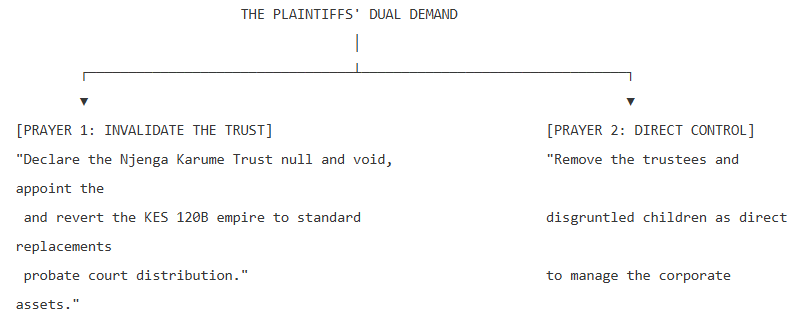
The disgruntled heirs argued that the Trust was an artificial legal barrier that disinherited them, kept them in the dark, and allowed external advisors to act as “lords of the estate.” They demanded that the court declare the Trust invalid and hand direct corporate control to the family.
2. The Four Pillars of Jurisprudence Established by the Court
Justice Aburili’s judgment drew a brilliant, decisive line between the validity of the trust structure itself and the personal conduct of the trustees running it.
Pillar I: The Sanctity of the Founder’s Intent
“It is not the duty of any court to alter or destroy a trust but to uphold and protect it and ensure that the trustees perform their duties as envisaged in the Trust Deed...” — High Court Judgment
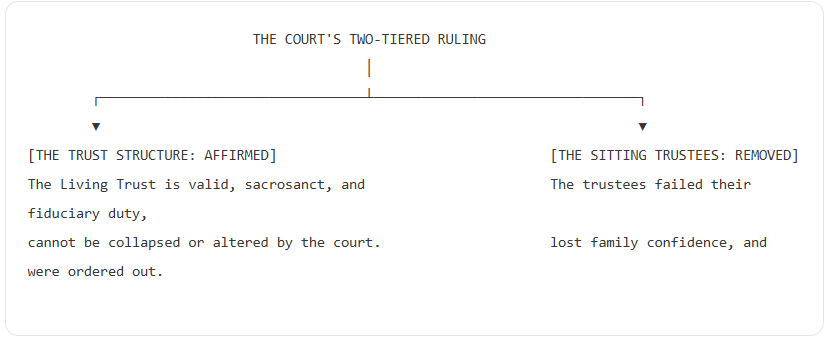
The High Court firmly rejected the prayer to invalidate the Trust. The judge ruled that a property owner’s right to choose how their wealth is structured and managed after death is sacrosanct. The court affirmed that as African fortunes grow larger and more complex, the good old Will is no longer sufficient as the sole tool of estate planning, and living trusts are entirely lawful, binding instruments in Kenya.
Pillar II: Beneficiaries’ Rights & Absolute Accountability
While upholding the Trust structure, the court dismantled the notion that trustees possess unchecked authority.
The Estate Belongs to the Beneficiaries: The judgment clarified that assets held in trust ultimately belong to the beneficiaries—including minor heirs like Emmanuel Karume. Trustees are merely stewards bound by a strict fiduciary duty of care.
Financial Transparency: Trustees are legally obligated to maintain complete transparency, furnish beneficiaries with audited books of account, and maintain open lines of communication.
Pillar III: The Duty of Impartiality vs. Day-to-Day Independence
The court established clear operational boundaries for trust administration:
The court found that the sitting trustees had breached their duty of impartiality by withholding financial support from heirs who refused to agree to certain trust conditions, while funding others. Justice Aburili ruled that trustees cannot show favoritism or retaliate against non-cooperative beneficiaries. However, she also affirmed that trustees are not required to take daily operational orders from family members, as doing so would defeat the purpose of establishing an independent trust.
Pillar IV: Breakdown of Confidence as Grounds for Removal
As SC William Maema highlighted in his DLA Piper analysis, the central practical lesson of the judgment is that for a trust to succeed, trustees must win and retain the confidence of the beneficiaries.
Finding that mutual trust had irretrievably broken down, the court ordered the immediate removal of the sitting trustees (George Ngugi Waireri, Henry Waireri Karume, Kung’u Gatabaki, and Margaret Nduta Kamithi).
Crucially, instead of arbitrarily appointing new managers, the court enforced the exact succession mechanism written into Karume’s original Trust Deed:
The court directed lawyer James Kamau—the specific individual designated by Njenga Karume in the trust instrument to nominate successor trustees—to step in.
Kamau was ordered to consult the beneficiaries and nominate new trustees who enjoyed the family’s confidence, ensuring the trust could finally operate harmoniously as the founder intended.
3. The Significance of the Ruling
The 2020 Njenga Karume judgment changed the trajectory of succession law in Kenya. It delivered a clear message to wealthy patriarchs, legal practitioners, and family heirs alike: Bad Trustees does not mean A Bad Trust: Mismanagement or hostility by trustees will lead to their removal by the court, but it will never justify dissolving a validly established Living Trust. A Precedent for Generational Wealth: The ruling provided a legal guarantee for wealth creators in East Africa that their estate structures will hold up in court, provided they build in transparent governance and maintain a bridge of trust with their heirs.
Part 6: Modern Lessons & The Horizon of Generational Wealth
The story of James Njenga Karume began in the forest margins of colonial Kenya and culminated in the halls of the High Court, laying down the foundational legal architecture for high-net-worth estate planning across East Africa.
Beyond the courtroom drama, the saga serves as a masterclass on the mechanics—and vulnerabilities—of wealth preservation in Africa. As Emmanuel Njenga Karume approaches adulthood and the re-anchored Njenga Karume Trust moves forward under restructured stewardship, the lessons from this decade-long battle resonate across boardrooms, wealth management firms, and family offices throughout the continent.
1. Core Takeaways for African Wealth Preservation
Karume’s succession saga highlights critical realities for founders, legal practitioners, and corporate trustees:
                            THE FIVE LESSONS OF SUCCESSION
                                          │
  ┌─────────────────┬─────────────────┼─────────────────┬─────────────────┐
  ▼                 ▼                 ▼                 ▼                 ▼
[Governance vs.   [Bad Trustees     [Liquidity vs.    [Minors in        [The 2nd to 3rd
 Exclusion]       ≠ Bad Trust]      Illiquidity]      Corporate Assets]  Gen Transition]
 Including heirs   Courts fix bad    Vast paper land   Placing direct    Bridging the gap
 in oversight to   governance but    value cannot      equity without    between founder
 prevent warfare.  protect the deed. fund cash needs.   sub-trusts fails. control & family.
Governance over Exclusion: A Living Trust cannot function as a secret fortress. Excluding adult heirs from governance visibility—or failing to establish a formal Family Advisory Council—guarantees hostility. Governance must balance professional management with family representation.
“Bad Trustees is not the same as A Bad Trust”: The High Court’s 2020 judgment established that trustee misconduct or a breakdown in communication is grounds for replacing the stewards, not collapsing the estate. The structural intent of the founder remains legally protected.
The Illiquidity Trap: Holding an empire valued at over KES 120 billion on paper offers little defense against real-time operational debt, KRA tax demands, and monthly family stipends if assets are locked in land and tea fields. Estate structures must maintain dedicated liquid reserves or income-generating cash engines.
Structuring Holdings for Minor Heirs: Bequeathing direct corporate equity blocks across 10 companies to a 4-year-old child creates systemic governance bottlenecks. Modern wealth structuring requires ring-fencing minor inheritances within discretionary sub-trusts managed by appointed guardians until full maturity.
Bridging the Generational Bridge: Only 17% of family enterprises in East Africa survive into the second generation, and fewer than 3% reach the third. Transitioning from an autocratic founder to professional institutional management requires dynamic communication, clear dispute-resolution channels, and generational consensus long before the patriarch passes.
2. Epilogue: The Horizon for the Empire
Today, the Njenga Karume estate operates under the legal framework affirmed by the Judiciary:
Restructuring the Operations: Guided by the High Court’s directive, new trustees were brought on board via the founder’s designated nominator, advocate James Kamau. Their primary mission has been stabilizing the debt-ridden flagship assets—such as the Jacaranda Hotel Group—and clearing long-standing KRA tax obligations through orderly asset rationalization rather than panic sales.
The Maturity of the Youngest Heir: Emmanuel Njenga Karume, whose status as a 4-year-old “overnight billionaire” captured the public imagination in 2014, is now reaching adulthood. His substantial direct equity allocations across major entities like Ngorongo Tea Factory, Heri Limited, and Kenya Wine Agencies Limited (KWAL) will transition out of guardianship and into a modernized corporate environment shaped by a decade of legal precedent.
3. Conclusion: The Legacy of a Pioneer
James Njenga Karume’s ultimate legacy is twofold. As a businessman, he proved that ambition, grit, and strategic alliances could build a world-class commercial empire from nothing.
As a patriarch, his decision to pioneer the Living Trust in Kenya exposed the challenges of post-colonial wealth transition while ultimately forging the modern jurisprudence that protects African fortunes today. His story remains the definitive case study on how wealth is forged in the fires of enterprise—and how it must be guarded by vision, transparency, and generational trust.
Court ousts 3 trustees appointed to manage Karume properties
This video provides real-time news coverage on the 2020 High Court ruling by Justice Aburili that deposed the sitting trustees and ordered a forensic audit, offering valuable visual context for the court’s intervention.
About Boardlot Africa Research
Boardlot Africa is a premier financial intelligence and corporate governance publication dedicated to unpacking the mechanics of capital, market strategies, and structural shifts across East Africa’s corporate landscape. By bridging the gap between raw economic data and actionable market intelligence, we deliver deep-dive research, independent corporate analysis, and policy insights designed for institutional investors, boardrooms, and sharp market observers.
Get in Touch
Email: boardlot.research@gmail.com
Phone: +254 753 133 901
Substack: Subscribe to Boardlot Africa
X (Twitter): BoardLotSultan
This was a really good lesson learnt in Kenya. The courts came though in the end
Wow! A legacy lived! Mzeyi had very good intentions in setting up the irrevocable trust but i guess his advisors laughed all the way to the bank but in reality, and on ground, some measures were way ahead of the kenyan game. Saw mzeyi’s portrait at Jacaranda Diani and alway wondered who he was..