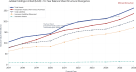

Following the recent Mwango Capital X Spaces session on Special Collective Investment Schemes (Special CIS), one thing became abundantly clear: while regulated Special Funds—including flagships like Standard Investment Bank’s Mansa-X, Faida’s Oak Special Fund, Arvocap, and Etica—have captured retail imagination with impressive net yields (15% to 25%+ p.a.), significant structural tension remains under the surface.
During the panel discussions, there was palpable discomfort and pushback from fund managers whenever audience members and financial analysts probed into granular portfolio holdings, derivative exposure, and Total Expense Ratio (TER) transparency.
In financial markets, defensiveness around disclosure is itself a major risk factor. When managers treat basic requests for line-by-line asset visibility or gross leverage ratios as unnecessary friction, it inevitably creates the impression that there are portfolio concentration risks, illiquid positions, or hidden fee extractions they prefer to keep out of public view.
Compounding this opacity is a growing concern among investors: Does the Capital Markets Authority (CMA) have the technical capacity and real-time oversight capability to effectively supervise these hyper-sophisticated funds?
This advisory breaks down the primary operational risk zones, the regulatory supervision gap, offers a practical due diligence framework, and outlines critical asset allocation principles for investors.
Risk Factor 1: The “Black Box” Portfolio & Manager Defensiveness
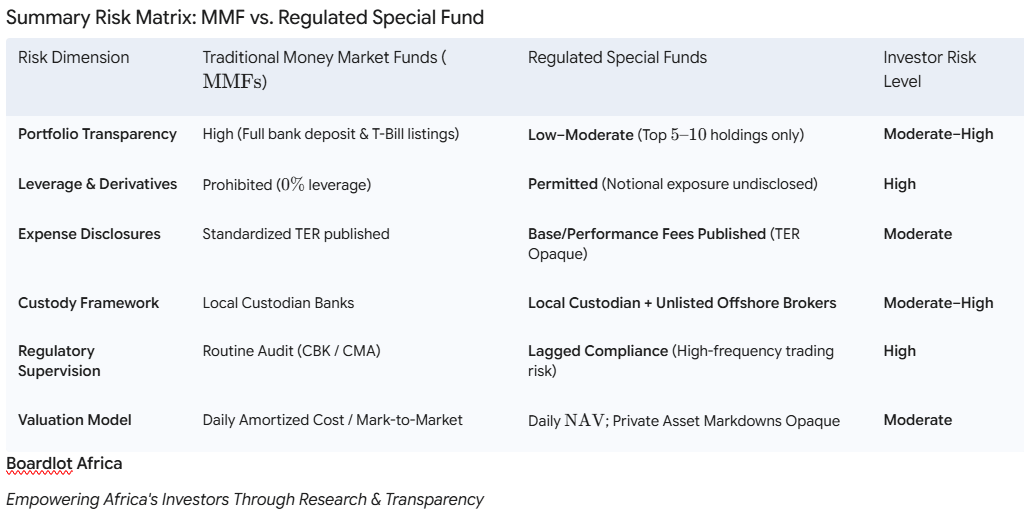
The Advisory Warning: Factsheets routinely publish top-level sector allocations (e.g., “Fixed Income 35.23%” or “North America 55.74%”) and list only the Top 5 or Top 10 holdings, leaving 70% - 80% of investor capital unaccounted for in public reporting.
The X Spaces Reality: When pushed on why full, line-by-line quarterly portfolio schedules are not published, fund managers cited competitive advantages and strategy protection.
Why This Matters: While protecting proprietary trading algorithms is understandable, withholding specific bond maturities, ISIN identifiers, commercial paper issuers, or corporate default statuses leaves investors blind. You cannot verify whether your capital is exposed to over-concentrated private debt, distressed corporate paper, or illiquid counterparties.
The Perceptual Risk: When fund representatives react with discomfort to standard transparency questions, it naturally leads investors to suspect that full disclosure would reveal unpalatable asset quality or excessive concentration.
Risk Factor 2: Supervisory Asymmetry — Can the CMA Safely Police These Funds?
The Advisory Warning: Kenya’s regulatory frameworks were historically built to supervise traditional, long-only asset classes—such as bank fixed deposits, Treasury Bills, and Nairobi Securities Exchange (NSE) equities. Special Funds, however, operate using high-frequency derivative strategies, complex multi-asset swaps, global forex pipelines, and offshore prime brokerages.
The Capacity Gap: Investors rightly question whether the CMA possesses the technical tooling, real-time data feeds, and specialized personnel needed to audit dynamic, multi-legged derivative books in real time.
The Threat of Regulatory Lag: If a fund manager takes on excessive off-balance-sheet leverage or enters risky OTC derivative contracts with foreign brokers, regulatory oversight often operates on a lagged compliance reporting schedule (e.g., quarterly or annual audits). By the time a regulatory red flag is raised, systemic capital impairment may have already occurred.
The “Regulated” Halo Effect: Retail investors frequently assume that a “CMA-Approved Special Fund” label guarantees sovereign-grade protection against risk. In reality, CMA approval confirms that the scheme’s legal structure and Information Memorandum comply with the Capital Markets CIS Regulations; it does not protect investors against poor trading strategy execution, derivative counterparty defaults, or sudden market liquidations.
Risk Factor 3: Hidden Leverage, Derivatives, and Margin Exposure
The Advisory Warning: Unlike traditional Money Market Funds (MMFs), Special Funds are legally permitted to trade leveraged financial products (futures, options, swaps, spot forex, and CFDs). However, managers rarely disclose their Gross Leverage Ratio, Net Market Exposure, or Margin Utilization Rates.
The Missing Data: Factsheets list allocations such as “Interest Rate Derivatives (4.61%)” or “Forwards, Swaps & Options (2.92%)”, but omit:
Notional Exposure: The total dollar or shilling value controlled via derivative leverage.
Margin Collateral: What percentage of physical cash reserves is posted as margin collateral with international brokers.
Counterparty Exposure: Which prime brokers or offshore liquidity pools host these positions.
What This Means for You: Derivatives create asymmetric downside risk. A modest 5% physical cash allocation to leveraged options can translate to a 50%+ effective exposure to market shocks. Without gross leverage reporting, neither retail investors nor domestic regulators can evaluate a fund’s true vulnerability during a sudden market crash.
Risk Factor 4: Operational Cost Drag & Opaque Expense Ratios (TER)
The Advisory Warning: Fund factsheets clearly publish Base Management Fees (e.g., 5% p.a. for Mansa-X, 6% for Oak) and Performance Fees (10% or 20%), but they routinely omit a standardized Total Expense Ratio (TER).
Unquantified Operational Deductions: Before net yield is declared to investors, several operational frictions erode gross returns:
Brokerage transaction fees and trading execution spreads.
Offshore custodian bank holding fees.
Legal, auditing, and independent trustee expenses.
Foreign exchange conversion markups (moving KES into offshore USD assets).
What This Means for You: A fund advertising a 5% base fee may incur an effective TER of 6.5% 7.0% once trading frictions and custody costs are deducted. Demanding standardized TER disclosures ensures investors see the exact operational drag on their capital.
Risk Factor 5: Valuation Methods for Illiquid & Private Debt Assets
The Advisory Warning: Funds investing in private credit, unlisted corporate commercial paper, or structured notes provide limited visibility into their asset valuation methodologies (Mark-to-Market vs. Mark-to-Model).
Key Due Diligence Questions:
If a private corporate borrower delays repayment or defaults, is the paper written down immediately, or carried at nominal face value until maturity?
How frequently does an independent Trustee or Custodian audit and revalue unlisted assets?
What This Means for You: If illiquid assets are overvalued on paper (Mark-to-Model), investors who redeem early receive cash based on an inflated Net Asset Value (NAV), transferring potential impairment losses directly to remaining long-term investors.
Risk Factor 6: Offshore Custody & Jurisdiction Risk
The Advisory Warning: While reputable local banks (e.g., I&M Bank, Equity Bank, Co-op Bank) act as primary custodians in Kenya, Special Funds must route capital to foreign prime brokers (e.g., Saxo Bank, Interactive Brokers) to execute global trades.
The Disclosure Blindspot: Factsheets rarely name these foreign sub-custodians or detail:
Whether offshore client funds are segregated or held in pooled omnibus accounts.
What legal remedies Kenyan regulators or trustees possess if an offshore broker faces insolvency.
What This Means for You: In an international financial crisis, foreign jurisdictional laws take precedence over domestic CMA frameworks.
Investor Checklist: 6 Due Diligence Questions to Ask Before Investing
Before allocating capital to any Special Collective Investment Scheme, request written responses to these six questions from your Fund Representative:
“What is the full Total Expense Ratio (TER) of the fund inclusive of trading spreads, offshore custody fees, and auditing costs?”
“Does the fund utilize leveraged derivatives, and if so, what is the current Gross Exposure to NAV ratio?”
“Can you provide a full schedule of unlisted assets, commercial paper issuers, and their default/revaluation status?”
“Who are the offshore sub-custodians and prime brokerages holding international cash, FX, and equity positions?”
“Does the High-Water Mark calculation reset annually, or is it perpetual across the life of the account?”
“What specific real-time risk reporting mechanisms does the fund provide to the CMA and the Trustee to monitor leverage?”
Key Takeaway: Treating Special Funds as Elevated-Risk Vehicles
The core conclusion for every rational investor is clear: Special Funds must be treated as elevated-risk, high-alpha vehicles—never as safe, cash-equivalent savings pockets.
While the advertised yields (15% to 25%+ p.a.) are attractive, they are the direct mathematical compensation for operational opacity, manager risk, derivative leverage, and illiquidity friction.
Core Asset Allocation Rules:
Never Hold 100% Allocation in a Single Fund: Sinking your entire capital or emergency reserves into one single Special Fund exposes you to severe single-manager concentration, operational freeze, or strategy failure risk. No matter how strong a flagship fund’s multi-year track record appears, zero single-fund concentration should be tolerated.
Diversify Across Multiple Special Funds: Spread your high-alpha growth allocation across managers with different underlying investment methodologies—for example, pairing an active multi-asset trading fund (e.g., SIB Mansa-X or Faida Oak) with a global equity fund (e.g., Arvocap) and a private credit/structured income fund (e.g., Etica).
Maintain Multi-Asset Tiering: Special Funds should form only one slice of your total net worth. Combine them with low-risk baseline anchors:
Tier 1 (Liquidity Shield): Bank-backed Money Market Funds (MMFs) for immediate emergency access (15% to 20%).
Tier 2 (Sovereign Shield): Tax-free Infrastructure Bonds (IFBs) and Treasury Bills for direct, risk-free baseline returns (30% to 40%).
Tier 3 (Alpha Engine): Diversified Special Funds for high compounding acceleration (30% to 50%).
Summary Risk Matrix: MMF vs. Regulated Special Fund

Key Operational Advisory Guidelines
Avoid Sub-Scale Funds (Less thanKES 5Billion AUM): Small asset pools lack the revenue capacity to hire world-class portfolio talent or command optimal institutional execution terms and asset access in international markets.
Avoid Vehicles with Unusually Low Minimum Entry Barriers: Funds with frictionless, low entry thresholds disproportionately attract panic-driven retail investors. During market corrections, sudden retail redemption waves force managers into premature asset sales, creating unnecessary performance drag for long-term compounders.
For comparison on the historical performance of different funds, read this article

Disclaimer: This advisory is published for educational and analytical purposes only and does not constitute formal financial advice. Always perform independent due diligence and consult a licensed financial advisor before making investment decisions.
Boardlot Africa is a premier financial intelligence and corporate governance publication dedicated to unpacking the mechanics of capital, market strategies, and structural shifts across East Africa’s corporate landscape. By bridging the gap between raw economic data and actionable market intelligence, we deliver deep-dive research, independent corporate analysis, and policy insights designed for institutional investors, boardrooms, and sharp market observers.
Get in Touch
Email: boardlot.research@gmail.com
Phone: +254 753 133 901
Substack: Subscribe to Boardlot Africa
X (Twitter): BoardLotSultan
Great analysis! Investors need to be very careful with Special Funds, much of their operations are obscured.