
How John Gachora Pairs Strategic Banking Excellence with Manchester United and Lenana Road Evenings
This profile examines the career of John Githua Mwangi (John Gachora), a leader who blends engineering precision with financial strategy. Known for his grounded personality, he often enjoys whisky and a Manchester United match at Ciders on Lenana Road
What’s in this Article
The Crucible – The NCBA Merger: The strategic choice for professional leadership.
Formative Years – From Gatamaiyu to MIT: Academic and personal foundations.
Global Foundations & The Homecoming: Professional experience on Wall Street and the return to Kenya.
The Merger of Titans – Synergistic Consolidation: Analyzing the integration of NIC Bank and CBA.
The NPL Test – The Multiple Hauliers Insolvency: Navigating risk, insolvency timelines, and institutional resilience.
The Growth Trajectory – NCBA Group Performance (2020–2025): Financial results, asset growth, profitability, and dividends.
The NCBA-Nedbank Strategic Partnership – John Gachora as the “Team Protector”: Strategic rationale and management continuity.
Corporate Stewardship – Sports Excellence and Environmental Sustainability: Investments in the golf circuit and reforestation initiatives.
The Legacy of a Financial Architect: A summary of Gachora’s impact and leadership philosophy.
Part 1: The Crucible – The NCBA Merger
The lead-up to the 2019 merger between NIC Bank and the Commercial Bank of Africa (CBA) was defined by an undercurrent of intense executive anxiety. While the deal was publicly framed as a union of two giants, internally, it was a high-stakes battle for the soul of the new entity.
The conflict pitted two distinct archetypes against one another. On one side stood Isaac Awuondo, whose deep-rooted connections to the country’s most influential power networks—including the Kenyatta and Ndegwa families—made him a perceived natural choice for the top seat. On the other stood John Gachora, the “pure professional,” an engineer-turned-banker whose career was forged in the meritocratic culture of Wall Street rather than local patronage.
The ultimate decision to appoint Gachora as Group Managing Director and CEO of the newly formed NCBA Group signaled a pivotal and historic shift in the Kenyan financial landscape: a clear preference for technical, global-standard expertise over traditional power-network influence.
Part 2: Formative Years – From Gatamaiyu to MIT
The story of John Gachora begins far from the gleaming glass towers of Nairobi’s financial district. Born in 1968 in Gatamaiyu, Kiambu County, he grew up as the eighth of thirteen children in a household dependent on subsistence farming. It was an environment that demanded resilience and early resourcefulness. Despite the significant financial pressures facing his family during his years at the prestigious Alliance High School, Gachora’s intellectual drive remained undeterred.
Gachora would go on to master the complexities of systems and logic at the Massachusetts Institute of Technology (MIT), where he earned both a Bachelor of Science and a Master of Science in Electrical Engineering and Computer Science. He rounded out his global education at the Wharton School of the University of Pennsylvania, where he obtained an MBA, bridging the gap between engineering precision and financial strategy.
Part 3: Global Foundations & The Homecoming
With a pedigree refined in the world’s most demanding academic institutions, Gachora entered the global financial stage. He built a formidable reputation on Wall Street, navigating the high-stakes corridors of powerhouse institutions like Credit Suisse and Bank of America. It was here, serving as a Managing Director and Group Head of Investment Banking, that he honed the deal-making instincts that would later define his career.
His transition to the African market began in 2009 when he joined Absa Capital in Johannesburg. Tasked with navigating the complexities of emerging markets, Gachora played a pivotal role in the bank’s strategic expansion, establishing a footprint in Nigeria, Mozambique, and Tanzania. This continental experience was the final preparation for his homecoming. In 2013, Gachora returned to Kenya to take the helm at NIC Bank.
Part 4: The Merger of Titans – Synergistic Consolidation
The 2019 merger between NIC Bank and the Commercial Bank of Africa (CBA) was a masterclass in strategic alignment, synthesizing two specialized financial engines into a single, dominant market leader. Prior to the consolidation, the two institutions occupied distinct but complementary niches:
NIC Bank (The Asset Finance Specialist): NIC Bank had established itself as the undisputed leader in asset finance, commanding deep, specialized expertise in the financing of machinery, vehicles, and industrial equipment.
CBA (The Institutional and Corporate King): Conversely, CBA operated as a powerhouse in corporate banking and institutional services, holding the deep-rooted relationships that formed the backbone of the economy.
The Shared Core: Both banks were already established players in the high-net-worth retail space, providing a common foundation of affluent, loyal customer bases that made the transition natural and highly accretive.
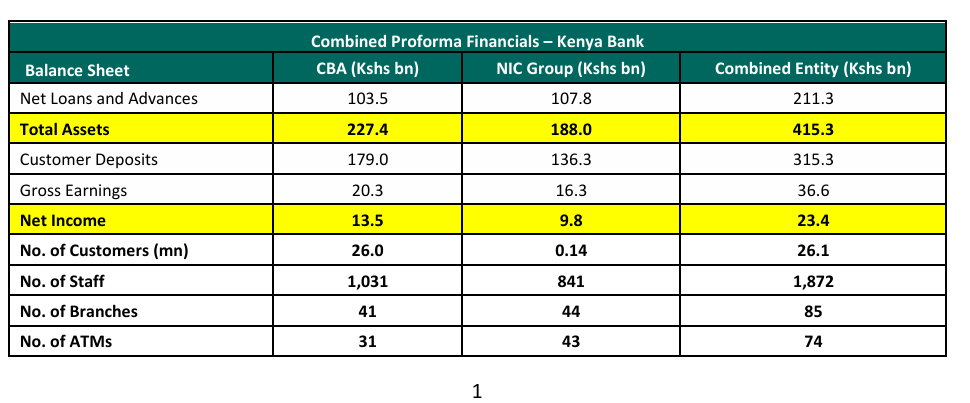
Pre-Merger Financial Comparison (FY 2018
The Synergy of Scale
Complementary Strengths: The data illustrates how the merger brought together distinct operational focuses; CBA brought a massive customer base of 26 million, while NIC Group contributed a robust, specialized physical infrastructure and a targeted customer segment.
Scale of the Combined Entity: By merging, the entities created a financial powerhouse with total assets of Kshs 415.3 billion and a combined net income of Kshs 23.4 billion, instantly altering the competitive landscape of the Kenyan banking sector.
Operational Integration: The merger integrated 1,872 staff members across a combined network of 85 branches and 74 ATMs, providing the necessary scale to dominate both the retail and corporate banking markets.
Strategic Direction: The confirmation of John Gachora as Group CEO was also the formal confirmation that the strategic direction to be followed by the combined entity would be anchored in the NCBA model.
Industry Leadership & Philosophy
Sector Advocacy: Serving as Chairperson of the Kenya Bankers Association (2021–2025), Gachora successfully navigated the industry through regulatory shifts and post-COVID economic volatility.
Leadership Philosophy: His approach is characterized by modesty, a cautious yet thoughtful demeanor, and a focus on long-term professional fulfillment.
Legacy of Efficiency: By integrating his engineering background into financial services, he has set a new standard for operational efficiency and how regional banks engage with modern economic dynamics.
As the architect of this consolidation, John Gachora orchestrated the transformative merger to form the NCBA Group. By uniting NIC’s technical prowess in asset finance with CBA’s extensive corporate and institutional reach, Gachora synthesized these capabilities into a cohesive industrial conglomerate that now ranks among East Africa’s largest financial entities.
Part 5: The NPL Test – The Multiple Hauliers Insolvency
One of John Gachora’s most significant trials as the newly appointed Group CEO was navigating the volatile landscape of Non-Performing Loans (NPLs), with the insolvency of Multiple Hauliers standing as a critical stress test for the merged NCBA entity.
Pre-Merger NPL Landscape
While the proforma financials in “Screenshot 2026-06-07 141734.png” emphasize the scale of assets and customer bases, the true measure of Gachora’s risk management capability lay in the contrasting NPL profiles he inherited:
NIC Bank’s Risk Profile: As an asset finance specialist, NIC Bank inherently carried higher exposure to collateral-backed loans, which were sensitive to economic downturns and industrial sector performance. NIC Bank’s 2018 report had previously identified Gross NPLs of Ksh 16.8 billion, reflecting an NPL ratio of 13.4% that required disciplined oversight.
CBA’s Corporate Exposure: CBA, as an institutional and corporate banking leader, held concentrated credit risks tied to large-scale infrastructure and transport logistics players—such as Multiple Hauliers—which were susceptible to systemic shocks.
The Multiple Hauliers Benchmark
The insolvency of Multiple Hauliers became the defining NPL test for Gachora. It was not merely a debt recovery exercise; it was a high-stakes demonstration of the new NCBA’s resolve.
Gachora had to manage the fallout of massive NPLs that threatened to undermine the institutional stability of the newly merged group.
The case forced the bank to navigate complex legal, recovery, and insolvency processes, cementing Gachora’s reputation for prioritizing institutional resilience over the “business as usual” approach that often characterized legacy banking relationships.
The insolvency of Multiple Hauliers (E.A.) Limited represents a landmark case in Kenyan corporate restructuring, characterized by a protracted legal battle and significant exposure for NCBA Bank.

Timeline of the Multiple Hauliers Insolvency Case
Pre-2021: Financial Distress and “Debt Attacks”: Multiple Hauliers faced mounting financial pressure due to aggressive expansion and diminishing freight margins. The company struggled with various “insolvency attacks” from multiple creditors, including Synergy Industrial Credit, which filed an insolvency petition in March 2020 over a Kshs 532 million vehicle financing deal.
June 7, 2021: Placing Under Administration: Following a liquidation petition by its creditors, Multiple Hauliers was officially placed under administration. NCBA Bank, a major creditor, was instrumental in this move, appointing joint administrators from Ernst & Young to manage the company.
April 2024: Change in Administration: The NCBA-appointed joint administrators resigned, leading the High Court to appoint the Official Receiver as the new administrator in September 2024.
February 2025: Extended Administration: The High Court extended the administration period by six months, warning that independent lawsuits from creditors like Prime Bank risked devaluing the company’s assets.
Post-February 2025: Court of Appeal Intervention: NCBA challenged the administration process, arguing its statutory rights were disregarded. The Court of Appeal suspended the Official Receiver’s appointment and all associated High Court orders, agreeing that NCBA’s recovery rights were at risk.
NCBA’s Exposure and Role in Multiple Hauliers
NCBA Bank emerged as the primary financial stakeholder in the insolvency proceedings, with its exposure being central to the legal strategy of the bank.
Total Exposure: NCBA held a significant debt of Kshs 7.2 billion in the logistics firm.
Strategic Stance: NCBA maintained that it held a statutory right to appoint administrators. The bank argued that the Official Receiver’s mandate was too narrow—limited primarily to the “Amava investment issue”—which left the remaining company assets unprotected and prone to dissipation by directors.
Institutional Resilience: For NCBA, the case served as a critical test of its ability to recover significant Non-Performing Loans (NPLs) within a complex legal framework. The bank’s persistent legal challenges reflected its determination to prevent asset erosion and maximize the recovery of its Kshs 7.2 billion exposure.
The company’s financial position at the time of reporting showed total assets of Kshs 17.0 billion against verified liabilities of Kshs 31.4 billion, resulting in a negative equity position of Kshs 14.4 billion
Part 6: The Growth Trajectory – NCBA Group Performance (2020–2025)
Since the formalization of the merger, NCBA Group has undergone a period of aggressive integration and expansion. The strategic focus under John Gachora has been to leverage the combined balance sheet to scale market share while maintaining disciplined control over asset quality.
The following graph illustrates the progression of these assets over the past six years:
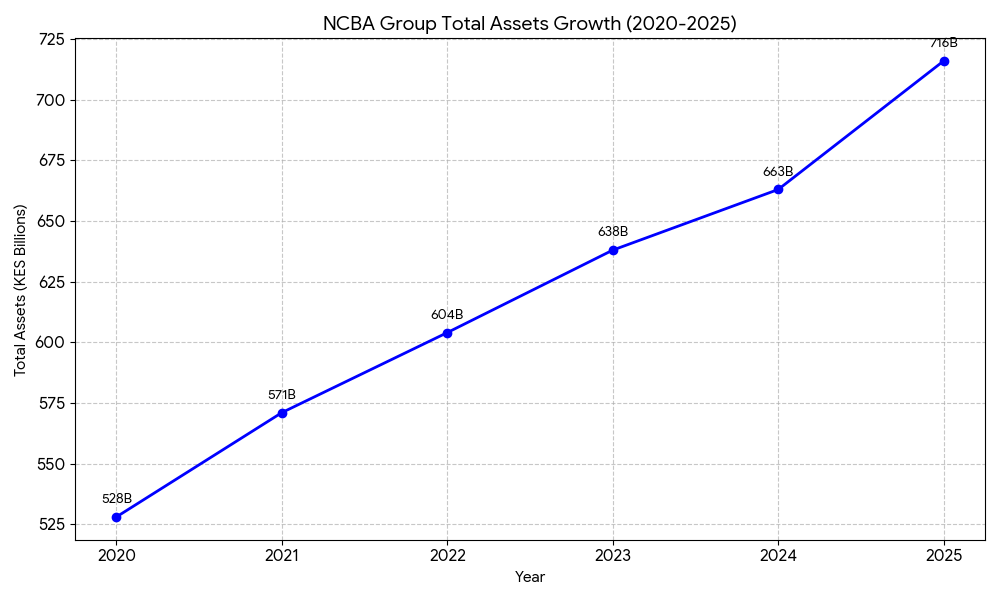
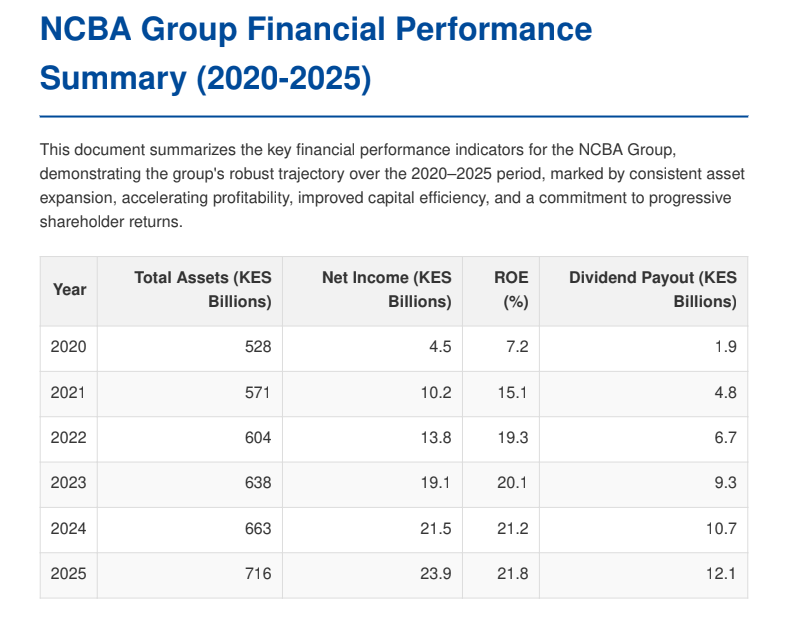
The NCBA Group has demonstrated consistent growth in its asset base over the 2020–2025 strategic cycle, closing the 2025 financial year with total assets of KES 716 billion.
Key Performance Summary (2020–2025)
Total Asset Growth: The group’s asset base expanded from KES 528 billion in 2020 to KES 716 billion by the end of 2025.
Strategic Execution: This growth aligns with the successful completion of the 2020–2025 strategic cycle, which emphasized balance sheet growth and business diversification.
Growth Drivers: The expansion was largely supported by increased customer deposits, retained earnings, and disciplined execution of the Group’s multi-pillar strategy.
Financial Health: Over the same period, NCBA achieved a 6% CAGR in total assets while significantly improving the quality of its loan book, with the Non-Performing Loan (NPL) ratio improving from 14.0% in 2020 to 10.2% in 2025.
Net Income Performance Highlights (2020–2025)
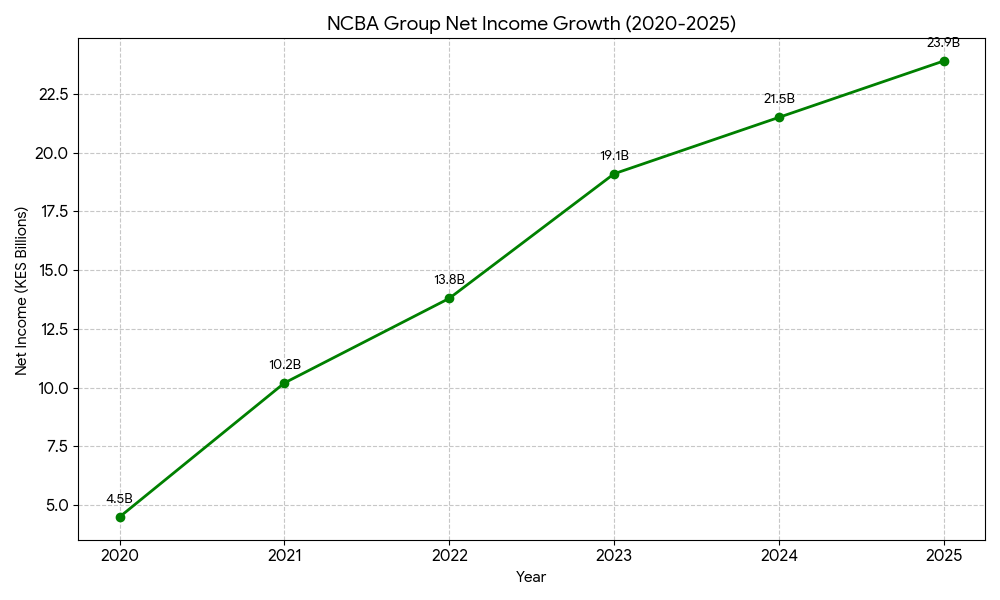
Steady Profitability Growth: Net income experienced strong growth over the period, increasing from KES 4.5 billion in 2020 to KES 23.9 billion by the end of 2025.
Operational Efficiency: This upward trend reflects significant improvements in core operating income and efficient management of the group’s cost-to-income ratio as the merged entity matured.
Scaling Success: The growth in net income outpaced the growth in total assets during this period, signaling improved profitability margins and effective capital deployment.
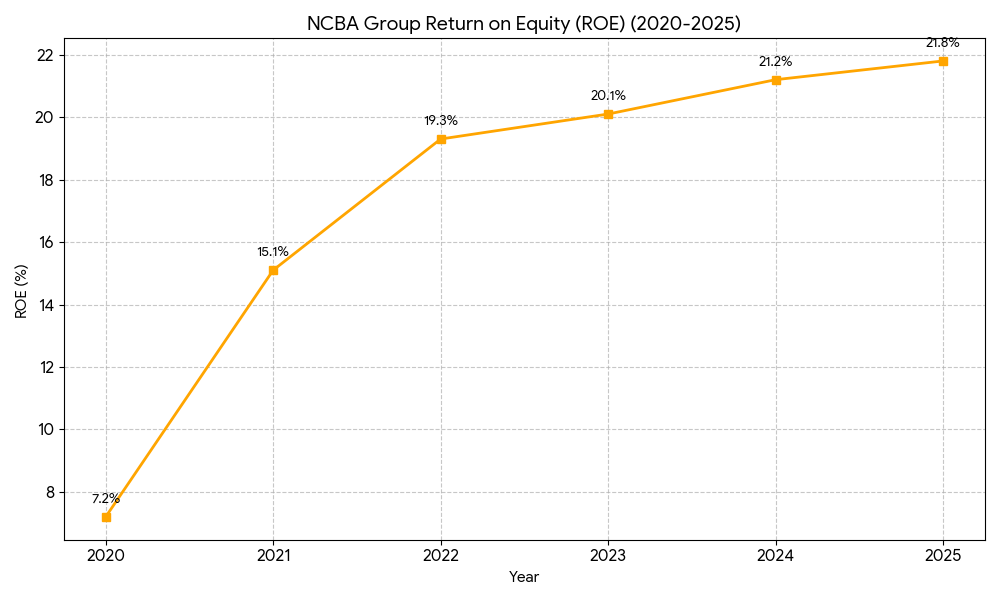
ROE Performance Highlights (2020–2025)
Strong Value Creation: The group’s ROE showed a significant upward trajectory, climbing from 7.2% in 2020 to a robust 21.8% by the end of 2025.
Post-Merger Maturation: The steep increase between 2020 and 2022 reflects the successful integration and synergy realization following the merger that formed the NCBA Group.
Capital Efficiency: The stabilization and continued growth from 2023 to 2025 underscore the Group’s ability to maintain high capital efficiency while scaling its operations and managing a growing asset base.
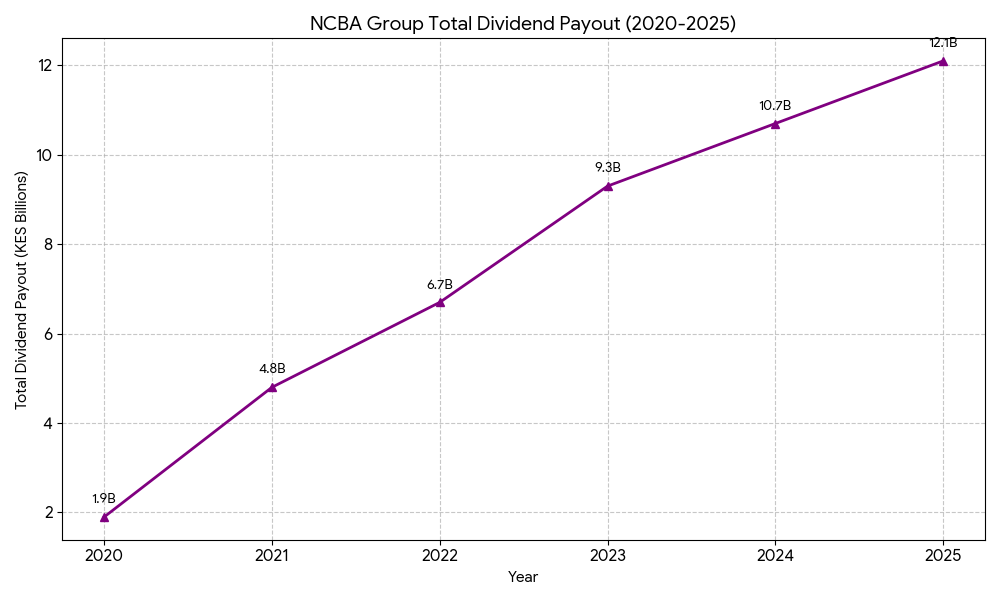
Dividend Analysis (2020–2025)
Consistent Growth: Total dividend payouts increased steadily from KES 1.9 billion in 2020 to KES 12.1 billion by the end of 2025.
Shareholder Value: The trajectory of these payouts reflects the group’s successful efforts to reward shareholders in line with the significant growth in net income observed over the same period.
Balanced Policy: The consistent upward trend demonstrates a disciplined balance between reinvesting earnings to fuel the asset growth discussed previously and providing cash returns to investors.
The graph below illustrates the growth in total dividend payouts from 2020 to 2025:
Driving the NCBA Model
Asset Growth: Total assets have grown consistently, reflecting the bank’s successful cross-selling of asset finance expertise to the broader institutional customer base.
PBT Expansion: The dramatic climb in Profit Before Tax (PBT) highlights the synergy of the merger, where operational efficiencies replaced the redundant legacy costs of two separate entities.
Asset Quality Improvement: The downward trend in the Non-Performing Loan (NPL) ratio demonstrates Gachora’s commitment to risk mitigation, moving from the volatile post-merger integration phase to a more stable, high-quality loan book.
Human Capital: The moderate increase in total employees suggests a focus on digital transformation and productivity rather than traditional labor-heavy expansion, maintaining the “meritocratic efficiency” that defines Gachora’s leadership.
Part 8: The NCBA-Nedbank Strategic Partnership – John Gachora as the “Team Protector”
The strategic partnership between NCBA Group and Nedbank Group—structured as a partial pro rata offer for approximately 66% of NCBA’s issued share capital—represents a defining moment for the bank’s future. The selection of Nedbank over other bidders, such as Standard Bank, was a deliberate strategic choice orchestrated by the board under the leadership of CEO and Group Managing Director John Gachora. By securing terms that retain the existing management team, Gachora has effectively acted as the “Team Protector,” ensuring his position and that of his leadership team remain secure while preserving the bank’s operational continuity.
The Rationale for Selecting Nedbank: The “Team Protector” Strategy
The decision to prioritize Nedbank was rooted in a desire to avoid the operational friction that would have accompanied a merger with a regional incumbent. Key drivers included:
Job and Management Retention: A primary condition of the deal is that Nedbank has committed to retaining the NCBA brand, the local board, and the existing management team. By insisting on these terms, John Gachora has successfully ensured that he and his executive team will continue to lead the institution.
Mitigation of Integration Risk: The board sought to avoid “painful integration” and the systemic disruptions, such as massive system rewrites or brand surgery, that would have been inevitable had they partnered with an institution that already maintained a significant, overlapping footprint in East Africa.
Operational Independence: By partnering with an entity like Nedbank, which operates almost exclusively outside the East African region, NCBA can maintain its operational independence and local focus rather than becoming a cog in a pre-existing regional machine.
Strategic Implications of merger for NCBA Group
This transaction is designed to inject capital and specialized expertise while preserving NCBA’s agility:
Execution of the “Ubuntu” Strategy: The partnership serves as a catalyst for NCBA’s new five-year strategy, which aims to secure top-five market positions across East Africa. It provides the financial backbone to support expansion into new markets, including Ethiopia and the DRC.
Enhanced Capabilities: NCBA will leverage Nedbank’s sophisticated expertise in corporate and investment banking to strengthen its own deal-structuring and institutional client service capabilities.
Shareholder Value and Flexibility: The deal structure allows shareholders to “roll forward” their investment into a larger, more diversified balance sheet, with 80% of the consideration offered in Nedbank shares and 20% in cash (incorporating flexibility for retail investors).
Governance and Oversight: While Nedbank will gain effective control and nominate at least two directors to the board, the preservation of the local management team is intended to minimize workforce uncertainty and maintain the bank’s current service delivery model.
Part 9: Corporate Stewardship – Sports Excellence and Environmental Sustainability
Beyond its financial dominance, NCBA, under John Gachora’s leadership, has woven itself into the fabric of East African society through strategic investments in sports and environmental conservation.

Elevating the Golf Circuit: The bank has become synonymous with elite golf, notably serving as a premier sponsor for high-profile events such as the Kenya Open. This commitment continues with the NCBA Royal Classic, the second leg of the 2026 Sunshine Development Tour – East Africa Swing, which tees off at the Royal Nairobi Golf Club from June 7 to 9. The tournament has attracted a diverse field of 96 golfers from 11 countries, including Kenya, Uganda, Rwanda, Tanzania, Nigeria, Ghana, Zimbabwe, Côte d’Ivoire, India, the United Kingdom, and the United States, all competing for Official World Golf Ranking (OWGR) and World Amateur Golf Ranking (WAGR) points.
Environmental Reforestation: NCBA has set an ambitious goal to plant and nurture 10 million trees across Kenya, Uganda, Tanzania, and Rwanda by 2030. This initiative is designed to bolster government reforestation agendas, enhance water security, and restore biodiversity.
Active Conservation: Reflecting this commitment, the bank recently facilitated the planting of 12,300 trees in Nairobi, including efforts within Karura Forest. By collaborating with various partners, NCBA ensures not only the planting but the long-term survival of these trees through active community engagement.
Part 10: The Legacy of a Financial Architect
John Gachora’s tenure as Group CEO of NCBA stands as a defining chapter in the evolution of the East African banking landscape. As a featured profile in our series of the “100 Men and Women Who Shaped Our Capital Markets,” Gachora is recognized for a rare synthesis of rigorous engineering logic and strategic financial foresight. By orchestrating the merger between NIC Bank and the Commercial Bank of Africa (CBA), he did more than consolidate assets; he redefined the industry’s structural standards.
His impact is marked by several defining pillars:
Architect of Scale: Through the 2019 merger, Gachora successfully integrated two distinct organizational cultures and operational models, creating a group with total assets exceeding Kshs 942 billion by 2025.
Disciplined Governance: Gachora’s leadership during his tenure as Chairperson of the Kenya Bankers Association (2021–2025) showcased his ability to guide the industry through significant regulatory shifts and economic uncertainty.
Institutional Resilience: His firm handling of high-profile insolvency cases, such as Multiple Hauliers, demonstrated a commitment to protecting the bank’s interests and maintaining the integrity of the loan book.
Holistic Value Creation: Beyond the balance sheet, he has successfully positioned NCBA as a brand deeply embedded in the community, linking corporate influence to national priorities like elite sports development and environmental reforestation.
In essence, as one of the 100 visionaries shaping our capital markets, John Gachora has set a new standard for leadership in the region. He has proven that operational efficiency and long-term institutional stability remain the most reliable drivers of success in the modern financial era