
THE BOARDLOT • CAPITAL INTELLIGENCE
Phase II Storyline: The Industrial Juggernaut & The Private Municipality
By @boardlotsultan
June 2026 • Premium Long-Form Analytical Preview
When Stephen Jennings and Rendeavour finally cleared the board of the original Kiambu syndicate’s legal land caveats, they didn’t just build a suburb—they completely rewrote the rules of infrastructure economics in sub-Saharan Africa.
While Phase I was a gritty legal thriller about survival, board manipulation, and multi-jurisdictional asset seizures, Phase II is a masterclass in raw commercial acceleration.
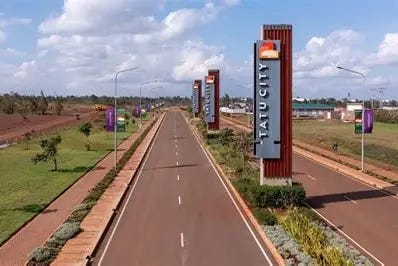
Once the land was secure, Rendeavour bypassed the structural failures of traditional local real estate development. Instead, they scaled a high-velocity, macro-level capital deployment model by converting 5,000 acres of disputed Kiambu coffee shambas into a self-governing, private municipal machine.
Here is the definitive narrative storyline proposed for Phase II: The Industrial Juggernaut, structured to match the sharp corporate finance and value-investing analysis of our brand.
🏗️ Phase II Narrative Architecture
Section 1: The SEZ Regulatory Hack (Bypassing the State)
The Big Idea: Real estate developments in Nairobi are historically plagued by a toxic bottleneck: sluggish county approvals, overlapping land registries, double-taxation, and decaying public infrastructure. Jennings realized that to maximize the internal rate of return (IRR), Tatu City had to break away from standard municipal governance.
The Strategic Move: Rendeavour successfully lobbied the national government to grant the entire 5,000-acre parcel Special Economic Zone (SEZ) status.
The Tax Oasis: We will dissect the exact corporate fiscal moats that triggered the corporate gold rush:
Corporate income tax chopped from the standard 30% down to a microscopic 10% for the first 10 years (and 15% for the subsequent decade).
Zero-rated VAT on all local procurement of goods and services.
Complete exemption from import duties, excise duties, and stamp duties.
The Governance Disruption: As a designated SEZ, Tatu City effectively became an independent regulatory zone. Businesses could access a “one-stop-shop” for permits, bypassing the bureaucratic paralysis of local county halls.
Section 2: The Industrial Stampede & The Blue-Chip
Anchor Inflows
Monetizing the Red Soil: With the tax moat firmly established, Rendeavour prioritized Tatu Industrial Park to generate immediate, high-margin institutional cash flows. They didn’t wait around for retail home buyers; they targeted the balance sheets of regional and multinational giants.
www.tatucity.com
The Logistics and FMCG Exodus: We will detail the corporate migration out of Nairobi’s crumbling, gridlocked Industrial Area and Mombasa Road. Over 100 industrial firms broke ground, establishing a multi-billion-shilling logistics powerhouse:
www.tatucity.com
The Tech/BPO Catalyst: CCI Global commissioned a $50 million state-of-the-art facility, establishing Kenya’s largest call center hub and dropping over 5,000 to 10,000 high-velocity jobs directly onto the property.
The Industrial Heavyweights: Heavy hitters like Dormans Coffee, Twiga Foods, Kim-Fay, and FullCare Medical set up massive processing plants.
The Ultimate Cash Engine: This operational density completely flipped the project’s economics. Commercial land prices skyrocketed, transforming a once-toxic asset into a highly liquid corporate yield generator.
The Kiambu Land Syndicate: How a Local Coffee Farmer, a CBK Governor, and Bidco Billionaire Triggered a 10-Year War for Tatu City, and Lost

THE BOARDLOT SULTAN • CAPITAL INTELLIGENCE
Section 3: The B2B Playbook: Projects Within Projects
The Master Developer Blueprint: A classic error in large-scale real estate is the attempt to brick-and-mortar build every single structure. It is too capital-intensive and slow. Rendeavour utilized a brilliant alternative: the “Nested Developer” model.
Laying the Core Infrastructure: Rendeavour absorbed the heavy initial CapEx—pouring high-spec internal tarmac roads, running underground fiber-optic loops, and sinking massive industrial water lines.
Outsourcing the Execution Risk: Once the “plug-and-play” grid was ready, they sliced up massive land sub-parcels and wholesaled them out to secondary institutional developers to build out the ecosystem:
The Residential Arms: Unity Homes stepped in to handle high-density middle-income residential estates (Unity West, Unity East, Unity Blossoms), absorbing the micro-construction and consumer sales risks.
The Commercial Giants: Real estate juggernauts like Abdiweli Hassan (Founder of Business Bay Square) committed an explosive KES 65 billion investment to build out massive integrated residential, retail, and office mini-cities within the SEZ.
The Premium Plots: Rendeavour maintained direct high-end monetization through Kijani Ridge, selling premium, low-density, controlled-entry residential plots to wealthy individual investors.
Section 3: The Somali Angle: Eastleigh’s KSh 65 Billion Migration
The most fascinating recent geopolitical shift in Tatu City’s commercial lifecycle is what insiders call “The Somali Angle.” For decades, the hyper-liquid trading capital of the East African Somali community remained heavily concentrated in the high-density hub of Eastleigh, Nairobi. However, facing intense congestion and structural bottlenecks in the CBD, the smart money from Eastleigh has begun migrating northward into Kiambu.
In a highly strategic move, developers from the Eastleigh commercial network have taken up massive acreage within the SEZ. This culminated in a blockbuster announcement: Abdiweli Hassan, the prominent developer and chairman behind Eastleigh’s crown jewel—Business Bay Square (BBS Mall), the largest shopping complex in East and Central Africa—signed a historic deal with Stephen Jennings
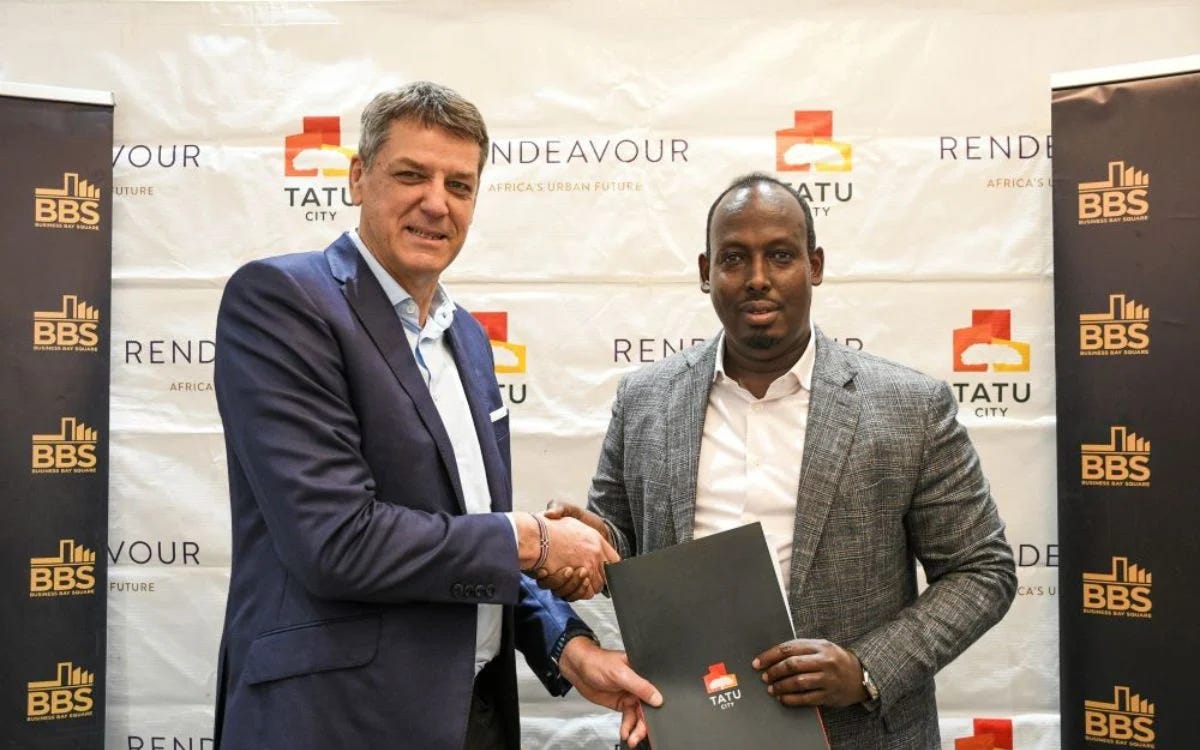
Hassan’s group is deploying a staggering KSh 65 billion to build an integrated mixed-use mini-city spanning over 60 acres within Tatu City. This mega-nested project will feature:
High-end residential housing units flanked by 30 acres of recreational parks.
Substantial commercial office blocks and retail complexes.
Dedicated warehousing and logistics operations integrated straight into Tatu Industrial Park.
A major community mosque built near the residential and educational quarters.
This massive deployment signals a profound structural shift: the frontier market’s most resilient local trading capital has officially chosen to institutionalize itself within Rendeavour’s heavily governed, Western-structured private city framework.
Section 4: Land Dispute with Kiambu County
Just as Rendeavour seemed to have permanently neutralized its corporate adversaries, a new battlefront opened—this time with the local state apparatus itself. In a dramatic escalation that quickly went viral across Kenyan media, Tatu City called a high-profile press conference to publicly accuse Kiambu Governor Kimani Wamatangi of weaponizing the county’s regulatory powers to frustrate foreign direct investment (FDI) inflows.
The developer claimed that the county administration was deliberately and maliciously sitting on the approvals for its revised 5,000-acre master plan. For everyday Kenyans watching the evening news, the public fallout became a textbook showcase of how bureaucratic red tape and local government friction can derail major international investments.
Governor Wamatangi, however, quickly fired back, dismissing Tatu City’s extortion narratives as “misleading and malicious claims” designed to bypass the law. According to the county government, the gridlock was not about corruption, but about a blatant violation of public land policy:
The Slashed Public Space: The county contended that in its revised master plan, Tatu City had drastically reduced the land allocated for vital public amenities from an initial 406 acres down to a meager 103 acres.
The 10% Statutory Demand: Governor Wamatangi maintained that by law, any developer handling a mega-project of roughly 5,000 acres is legally obligated to surrender 10% of the total acreage for public utility. This translates to a mandatory 500 acres that the county insists must be set aside to support low-income workers and the broader Ruiru municipality.
This ongoing face-off serves as a stark reminder for frontier-market investors: even if you defeat your boardroom rivals in international courts, you still have to contend with the shifting political realities of the local ground.
Section 5: The Financial Ledger: A Sovereign Corporate State
The Infrastructure Monopoly: Tatu City now essentially functions as a private, self-sufficient municipality. It bypasses the national utility gridlocks by building out its own independent infrastructure:
A massive, dedicated 31.5MVA private power substation linked directly to the national grid lines.
Independent multi-million-liter private water reservoirs and localized wastewater treatment plants.
The Valuation Eclipse: To close out Phase II, we look at the raw financial metrics. A project that was nearly broken in 2011 by an $11 million shareholder debt impasse has now successfully attracted over $1.5 billion to $2 billion in total capital investment.
The Fixed-Income Catalyst: As private equity and institutional funds pour cash into infrastructure assets, the success of Tatu City has set the exact blueprint for modern asset-backed real estate securitization in the region, paving the way for institutional capital to hunt for structured yields in private cities.
What Is Tatu City Today?
The dust from the KES 1.7 billion courtroom battles has long settled, and what remains is no longer a speculative real estate gamble. Today, Tatu City has transformed into a high-octane economic engine and a private municipality that is actively reshaping the commercial and social geography of the Nairobi metropolitan area.
The modern reality of the project breaks down into four defining pillars:
1. The Capital of Kenya’s Supply Chain & Logistics Hub
Tatu City has successfully broken the monopoly of Nairobi’s traditional, gridlocked Industrial Area and Mombasa Road. It has officially become the undisputed nerve center for modern East African supply chain logistics. Backed by world-class, plug-and-play internal infrastructure, regional logistics giants and deep-pocketed infrastructure funds have concentrated their assets here. The zone is now home to ALP (African Logistics Properties) Cold Chain, BigCold, Copart, and Twiga Foods, establishing the SEZ as the premier nexus for high-velocity distribution and cold-storage operations in the region.
Section 2: The Logistics Capital & The Manufacturing Stampede
With the tax moat firmly established, Rendeavour prioritized Tatu Industrial Park to generate immediate, high-margin institutional cash flows. They didn’t wait around for retail home buyers; they targeted the balance sheets of regional and multinational industrial giants.
The industrial zone has triggered a mass exodus out of Nairobi’s crumbling, gridlocked Industrial Area and Mombasa Road:
The Supply Chain & Logistics Hub: The park has officially become the undisputed nerve center for modern East African supply chain logistics. Backed by world-class, plug-and-play internal infrastructure, regional distribution giants and deep-pocketed infrastructure funds have concentrated their assets here. The zone is now home to ALP (African Logistics Properties) Cold Chain, BigCold, Copart, and Twiga Foods, establishing the SEZ as the premier nexus for high-velocity distribution and cold-storage operations.
The Manufacturing Powerhouses: Attracted by the SEZ custom-duty exemptions, heavy-hitting industrial companies have set up massive, state-of-the-art production plants lately. Leading the charge are consumer and industrial giants like:
Bidco Africa: The ultimate corporate irony given Vimal Shah’s past warfare.
Dormans: The pioneer regional coffee exporter and roaster.
Davis & Shirtliff: The undisputed regional leader in water and energy infrastructure.
FullCare (Kenya) Medical SEZ Limited: A global medical apparel manufacturer that opened a massive facility with an estimated $100 million investment. Its Phase 1 operations dropped 1,800 direct jobs into the economy, with Phase 2 engineered to scale local employment to roughly 7,000 workers.
Sun King: Kenya’s leading solar and energy-efficient appliances company, which inaugurated its first African manufacturing facility here. Spanning 7,600 square meters, the plant boasts an annual production capacity of up to 700,000 units and actively aims to localize production while substituting over $150 million in imports across Africa over a five-year horizon.
This operational density has completely flipped the project’s economics. Commercial land prices have skyrocketed, transforming a once-toxic asset into a highly liquid corporate yield generator.
3. The Enclave of the Remote Elite & Aspirational Class
On the residential front, Tatu City has evolved into the definitive “go-to” address for high-earning, aspirational young Kenyans and affluent expatriates. Driven by the post-pandemic work-from-home (WFH) shift, this demographic has flocked to the estate for its safety, stable utilities, and reliable fiber networks.
However, this premium lifestyle comes with an ultra-exclusive price tag and a highly controlled social environment. The estate has drawn significant media attention for its commanding, high-end rental yields, an exclusive country club culture, and its notoriously strict estate management guidelines. The management aggressively enforces institutional order—slapping residents with hefty speed fines, strict noise control regulations, and tight aesthetic codes—creating a hyper-managed corporate sanctuary that stands in stark contrast to the chaotic governance of public Nairobi suburbs.
💡 The Sultan’s Corner: A Question for the Boardlot
The entry of Eastleigh’s premier developer with a KSh 65 billion master plan proves that local trading capital is aggressively moving away from the congested city center and into master-planned private SEZs. As value investors and corporate strategists, does this signal the permanent economic decline of Nairobi’s traditional commercial business districts, or is the capital concentration in private cities creating a high-end real estate bubble? Let’s talk numbers in the comments below.
4. The Macro Economic Ripple: Skyrocketing Land Values & The “Copy-Cat” Phenomenon
The sheer velocity of Tatu City’s commercial success has triggered a massive capital appreciation ripple effect across the entire Kiambu sub-market. Land parcels immediately neighboring the 5,000-acre project have seen their valuations skyrocket exponentially, pricing out traditional agricultural buyers.
More importantly, Tatu City has set a new frontier-market standard, sparking a wave of smaller “copy-cat” private gated estates and miniature master-planned hubs trying to duplicate Rendeavour’s B2B plug-and-play playbook. Tatu City did not just build a project; it single-handedly created a speculative, high-value real estate ecosystem along the Northern bypass.
The Sultan’s Question: “Tatu City’s transition from a messy legal war into a $2 billion private municipality proves that institutional capital in frontier markets prefers paying for private, high-spec infrastructure over relying on dysfunctional public municipalities. As value investors, if you were deploying capital into East African real estate today, would you entirely abandon traditional urban commercial corridors like Mombasa Road and place your bets exclusively on heavily guarded private SEZ ecosystems? Or is the capital concentration in these mega-hubs creating a speculative bubble? Let’s talk numbers in the comments below.”