
Executive Summary:
Navigating Kenya’s Virtual Asset Service Providers Regulations, 2026
The long-awaited gazettement of Legal Notice No. 134: The Virtual Asset Service Providers Regulations, 2026 on July 22, 2026—issued under Kenya Gazette Supplement No. 185—marks the definitive transition of East Africa’s largest fintech economy from a reactive regulatory posture to a fully institutionalized prudential regime. Operationalizing the statutory framework established by the Virtual Asset Service Providers (VASP) Act, 2025 (Act No. 20 of 2025)—which received presidential assent in October 2025 and took effect on November 4, 2025—the new regulations establish strict rules for digital asset activities operating in or targeting Kenya.
With an estimated $19 billion in annual on-chain transaction volume and a history spanning early P2P pioneer BitPesa in 2013, the initial 2015 CBK cautionary prohibition, and a 1.5% Digital Asset Tax introduced in 2023, Kenya now joins jurisdictions like the European Union (MiCA) and Dubai (VARA) in offering formal regulatory clarity. Existing market operators have been given a strict grandfathering window ending on November 4, 2026, to satisfy capital reserves, local governance standards, and anti-money laundering (AML/CFT) mandates or cease operations.
Core Structural & Operational Highlights
┌──────────────────────────────────────────────────────────────────────────────────┐
│                   EXECUTIVE SUMMARY: KEY COMPLIANCE PILLARS                       │
└─────────────────────────────────────────────────────────────────────────────────┘

  1. DUAL-REGULATOR    Central Bank of Kenya (CBK) oversees fiat/stablecoins & wallets;
     JURISDICTION      Capital Markets Authority (CMA) oversees exchanges & tokenization.

  2. HIGH CAPITAL      KES 300M ($2.3M+) paid-up capital for stablecoin issuers;
     BARRIERS          KES 150M for wallet providers; KES 100M for virtual asset exchanges.

  3. STRICT YIELD      Regulation 72 explicitly prohibits interest or yield generation
     PROHIBITION       on stablecoin holdings to mitigate deposit flight from commercial banks.

  4. DOMESTIC CUSTODY  At least 30% of stablecoin reserve assets must be deposited in local
     & LOCAL PRESENCE  Kenyan commercial bank trust accounts; resident CEO required.

  5. COMPLIANCE        Existing operators must achieve full compliance by November 4, 2026;
     COUNTDOWN         extraterritoriality applies to offshore firms targeting Kenya.
1. Dual-Agency Regulatory Jurisdiction
The framework divides supervisory oversight between two primary regulators:
Central Bank of Kenya (CBK): Exercises primary authority over virtual asset payment processors, custodial wallet providers, virtual asset-to-fiat currency exchange conversions, and fiat-referenced stablecoin issuers.
Capital Markets Authority (CMA): Supervises Virtual Asset Exchanges (VAX), Initial Coin Offerings (ICOs), Real-World Asset (RWA) tokenization platforms, digital asset fund managers, and investment advisors.
2. Contextual Timeline: Kenya’s Journey from BitPesa to Statutory Oversight
To understand why the 2026 Regulations are so detailed regarding capital, custody, and AML/CFT safeguards, it helps to review the regulatory journey over the past decade:
┌──────────────────────────────────────────────────────────────────────────────────┐
│                    THE EVOLUTION OF DIGITAL ASSET REGULATION IN KENYA             │
└─────────────────────────────────────────────────────────────────────────────────┘

   2013 - 2014   BitPesa Launches (Early backing from tech leaders like Joe Mucheru)
        │
   DEC 2015      CBK Cautionary Notice & Banking Circular No. 14
        │
   FEB 2018      Blockchain & AI Task Force Formed (Chaired by Dr. Bitange Ndemo)
        │
   MAR 2019      CMA Regulatory Sandbox Guidance Note
        │
   FEB 2022      CBK CBDC Discussion Paper (First formal shift toward digital money)
        │
   JULY 2023     Finance Act 2023 Introduces 1.5% Digital Asset Tax (DAT)
        │
   DEC 2024      National Policy on Virtual Assets & VASPs Published
        │
   OCT 2025      Presidential Assent of VASP Act, 2025 (No. 20 of 2025)
        │
   JULY 2026     Legal Notice 134: VASP Regulations, 2026 Formally Promulgated

Key Milestones & Regulatory Turning Points
2013–2014 (The Early Frontier & BitPesa): BitPesa (now AZA Finance) launches in Nairobi, using Bitcoin for cross-border remittance settlements into M-Pesa wallets. Early-stage tech investor Joe Mucheru—former Google Sub-Saharan Africa lead—serves as an early investor and board member, highlighting institutional interest in local crypto-fiat rails.
December 2015 (The Cautionary Era & Ministerial Conflict): Following a legal suit between Safaricom and BitPesa gateway partners over M-Pesa access, the Central Bank of Kenya (CBK) issues a public warning against virtual currencies and publishes Banking Circular No. 14 of 2015, directing commercial banks to cut banking access to crypto-related entities. When Joe Mucheru is appointed Cabinet Secretary for ICT by President Uhuru Kenyatta in late 2015, he resigns from BitPesa’s board to prevent conflicts of interest. However, CBK’s bank account closures temporarily leave his minority shares illiquid due to local platform disruption.
February 2018 (The Blockchain Task Force Initiative): As ICT Cabinet Secretary, Joe Mucheru appoints the Distributed Ledger Technology (Blockchain) and AI Task Force, chaired by Dr. Bitange Ndemo. The task force is tasked with creating a national blueprint to harness blockchain for land registry, identity management, and public sector transparency.
March 2019 (CMA Launches Regulatory Sandbox): Recognizing the expansion of digital capital markets, the Capital Markets Authority (CMA) releases its Regulatory Sandbox Policy Guidance Note, allowing fintech ventures to live-test asset tokenization and financial products under structured oversight.
February 2022 (CBK CBDC Discussion Paper): CBK publishes a public Discussion Paper on Central Bank Digital Currency (CBDC), marking a institutional shift from initial resistance toward evaluating sovereign digital settlement structures.
July 2023 (Taxation Ahead of Regulation): The Finance Act 2023 establishes a 1.5% Digital Asset Tax (DAT) on earnings from virtual asset transfers, integrating crypto transactions into the national revenue framework prior to complete licensing codification.
December 2024 (The Joint Policy Framework): The National Treasury, CBK, and CMA jointly introduce the Draft National Policy on Virtual Assets and VASPs, aligning Kenya’s regulatory posture with Financial Action Task Force (FATF) Recommendation 15.
October 2025 (Enactment of the VASP Act, No. 20 of 2025): The President signs the Virtual Asset Service Providers Act, 2025 into law, dividing regulatory authority between the CBK (payments, wallets, stablecoins) and the CMA (exchanges, ICOs, RWA tokens).
July 2026 (Legal Notice 134 Promulgation): The National Treasury gazettes Legal Notice No. 134: The Virtual Asset Service Providers Regulations, 2026, establishing explicit paid-up capital limits, liquid buffer requirements, and operational guidelines.

3. The Stablecoin Reserve Mandate & Interest Ban
Under Part VIII (Regulations 72–77) of Legal Notice No. 134, fiat-referenced stablecoins are subjected to the most rigorous prudential standards in Kenya’s virtual asset framework. Recognizing that stablecoins serve as the primary gateway for cross-border remittances, decentralized finance (DeFi) trading, and commercial settlement, the Central Bank of Kenya (CBK) has implemented a prudential framework aimed at preventing run risks, preserving monetary policy sovereignty, and guarding commercial bank liquidity.
A. 1:1 High-Quality Liquid Reserve Backing
To eliminate counterparty risk and guarantee uninterrupted par-value redemptions (1:1 ratio), stablecoin issuers are legally required to maintain reserve backing equal to or exceeding 100% of the nominal value of all circulating tokens.
Under Regulation 75, reserve assets are strictly limited to low-risk, high-quality liquid assets (HQLA):
Central Bank Reserves: Cash balances deposited directly with the Central Bank of Kenya (CBK).
Domestic Commercial Bank Balances: Demand deposits held in Tier-1 licensed Kenyan commercial banks.
Short-Term Government Debt: Kenyan Treasury Bills with an remaining maturity of 90 days or fewer.
Cash-Backed Repos: Sovereign repurchase agreements collateralized fully by cash or short-term Treasury securities with maturities of 7 days or fewer.
Reinvestment into yield-bearing corporate debt, real estate assets, or secondary crypto assets is explicitly prohibited. Furthermore, reserve assets must be legally ring-fenced from the issuer’s corporate operational balance sheet to protect token holders in the event of issuer bankruptcy or insolvency.

B. Domestic Banking Localization & Trust Custody (30% Rule)
To prevent offshore capital drain and ensure that local redemption requests can be satisfied instantly without FX bottleneck delays, Regulation 77 introduces a mandatory domestic segregation rule:
The 30% Local Liquidity Threshold: At least 30.0% of the total reserve backing for any KES-referenced or locally circulating stablecoin must be held in dedicated trust accounts physically located within CBK-regulated commercial banks in Kenya.
These funds must be maintained under an irrevocable trust structure where the commercial bank acts as a custodian. This mechanism guarantees that even during broad international liquidity freezes, local Kenyan consumers and payment processors can execute immediate fiat redemptions in local currency.
C. The Explicit Yield & Interest Ban (Regulation 72)
The most debated policy measure within Part VIII is the unconditional ban on paying yield or financial returns to stablecoin holders.
Regulation 72: “An issuer of a stablecoin, or any virtual asset service provider offering stablecoin services, shall not grant interest, yield, or any temporal financial remuneration related to the duration for which a holder retains ownership of the stablecoin...”
┌─────────────────────────────────────────────────────────────────────────────────┐
│                    THE STABLECOIN INTEREST BAN RATIONALE                         │
└─────────────────────────────────────────────────────────────────────────────────┘

        STABLECOIN ISSUER                      COMMERCIAL BANKING SYSTEM
   ┌──────────────────────────┐               ┌──────────────────────────┐
   │ Yield / Interest Model   │               │ Low-Cost Savings Account │
   │ (e.g., 5-8% DeFi Returns)│               │ (e.g., 2-4% Interest)    │
   └─────────────┬────────────┘               └─────────────▲────────────┘
                 │                                          │
                 └────────────── CAPITAL FLIGHT ────────────┘
                            (Prevented by Regulation 72)
Policy Rationale for the Interest Ban:
Prevention of Banking Disintermediation: If stablecoins were permitted to distribute yield generated from underlying Treasury assets (or DeFi protocols) to retail users, capital would rapidly migrate out of low-yield commercial bank savings accounts into stablecoins. This risk could starve the domestic banking sector of low-cost deposit funding.
Narrow Banking Classification: By eliminating interest, the CBK enforces a strict narrow banking model. Stablecoins are treated legally and economically as payment and settlement instruments rather than investment products or deposit substitutes.
Neutralizing Risk Arbitrage: Allowing interest would incentivize issuers to seek higher yields in riskier asset classes to pay out uncompetitive returns, undermining the core requirement of $1:1$ risk-free liquidity.
4. Governance, Cybersecurity, & Extraterritorial Jurisdiction
Part IV, Part V, and Part X of Legal Notice No. 134 lay down the structural governance, risk management, and cybersecurity protocols that virtual asset entities must institutionalize to operate legally within Kenya. These provisions elevate corporate governance standards to match those enforced across conventional commercial banks and capital market intermediaries.
A. Local Governance Mandate & Fitness Standards
To ensure regulatory accountability and eliminate the use of shell companies, all applicants seeking a VASP license must satisfy strict structural criteria:
Corporate Form: Applicants must be incorporated under the Companies Act, 2015 as a company limited by shares or registered as a foreign company branch in Kenya.
Physical Footprint & Resident CEO: Licensees must establish a physical, verifiable office within the Republic of Kenya and appoint a resident Kenyan Chief Executive Officer responsible for day-to-day operational compliance.
Board Structure & Independent Oversight: The board of directors must comprise at least three members, with at least one-third being independent non-executive directors.
Fit and Proper Vetting: Every director, executive officer, and beneficial shareholder undergoes mandatory background checks, including Credit Reference Bureau (CRB) ratings, criminal record clearance, tax compliance certificates, and professional reference evaluations.
┌─────────────────────────────────────────────────────────────────────────────────┐
│                    MANDATORY LOCAL GOVERNANCE STRUCTURE                          │
└─────────────────────────────────────────────────────────────────────────────────┘

                            BOARD OF DIRECTORS
                   (Min. 3 Members | ≥ 1/3 Independent)
                                     │
                 ┌───────────────────┴───────────────────┐
                 ▼                                       ▼
    RESIDENT KENYAN C-SUITE                 CHIEF COMPLIANCE OFFICER
  • Resident CEO (Operational Control)     • Direct Reporting Access to Board
  • Chief Information Security Officer     • Independent AML/CFT Oversight
B. Extraterritorial Reach & Foreign Operators (Regulation 4(2))
Recognizing the boundaryless nature of decentralized networks and offshore trading platforms, Regulation 4(2) explicitly expands Kenya’s regulatory perimeter beyond physical borders:
Extraterritorial Jurisdiction: Any foreign or offshore platform that actively solicits, markets to, advertises towards, or derives commercial income/economic benefit from users residing in Kenya falls squarely under the mandatory licensing regime.
Offshore entities cannot serve Kenyan retail or institutional capital on a “reverse solicitation” loophole if active commercial benefit is derived. To achieve compliance, foreign platforms must either obtain a Foreign VASP Compliance Certificate, set up a locally registered subsidiary branch, or route local transactions through an authorized Kenyan partner.
C. Cybersecurity Architecture & 24-Hour Breach Reporting
Given the systemic risks posed by smart contract exploits, key management breaches, and cyber attacks, Part X mandates a defense-in-depth security infrastructure:
Chief Information Security Officer (CISO): Every VASP must appoint a dedicated CISO who oversees data protection, cold/hot wallet key management protocols, and cyber resilience.
Bi-Annual Independent Audits: Licensees must undergo mandatory bi-annual penetration testing and cybersecurity audits conducted by accredited third-party security firms, submitting full findings to the regulator.
Strict Incident Reporting Timelines:
24-Hour Notification: Licensees must formally notify the relevant regulatory authority (CBK or CMA) within 24 hours of discovering any cybersecurity threat, breach, or unauthorized intrusion attempt.
5-Day Incident Report: For any successful breach impacting network systems or client assets, a comprehensive forensic report detailing the breach vector, financial impact, and remediation plan must be submitted within five working days.
Comparative Benchmarking: Kenya vs. Global Regimes
Kenya’s Legal Notice No. 134 of 2026 does not exist in a vacuum. It represents a deliberate hybrid policy approach—combining the European Union’s strict prudential standards for stablecoins, Dubai’s activity-based licensing, and South Africa’s conduct-driven risk management. Benchmarking Kenya’s VASP regime against global precedents reveals how its capital intensity, governance thresholds, and stablecoin rules align with international standards.
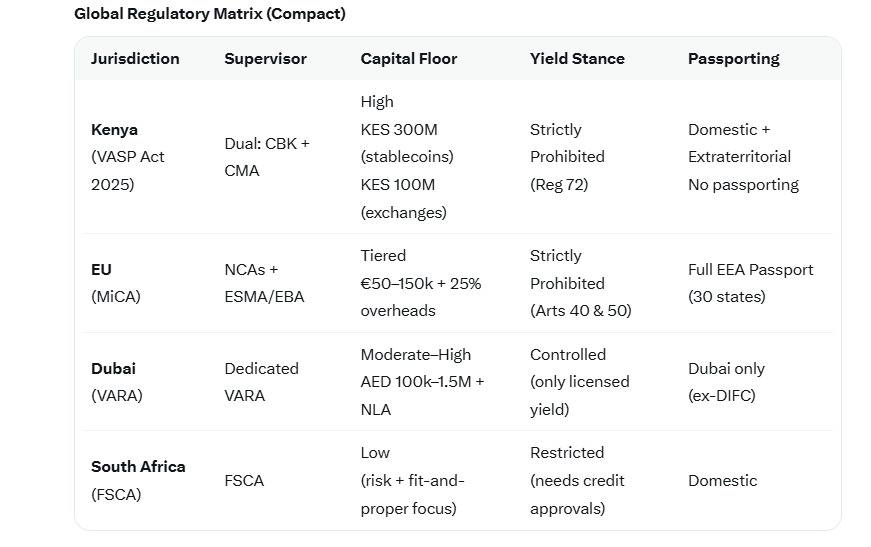
Global Regulatory Matrix: Key Jurisdiction Comparisons
Detailed Comparative Analysis
1. European Union (MiCA) vs. Kenya: The Prudential Convergence
Kenya’s Legal Notice No. 134 shares structural parallels with the EU’s Markets in Crypto-Assets (MiCA) regulation:
The Stablecoin Interest Prohibition: Both regimes explicitly prohibit stablecoin issuers and service providers from paying interest or yield to holders (MiCA Articles 40 & 50 vs. Kenya Regulation 72). Both regulators classify stablecoins strictly as payment instruments rather than deposit substitutes, preventing capital flight out of commercial banks.
Asset Segregation & Trust Reserves: Like MiCA’s requirement for e-money tokens (EMTs), Kenya requires 1:1 reserve backing and mandates that at least 30.0% of stablecoin reserves be localized in domestic commercial bank trust accounts.
Key Divergence (Passporting): While a single MiCA license in any EU member state grants “passporting” rights across all 30 European Economic Area (EEA) countries, Kenya’s framework operates on a localized model requiring physical incorporation and local CEO residency.
2. Dubai (VARA) vs. Kenya: Dedicated Agency vs. Dual-Agency Model
Regulatory Architecture: Dubai established a single, specialized regulator (VARA) focused entirely on digital assets. Kenya chose a dual-regulatory framework split between the Central Bank of Kenya (CBK) and Capital Markets Authority (CMA). While VARA provides a single portal for multi-activity licenses, Kenyan VASPs offering hybrid products (e.g., a wallet with integrated exchange features) must interface with both CBK and CMA rules.
Capital & Liquidity Mechanics: VARA applies a dynamic capital rule based on annual fixed overheads (15% to 25%) combined with daily Net Liquid Asset checks. Kenya utilizes high fixed upfront paid-up capital floors (e.g., KES 300M for stablecoins and KES 100M for exchanges) alongside a 30-day liquidity buffer requirement.
3. South Africa (FSCA) vs. Kenya: Conduct-Based vs. High-Capital Approach
Barrier to Entry: South Africa’s FSCA designated crypto assets as financial products under the existing FAIS Act, focusing heavily on market conduct, intermediary licensing, and compliance governance without imposing steep upfront paid-up capital limits.
Institutional Screening: Kenya’s decision to impose a KES 300 Million (~USD 2.3M) core capital floor for stablecoins and KES 150 Million for custodial wallets places Kenya closer to institutional banking standards. This creates a high barrier to entry that favors well-capitalized institutions and commercial banks over early-stage startups.
5. Strategic Takeaway for Stakeholders
Legal Notice No. 134 of 2026 establishes regulatory certainty while significantly raising the cost of compliance and operation. While early-stage, bootstrapped startups may find the upfront capital thresholds prohibitive—potentially turning to the CMA Regulatory Sandbox as a temporary staging ground—institutional players, commercial banks, and established international exchanges gain a clear legal framework to offer digital asset services across East Africa.
With the November 4, 2026 compliance deadline fast approaching, market participants must urgently audit their capital structures, corporate governance, and custody mechanics. Over the next 12 to 24 months, stakeholders should prepare for three major structural shifts in Kenya’s financial ecosystem:
What to Expect Next!
1. Enhanced Crackdown on Unregulated & Peer-to-Peer Operators
As the November 4 deadline passes, the Central Bank of Kenya, CMA, and law enforcement agencies (including the Assets Recovery Agency and Anti-Money Laundering Directorate) will initiate targeted enforcement operations against non-compliant entities.
Offshore De-Banking: P2P desk facilitators and non-licensed foreign exchanges actively serving Kenyan retail users will face domain-level restrictions, social media ad bans, and IP blocks.
Compliance Consolidation: Unlicensed micro-operators will be forced to either merge with capitalized partners, operate under regulated white-label brokers, utilize the CMA Sandbox, or exit the Kenyan jurisdiction altogether.
2. Entry of Institutional Players Previously Sidelined
Historically, institutional fund managers, pension funds, and Tier-1 commercial banks avoided digital assets due to fiduciary restrictions and regulatory ambiguity.
Bank-Backed Digital Asset Desks: With explicit rules for custody, fiat-to-crypto rails, and stablecoin reserves, tier-1 banking institutions are positioned to launch institutional crypto-fiat settlement portals, custodial vaults, and local currency stablecoins.
Asset Tokenization & Capital Markets: Real-World Asset (RWA) tokenization (such as fractionalized real estate, tea/coffee export receivables, and local sovereign debt tokens) will see increased activity under CMA oversight.
3. Rigorous Transparency & CBK-Grade Reporting Standards
The era of self-reported “Proof-of-Reserves” and informal balance sheet declarations is officially over. Digital asset entities will be held to the same reporting cadence as licensed commercial banks and payment service providers (PSPs).
Automated Regulatory Reporting: Licensed VASPs must integrate real-time transaction monitoring and automated AML/CFT Travel Rule compliance systems to report suspicious transactions instantly.
Daily FX & Liquidity Audit Trails: Stablecoin issuers and fiat gateways will submit daily liquidity reserve reports to CBK systems, guaranteeing that client funds are fully backed, segregated, and audit-ready at all times.
About Boardlot Africa Research
Boardlot Africa is a premier financial intelligence and corporate governance publication dedicated to unpacking the mechanics of capital, market strategies, and structural shifts across East Africa’s corporate landscape. By bridging the gap between raw economic data and actionable market intelligence, we deliver deep-dive research, independent corporate analysis, and policy insights designed for institutional investors, boardrooms, and sharp market observers.
Get in Touch
Email: boardlot.research@gmail.com
Phone: +254 753 133 901
Substack: Subscribe to Boardlot Africa
X (Twitter): BoardLotSultan