
The Micro-Insurance Illusion: Why Kenya’s Tier-1 Insurers Keep Launching Innovative Products Nobody Can Buy
Table of Contents
1. Executive Summary: The Micro-Insurance Paradox
2. Forensic Data Breakdown: What IRA Q1 2026 Filings Reveal
3. The Bancassurance Illusion & Channel Conflict
4. Operational Benchmark: Broker Push vs. Embedded API Pull
5. Strategic Playbook & Recommendations
6. Conclusion: The Future of Mass-Market Distribution

1. Executive Summary: The Micro-Insurance Paradox
Over the past year, Britam Insurance has launched an aggressive micro-insurance pipeline aimed at Kenya’s informal economy—headlined by Bima ya Wafanyikazi (a domestic worker health cover from KES 336/month), the Heshima Farewell Plan, alongside specialized products like Bima ya Mwananchi, Malkia Cover, and Senior Medical. While these solutions demonstrate world-class product engineering on paper, there is virtually zero visible mass-market traction or organic retail conversion. A casual discussion with any domestic worker, casual laborer, or low-wage earner across Kenya immediately exposes the core problem: the very target market these covers were built for is entirely unaware that they even exist. Despite the flurry of PR campaigns and IRA filings showcasing technical activity, Britam’s innovative retail portfolio remains largely dormant on the shelf—a costly exercise in corporate R&D.
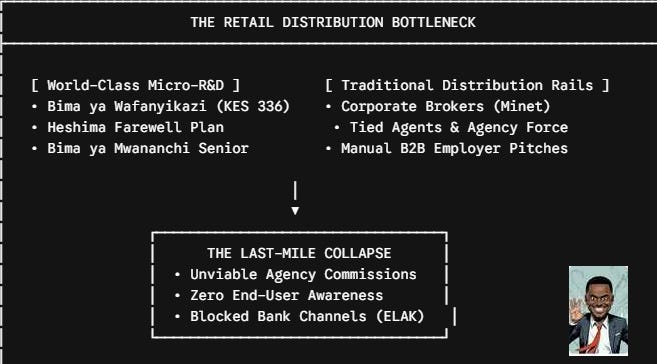
This disconnect stems directly from a fundamental flaw in distribution strategy. Rather than embedding micro-covers natively into high-frequency digital channels like mobile money, Britam continues to push low-ticket policies through traditional corporate brokers (such as Minet Kenya) and tied agency forces. Corporate brokers pitch top-down to HR executives—relying on employers to buy policies as perks rather than building direct retail awareness—while human agents cannot survive on KES 336 monthly commissions. Furthermore, bank channels are closing as financial partners build captive underwriters (such as Equity Life/ELAK). Without shifting to frictionless, embedded “API pull” infrastructure—the approach taken by Jubilee Health via bolttech—even the most affordable policies will remain invisible to the everyday consumers they were designed to protect.
Key Findings & Strategic Analysis
1. The IRA Q1 2026 Data Signals Disparity in Market Focus
Analysis of the 28 Q1 2026 filings reveals three distinct strategic postures:
Commodity Defensiveness (Corporate Lines): Legacy leaders (Britam, CIC, Old Mutual, Heritage) all cross-filed duplicate EAC Customs Bonds to protect their commercial brokerage revenues in trade logistics.
Balance Sheet Accumulation (Education & Life): Insurers like Jubilee Life (Smart Scholar & Faida Maisha) and Prudential (Pru Assure) are aggressively competing for mass-affluent long-term savings and high-yield investment liabilities.
The Banking Threat (Captive Disintermediation & Cross-Selling): Tier-1 banks are moving aggressively to consolidate non-banking revenues by directly converting their active customer bases into high-margin underwriting income:
Equity Group: Newly licensed bank-owned underwriters Equity Health (Equity Afya Health Cover) and Equity General (Travel, Trustee Liability) filed four retail products in 90 days, systematically internalizing captive branch traffic.
Absa Bank Kenya: Through Absa Life, the bank is aggressively expanding its proprietary education, savings, and credit life covers to capture maximum wallet share from its active retail and SME account holders.
NCBA Group: Following its 100% acquisition of AIG Kenya (rebranded to NCBA Insurance), NCBA is leveraging its market-leading corporate banking, digital lending, and asset finance footprint to seamlessly cross-sell general and commercial insurance across its physical and digital channels.
2. The Bancassurance Illusion & The Corporate Broker Wall
Channel Conflict with Bank Partners: Cross-shareholdings (such as Britam’s ties with Equity Group) no longer guarantee mass distribution. Bank networks prioritize their own internal underwriting arms (e.g., Equity Life/ELAK) over third-party policies.
The Corporate Broker Bottleneck: Forced out of bank branches, legacy insurers deploy retail policies through corporate mega-brokers like Minet Kenya. However, brokers operate via B2B relationships with corporate HR heads and executives. Pitching a mass-market domestic worker cover through Minet relies on employer top-down sponsorship rather than organic, direct-to-consumer (B2C) mass-market adoption.
3. Strategic Archetype Benchmark: Legacy Push vs. Embedded APIs


Section 2: Decoding the IRA Q1 2026 Data—Product Proliferation vs. Strategic Reality
A forensic analysis of the Insurance Regulatory Authority (IRA) Q1 2026 industry report reveals that product filings are heavily concentrated within three distinct strategic postures. Rather than signaling broad-based, transformative innovation, these 28 approved filings illustrate how Kenya’s tier-1 underwriters are dividing their balance sheets between defending commercial brokerage fees, capturing mass-affluent assets, and reacting to bank-led disintermediation.
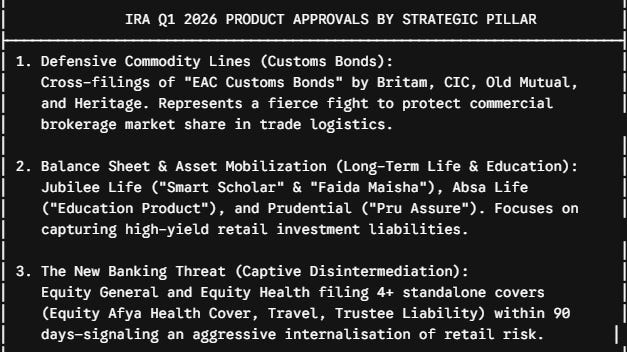
1. Commodity Defensiveness: The EAC Customs Bond Cluster
Between March 6 and March 12, 2026, four major general insurers—Britam General, CIC General, Old Mutual General, and The Heritage Insurance Company—each received regulatory approval for an identical product: the EAC Customs Bond. This sudden cluster of identical filings reflects a fierce defense of commercial brokerage revenues rather than retail expansion.
As regional trade integration under the East African Community (EAC) Single Customs Territory deepens, logistics operators require standardized financial guarantees to clear goods across transit corridors. Instead of competing on product differentiation, legacy underwriters are forced to duplicate commodity regulatory filings simply to prevent commercial brokers from moving lucrative corporate freight-forwarding accounts to competitors.
2. Asset Mobilization: The Endowments & Education Push
On the long-term life side, Q1 filings show a heavy concentration in endowment, education, and investment-linked plans. Jubilee Life secured approvals for Faida Maisha (linked investments) and Smart Scholar (life assurance). Concurrently, Absa Life Assurance filed two separate education and life products, flanked by Prudential Life (Pru Assure) and Kenya Orient Life (Orient Educator).
For equity research analysts, this pattern highlights an aggressive push for long-term retail liquidity. Education and endowment policies serve as sticky, high-yielding asset accumulation vehicles. They allow life underwriters to build up investment float and expand their Asset Management (AUM) arms to compete against Money Market Funds (MMFs) and high-yielding government paper. However, these are traditional, middle-to-upper-income products that depend on high-touch agency distribution to close—leaving lower-income mass retail unserved.
3. The Banking Threat: Equity Group’s Internalization Drive
The most strategically significant signal in the IRA report comes from the banking sector’s direct underwriting subsidiaries. Within the 90-day window, Equity General Insurance and Equity Health Insurance received approvals for four standalone covers, including Travel Insurance, Trustee Liability, and the Equity Afya Health Cover.
This filing velocity demonstrates how banking groups are moving from passive bancassurance fee collection to active risk retention. By deploying proprietary underwriting entities like Equity Life (ELAK), Equity Health, and Equity General directly across their branch networks, digital apps, and Equity Afya medical centers, bank-backed insurers are systematically shutting out third-party legacy underwriters from their captive distribution channels.

Section 3: The Bancassurance Illusion & Channel Conflict
On paper, a tier-1 underwriter with deep institutional cross-shareholdings should command an unassailable mass-market distribution advantage. Britam’s historic shareholding ties with Equity Group and its controlling stake in HF Group (HFCK) theoretically grant it direct, privileged access to tens of millions of bank account holders and a nationwide branch footprint. Yet, when Britam launched Bima ya Wafanyikazi—an innovative domestic worker health cover structured by its micro-insurance unit, Britam Connect, at KES 336 per month—it did not roll out natively across Equity Bank’s mobile banking app or branch counters. Instead, it announced distribution via Minet Kenya, a top-tier corporate insurance broker.
This structural disconnect exposes the reality of channel conflict within Kenyan financial services: bancassurance and cross-shareholdings no longer guarantee third-party product distribution.
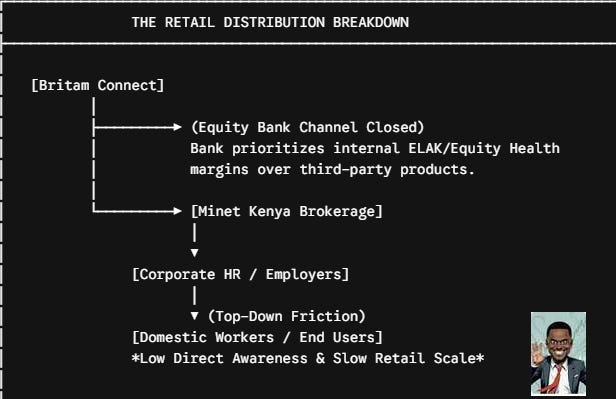
1. The Bancassurance Cannibalization Trap
The primary reason legacy underwriters are pushed out of tier-1 bank branches is straightforward: banks are building their own balance sheets. Equity Group’s fully licensed underwriting subsidiary, Equity Life Assurance Kenya (ELAK), alongside its expanding Equity Health and Equity General arms, operates with a clear mandate: capture and retain the entire underwriting margin generated across Equity’s 18+ million customer base.
For a bank branch manager or bancassurance officer, pushing a third-party policy from Britam or Jubilee yields a modest, single-digit agency commission. Pushing an internal ELAK or Equity Health policy retains 100% of the premium float and underwriting profit within the parent holding company. As a result, third-party micro-insurance policies are systematically deprioritized at the branch counter, rendering historic bancassurance arrangements functionally obsolete for retail scale.
2. HFCK’s Geographic and Segment Constraints
While Britam retains controlling influence over HF Group (HFCK), relying on HF’s bancassurance arm to drive mass retail micro-insurance introduces a fundamental demographic mismatch.
HF Group’s distribution footprint remains heavily urbanized and mortgage-skewed, focused on urban property, project financing, and middle-to-upper-income banking clients. It lacks the high-frequency, low-ticket transaction velocity required to distribute daily micro-insurance policies like Bima ya Wafanyikazi to informal and lower-income workers.
3. The Corporate Broker Wall (The HR Bottleneck)
Lacking direct, frictionless retail access through bank channels, legacy underwriters fall back on their established institutional relationships: corporate mega-brokers like Minet Kenya.
However, routing mass-market micro-products through corporate brokers introduces a B2B2C structural wall:
The HR Dependency: Minet operates primarily by pitching corporate employee benefits packages to HR directors, C-suite executives, and enterprise decision-makers.
Top-Down Acquisition Friction: To sell a KES 336 monthly domestic worker policy through a corporate broker, the underwriter relies on middle- and upper-income executives buying the policy as an employer-funded perk for their household staff.
Zero Last-Mile Awareness: Because the marketing and onboarding occur at the corporate executive level, the target end-users—the domestic workers themselves—are never directly engaged. They remain entirely unaware of the product, its claims process, or its standalone value, eliminating organic bottom-up demand.
Why this reliance on these channels
The reliance on corporate brokers for retail products represents a channel mismatch. Traditional tied agents avoid low-ticket micro-insurance because micro-commissions cannot sustain their livelihood. Bank partners are busy building competing internal underwriting arms. Corporate brokers push products top-down to corporate buyers.
Consequently, innovative products like Britam’s Bima ya Wafanyikazi or Heshima Last Expense remain well-designed policies trapped behind institutional walls—leaving the target mass market unaware that the cover even exists.
4. Operational Benchmark: Broker Push vs. Embedded API Pull
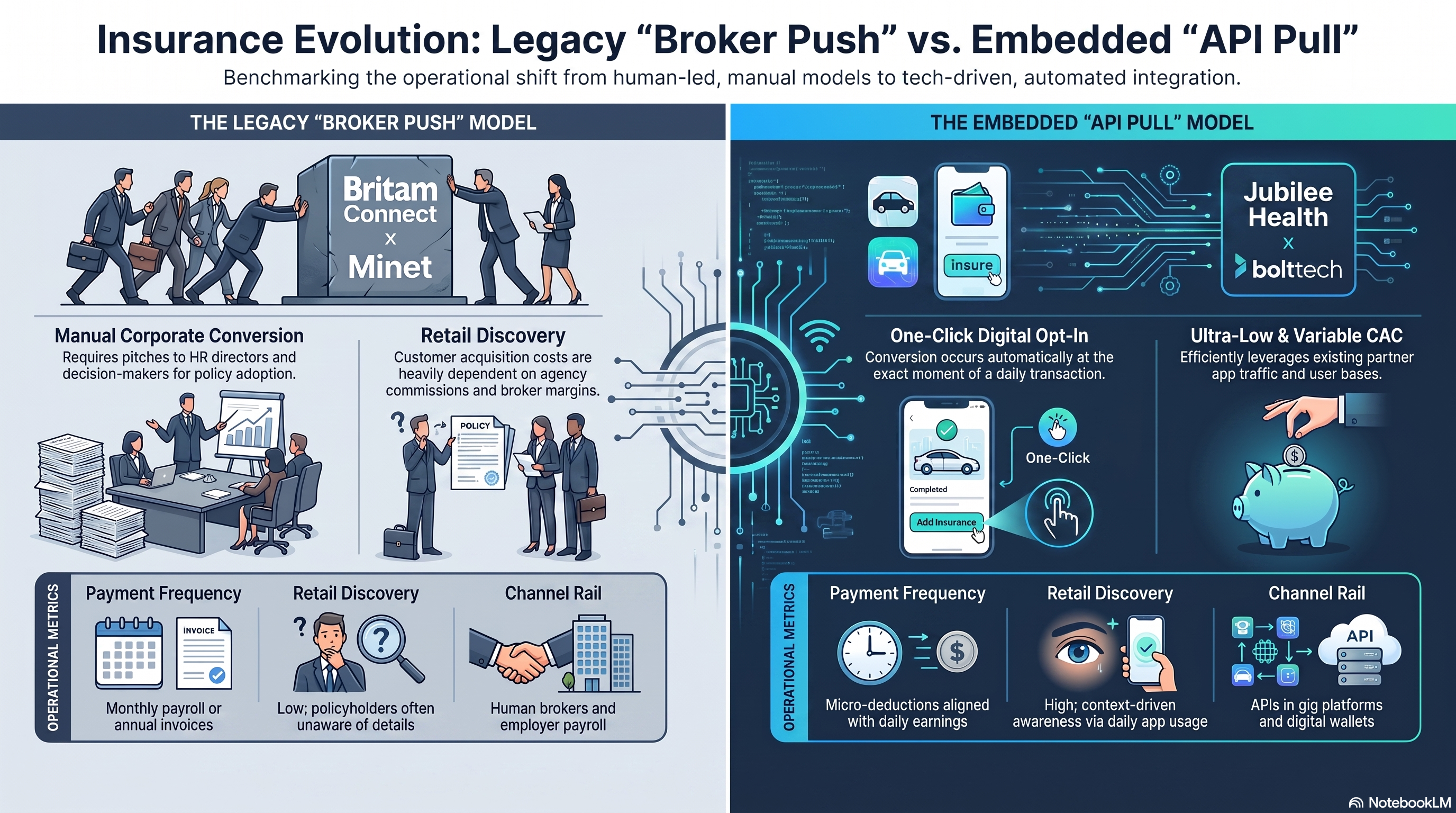
To understand why retail micro-insurance policies stall at the last mile, we must examine the stark operational divergence between traditional “broker push” models and modern “embedded API pull” architecture.
The structural failure of low-ticket retail insurance in Kenya is not a product problem—it is a distribution cost problem. Pushing a KES 300 to KES 500 monthly policy through legacy human agents and corporate broker channels creates prohibitive customer acquisition costs (CAC) relative to lifetime value (LTV).
Comparative Framework: Britam Insurance vs. Jubilee Health
Key Unit Economic & Distribution Takeaways
1. The Flaw in B2B2C Corporate Broker Pitches
When an underwriter relies on corporate brokers (like Minet Kenya) to distribute micro-covers like Bima ya Wafanyikazi, the product is pitched to corporate HR heads or business owners rather than the actual workers. Employers may purchase policies as a fringe benefit or skip them entirely. Because the end-user (e.g., a domestic worker or casual employee) never interacts directly with the insurer or product onboarding, organic pull and direct consumer renewal remain non-existent.
2. Commission Starvation for Agency Forces
A tied agent earning a 10%–15% commission on a KES 336 monthly domestic worker policy receives roughly KES 33 to KES 50 per month. After factoring in transport and airtime, human agents face negative net margins on micro-lines. Consequently, agency forces naturally abandon micro-insurance to sell high-ticket corporate general or motor policies, leaving retail products dormant.
3. The “Invisible Integration” Solution (The Jubilee / bolttech Playbook)
By partnering with global insurtech bolttech, Jubilee Health shifts the entire distribution paradigm. Rather than asking a low-income consumer to fill out a standalone paper form or deal with an agent, health products (starting with HospiCash) are embedded via APIs directly into platforms consumers already trust—such as mobile money wallets, fuel pay-points, ride-hailing apps, and digital lenders.
Core Takeaway for Analysts & C-Suite:
Micro-insurance cannot be sold; it must be bought seamlessly. Legacy underwriters that fail to transition from human-pushed sales to embedded, API-driven platform integrations will continue to write off R&D spending on retail products that never convert on the ground.

Section 5: Strategic Playbook & Conclusion
The divergence between rapid product innovation and lagging retail conversion creates both critical risks and structural opportunities across the East African financial services sector. Navigating this transition requires updating traditional underwriting models, valuation metrics, and distribution playbooks.
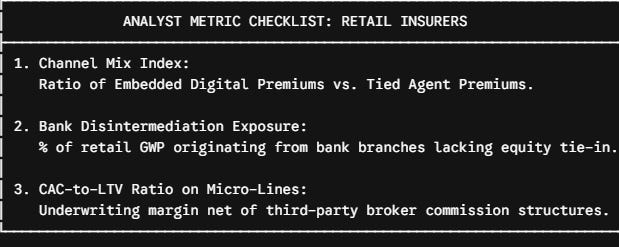
1. For Equity Research Analysts & Portfolio Managers
Apply Higher Risk Discounts to Agency-Driven Retail Models
The Expense Ratio Reality: Retail volume growth strategies built on traditional, human-led tied agencies carry an unsustainably high Customer Acquisition Cost (CAC). When analyzing companies attempting to drive low-ticket micro-insurance (KES 300–500/month) via agency force, analysts should model for compressed underwriting margins.
The Valuation Metric Shift: Value insurance stocks not merely on Gross Written Premium (GWP) growth, but on Distribution Efficiency Ratios—specifically the ratio of Acquisition & Commission Expense to Net Earned Premium within retail lines. Insurers relying on physical branch sales or commission-heavy agency networks will see return on equity (ROE) diluted by fixed sales overhead.
Factor in Bank-Owned Underwriting Disintermediation
Declining Fee Income for Legacy Players: Historically, independent insurers enjoyed stable retail flows via bank partnerships. As banking groups systematically route retail credit life, health, and property covers to their proprietary underwriting subsidiaries (such as Equity Life/ELAK, Equity Health, and Absa Life), analysts must model a multi-year decline in traditional bancassurance fee share for non-bank underwriters.
2. For C-Suite Insurance Executives & Product Heads
Enforce Pre-Integration Channel Standards
Eliminate “Field-First” R&D: Product development units must cease launching retail micro-insurance policies without a pre-configured digital rail (USSD, mobile wallet, or app API) already locked in place for distribution. R&D capital spent on un-embedded retail covers yields shelf-ware that fails at the point of sale.
Pivot from Traditional Bancassurance to Embedded API Ecosystems
Bypass the Branch Network: Rather than fighting bank-owned insurers inside physical bank branches, tier-1 underwriters must adopt embedded infrastructure frameworks—such as Jubilee Health’s strategic integration with bolttech.
Target High-Frequency Digital Rails: To capture the informal and daily-earning mass market, insurance policies must be embedded directly into non-bank platforms where consumers daily live and transact:
Gig & Mobility Platforms: Ride-hailing daily health/accident opt-ins triggered per trip.
Digital Lenders & Merchants: Instant credit life or product protection integrated at checkout.
FMCG Supply Chains: Micro-health covers embedded into distributor and shopkeeper stock-order apps.
Re-engineer Payment Frequencies to Match Cash-Flow Realities
Daily and Pay-as-You-Earn Structuring: The mass market does not operate on annual premium budgets. Insurers must deconstruct policies into daily micro-deductions aligned with daily earnings loops. The objective is to make health and income protection a frictionless, automatic component of everyday commerce rather than a deliberate, high-friction financial decision.
Conclusion
The IRA Q1 2026 data confirms that Kenya’s insurance market possesses the technical capability to engineer sophisticated financial protection. However, product sophistication without last-mile distribution efficiency yields empty volume. The era of relying on traditional corporate brokers and tied agency forces to push low-ticket retail insurance is over. Product R&D without native digital distribution yields nothing more than corporate shelf-ware.
The future of retail insurance in East Africa will not be won by corporate brokers selling top-down to employers, nor by traditional tied agents chasing micro-commissions. It will belong to underwriters who turn coverage into an invisible, embedded layer resting inside the daily digital workflows of the African consumer.
About Boardlot Africa Research
Boardlot Africa is a premier financial intelligence and corporate governance publication dedicated to unpacking the mechanics of capital, market strategies, and structural shifts across East Africa’s corporate landscape. By bridging the gap between raw economic data and actionable market intelligence, we deliver deep-dive research, independent corporate analysis, and policy insights designed for institutional investors, boardrooms, and sharp market observers.
Get in Touch
Email: boardlot.research@gmail.com
Phone: +254 753 133 901
Substack: Subscribe to Boardlot Africa
X (Twitter): BoardLotSultan