
Coming on the heels of the High Court's historic Ksh 1.4 Billion copyright judgment against Safaricom over the M-Pesa Go (Peter Muoki vs Safaricom) parental control USSD code, the BLAZE saga exposes a chilling, recurring pattern: a corporate culture where pitches submitted by independent creators are allegedly treated not as protected intellectual property, but as an open-source library for internal execution.
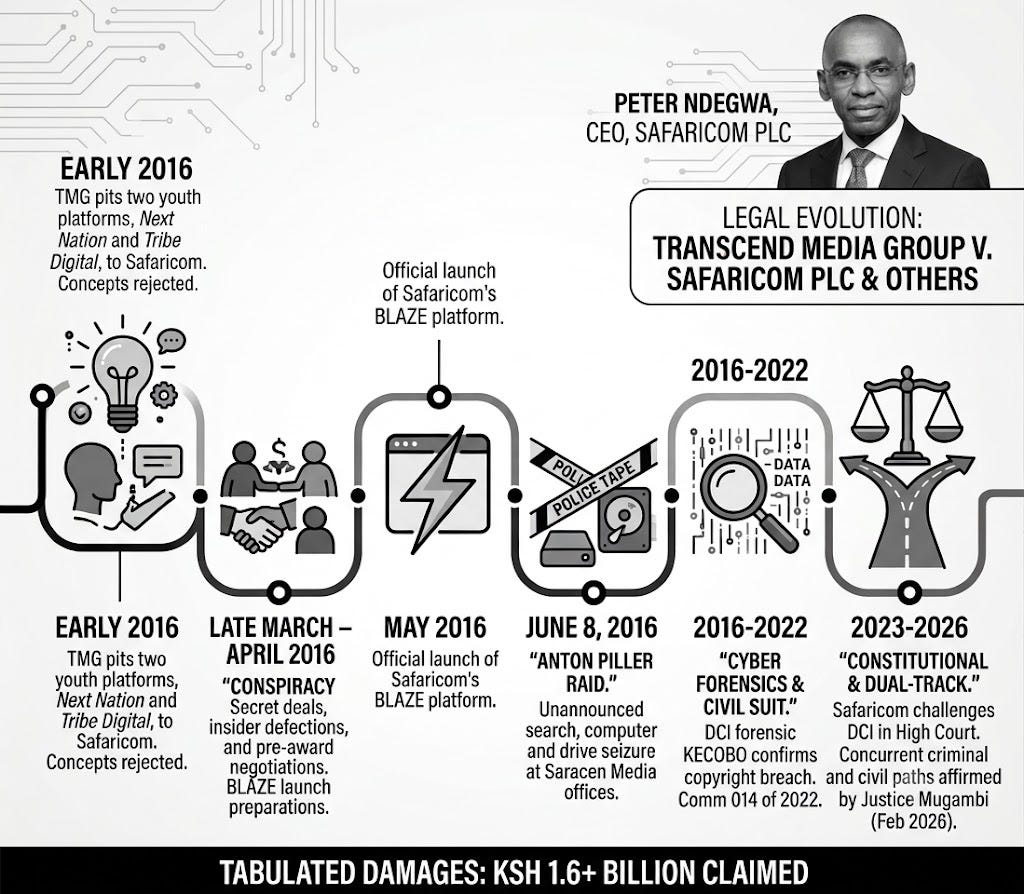
Table of Contents
I. Introduction & The Litigants
II. The Issues for Determination
III. Detailed Timeline of Events Leading to the Dispute
IV. Spotlight: The Smoking Gun — Anatomy of the Active Conspiracy (Late March – April 2016)
V. Spotlight: The Raid — Executing the Anton Piller Order and Seizing the Evidence
VI. The Legal Arguments in Court
VII. The Judgment
VIII. Key Governance & Legal Takeaways
I. Introduction & The Litigants
When corporate procurement, high-stakes advertising, and massive commercial budgets intersect, the line between aggressive bidding and corporate espionage can become severely tested.
In 2016, Safaricom PLC, Kenya’s largest telecommunications provider, launched BLAZE Kenya—a multi-billion-shilling platform created to capture the lucrative youth demographic. However, behind the flashy launch lay allegations of corporate collusion, stolen intellectual property, covert emails, and an intense decade-long legal battle spanning commercial, criminal, and constitutional courts.
The Plaintiff / Complainant
Transcend Media Group Limited (TMG): A Kenyan creative advertising and media agency owned and directed by Lai Muthoka & Mike Njeru
The Defendants & Interested Parties
Safaricom PLC (1st Defendant / Petitioner in Constitutional Petition): Kenya’s leading telecom operator.
Sylvia Mulinge, Flora Omuhaka Mangala, Emily Too, Flora Baiya, Janice Kemoli (2nd–6th Defendants): Current and former executive officials of Safaricom involved in the procurement and tender evaluation process.
Thomas Omanga & Timla Tieng (7th & 8 th Defendants): Former senior staff of TMG. Omanga was TMG’s Client Service Director and lead strategist for the Safaricom pitch.
Saracen Media Kenya Limited (9th Defendant): A rival media agency awarded the Safaricom youth creative and digital contract.
Fieldstone Helms Limited (10th Defendant): A corporate entity established by departing TMG employees (Thomas Omanga, Timla Tieng, and Christine Muchendu) to execute the Safaricom account alongside Saracen Media.
State Organs: The Director of Public Prosecutions (ODPP) and the Directorate of Criminal Investigations (DCI) Cybercrime Unit.
II. The Issues for Determination
Across the primary commercial suit (COMM 014 of 2022) and the constitutional challenge (HCCHRPET/E331/2023), the courts were asked to adjudicate five core legal questions:
Copyright Infringement & IP Theft: Did Safaricom, Saracen Media, and Fieldstone Helms unlawfully copy, adapt, and commercially exploit TMG’s pitched concepts (Next Nation / Tribe Digital) to create BLAZE Kenya without TMG’s consent or license?
Breach of Contract & Corporate Sabotage: Did Safaricom and Saracen conspire with TMG’s senior executives, inducing them to breach their fiduciary duties, employment non-compete clauses, and confidentiality obligations while still on TMG’s payroll?
Co-existence of Civil and Criminal Suits (Section 193A Penal Code): Can a state criminal investigation into fraud, bribery, and corporate theft proceed concurrently with a civil commercial suit involving the same facts, or does it amount to an abuse of court process?
Admissibility of Forensic Digital Evidence (Res Judicata): Are digital evidence and forensic reports generated via court-ordered Anton Piller search warrants admissible, or do technical chain-of-custody and electronic certificate objections bar their production?
Investigative Secrecy vs. Right to Information (Article 35): Does a corporate suspect under police investigation have a constitutional right under Article 35 to compel law enforcement to hand over internal police inquiry files prior to being charged in court?

III. Detailed Timeline of Events Leading to the Dispute
25th January 2016: Safaricom issues a Request for Proposal (RFP) seeking a second creative/digital agency to handle its upcoming youth segment communication campaign.
1st–12th February 2016: TMG appoints Thomas Omanga as team lead. TMG formally submits its tender via Safaricom’s online S-Hub portal, pitching proprietary concepts titled Tribe Digital, Hack it, Next Nation, and Safcom 2.0.
17th February 2016: TMG pitches to Safaricom’s evaluation panel, submitting physical pitch decks and digital presentation CDs. TMG makes the final shortlist alongside Brainwave Communications and Saracen Media (bidding in a consortium with 5ive and Bean).
16th–17th March 2016 (The Collusion): Forensics later retrieve internal emails showing TMG’s pitch lead, Thomas Omanga, instructing advocates on March 16 to draft an “Exclusivity & Non-Circumvention Agreement” between Fieldstone Helms and Saracen Media to handle Safaricom’s account. On March 17, a collaboration agreement is emailed directly to Saracen Media’s directors while Omanga and his team are still employed by TMG.
1st April 2016: Safaricom issues an initial letter of award regarding the campaign (produced as Exhibit 40).
15th April 2016: Safaricom’s procurement team conducts a conference call notifying TMG’s directors that their bid was unsuccessful. TMG later alleges Safaricom made Saracen’s contract award conditional on Saracen partnering with the departing TMG staff under their new vehicle, Fieldstone Helms.
May–June 2016: Thomas Omanga, Timla Tieng, and Christine Muchendu resign from TMG and operationalize Fieldstone Helms alongside Saracen Media. Safaricom officially launches its youth campaign under the name BLAZE Kenya.
25th May 2016: TMG Executive Director Lai Muthoka files a formal criminal complaint with the police alleging corporate espionage, fraud, and IP theft, opening DCI Inquiry File No. 14 of 2016.
6th June 2016: Senior Magistrate E. K. Usui grants Anton Piller search orders in Milimani CMCC No. 3644 of 2016 (TMG v. Saracen Media & Others).
8th June 2016: KECOBO officers, police, and TMG directors execute the raid at Saracen Media and Fieldstone Helms’ offices, seizing laptops and storage media used by former TMG staff.
23rd June 2016: Hon. Ng’etich orders the seized storage devices to undergo technical forensic extraction by the DCI Cybercrime Unit.
13th October 2016: DCI Cybercrime Inspector Anthony Kariuki completes the Computer Forensic Examiner’s Report (Exhibit 18), identifying extensive structural and technical similarities between TMG’s pitched decks and BLAZE Kenya.
19th October 2016: KECOBO issues official findings analyzing copyright infringement based on the DCI report.
17th June 2019: The Magistrate Court affirms that the search and forensic extraction were lawful and properly conducted pursuant to court orders.
2022: CMCC No. 3644 of 2016 is transferred and consolidated into High Court Commercial & Tax Division COMM 014 of 2022 (TMG v. Safaricom PLC & 9 Others).
27th Jan 2023 & 26th May 2023: Justice A. Mabeya repeatedly dismisses applications by the Defendants challenging the forensic evidence, ruling that technical challenges must be tested via cross-examination during full trial.
11th September 2023: Safaricom PLC files Constitutional Petition No. HCCHRPET/E331/2023 against the ODPP, DCI, and TMG, seeking to quash the police inquiry and permanently stop the police from interviewing or arresting its executives.

IV. The Smoking Gun: Anatomy of the Active Conspiracy (Late March – April 2016)
While the formal tender process was publicly presented as a competitive bid evaluation, forensic email extractions reveal an intricate, parallel operation occurring behind closed doors between Safaricom officials, Saracen Media, and insider defectors from Transcend Media Group.
1. The Forced Marriage & Pre-Award Mobilization
21st March 2016: Safaricom procurement officials insist that Saracen Media must partner with Fieldstone Helms—the entity being surreptitiously established by TMG’s departing team—as a mandatory condition for receiving the creative work.
23rd March 2016: Safaricom Procurement Officer Flora Mangala writes to Saracen Media demanding a revised organizational structure confirming that Fieldstone Helms and TMG team lead Thomas Omanga are integrated into their consortium. On the same day, Omanga meets directly with Safaricom and Saracen executives to review the secret BLAZE campaign strategy.
24th March 2016: Eleven days prior to any official contract award announcement, Saracen Media begins actively recruiting 35 additional staff members specifically to handle the Safaricom account.
2. Insider Sabotage & Leaked Proprietary Intelligence
27th March 2016: In a revealing email, Thomas Omanga explicitly acknowledges the grave personal and legal risks of his dual employment, noting the danger if his breach of fiduciary duty and conflict of interest were to be “exposed”.
29th March 2016: Timla Tieng, acting alongside Omanga while still on TMG’s payroll, transmits TMG’s confidential pitch materials and proprietary creative assets directly to Saracen Media.
3. Procurement Manipulation & Parallel Negotiations
31st March 2016: Safaricom Senior Procurement Manager Emily Too emails Saracen Media, privately advising them to adjust their financial figures to fit Safaricom’s internal budget—a direct commercial advantage denied to TMG and all other competing bidders.
1st April 2016: In a duplicitous sequence of events, Safaricom’s Flora Baiya emails TMG’s Timla Tieng praising her for “great work done” on TMG’s presentation. Simultaneously, Safaricom’s Janice Kemoli meets with Saracen Media to negotiate and finalize a monthly retainer fee of Ksh 9.13 Million, locking in commercial terms before the tender evaluation is officially concluded.
4. Execution, Staff Poaching & The Cover-Up
4th April 2016: Safaricom formally issues the contract award letter to Saracen Media. To ensure immediate operational takeover, Saracen agrees to pay Ksh 600,000 in lieu of notice to buy out Timla Tieng’s contract at TMG. Thomas Omanga requests Saracen directors to conceal his resignation from TMG leadership while providing a target list of additional TMG creative talent to poach.
5th April 2016: Flora Mangala sends post-award financial and operational instructions jointly to Saracen Media and Fieldstone Helms.
15th April 2016: Eleven days after secretly awarding the contract and organizing staff departures, Safaricom conducts a conference call with TMG directors to formally notify them that their bid was unsuccessful, flatly refusing to disclose who won the tender or provide reasons for TMG’s rejection.
V. The Raid: Executing the Anton Piller Order and Seizing the Evidence
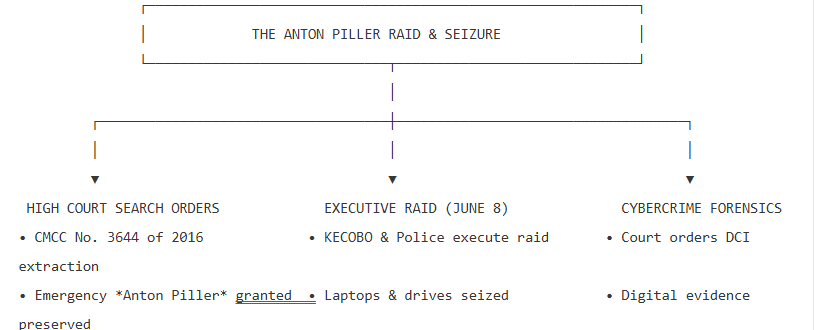
When Transcend Media Group (TMG) realized its pitch materials were being deployed under Safaricom’s new BLAZE Kenya platform, TMG moved swiftly to secure evidence before it could be wiped or concealed. Recognizing that electronic evidence in corporate espionage cases is inherently volatile, TMG turned to one of the most powerful civil remedies available under Kenyan law: an Anton Piller search order.
1. Securing the Emergency Court Orders
On 6th June 2016, Hon. E. K. Usui issued emergency Anton Piller orders in Milimani CMCC No. 3644 of 2016 (Transcend Media Group Limited v. Saracen Media Limited & 2 Others). The court order authorized TMG, accompanied by statutory enforcement officers from the Kenya Copyright Board (KECOBO) and police officers, to enter the commercial premises of Saracen Media and Fieldstone Helms without prior notice to inspect, preserve, and seize storage devices, computer hard drives, and physical pitch documents.
2. The Execution: Raid at Lavington (8th June 2016)
On the morning of 8th June 2016, KECOBO enforcement officers, police, and TMG directors executed the search order at Saracen Media’s offices in Lavington. The operation targeted the specific workstations and electronic devices utilized by the former TMG employees—including Thomas Omanga, Timla Tieng, and Christine Muchendu. During the raid, enforcement officers impounded several laptops, external storage devices, local desktop drives, and internal network backup media. The seized items were cataloged and placed under statutory custody to ensure the chain of custody remained untampered.
3. The Forensic Turning Point (23rd June – 13th October 2016)
To maintain impartiality and satisfy legal standards for electronic evidence, the court directed on 23rd June 2016 (Hon. Ng’etich) that all seized storage media be submitted directly to the Directorate of Criminal Investigations (DCI) Cybercrime Unit for technical forensic mirror-imaging and extraction.
By 13th October 2016, DCI Forensic Examiner Inspector Anthony Kariuki compiled the official Computer Forensic Examiner’s Report (Exhibit 18). The forensic extraction uncovered:
Internal emails between Safaricom procurement officials and Saracen directors detailing the pre-award alignment.
Draft collaboration agreements created while TMG staff were still actively employed by TMG.
Direct side-by-side structural, visual, and conceptual similarities between TMG’s pitched Next Nation and Tribe Digital decks and the operational launch decks for Safaricom’s BLAZE Kenya.
On 19th October 2016, KECOBO issued an official analysis confirming copyright infringement based on the DCI’s forensic findings.
This seizure proved to be the pivotal turning point of the entire decade-long litigation. It anchored TMG’s Ksh 1.6 Billion commercial suit with forensic proof and formed the basis of DCI Inquiry File No. 14 of 2016, which Safaricom later unsuccessfully tried to block in its 2023–2026 constitutional petition.

VI. From Commercial Dispute to Criminal Prosecution: The Intervention of the DCI and ODPP
What began as a commercial dispute over pitch materials crossed the Rubicon into a full-scale criminal investigation the moment the seized electronic devices revealed evidence far beyond mere breach of contract. Following the Anton Piller raid, the involvement of the Directorate of Criminal Investigations (DCI) Cybercrime Unit and the Office of the Director of Public Prosecutions (ODPP) fundamentally altered the character of the litigation. The forensic extractions did not merely show conceptual similarities; they uncovered an active paper trail of covert emails, pre-award financial inducements, deliberate poaching schemes, and unauthorized transmission of proprietary assets while key conspirators were still on Transcend’s payroll. These findings triggered DCI Inquiry File No. 14 of 2016 into grave penal offenses—including corporate fraud, conspiracy to defraud, bribery, and criminal copyright infringement. Under Section 193A of the Criminal Procedure Code, the state’s criminal machinery operates independently of private civil litigation. Thus, what Safaricom sought to compartmentalize as a routine procurement disagreement transformed into a high-stakes criminal inquiry, exposing corporate executives and individual defectors alike to police summonses, criminal charges, and potential prosecution.
VII. The Legal Arguments in Court
When the dispute escalated into full-scale litigation, the battlefield split across two fronts: Commercial Case COMM 014 of 2022 in the High Court Commercial & Tax Division and Constitutional Petition No. HCCHRPET/E331/2023 in the High Court Human Rights Division.
1. Transcend Media Group’s Arguments (Commercial Suit & Constitutional Petition)
Substantial Appropriation & IP Theft: TMG asserted that BLAZE Kenya was a direct structural, visual, and operational mirror of its pitched campaign concepts, Next Nation and Tribe Digital. TMG contended that Safaricom and Saracen did not independently generate the campaign brief, but instead adapted TMG’s proprietary materials.
Collusion & Corporate Sabotage: TMG relied on retrieved internal email trails showing that key TMG staff (led by Client Service Director Thomas Omanga) had entered into secret collaboration agreements with Saracen Media and formed Fieldstone Helms while still employed at TMG. TMG argued that Safaricom’s procurement officials actively facilitated this transfer by awarding the contract on the condition that Saracen partner with the departing TMG employees.
Quantum of Damages (Over Ksh 1.6 Billion): TMG sought recovery for both direct and consequential losses:
Ksh 300,000,000 in exemplary and punitive damages;
Ksh 496,734,336 representing lost retainer fees and agency commissions directly tied to the BLAZE campaign;
Ksh 842,400,000 for loss of revenue from previous sole agency contracts terminated amid the dispute;
Ksh 29,442,740 in direct tendering, market research, and pitching expenses.
Admissibility of Forensic Evidence & Res Judicata: TMG argued that the lawfulness of the 2016 Anton Piller search order and the DCI Cybercrime Forensic Report (Exhibit 18) had already been litigated and affirmed across four separate High Court rulings (17th June 2019, 27th January 2023, 26th May 2023, and 16th January 2025). TMG argued that defense objections regarding technical certificates under Section 106B of the Evidence Act or gaps in the chain of custody pertained to the weight of evidence during trial, not its initial admissibility.
2. Safaricom PLC’s Arguments (Constitutional Petition & Civil Suit)
Abuse of Criminal Justice System: Safaricom argued that TMG was instigating DCI police summonses and criminal threats solely as a coercive tool to force Safaricom into a commercial settlement. Safaricom claimed that a commercial dispute over tender concepts should not be converted into a criminal prosecution.
Violation of Fair Hearing & Administrative Rights (Articles 47 & 50): Safaricom alleged that the DCI and ODPP acted arbitrarily by attempting to interview and arrest its senior executives (including Sylvia Mulinge) without disclosing the exact contents of DCI Inquiry File No. 14 of 2016 or making the police forensic findings available.
Technical Inadmissibility of Digital Evidence: In the commercial suit, Safaricom, Saracen Media, and Fieldstone Helms filed formal Notices of Objection claiming that TMG’s digital forensic reports failed to comply with strict statutory certification requirements under Section 106B of the Evidence Act, lacked an unbroken chain of custody, and violated the defendants’ right to privacy under Article 31.
3. State Organs’ Arguments (ODPP & DCI Cybercrime Unit)
Statutory Mandate & Section 193A Penal Code: The Director of Public Prosecutions and the DCI maintained that Section 193A of the Criminal Procedure Code explicitly permits criminal investigations and civil suits to proceed concurrently.
Distinction Between IP Infringement and Criminal Fraud: The DCI argued that TMG’s complaint was not a simple copyright dispute; it alleged fraud, bribery, corporate conspiracy, and breach of trust by corporate officers—offenses that fall under the DCI’s constitutional mandate to investigate criminal conduct.
Protection of Active Investigations (Access to Information Act): The ODPP submitted that suspects do not possess an unqualified right under Article 35 to demand ongoing police investigation files prior to formal charges being instituted, as pre-charge disclosure could compromise active investigations.

VIII. The Judgment
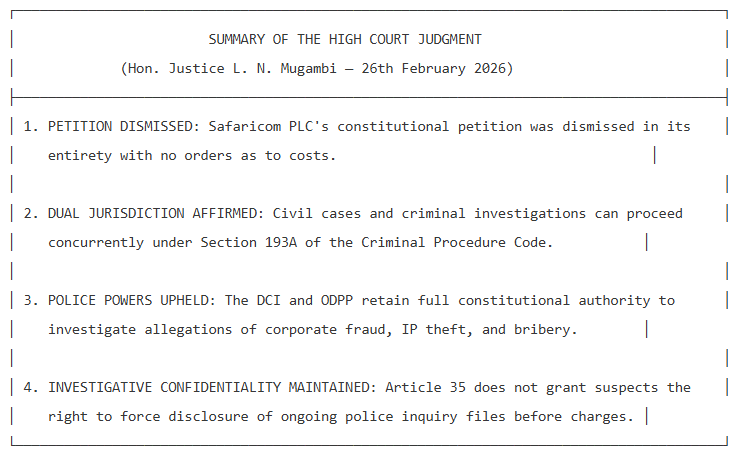
In Constitutional Petition No. HCCHRPET/E331/2023 (Safaricom PLC v. ODPP, DCI, TMG & 13 Others), delivered on 26th February 2026, Hon. Justice L. N. Mugambi issued a decision addressing the intersection of corporate law and criminal justice:
Key Legal Principles Established in the Ruling:
No Shield Against Criminal Inquiry: The High Court held that a corporate entity cannot utilize a pending civil commercial suit as an injunction against state criminal investigations. Where an enterprise’s procurement activities involve allegations of fraud or corruption, the state’s investigative machinery operates independently of private commercial claims.
Constitutional Invalidation of Article 47 Claims in Police Inquiries: Adopting the Supreme Court precedent in EACC v. Tom Ojienda, Justice Mugambi noted that law enforcement agencies conducting criminal investigations are exercising statutory investigative powers rather than making “administrative decisions” under Article 47. Consequently, police are not bound to afford potential suspects pre-charge administrative hearings
Pre-charge Disclosure Restrictions: The Court ruled that under Section 6 of the Access to Information Act, police internal reports and DCI inquiry files are protected from public disclosure during active investigations to avoid evidence tampering or witness intimidation
Res Judicata on Search and Seizure: In companion rulings within the commercial suit, the High Court repeatedly held that challenges to the Anton Piller search and DCI cybercrime reports had been conclusively determined. Evidentiary challenges regarding electronic certificates go to the weight and probative value of the evidence, which must be tested via cross-examination during the main trial.

IX. Governance & Legal Takeaways
1. Corporate Procurement & RFP Compartmentalization
The Transcend v. Safaricom litigation underscores the legal risks surrounding corporate procurement processes. Corporations must implement strict, auditable IP firewall protocols during Request for Proposal (RFP) evaluations. Allowing pitch materials from unsuccessful bidders to migrate into the operational workflow of a selected vendor creates significant exposure to copyright claims, civil damages, and criminal liability.
2. The Strategic Scope of Anton Piller Orders
The case demonstrates the evidentiary impact of early-stage Anton Piller ex-parte search orders. By obtaining immediate judicial authorization to raid defense premises alongside statutory copyright enforcement officers (KECOBO), TMG preserved critical digital artifacts—including deleted local drafts, metadata, and secret email exchanges—that formed the backbone of both its civil claim and the DCI criminal inquiry.
3. Limits of Non-Disclosure Agreements vs. Section 193A Exposure
Corporate executives and procurement managers cannot assume that disputes arising from pitch submissions will remain confined to private arbitration or civil suits. Under Section 193A of the Criminal Procedure Code, allegations of trade secret theft achieved via collusion, bribery, or breach of fiduciary duty can proceed as concurrent criminal investigations
4. Technical Objections to Electronic Evidence
The rulings reinforce the High Court’s modern approach to Section 106B electronic evidence certificates. Courts prefer evaluating technical deficiencies—such as chain-of-custody gaps or missing examiner signatures—during trial cross-examination rather than issuing pre-trial orders striking out forensic evidence.
5. Executive Liability in Intellectual Property Disputes
By targeting individual corporate executives alongside the parent company, the litigation demonstrates that corporate shields do not grant immunity to officers involved in disputed procurement awards. Corporate directors remain personally exposed to police summonses and criminal investigation where bad faith or conspiracy is alleged.

About Boardlot Africa Research
Boardlot Africa is a premier financial intelligence and corporate governance publication dedicated to unpacking the mechanics of capital, market strategies, and structural shifts across East Africa’s corporate landscape. By bridging the gap between raw economic data and actionable market intelligence, we deliver deep-dive research, independent corporate analysis, and policy insights designed for institutional investors, boardrooms, and sharp market observers.
Get in Touch
Email: boardlot.research@gmail.com
Phone: +254 753 133 901
Substack: Subscribe to Boardlot Africa
X (Twitter): BoardLotSultan
A reminder for any creative to protect their work under IP…This Green Telco seems to be a master in abusing IP Law…and taking advantage of creatives!